Advertisement
Advertisement
The prevalence of critical limb ischemia (CLI) is estimated to be approximately 2 million in the United States and is expected to increase.1 One of the most concerning potential consequences of CLI is amputation. Although great advances in endovascular techniques and devices have occurred, the amputation rate remains unacceptably high, exceeding 15% to 20% at 1 year.1 Course of care and outcomes vary widely, depending on the quality and availability of primary and secondary care. Sadly, it is estimated that approximately half of all patients with CLI do not undergo revascularization procedures.2 In one study out of Germany, 44% of amputees with CLI had not undergone even a diagnostic angiogram prior to their amputation.2 Limb loss, in addition to its psychologic toll, is associated with an elevated risk of mortality that ranges from 15% to 40% within 1 year.1
Office-based labs (OBLs) are a rapidly expanding service model that provides physicians more autonomy and patients a more comfortable, patient-focused environment. Furthermore, hospital capacity has been challenged in many regions of the United States due to the devastating effects of the coronavirus pandemic. This has limited the abilities of staff and facilities to accommodate for more elective, less urgent procedures. In our facility, only elective patients who have been evaluated by polymerase chain reaction COVID-19 testing with negative results have been allowed to enter the facility. This has not only protected the staff but allowed for peace of mind for our patients.
In addition to patient safety, OBL patient satisfaction scores (Healthgrades) have improved as compared to the hospital setting. This is likely driven by less paperwork and more flexible and open scheduling, in addition to a more dedicated and focused staff who made the patient experience more welcoming. A wide spectrum of percutaneous peripheral interventions is performed in this setting, from elective claudicants to critical limb- and life-saving dialysis access salvage procedures. The safety and efficacy of OBL interventions have proven to not only mirror hospital settings but also lead to a decrease in the rate of above-the-ankle amputations.3 Ownership of the facility has trained the providers to deliver excellent vascular care with a cost-conscious mind set. Kentucky is notorious for poverty, obesity, diabetes, and tobacco use,4,5 and our OBL has allowed us to serve this population with better efficiency and less overall cost to the health care network.
CASE EXAMPLE
Patient History
A diabetic female in her mid-60s was referred to our services from podiatry for left leg CLI. She had a multitude of chronic medical conditions, including insulin-dependent diabetes mellitus managed by endocrinology, hypertension, chronic renal insufficiency, and coronary artery disease with coronary artery stenting. She had a surgical history of a right femoropopliteal bypass in 2010 and bilateral iliac artery stents placed in 2017 by her cardiologist. In May 2020, she underwent left brachial arterial access and placement of a superior mesenteric artery stent by interventional radiology for acute-on-chronic mesenteric ischemia. This resulted in a postoperative complication of left brachial artery thrombosis that required open thrombectomy.
At another institution, she was treated for left leg rest pain in June 2020 and underwent right radial arterial access with peripheral angiography by her cardiologist. Postoperatively, she had embolization complications after left iliac artery angioplasty, thrombosis of the entire right iliac artery, and common femoral artery (CFA) and femoropopliteal bypass. This led to an open thrombectomy procedure by a cardiothoracic surgeon. The left leg, which was the initial presenting symptomatic limb, was deemed not salvageable due to the occluded superficial femoral artery (SFA) and external iliac artery (EIA). The patient was ultimately sent to rehabilitation to recover from the right lower extremity complication before the planned left leg amputation.
Fortunately, her podiatrist referred her to our practice. At the time of consultation with our services, the patient had progressed from rest pain to the development of ulcers on the left foot. She expressed that her previous catheterization experiences (all performed in a hospital setting) were traumatic but was willing to attempt peripheral intervention to salvage her left lower extremity in our OBL.
Procedural Overview
With a recent history of right femoral open thrombectomy, we were not able to achieve access with the contralateral femoral artery. The recent brachial artery injury and thrombosis led us to choose the pedal artery as the access site for peripheral angiography at our office-based catheterization lab. Under ultrasound guidance, the dorsalis pedis artery was accessed with a 6-F sheath. Retrograde angiography was performed, demonstrating patency of the anterior tibial and peroneal arteries but revealing occlusion of the posterior tibial artery at the ankle level. Her vessels were extremely small at approximately 2 mm in diameter and were circumferentially calcific.
After 100 U/kg of heparin was administered, a Berenstein catheter and Bentson guidewire were advanced beyond the anterior tibial artery to the above-the-knee popliteal segment. Calcific plaque was present, and segments of the popliteal artery and SFA were occluded. The catheter and guidewire successfully reentered through the SFA and into the EIA. Antegrade angiography through the catheter revealed presence of severe stenosis of the EIA within the preexisting common iliac artery stent. The CFA was severely stenotic, as was the femoral profunda. The SFA and popliteal arteries were also occluded.
For better assessment and due to calcified vessels, a 0.014-inch guidewire was exchanged, and intravascular ultrasound (IVUS) was used to image from the anterior tibial artery through the common iliac artery. This confirmed severe stenosis of the anterior tibial artery, occlusion of the proximal popliteal artery and SFA, and severe stenosis of the EIA.
Due to calcification, the decision was made to perform directional atherectomy for debulking of focal segments and vessel compliance modification prior to angioplasty. A 6-F HawkOne™ directional atherectomy system (Medtronic) was chosen. In a retrograde fashion, a single pass was made through the anterior tibial artery, with successful reentry into the popliteal artery. The retrograde sheath side port was opened to allow for flushing of the embolic debris. The popliteal segment was calcified, and focal directional atherectomy was used to debulk this segment. Two passes were made in opposing quadrants throughout the entire SFA and CFA (Figure 1).
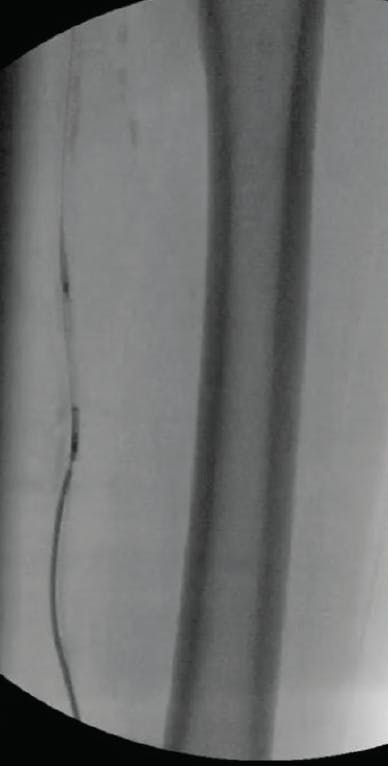
Figure 1. HawkOne directional atherectomy system in SFA.
After successful atherectomy, the entirety of the EIA, CFA, SFA, and popliteal artery were treated with angioplasty using a 5- X 300-mm Pacific Xtreme™ PTA balloon dilatation catheter (Medtronic) (Figure 2). The anterior tibial artery was treated with a 3- X 150-mm NanoCross™ Elite PTA balloon catheter (Medtronic) (Figure 3). Subsequent IVUS revealed mild residual stenosis (< 30%) in the femoropopliteal segment. A flow-limiting dissection was present within the proximal EIA, which was successfully treated with a 7- X 60-mm EverFlex™ self-expanding peripheral stent system (Medtronic) and postdeployment angioplasty with a 6- X 60-mm EverCross™ PTA balloon catheter (Medtronic). Final angiography revealed normal inline flow throughout the previously stenotic EIA, SFA, popliteal artery, and anterior tibial artery. Pulsatile flow was present within our retrograde dorsalis pedis artery sheath. The sheath was removed, and manual compression was applied to achieve hemostasis. At present, the patient is 3 months postprocedure and doing well. Her wound has healed, and her rest pain is resolved.
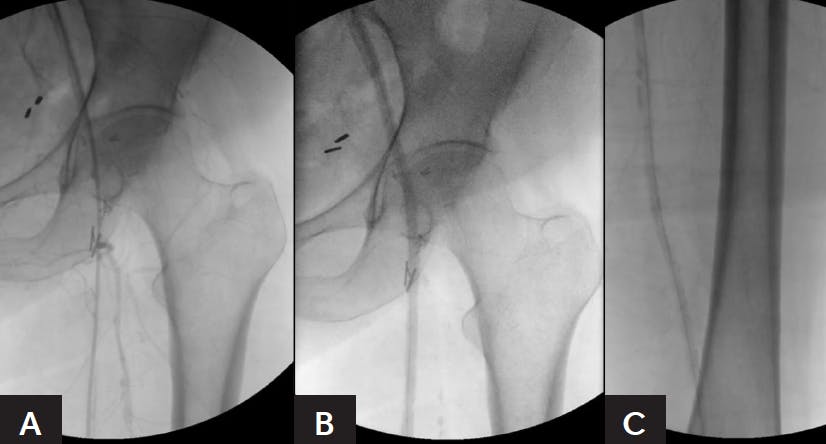
Figure 2. Angiograms of the CFA and EIA showing a lack of lumen preintervention (A) and successful final results after angioplasty using a 5-mm Pacific Xtreme balloon throughout the EIA and directional atherectomy with HawkOne and angioplasty in the SFA (B, C).
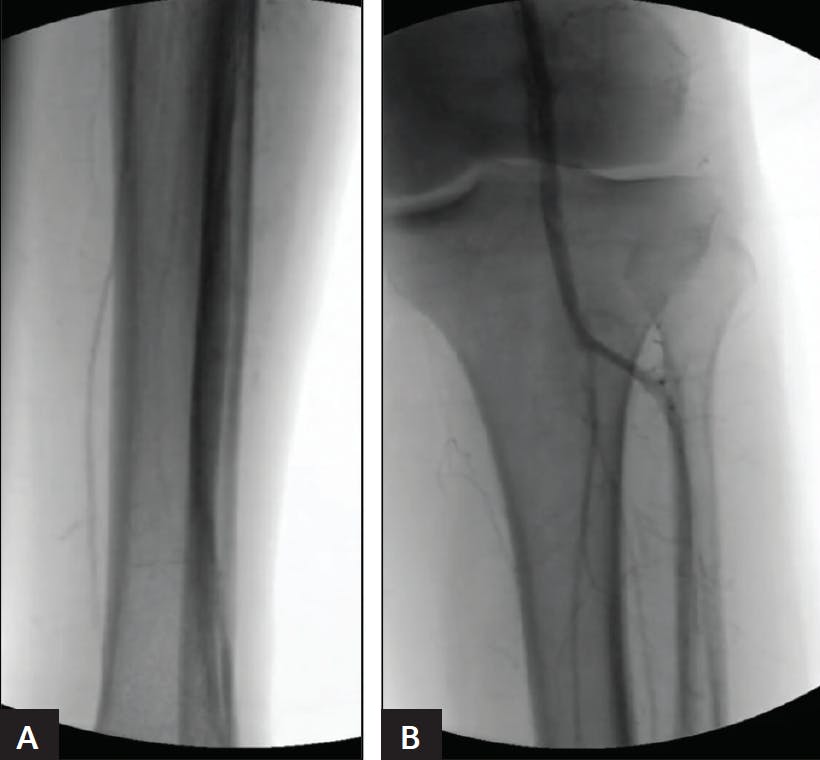
Figure 3. Anterior tibial artery pretreatment (A) and after directional atherectomy with HawkOne and angioplasty with a 3-mm NanoCross Elite balloon (B).
DISCUSSION
The use of retrograde pedal access has allowed for not only diagnostic angiography but also an access point for complete interventional therapy. Despite very small angiographic anatomy of tibial vessels, a 5- or even 6-F sheath can often be placed to allow for full delivery of atherectomy devices, as well as peripheral stents that traditionally could only be delivered through femoral access sites. The advantage in this case was evident due to the inability to access the contralateral femoral artery and the recent brachial artery injury and thrombosis. An additional advantage of retrograde pedal access is the ability to flush from the side port of the sheath, allowing for drainage of any embolic debris.
There is a steep learning curve for using ultrasound guidance to access small pedal or tibial vessels without causing puncture injury. Ultrasound has advanced interventional treatment by enabling entry into small vessels and even occluded vessels with no flow channel. This is a skill set that must be learned for advanced peripheral interventions to be successful. After this is achieved, retrograde cannulation of occluded tibials and/or femoropopliteal segments is easier to learn. In our experience, nonhydrophilic wires can prevent subintimal access into occluded segments. The chronic total occlusion appears to be crossed in an intraluminal plane with simple nonhydrophilic wires such as a Bentson guidewire.
Visualization can oftentimes be limited due to retrograde angiography only. IVUS has been heavily used in our practice for better assessment of plaque morphology, as well as determination of stenosis level. Our preference is to use directional atherectomy from this pedal approach. This allows for treatment of both small tibial vessels and larger femoropopliteal vessels with a single atherectomy device. Focal debulking is also more accessible with directional atherectomy. We have adopted with excellent results the concept of compliance modification with atherectomy. This allows for a more controlled expansion of the vessel during angioplasty and prevention of dissection. Our case is a clear example where segments treated with atherectomy did not dissect within the previously occluded SFA or popliteal artery. The EIA, which does not meet the indication for atherectomy, did have a flow-limiting dissection that required a stent.
In addition to the technical contributions of pedal access, specialized interventionalists such as experienced vascular surgeons can allow additional options for limb salvage for complicated patients. Tibial occlusions or lack of pedal arches are no longer clear-cut indications for patients to be referred for amputation services. Establishment of independent OBLs have expanded nationwide (Figure 4). This allows for easier access for patients in need of immediate care, such as those with CLI. Complex peripheral cases can now be performed in an OBL with less risk of complications, partly due to alternative access sites such as the pedal approach.

Figure 4. Fayette Surgical Associates Vascular Center, with Dr. Abedi (center) and staff.
1. Duff S, Mafilios MS, Bhounsule P, Hasegawa JT. The burden of critical limb ischemia: a review of recent literature. Vasc Health Risk Manag. 2019;15:187-208. doi: 10.2147/VHRM.S209241
2. Reinecke H, Unrath M, Freisinger E, et al. Peripheral arterial disease and critical limb ischaemia: still poor outcomes and lack of guideline adherence. Eur Heart J. 2015;36:932-938. doi: 10.1093/eurheartj/ehv006
3. Itoga NK, Baker LC, Mell MW. Impact of office-based laboratories on physician practice patterns and outcomes after percutaneous vascular interventions for peripheral artery disease. J Vasc Surg. 2019;70:1524-1533.e12. doi: 10.1016/j.jvs.2019.01.060
4. Centers for Disease Control and Prevention. State tobacco activities tracking and evaluation (STATE) system: map of current cigarette use among adults. Accessed April 27, 2021. https://www.cdc.gov/statesystem/cigaretteuseadult.html
5. Centers for Disease Control and Prevention; National Center for Health Statistics. Diabetes mortality by state. Accessed April 27, 2021. https://www.cdc.gov/nchs/pressroom/sosmap/diabetes_mortality/diabetes.htm

HawkOne™ directional atherectomy system Reference Statement
Important Information: Indications, contraindications, warnings and instructions for use can be found in the product labeling supplied with each device.
Indications for Use: The HawkOne directional atherectomy system is intended for use in atherectomy of the peripheral vasculature. The HawkOne catheter is indicated for use in conjunction with the SpiderFX™ embolic protection device in the treatment of severely calcified lesions. The HawkOne catheter is NOT intended for use in the coronary, carotid, iliac or renal vasculature.
CAUTION: Federal (USA) law restricts this product for sale by or on the order of a physician.
EverFlex™ self-expanding peripheral stent system Brief Statement
Indication: The EverFlex self-expanding peripheral stent system is intended to improve luminal diameter in the treatment of symptomatic de novo or restenotic lesions up to 180 mm in length in the native superficial femoral artery and/or proximal popliteal arteries with reference vessel diameters ranging from 4.5 mm – 7.5 mm.
The EverFlex self-expanding peripheral stent system is indicated for improving luminal diameter in patients with atherosclerotic disease of the common and/or external iliac arteries up to and including 100 mm in length, with a reference vessel diameter of 4.5 mm - 7.5 mm.
The Protégé™ EverFlex™ self-expanding biliary stent system is intended as a palliative treatment of malignant neoplasms in the biliary tree.
Contraindications: Use of the EverFlex self-expanding peripheral stent system is contraindicated in patients with known hypersensitivity to nickel titanium and in patients contraindicated for anticoagulant and/or antiplatelet therapy, patients who are judged to have a lesion that prevents complete inflation of an angioplasty balloon or proper placement of the stent or stent delivery system.
Potential Adverse Events: Potential adverse events which may be associated with the use of a stent in the SFA and proximal popliteal arteries include, but are not limited to: Allergic reaction, Amputation, Artery perforation or rupture, Bleeding requiring transfusion, Infection, Pseudoaneurysm, Restenosis, Stent collapse or fracture, Stent migration, Surgical or endovascular intervention, Thrombosis/occlusion of the stent.
See the Instructions for Use provided with the product for a complete list of warnings, precautions, adverse events and device information.
CAUTION: Federal (USA) law restricts these devices to sale by or on the order of a physician
Pacific Xtreme™ PTA balloon dilatation catheter Reference Statement
Important Information: Prior to use, refer to the Instructions for Use supplied with these devices for indications, contraindications, side effects, suggested procedure, warnings and precautions.
Indications for Use: The Pacific Xtreme PTA balloon dilatation catheter in 150 mm, 200 mm, 250 mm and 300 mm balloon length is intended to dilate stenoses in femoral, popliteal and infrapopliteal arteries.
CAUTION: Federal (USA) law restricts these devices to sale by or on the order of a physician.
NanoCross™ Elite 0,014” OTW PTA balloon catheter Reference Statement
Important Information: Indications, contraindications, warnings and instructions for use can be found in the product labeling supplied with each device.
Indications for Use: The NanoCross Elite 0.014” OTW PTA balloon dilatation catheter is intended to dilate stenoses in the iliac, femoral, ilio-femoral, popliteal, infra-popliteal, and renal arteries, and for the treatment of obstructive lesions of native or synthetic arteriovenous dialysis fistulae. This device is also indicated for stent post-dilatation in the peripheral vasculature.
CAUTION: Federal (USA) law restricts this product for sale by or on the order of a physician.
EverCross™ PTA balloon catheter Reference Statement
Important Information: Indications, contraindications, warnings and instructions for use can be found in the product labeling supplied with each device.
Indications for Use: The EverCross 0.035” OTW PTA dilatation catheter is intended to dilate stenoses in the iliac, femoral, ilio-femoral, popliteal, infrapopliteal, and renal arteries, and for the treatment of obstructive lesions of native or synthetic arteriovenous dialysis fistulae. This device is also indicated for stent post-dilatation in the peripheral vasculature.
CAUTION: Federal (USA) law restricts this product for sale by or on the order of a physician.
500725 ©2021 Medtronic. Medtronic, Medtronic logo are trademarks of Medtronic. For global distribution. 05/2021
Advertisement
Advertisement