Advertisement
Advertisement
November 2021
The Debate Continues: Current Perspectives on Routine Versus Selective Lumbar Drainage
Two viewpoints assessing the application of lumbar drainage.
With Martin Czerny, MD, MBA; Bartosz Rylski, MD; E. Hope Weissler, MD; and G. Chad Hughes, MD
The Case for Routine Lumbar (Cerebrospinal Fluid) Drainage
Martin Czerny, MD, MBA
Department of Cardiovascular Surgery
University Heart Center Freiburg-Bad Krozingen
Bad Krozingen, Germany
Faculty of Medicine
Albert Ludwigs University
Freiburg, Germany
martin.czerny@universitaets-herzzentrum.de
Disclosures: Consultant to Terumo Aortic, Medtronic, Endospan, and NEOS; received speaking honoraria from Bentley and CryoLife Jotec; shareholder of TEVAR Ltd. and Ascense Medical.
Bartosz Rylski, MD
Department of Cardiovascular Surgery
University Heart Center Freiburg-Bad Krozingen
Bad Krozingen, Germany
Faculty of Medicine
Albert Ludwigs University
Freiburg, Germany
Disclosures: Consultant to Terumo Aortic and KLS-Martin; received speaking honoraria from Medtronic; shareholder of Ascense Medical.
“Cerebrospinal fluid (CSF) drainage is the fasciotomy of the spinal cord.” This decisive sentence impacted our clinical perception for years and turned out to be true in many scenarios. But what this truly means and how it may guide us in our decision-making to use or not use CSF drainage remains undefined.
Tissue tends to swell after ischemia, which is true for every solid organ. Two impressive clinical examples from daily practice help illustrate this fact. The first example is ischemia/reperfusion injury as seen in chronic peripheral artery disease (PAD), where the clinical picture is most impressive when there is no ischemic preconditioning of the affected extremity and where, for instance, embolic occlusion of a regular vascular tree is caused by intermittent atrial fibrillation. The second example is reperfusion of the intestine after an ischemic impact, which frequently requires laparotomy/leaving the abdomen open to avoid abdominal compartment syndrome or, in other words, to permit swelling until recovery. Similarly, postcardiotomy cardiac edema can be so extensive that the chest must stay open for at least 2 days for recompensation; if the underlying pathology has been addressed adequately, the condition resolves.
Similar to the aforementioned examples of the peripheral, abdomen, and heart, the amount of ischemic injury to the spinal cord determines both the amount of ischemia/reperfusion injury and the need of the affected solid organ to swell for compensatory reasons. To anticipate the need for prophylactic CSF drainage, we must have a closer look at arterial spinal cord perfusion components and their effect from therapy. The “four-territory” concept has been mutually inspired by the work of Etz et al, as has the concept of a preexisting intraspinal network that was first proven experimentally by Kari et al and recently demonstrated to be present morphologically in humans.1-4 All of these components suggest a kind of Riolan’s arcade for the spinal cord. However, permitting swelling in ischemia/reperfusion negatively impacts the outcome of malperfusion just as it does in the peripheral, abdomen, and heart. The spinal cord seems to be the most vulnerable to ischemia/reperfusion because the natural space for swelling within the spinal canal is limited.
Therefore, it seems very logical to have a CSF drain in every patient undergoing aortic surgery/intervention requiring closure of spinal arteries. But as we know from experience, every invasive procedure has complications, and that is also true for CSF drainage. In extreme cases, the effort of preventing symptomatic spinal cord injury can cause what we want to prevent, such as a hematoma requiring a laminectomy in the most extensive cases or liquor loss syndrome leading to subarachnoidal bleeding.5,6
We also know that frequency amplifies experience and simultaneously reduces procedure-related complications. This is a phenomenon that everyone will testify in their own clinical experience, that has also been investigated scientifically in several cardiovascular and oncologic conditions, and that is now a well-accepted condition.7
What does this mean for the routine application of CSF drainage? Besides the brain, the spinal cord is the organ most vulnerable to ischemic injury. The extent of ischemic injury during treatment and the 72 hours after treatment remains speculative. The option to have an early clinical assessment is not guaranteed, and neither is the possibility or nonpossibility to react in case of secondary symptomatic conditions that might be detected too late. Experience and repetition are keys to success. We support a strong advocation of routine CSF drainage in each case of open and endovascular aortic procedures that affect thoracic or a combination of thoracic and lumbar segmental artery occlusion, irrespective of extent because the risk/benefit ratio remains more on the side of prophylaxis than on the side of treating secondary complications of a potentially avoidable dreadful complication.
1. Czerny M, Eggebrecht H, Sodeck G, et al. Mechanisms of symptomatic spinal cord ischemia after TEVAR: insights from the European Registry of Endovascular Aortic Repair Complications (EuREC). J Endovasc Ther. 2012;19:37-43. doi: 10.1583/11-3578.1
2. Etz CD, Kari FA, Mueller CS, et al. The collateral network concept: a reassessment of the anatomy of spinal cord perfusion. J Thorac Cardiovasc Surg. 2011;141:1020-1028. doi: 10.1016/j.jtcvs.2010.06.023
3. Kari FA, Saravi B, Krause S, et al. New insights into spinal cord ischaemia after thoracic aortic procedures: the importance of the number of anterior radiculomedullary arteries for surgical outcome. Eur J Cardiothorac Surg. 2018;54:149-156. doi: 10.1093/ejcts/ezy058
4. Heber U, Mayrhofer M, Gottardi R, et al. The intraspinal arterial collateral network. A new anatomical basis for understanding and preventing paraplegia during aortic repair. Eur J Cardiothorac Surg. 2021;59:137-144. doi: 10.1093/ejcts/ezaa227
5. Etz CD, Weigang E, Hartert M, et al. Contemporary spinal cord protection during thoracic and thoracoabdominal aortic surgery and endovascular aortic repair: a position paper of the vascular domain of the European Association for Cardio-Thoracic Surgery. Eur J Cardiothorac Surg. 2015;47:943-957. doi: 10.1093/ejcts/ezv142
6. Czerny M, Pacini D, Aboyans V, et al. Current options and recommendations for the use of thoracic endovascular aortic repair (TEVAR) in acute and chronic thoracic aortic disease: an expert consensus document of the European Society for Cardiology (ESC) Working Group of Cardiovascular Surgery, the ESC Working Group on Aorta & Peripheral Vascular Diseases, the European Association of Percutaneous Cardiovascular Interventions (EAPCI) of the ESC and the European Association for Cardio-Thoracic Surgery (EACTS). Eur J Cardiothorac Surg. 2021;59:65-73. doi: 10.1093/ejcts/ezaa268
7. Czerny M, Schmidli J, Adler S, et al. Current options and recommendations for the treatment of thoracic aortic pathologies involving the aortic arch- an expert consensus document of the European Association for Cardio-Thoracic Surgery (EACTS) and the European Society of Vascular Surgery (ESVS). Eur J Cardiothorac Surg. 2019;55;133-162. doi: 10.1016/j.ejvs.2018.09.016
When to Use Lumbar Drains Prior to Descending [With/Without Concomitant Arch] TEVAR? Never
E. Hope Weissler, MD
Division of Cardiovascular and Thoracic Surgery
Department of Surgery
Duke University School of Medicine
Durham, North Carolina
Disclosures: None.
G. Chad Hughes, MD
Director, Duke Center for Aortic Disease
Division of Cardiovascular and Thoracic Surgery
Department of Surgery
Duke University School of Medicine
Durham, North Carolina
gchad.hughes@duke.edu
Disclosures: None.
Given that spinal cord ischemia (SCI) is one of the most feared complications of thoracic endovascular aortic repair (TEVAR), the amount of attention paid to its prevention is no surprise.1,2 As is often stated, spinal cord perfusion pressure (SCPP) is determined by the difference between the systolic or mean arterial pressure (MAP) and the intraspinal canal pressure (or central venous pressure if it is greater). TEVAR primarily affects SCPP through decreased local perfusion related to coverage of the great anterior radicular artery and other collateral vessels.3 Lumbar CSF drainage has been used since the early days of TEVAR as a means to mitigate the risk of SCI by decreasing the intraspinal canal pressure component of SCPP.4 CSF drainage was adopted based on extrapolation of data from open descending and thoracoabdominal repair despite systematic reviews failing to confirm the utility of CSF drainage as a method for preventing SCI with TEVAR.5,6 Further, CSF drainage carries nonzero risks of significant complications, including hemorrhage and death, even in high-volume centers and when placed by a dedicated team.7-10 CSF drainage is better justified in open aortic cases, in which a greater frequency and degree of MAP lability is to be expected, but dramatic blood pressure swings should be relatively infrequent during and after TEVAR. Despite this risk/benefit imbalance, and without any supporting randomized trial data, CSF drainage remains the preferred approach to SCI prevention post-TEVAR at many centers worldwide.11-13
At our institution, the approach to CSF drainage used has evolved over the past 15 plus years. In 2013, we published results with a selective CSF drainage protocol, in which lumbar drains were placed only for patients with high-risk features, including those with a history of distal aortic repair plus planned long-segment thoracic aortic coverage or hybrid thoracoabdominal aortic aneurysm repair.14 Based off that experience, in which no SCI was seen among the 39% of patients who qualified for CSF drainage but did not have a drain placed, we have now moved to complete avoidance of preoperative CSF drainage among patients undergoing isolated descending ± arch TEVAR.15 We have had encouraging results with this approach with no temporary or permanent SCI among 223 consecutive patients undergoing TEVAR in a 6.5-year period, most of whom had SCI risk factors, including prior distal aortic repair or long-segment aortic coverage.
Our institutional CSF drainage–sparing SCI prevention protocol includes obligate left subclavian artery (LSA) revascularization in cases of full coverage and permissive hypertension, maintaining systolic blood pressures ≥ 120 mm Hg and MAPs ≥ 70 mm Hg for the first month post-TEVAR (Figure 1). The LSA represents the major source of collaterals to the great anterior radicular artery, which is often covered in descending TEVAR, and it also gives rise to the anterior spinal artery, in part through its vertebral artery branches.3 Its importance to spinal cord perfusion can be seen in the fact that delayed revascularization of the LSA has been reported to lead to resolution of SCI symptoms after its coverage in TEVAR, even when CSF drainage has failed.16,17 The blood pressure goals in our institutional algorithm are derived from data from a review of > 1,000 patients undergoing open distal aortic repair by Sandhu et al, which found that 90% of delayed SCI events occurred when the systolic blood pressure was < 130 mm Hg.18
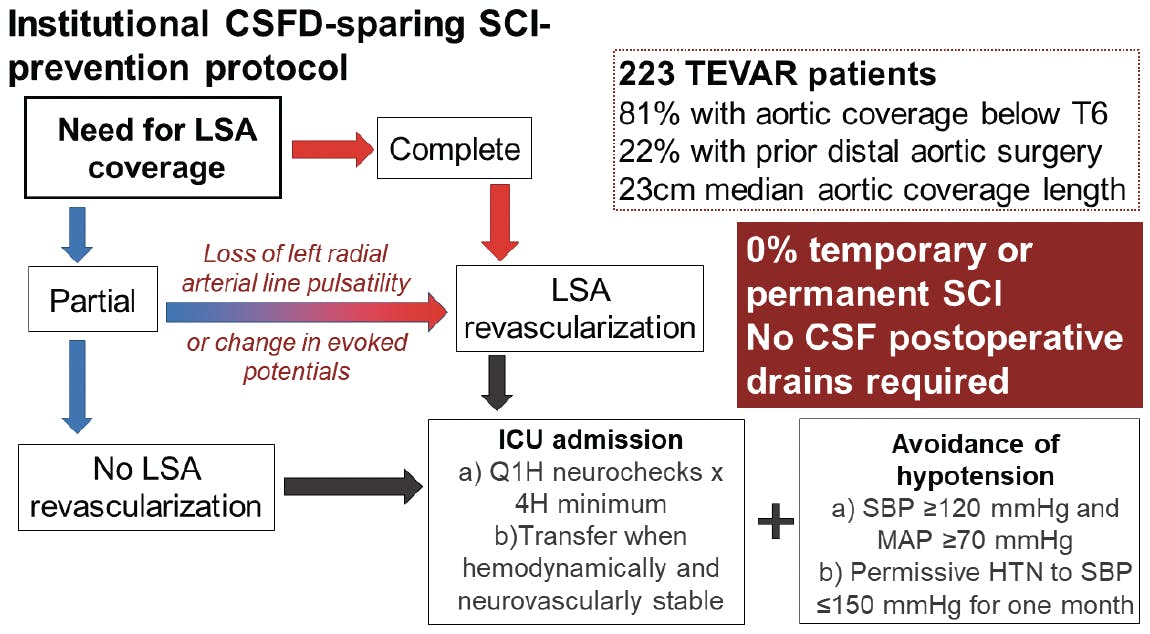
Figure 1. Institutional TEVAR SCI prevention algorithm and outcomes. Reprinted from The Annals of Thoracic Surgery, 110, Weissler EH, Voigt SL, Raman V, et al. Permissive hypertension and collateral revascularization may allow avoidance of cerebrospinal fluid drainage in thoracic endovascular aortic repair, 1469-1474, Copyright (2021), with permission from Elsevier. 4H, 4 hours; CSFD, cerebrospinal fluid damage; HTN; hypertension; ICU, intensive care unit; Q1H, every 1 hour; SBP, systolic blood pressure.
Permanent SCI rates may be as low as 1% to 2% after TEVAR for descending pathology, and CSF drainage is associated with a 6.5% complication rate (including a mortality rate of up to 1%) based on data from a systematic review and meta-analysis of 4,714 patients and 34 studies; thus, prophylactic CSF drainage may cause more complications than TEVAR itself.1,19,20 Yet, CSF drainage is still highly prevalent, while LSA revascularization—a safer, more effective approach to SCI prevention—has not received the attention it deserves and has yet to be recommended in all relevant cases and settings.21 A randomized trial of CSF drainage in the setting of mandatory LSA revascularization during descending TEVAR would likely settle the issue but is unlikely to be performed. Regardless, the needle is shifting away from the routine use of CSF drainage during TEVAR,10,22-24 and we hope that other institutions continue to move toward LSA revascularization over CSF drainage for SCI prevention as evidence supporting this approach further accumulates.
1. Dijkstra ML, Vainas T, Zeebregts CJ, et al. Editor’s choice - spinal cord ischaemia in endovascular thoracic and thoraco-abdominal aortic repair: review of preventive strategies. Eur J Vasc Endovasc Surg. 2018;55:829-841. doi: 10.1016/j.ejvs.2018.02.002
2. Huang Q, Chen XM, Yang H, et al. Effect of left subclavian artery revascularisation in thoracic endovascular aortic repair: a systematic review and meta-analysis. Eur J Vasc Endovasc Surg. 2018;56:644-651. doi: 10.1016/j.ejvs.2018.07.018
3. Hughes GC. Commentary: left subclavian artery revascularization during zone 2 thoracic endovascular aortic repair: bypass versus transposition? Just do it! J Thorac Cardiovasc Surg. 2020;159:1228-1230. doi: 10.1016/j.jtcvs.2019.05.050
4. Cheung AT, Pochettino A, McGarvey ML, et al. Strategies to manage paraplegia risk after endovascular stent repair of descending thoracic aortic aneurysms. Ann Thorac Surg. 2005;80:1280-1288; discussion 1288-1289. doi: 10.1016/j.athoracsur.2005.04.027
5. Hiratzka LF, Bakris GL, Beckman JA, et al. 2010 ACCF/AHA/AATS/ACR/ASA/SCA/SCAI/SIR/STS/SVM guidelines for the diagnosis and management of patients with thoracic aortic disease: a report of the American College of Cardiology Foundation/American Heart Association Task Force on Practice Guidelines, American Association for Thoracic Surgery, American College of Radiology, American Stroke Association, Society of Cardiovascular Anesthesiologists, Society for Cardiovascular Angiography and Interventions, Society of Interventional Radiology, Society of Thoracic Surgeons, and Society for Vascular Medicine. Circulation. 2010;121:e266-369. doi: 10.1161/CIR.0b013e3181d4739e
6. Wong CS, Healy D, Canning C, et al. A systematic review of spinal cord injury and cerebrospinal fluid drainage after thoracic aortic endografting. J Vasc Surg. 2012;56:1438-1447. doi: 10.1016/j.jvs.2012.05.075
7. Wynn MM, Mell MW, Tefera G, et al. Complications of spinal fluid drainage in thoracoabdominal aortic aneurysm repair: a report of 486 patients treated from 1987 to 2008. J Vasc Surg. 2009;49:29-34; discussion 34-35. doi: 10.1016/j.jvs.2008.07.076
8. Yang GK, Misskey J, Arsenault K, et al. Outcomes of a spinal drain and intraoperative neurophysiologic monitoring protocol in thoracic endovascular aortic repair. Ann Vasc Surg. 2019;61:124-133. doi: 10.1016/j.avsg.2019.04.022
9. Lyden SP, Ahmed A, Steenberge S, et al. Spinal drainage complications after aortic surgery. J Vasc Surg. Published online May 1, 2021. doi: 10.1016/j.jvs.2021.04.031
10. Plotkin A, Han SM, Weaver FA, et al. Complications associated with lumbar drain placement for endovascular aortic repair. J Vasc Surg. 2021;73:1513-1524.e2. doi: 10.1016/j.jvs.2020.08.150
11. Hiratzka LF, Bakris GL, Beckman JA, et al. 2010 ACCF/AHA/AATS/ACR/ASA/SCA/SCAI/SIR/STS/SVM Guidelines for the diagnosis and management of patients with thoracic aortic disease. A report of the American College of Cardiology Foundation/American Heart Association Task Force on Practice Guidelines, American Association for Thoracic Surgery, American College of Radiology, American Stroke Association, Society of Cardiovascular Anesthesiologists, Society for Cardiovascular Angiography and Interventions, Society of Interventional Radiology, Society of Thoracic Surgeons, and Society for Vascular Medicine. J Am Coll Cardiol. 2010;55:e27-e129. doi: 10.1016/j.jacc.2010.02.015
12. Erbel R, Aboyans V, Boileau C, et al. 2014 ESC guidelines on the diagnosis and treatment of aortic diseases: document covering acute and chronic aortic diseases of the thoracic and abdominal aorta of the adult. The task force for the diagnosis and treatment of aortic diseases of the European Society of Cardiology (ESC). Eur Heart J. 2014;35:2873-2926. doi: 10.1093/eurheartj/ehu281
13. Riambau V, Bockler D, Brunkwall J, et al. Editor’s choice - management of descending thoracic aorta diseases: clinical practice guidelines of the European Society for Vascular Surgery (ESVS). Eur J Vasc Endovasc Surg. 2017;53:4-52. doi: 10.1016/j.ejvs.2016.06.005
14. Hanna JM, Andersen ND, Aziz H, et al. Results with selective preoperative lumbar drain placement for thoracic endovascular aortic repair. Ann Thorac Surg. 2013;95:1968-1974; discussion 1974-1975. doi: 10.1016/j.athoracsur.2013.03.016
15. Weissler EH, Voigt SL, Raman V, et al. Permissive hypertension and collateral revascularization may allow avoidance of cerebrospinal fluid drainage in thoracic endovascular aortic repair. Ann Thorac Surg. 2020;110:1469-1474. doi: 10.1016/j.athoracsur.2020.04.101
16. Nakamura E, Nakamura K, Furukawa K, et al. Left subclavian artery revascularization for delayed paralysis after thoracic endovascular aortic repair. Ann Vasc Dis. 2019;12:233-235. doi: 10.3400/avd.cr.18-00158
17. Borghese O, Sbenaglia G, Giudice R. Late-onset paraplegia after endovascular repair of type B aortic dissection managed by urgent left subclavian artery revascularization: a case report. Ann Vasc Surg. 2019;58:384 e9-384.e14. doi: 10.1016/j.avsg.2018.11.032
18. Sandhu HK, Evans JD, Tanaka A, et al. Fluctuations in spinal cord perfusion pressure: a harbinger of delayed paraplegia after thoracoabdominal aortic repair. Semin Thorac Cardiovasc Surg. 2017;29:451-459. doi: 10.1053/j.semtcvs.2017.05.007
19. Rong LQ, Kamel MK, Rahouma M, et al. Cerebrospinal-fluid drain-related complications in patients undergoing open and endovascular repairs of thoracic and thoraco-abdominal aortic pathologies: a systematic review and meta-analysis. Br J Anaesth. 2018;120:904-913. doi: 10.1016/j.bja.2017.12.045
20. Ranney DN, Cox ML, Yerokun BA, et al. Long-term results of endovascular repair for descending thoracic aortic aneurysms. J Vasc Surg. 2018;67:363-368. doi: 10.1016/j.jvs.2017.06.094
21. Matsumura JS, Lee WA, Mitchell RS, et al. The Society for Vascular Surgery practice guidelines: management of the left subclavian artery with thoracic endovascular aortic repair. J Vasc Surg. 2009;50:1155-1158. doi: 10.1016/j.jvs.2009.08.090
22. Kärkkäinen JM, Cirillo-Penn NC, Sen I, et al. Cerebrospinal fluid drainage complications during first stage and completion fenestrated-branched endovascular aortic repair. J Vasc Surg. 2020;71:1109-1118.e2. doi: 10.1016/j.jvs.2019.06.210
23. Bradshaw RJ, Ahanchi SS, Powell O, et al. Left subclavian artery revascularization in zone 2 thoracic endovascular aortic repair is associated with lower stroke risk across all aortic diseases. J Vasc Surg. 2017;65:1270-1279. doi: 10.1016/j.jvs.2016.10.111
24. Patterson BO, Holt PJ, Nienaber C, et al. Management of the left subclavian artery and neurologic complications after thoracic endovascular aortic repair. J Vasc Surg. 2014;60:1491-1497.e1. doi: 10.1016/j.jvs.2014.08.114
Advertisement
Advertisement
