Advertisement
Advertisement
October 2021
Interventional Oncology: Fast Forward to the Future
The field is at a crossroads where opportunities must be seized to establish a permanent foothold in the crowded world of oncology care.
The flight home from this year’s American Association of Clinical Oncology (ASCO) meeting was particularly satisfying. Not only was the flight especially fast, but more importantly, any lingering doubts about interventional oncology being a mainstay within the crowded multidisciplinary oncology care have vanished. “We finally made it!” gleefully exclaimed an old pioneer of this field sitting next to me on the plane, who, like me, is past retirement age and ready to savor this precious moment. For many years, we had fought to establish the field of interventional oncology as a legitimate fourth pillar of oncology, and then just as we were about to succeed, the immuno-oncology revolution arrived, and with it the acronym “IO” was no longer synonymous with interventional oncology but rather immuno-oncology! But this ASCO meeting—filled with oral presentations and lectures about the benefit of combining locoregional with systemic therapies, scientifically robust clinical trial data from new cutting-edge technologies solidly anchored in interventional oncology, and the exponential growth of biomedical imaging, including molecular imaging and artificial intelligence (AI)—has cemented the role of the real IO (meaning interventional oncology) in the minds of our oncology colleagues, industry leaders, and the public at large.
Is this wishful thinking, a futuristic illusion, or truly the path that lies ahead for interventional oncology? Let’s come back to the present in 2021. What will it take for the youngest and most rapidly growing offshoot of interventional radiology to gain that permanent foothold within oncology?
THE NEED FOR SCIENTIFICALLY SOUND CLINICAL DATA
As cancer has surpassed cardiovascular diseases and is now the leading cause of death worldwide, its conquest remains elusive despite recent notable progress. Cancer remains an incredibly complex disease, involving virtually every tissue in the body and affecting many genes.1 The investment in cancer research continues to be enormous, and progress has clearly been made in cancer cell genetics, biochemistry, and function, but a cure is still far away.1 This presents an opportunity for interventional oncologists because the need for local control of cancer remains an important aspect of the overall therapeutic strategy. As a result, a meaningful collaboration between various specialties involved in cancer care—including interventional oncology—has been highlighted as a critical need. The new era of cancer research is here, and interventional oncology can play its part to bring about therapeutic benefits for cancer patients. However, in order to “belong,” interventional oncology must evolve away from single-institution, retrospective, underpowered reports that have no influence on clinical practice to meaningful prospective multicenter clinical trials that offer significant outcomes.
To that end, the recent data on yttrium-90 (Y-90) radioembolization for liver cancer are compelling because they show that the field of interventional oncology is indeed capable of generating the much-needed (and long overdue) data to lead to adoption of therapies anchored in interventional oncology, such as radioembolization.2-5 During this past year, several studies have shown the importance of both the absorbed dose by the tumor and the relationship between baseline imaging, preprocedure technetium 99m (99mTc)-macroaggregated human albumin (MAA) single-photon emission CT (SPECT)/CT, and immediate post–Y-90 radioembolization SPECT/CT. A secondary analysis of the SARAH study demonstrated the close association between tumor radiation–absorbed dose and improvement in overall survival and disease control at a threshold of 100 Gy, whereby patients who received ≥ 100 Gy had a much higher median overall survival than those who received < 100 Gy (14.1 vs 6.1 months; hazard ratio [HR], 0.38; P < .001). More remarkably, when the visual agreement between baseline CT imaging, preprocedure 99mTc-MAA SPECT/CT, and immediate post–Y-90 radioembolization SPECT/CT was optimized and coupled with an absorbed tumor dose of ≥ 100 Gy, the results were even more impressive (24.9 vs 6.7 months; HR, 0.24; P < .001).3,5 The DOSISPHERE study demonstrated that the implementation of a personalized dosimetry approach including a tumor-absorbed dose > 205 Gy resulted in significantly better outcomes (overall median survival, 26.6 vs 10.7 months; HR, 0.421; P = .0096).2 These two studies clearly show that the concept of radioembolization as we knew it has been radically changed for the better. Thus, careful treatment planning in the form of dosimetry planning is now indispensable to maximize the tumor-absorbed dose and achieve the best outcomes both in terms of tumor response and patient survival.
Yet in a way, these studies illustrate the problems inherent in the fields of interventional oncology and interventional radiology. In the absence of rigorous data justifying a dogmatic approach to specific therapeutic procedures performed in interventional oncology, a sort of “free for all” remains the modus operandi that, to a certain extent, allows creativity and may foster innovation but at the same time restricts the acceptance of our specialty because of its lack of meaningful clinical data. In the mind of many, interventional oncology is still a field of “technicians” more interested in the technical aspects of a procedure and anecdotal case series rather than the clinical management of complex cancer patients and prospectively collected clinical evidence. This is why the previously highlighted studies are so important; they represent precisely what is needed in this field—prospective randomized clinical trials demonstrating the efficacy of a therapy for a specific cancer. The data speak for themselves. However, much more is needed, and the bar must continue to be pushed higher until there is no debate as to the impact of interventional oncology on the care and management of cancer patients, its credibility as a specialty of medicine is fully established, and its perception moves away from one of ignorance or skepticism into one of acceptance and indispensability.
IMPORTANCE OF NEW TECHNOLOGY
From holmium-166 radioactive microspheres to irreversible electroporation incidentally being tested in a large clinical trial for pancreatic cancer, imaging technology to histotripsy, and dosimetry software for radioembolization to AI and virtual tumor boards, the drive for innovation in interventional oncology is continuously advancing cancer diagnosis and management. This is a tremendous asset and one that should not be trivialized or ignored; however, with each innovative therapy, clinical data must follow. The “old” way of pursuing approval by the FDA based on a predicate technology for a 510(k) should be abandoned in most cases and replaced with a strategy based on clinical adoption—and adoption means clinical data!
Histotripsy
Histotripsy is one such therapy that has the promise of changing cancer care. It is a completely noninvasive approach akin to radiation oncology without the toxicity due to radiation and to high-intensity focused ultrasound without the problems inherent in thermal deposition in tissue with existing ablative therapies.6 The cellular destruction caused by histotripsy stems from acoustic cavitation of the targeted tissue caused by clusters of microbubbles generated inside the tissue by short, alternating, high-amplitude pulses arising from focused ultrasound. As a result, the tissue destruction consists of a tissue homogenate with limited to no recognizable cellular structure, is extremely precise with a well-defined margin, and can be visualized in real time under ultrasound. In addition, recent software developments have allowed the therapy delivery to a target of virtually any size and shape. Clinical trials have started testing histotripsy as a stand-alone therapy for patients with both primary and secondary liver cancer (Figure 1), but an intriguing prospect about histotripsy is its potential as a combination therapy with immuno-oncology drugs. This is probably the most anticipated aspect of this newest therapy, because histotripsy releases neoantigens that can be recognized by the immune system and therefore exploited in combination with checkpoint inhibitors administered systemically to synergize the primary effect of histotripsy. In this manner, the hope is that unlike the traditional and currently clinically available ablative therapies that are limited to patients with early stage cancers, histotripsy could also be used in combination with systemic drugs either as a primer or adjunct therapy to tackle advanced cancers, which would be a true paradigm shift for locoregional therapies. Such results have been demonstrated in animal models and will need to be replicated in human clinical trials but represent an encouraging development in interventional oncology.6
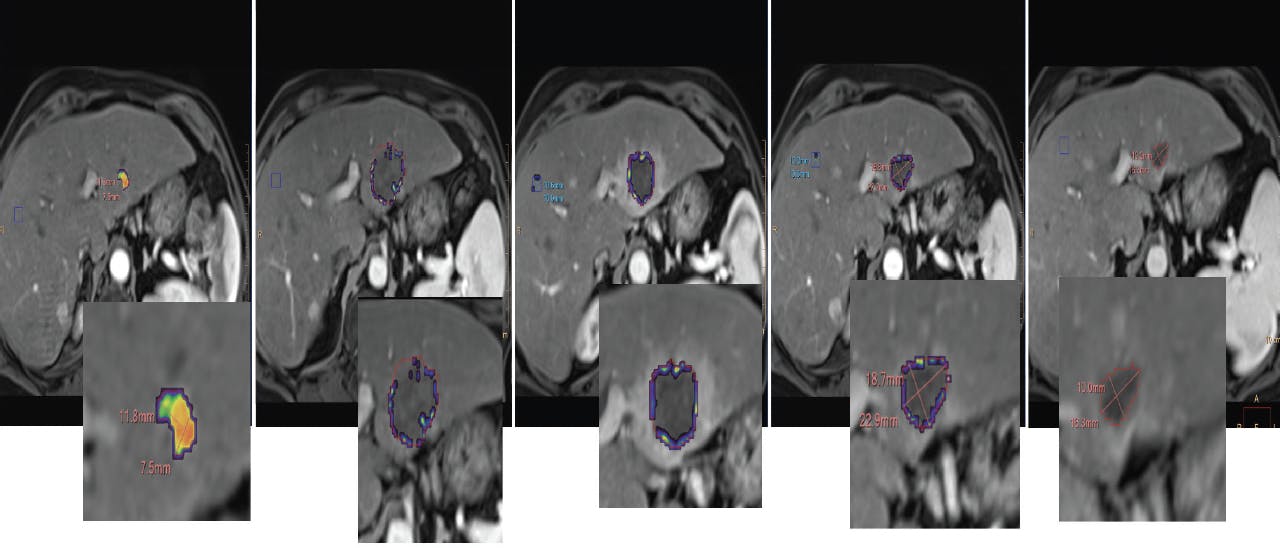
Figure 1. MRIs obtained at baseline and 24 hours, 1 week, 1 month, and 2 months posttreatment (from left to right) with histotripsy in a patient with a small hepatocellular carcinoma in segment 2/3. The three-dimensional measurement known as qEASL (quantifiable European Association for the Study of Liver) was performed using a semiautomatic tumor segmentation software (Philips Healthcare). The qEASL color map is overlaid on the subtracted MRI, showing the enhancing portions of the tumor in red/yellow before treatment and complete lack of enhancement after treatment consistent with a complete response to histotripsy (bottom row images are magnified views of the MRIs in the top row).
Artificial Intelligence
Because interventional oncology relies primarily on imaging for visualization, guidance, or targeting of the tumor and assessment of response, it was only a matter of time before AI would be considered a valuable tool, for example to identify imaging biomarkers that could be used as prognostic indicators of treatment success or establish more complex nomograms and artificial neural networks to aid our clinical decision-making capabilities and predict outcomes.7-14 Progress on this front has clearly been made, but the problem lies in the fact that machine or deep learning is as good as the data that help generate the algorithms in the first place. Thus, the fact that the data arising from interventional oncology remain largely insufficient limits the applicability of AI.14 For these tools to be truly helpful, large cohorts of patients and data sets preferably acquired prospectively from well-designed phase 2 or 3 clinical trials must be used. Only in this manner can nomograms and other tools of AI become an important and accurate source of information where individualized patient information, which is so critical in the era of personalized medicine, can truly be accounted for. Oncologists and cancer centers have created nomograms for virtually every cancer and therapy that exists based on high-caliber data sets.7-14 Given the complexity of tumor biology and the field of cancer and its need to integrate an increasing number of parameters reflective of individualized care, such as genomics, imaging and molecular features, tumor characteristics, and presence of comorbidities, the role of AI will undoubtedly continue to grow. Therefore, it is incumbent on the interventional oncology community to join this forward march anchored in AI.
INTERVENTIONAL ONCOLOGY AS AN OUTPATIENT-BASED PRACTICE
Interventional oncology has traditionally been and continues to be practiced in large academic or hospital-based practices, mostly due to the need for expensive imaging equipment and availability of inpatient services to manage postprocedure care.15 This was also the case with most cancer care services, including infusion centers for systemic chemotherapy. However, over the course of the last decade, outpatient cancer care has seen tremendous growth. Despite the clear economic benefits of outpatient centers, this shift toward outpatient oncology care has largely been driven by patient preference, whereby the ability to stay out of the hospital environment and in a smaller, more intimate, familiar, and comfortable setting is directly linked with higher patient satisfaction. As a result, outpatient oncology care has exploded to the point that it now includes virtually all services, from infusion centers and palliative clinics to dedicated imaging centers and surgical oncology. This shift away from inpatient to outpatient care has also been reinforced and even accelerated by the crisis due to the COVID-19 pandemic, which, regardless of the success of vaccination, has radically changed the mind set of patients and physicians regarding the delivery of oncology care. If surgery and radiation therapy can be performed in an outpatient setting, there is no reason image-guided biopsies, venous access for placement of ports or tunneled catheters, and ablative and intra-arterial therapies that are part of a “typical” interventional oncology practice could not follow suit.
SUMMARY
After many years of stagnation, the race to conquer cancer has accelerated significantly in the last decade. The discoveries about the genetic determinants and molecular biology of cancer are finally bearing fruit, such as improved detection and monitoring and treatments where new, effective drugs have found their way into the everyday management of cancer patients. This is a golden opportunity that interventional oncology must seize to permanently establish itself as a pillar of oncology care. There is no denying that progress in interventional oncology has been made, but much more is needed. In an era increasingly dependent on individualized and affordable health care, interventional oncologists through their reliance on technology should have all the resources and tools to address these demands, provided the specialty continues to focus on high-level clinical research and evidence-based medicine to generate the necessary data to change the mind of skeptics.
1. Varmus H. The new era in cancer research. Science. 2006;312:1162-1165. doi: 10.1126/science.1126758
2. Garin E, Tselikas L, Guiu B, et al. Personalised versus standard selective internal radiation therapy in patients with locally advanced hepatocellular carcinoma (DOSISPHERE-01): a randomised, multicentre, open-label phase 2 trial. Lancet Gastroenterol Hepatol. 2021;6:17-29. doi: 10.1016/S2468-1253(20)30290-9
3. Vilgrain V, Pereira H, Assenat E, et al. Efficacy and safety of selective internal radiotherapy with yttrium-90 resin microspheres compared with sorafenib in locally advanced and inoperable hepatocellular carcinoma (SARAH): an open-label randomised controlled phase 3 trial. Lancet Oncol. 2017;18:1624-1636. doi: 10.1016/S1470-2045(17)30683-6
4. Chow PKH, Gandhi M, Tan SB, et al. SIRveNIB: selective internal radiation therapy versus sorafenib in Asia-Pacific patients with hepatocellular carcinoma. J Clin Oncol. 2018;36:1913-1921. doi: 10.1200/JCO.2017.76.0892
5. Hermann AL, Dieudonne A, Ronot M, et al. Relationship of tumor radiation-absorbed dose to survival and response in hepatocellular carcinoma treated with transarterial radioembolization with yttrium-90 in the SARAH trial. Radiology. 2020;296:673-684. doi: 10.1148/radiol.2020191606
6. Qu S, Worlikar T, Felsted A, et al. Non-thermal histotripsy tumor ablation promotes abscopal immune responses that enhance cancer immunotherapy. J Immunother Cancer. 2020;8:e000200. doi:10.1136/jitc-2019-000200
7. Zhong BY, Ni CF, Ji JS, et al. Nomogram and artificial neural network for prognostic performance on the albumin-bilirubin grade for hepatocellular carcinoma undergoing transarterial chemoembolization. J Vasc Interv Radiol. 2019;30:330-338. doi: 10.1016/j.jvir.2018.08.026
8. Johnson PJ, Berhane S, Kagebayashi C, et al. Assessment of liver function in patients with hepatocellular carcinoma: a new evidence-based approach—the ALBI grade. J Clin Oncol. 2015;33:550-558. doi: 10.1200/JCO.2014.57.9151
9. Pinato DJ, Sharma R, Allara E, et al. The ALBI grade provides objective hepatic reserve estimation across each BCLC stage of hepatocellular carcinoma. J Hepatol. 2017;66:338-346. doi: 10.1016/j.jhep.2016.09.008
10. Balachandran VP, Gonen M, Smith J, DeMatteo RP. Nomograms in oncology – more than meets the eye. Lancet Oncol. 2015;16:e173-e180. doi: 10.1016/S1470-2045(14)71116-7
11. Temel JS, Shaw AT, Greer JA. Challenge of prognostic uncertainty in the modern era of cancer therapeutics. J Clin Oncol. 2016;34:3605-3608. doi: 10.1200/JCO.2016.67.8573
12. Mack JW, Smith TJ. Reasons why physicians do not have discussions about poor prognosis, why it matters, and what can be improved. J Clin Oncol. 2012;30:2715-2717. doi: 10.1200/JCO.2012.42.4564
13. Kiely BE, Soon YY, Tattersall MHN, et al. How long have I got? Estimating typical, best-case, and worst-case scenarios for patients starting first-line chemotherapy for metastatic breast cancer: a systematic review of recent randomized trials. J Clin Oncol. 2011;29:456-463. doi: 10.1200/JCO.2010.30.2174
14. Abajian A, Murali N, Savic LJ, et al. Predicting treatment response to intraarterial therapies for hepatocellular carcinoma with the use of supervised machine learning-an artificial intelligence concept. J Vasc Interv Radiol. 2018;29:850-857. doi: 10.1016/j.jvir.2018.01.769
15. Joo EH, Rha SY, Ahn JB, Kang HY. Economic and patient-reported outcomes of outpatient home-based versus inpatient hospital-based chemotherapy for patients with colorectal cancer. Support Care Cancer. 2011;19:971-978. doi: 10.1007/s00520-010-0917-7
Advertisement
Advertisement