Advertisement
Advertisement
October 2021
Percutaneous Mechanical Thrombectomy and Catheter-Directed Thrombolysis Challenges in Cancer Patients With Acute DVT
An interventional radiology roadmap for managing acute presentations of venous thromboembolism in patients with cancer and contraindications to fibrinolytic therapy.
By Eric Wehrenberg-Klee, MD; Sara Smolinski-Zhao, MD; and Gloria Salazar, MD, FSIR
Cancer patients presenting with venous thromboembolism (VTE) comprise a unique subset of patients in interventional radiology (IR), and their treatment is often challenged by balancing the benefits of IR procedures such as catheter-directed thrombolysis (CDT) and percutaneous mechanical thrombectomy (PMT) versus the risk of bleeding-associated complications. Both VTE and anticoagulation-related complications are very prevalent in these patients.1 Despite the lack of patient-specific guidelines,2 IR procedures are usually individualized and adapted to cancer type and location, VTE extension (splanchnic, peripheral, incidental), and presence of metastatic disease. In this article, a practical guide for managing these patients will be discussed, focusing on IR procedures for acute presentations of caval and proximal deep vein thrombosis (DVT) with contraindications to fibrinolytic therapy.
PATIENT SELECTION
Before electing to perform an IR procedure, several variables that may influence outcomes should be considered. For example, the rate of VTE recurrences and major bleeding during anticoagulation largely varies according to the cancer location.2 Moreover, some patients may present with external compression of veins secondary to lymphadenopathy and/or associated iliac vein stenosis. Furthermore, the presence of an inferior vena cava filter (IVCF) may make the approach of these patients difficult, and caval extension of iliofemoral thrombosis may require iliac vein reconstruction with stenting.
To select proper candidates for CDT/PMT, a multidisciplinary approach with participation from oncologists and hematologists is needed. Current clinical guidelines for anticoagulation therapy do not account for cancer-specific risks of VTE and their complications (ie, incidence of fatal pulmonary embolism [PE] and/or bleeding).2 As such, a multidisciplinary discussion should start with patient eligibility for oral anticoagulant therapy. Although anticoagulation remains the mainstay treatment option for these patients, it is associated with a sixfold increase in bleeding events compared with the general population.3 Indications for CDT also vary depending on societal guidelines. Lastly, the risk of postthrombotic syndrome in these patients is not fully understood given the relative short-term survival with most patients being excluded from clinical trials due to contraindications to thrombolysis (eg, ATTRACT).4 Therefore, for the purposes of this article, we will focus on patients who are not eligible for anticoagulation therapy, are contraindicated to lysis, and thus present for PMT alone.
It is important to note that a recent review of 1,297 propensity score–matched cancer patients who underwent CDT plus anticoagulation versus anticoagulation alone demonstrated no difference in in-hospital mortality.5 However, intracranial hemorrhage (ICH) and resource use were significantly higher in the CDT group compared to anticoagulation alone. At the authors’ institution, we often rule out brain metastasis before proceeding to CDT. Moreover, a recent comparative study in which 20% of patients had an underlying malignancy demonstrated no difference in outcomes and similar bleeding complications in patients undergoing CDT alone compared to CDT associated with PMT.6
According to the Society of Interventional Radiology Quality Improvement Guidelines, absolute contraindications to CDT for lower extremity DVT include recent cerebral vascular accident, active internal bleeding, intracranial trauma, neurosurgery within 3 months, and absolute contraindication to anticoagulation.7 Aside from intracranial tumors, most cancer patients will present with relative contraindications to CDT, such as recent major surgery, organ biopsy and/or cardiopulmonary resuscitation, and uncontrolled hypertension.7
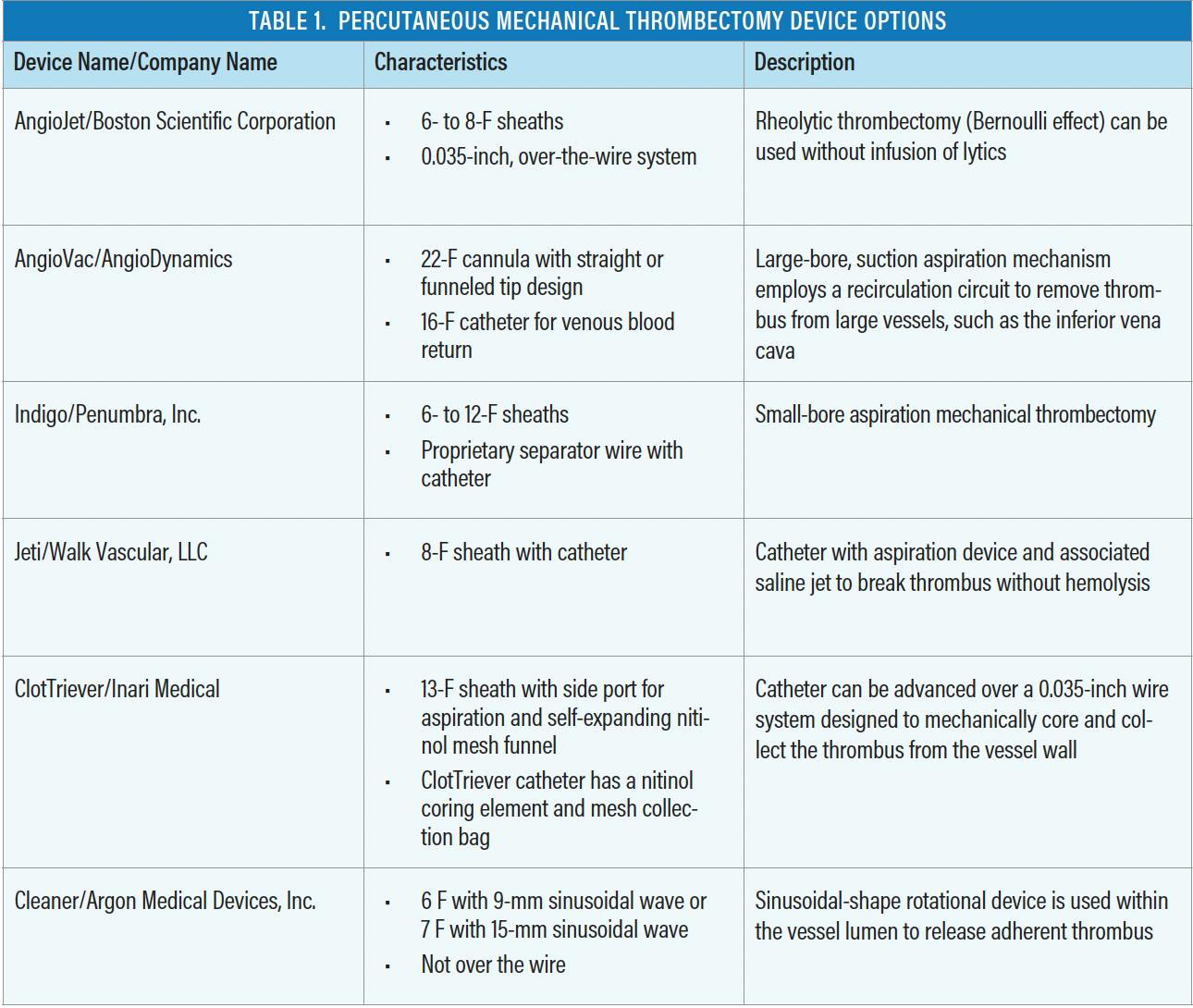
Given the paucity of data, we perform PMT with aspiration devices (Indigo [Penumbra, Inc.] and ClotTriever [Inari Medical]) or rheolytic thrombectomy without lytics (AngioJet, Boston Scientific Corporation) because cancer patients are commonly contraindicated to lytics and are already coagulopathic at the time of intervention. Patients should have a complete blood count, partial thromboplastin time, and fibrinogen level drawn prior to procedure, and cross-sectional imaging is usually required for planning access and choosing devices.
INTRAPROCEDURAL TIPS AND TRICKS
Access
Careful evaluation with noninvasive imaging (eg, Doppler, CT/MR venography) should be performed prior to consideration of endovascular therapy. Patients with isolated iliac vein thrombosis (the minority) can receive ipsilateral common femoral venous access for the procedure. However, it is more common that the femoral and popliteal veins are simultaneously involved along with the iliac vein, requiring popliteal venous access. Whenever possible, it is ideal to access an open flowing vein below the thrombosed venous segment, and this sometimes requires more peripheral sites, such as the posterior tibial vein. In the case of IVC thrombosis extension, at Massachusetts General, we combine jugular and femoral approaches for through-and-through access to a lower extremity vein. Access sites usually require large-size sheaths, depending on the device choice (Table 1) and recanalization technique. When large sheaths are used, it is prudent to plan venotomy closure prior to dilatation, such as purse-string sutures or suture-mediated closure devices.
Prophylactic IVCF
The benefit of placing a prophylactic IVCF before a definitive clot removal procedure to avoid PE is unclear.8 Some authors suggest their use in the presence of large-volume or free-floating IVC thrombus, resistance or contraindication to anticoagulation, or history of recurrent PE.7 When needed, an IVCF is placed through the contralateral femoral or jugular venous access. In the setting of iliac vein compression, the incidence of PE is very low due to the protective effect of venous stenosis.9 When PMT is performed without lysis, IVCF may have a role in preventing a large clot burden from embolizing to the lungs. Nonetheless, the presence of an IVCF does not seem to be advantageous to protect from PE in patients with IVC thrombosis undergoing recanalization.10 Moreover, the presence of an IVCF is a relative contraindication to the use of newer mechanical thrombectomy devices such as the ClotTriever system, a percutaneous device designed to facilitate thrombus removal without the need for lytic drugs within 6 weeks of acute DVT.11
PMT Without Infusion of a Fibrinolytic Drug
Patients who are eligible for thrombolysis should be strongly considered for PMT for maximal thrombus clearance and assessment of underlying iliac stenosis, followed by angioplasty and stenting of the underlying stenotic lesion when needed. Isolated mechanical thrombectomy can be chosen based on individual patient factors, operator expertise, and device availability. In our practice, most patients with cancer have a contraindication to lysis, so we elect to perform PMT alone with devices that can either macerate and/or remove thrombus fragments. Although PMT increases the surface area of residual thrombosis and promotes flow within the occluded segment, it can also cause valve injury and thrombus embolization. Limited data exist on standalone PMT for DVT with currently available devices, and it does not appear to remove sufficient thrombus volumes to be clinically useful.12 Recent great alternatives to CDT in the VTE arena use aspiration of thrombus with large-bore (AngioVac, AngioDynamics) or smaller (Indigo) suction catheter systems or thrombus coring and collection (ClotTriever).
After achieving access, venographic images are obtained to determine the extent of thrombus burden. Then, a combination of a 0.035-inch hydrophilic guidewire and a 4-F angled-tip catheter is typically used with an initial 6-F sheath to cross the acute thrombotic segments. There is rarely a need for advanced techniques such as sharp recanalization. Once the thrombotic segment is crossed, the system should be upsized according to the type of device (Table 1), and guidewires should be exchanged for an Amplatz Super Stiff guidewire (Boston Scientific Corporation) to provide stability for subsequent procedural steps. When there is significant thrombus burden, initial angioplasty with a balloon 8 to 10 mm in diameter might be helpful to allow for placement of large-bore sheaths.
In our practice, we use a combination of rheolytic thrombectomy (AngioJet) without lytic infusion, rotational thrombectomy (Cleaner, Argon Medical Devices, Inc.), and aspiration devices (Indigo). More recently, we have used ClotTriever, which has been reported to be useful in patients with acute DVT,11 particularly those with cancer, who often present with relative and/or absolute contraindications to thrombolytic infusion. Moreover, ClotTriever can be used when rapid flow restoration is needed to improve tissue perfusion, such as in patients with severe phlegmasia cerulea dolens (PCD) without the need for surgical embolectomy.13 In situations with extensive iliocaval thrombosis, contraindication to lytics, and presence of IVCF, we elect to use the Indigo aspiration system with Lightning intelligent aspiration tubing (Penumbra, Inc.), along with the 6-F AngioJet system as adjunct.
CASE EXAMPLE OF PMT WITHOUT FIBRINOLYTICS
A 40-year-old man with progressive anaplastic oligodendroglioma presented with symptomatic right lower extremity DVT in the femoropopliteal venous segments and was started on intravenous (IV) heparin. After 2 weeks, he developed ICH and anticoagulation was stopped (Figure 1). He then underwent IVCF placement and further developed PCD (Figure 2) secondary to extension of thrombosis into the infrarenal IVC below the filter. After multidisciplinary discussion, the decision was to performed mechanical thrombectomy alone given the high risk of ICH and the clinical severity of PCD.
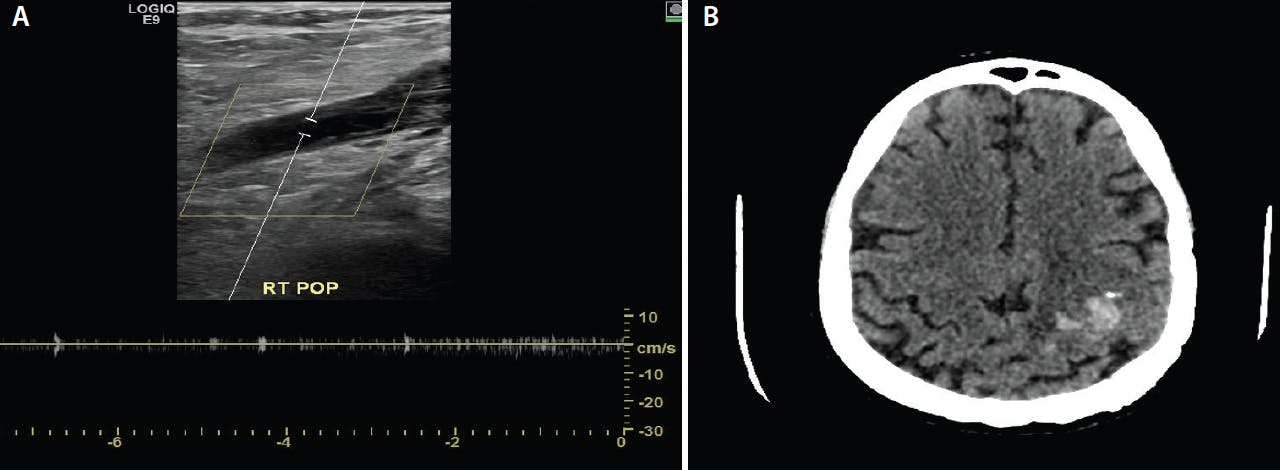
Figure 1. Ultrasound Doppler demonstrating acute thrombosis in the popliteal vein in a 40-year-old man with anaplastic oligodendroglioma and started on IV (A). Noncontrast-enhanced CT demonstrated acute ICH after starting anticoagulation (B).
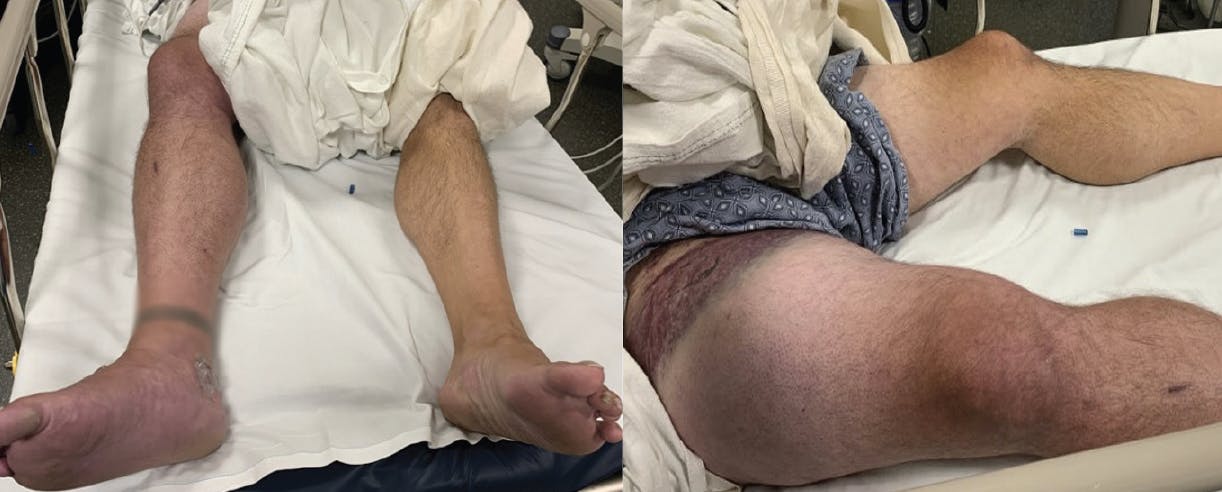
Figure 2. Photographs after 2 weeks demonstrated severe right lower extremity swelling with discoloration and cyanosis that was consistent with PCD.
Initial venography from a right transjugular approach demonstrated extensive thrombosis in the IVC below the filter. Subsequent access to the right popliteal vein was achieved and a suprarenal IVCF placed because of the extent of thrombosis and the contraindication to IV heparin during the case (Figure 3A and 3B). A 12-F Indigo catheter was then placed, and injection of contrast confirmed extensive IVC thrombosis (Figure 3C).
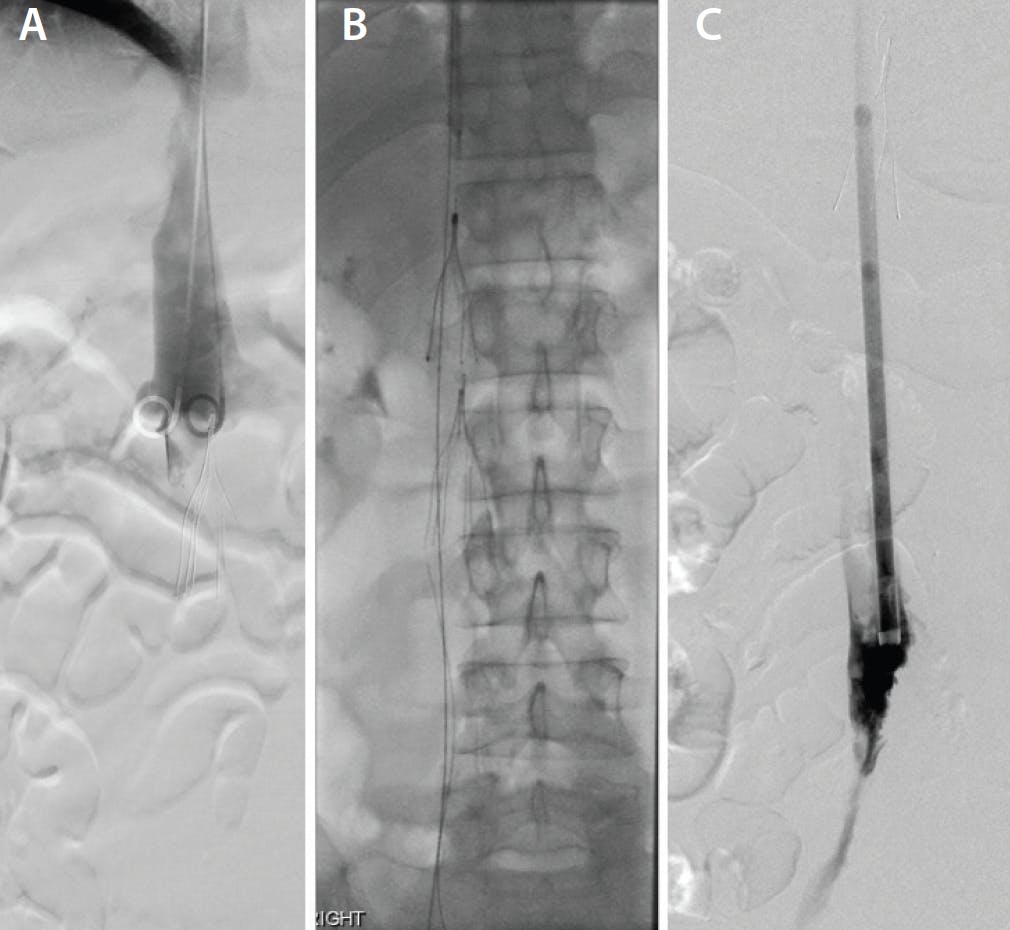
Figure 3. Extensive IVC thrombosis after infrarenal IVCF placement for popliteal DVT in the case patient, who had recent intracranial bleeding secondary to an oligodendroglioma tumor, as well as PCD. Initial venography from the jugular approach demonstrated an IVCF filling defect (A). Popliteal access was subsequently obtained, and a suprarenal IVCF was placed (B). The infrarenal IVCF was then removed, a 12-F sheath was placed, and significant thrombus burden in the IVC was demonstrated (C).
Multiple passes into the right iliac and femoral veins were performed with a combination of Indigo and AngioJet, with good improvement of flow (Figure 4). Using a 12-F Indigo, the outflow segments were treated due to the residual thrombosis of the IVC segments (Figure 5). Finally, 12- to 18-mm balloons were used to angioplasty residual areas in the iliofemoral and IVC segments (Figure 6). The suprarenal IVCF was then removed, and final venography confirmed patency of IVC (Figure 7).
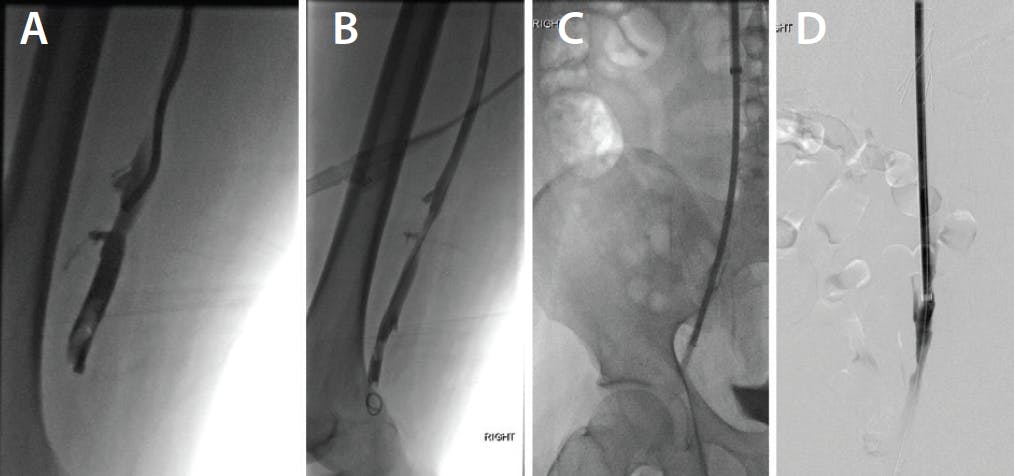
Figure 4. Iliofemoral venous segments before (A, C) and after PMT with Indigo and AngioJet (B, D).
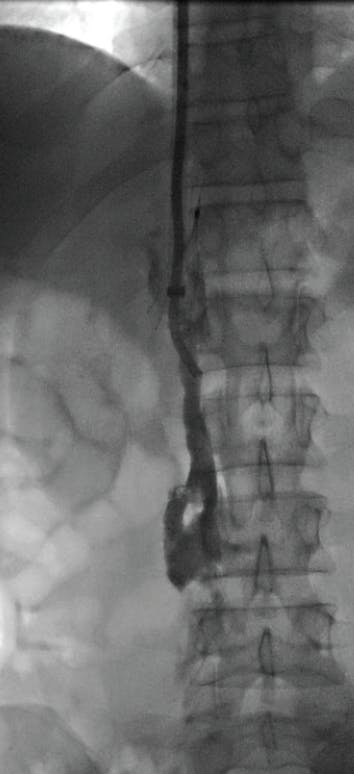
Figure 5. A 12-F Indigo catheter was placed, demonstrating significant thrombus burden in the IVC.
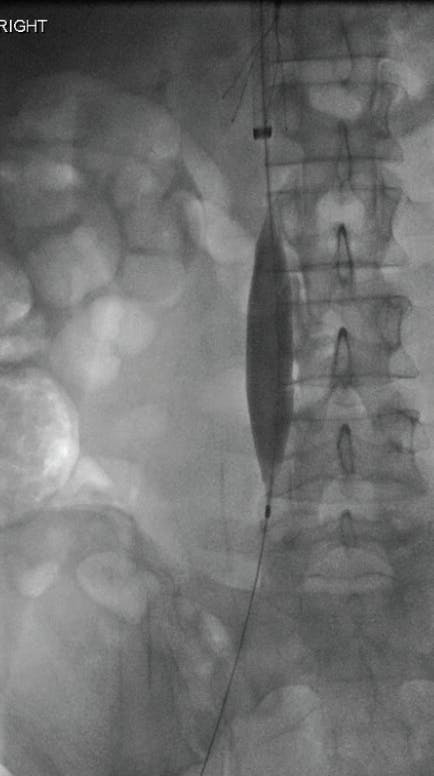
Figure 6. Angioplasty of the IVC with an 18-mm-diameter high-pressure balloon.
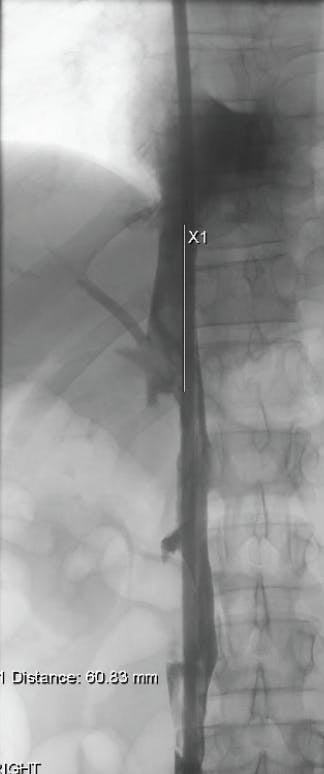
Figure 7. Final venography prior to placement of the suprarenal IVCF at the completion of the PMT procedure.
Before the procedure was completed, another suprarenal IVCF was placed, and the patient was started on low-dose bivalirudin on the floor, with significant improvement of PCD as an inpatient. At 5-month follow-up, the patient had complete resolution of the thrombosis, the suprarenal IVCF was retrieved, and venography demonstrated a patent IVC (Figure 8).
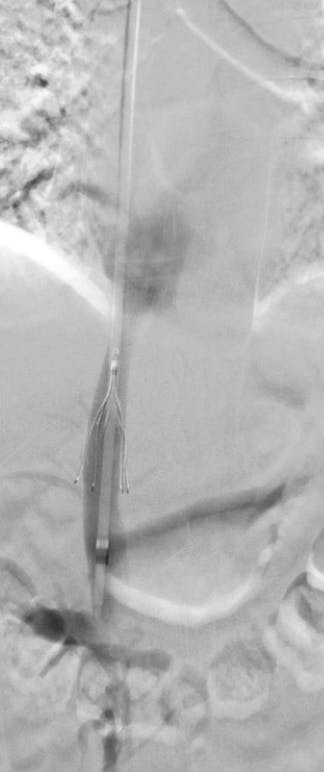
Figure 8. Follow-up at 5 months after the PMT intervention and before IVCF removal demonstrated a patent IVC.
POSTPROCEDURAL MANAGEMENT
After intervention, patients should continue to be monitored for thrombosis recurrence, coagulation status, and bleeding risk, depending on the anticoagulation regimen. When stenting is performed for IVC reconstruction and/or underlying left iliac vein stenosis, anticoagulation management must be discussed with the oncologic and hematology teams because these patients will likely require lifelong anticoagulation.
SUMMARY
In this technical review, we discussed the limitations of thrombolysis in patients with cancer given their increased risk of VTE and associated inherent high risk of bleeding complications, providing a roadmap for proceduralists dealing with these challenging clinical scenarios. Overall, newer mechanical and aspiration thrombectomy devices provide safe alternatives for performing single-session mechanical thrombectomy in patients with a contraindication to lytic infusion. However, more studies using oncologic patient-level data are needed to fully evaluate these techniques and determine clinical outcomes and safety when acute DVT is present.
1. Horsted F, West J, Grainge MJ. Risk of venous thromboembolism in patients with cancer: a systematic review and meta-analysis. PLoS Med. 2012;9:e1001275. doi: 10.1371/journal.pmed.1001275
2. López-Núñez JJ, Trujillo-Santos J, Monreal M. Management of venous thromboembolism in patients with cancer. J Thromb Haemost. 2018;16:2391-2396. doi: 10.1111/jth.14305
3. Prandoni P, Lensing AW, Piccioli A, et al. Recurrent venous thromboembolism and bleeding complications during anticoagulant treatment in patients with cancer and venous thrombosis. Blood. 2002;100:3484-3488. doi: 10.1182/blood-2002-01-0108
4. Vedantham S, Goldhaber SZ, Julian JA, et al. Pharmacomechanical catheter-directed thrombolysis for deep-vein thrombosis. N Engl J Med. 2017;377:2240-2252. doi: 10.1056/NEJMoa1615066
5. Brailovsky Y, Yeung HM, Lakhter V, et al. In-hospital outcomes of catheter-directed thrombolysis versus anticoagulation in cancer patients with proximal deep venous thrombosis. J Vasc Surg Venous Lymphat Disord. 2020;8:538-544.e3. doi: 10.1016/j.jvsv.2019.10.014
6. Loss L, Stefanopoulos S, Siddiq A, et al. Catheter directed lysis and thrombectomy are equally effective for extensive deep vein thrombosis. J Surg Res. 2019;244:540-546. doi: 10.1016/j.jss.2019.06.083
7. Vedantham S, Sista AK, Klein SJ, et al. Quality improvement guidelines for the treatment of lower-extremity deep vein thrombosis with use of endovascular thrombus removal. J Vasc Interv Radiol. 2014;25:1317-1325. doi: 10.1016/j.jvir.2014.04.019
8. Sharifi M, Bay C, Skrocki L, et al. Role of IVC filters in endovenous therapy for deep venous thrombosis: the FILTER-PEVI (filter implantation to lower thromboembolic risk in percutaneous endovenous intervention) trial. Cardiovasc Intervent Radiol. 2012;35:1408-1413. doi: 10.1007/s00270-012-0342-z
9. Birn J, Vedantham S. May-Thurner syndrome and other obstructive iliac vein lesions: meaning, myth, and mystery. Vasc Med. 2015;20:74-83. doi: 10.1177/1358863X14560429
10. Teter K, Schrem E, Ranganath N, et al. Presentation and management of inferior vena cava thrombosis. Ann Vasc Surg. 2019;56:17-23. doi: 10.1016/j.avsg.2018.08.082
11. Crowner JR, Marston W. Percutaneous thrombectomy using a novel single-session device for acute ilio-caval deep vein thrombosis. J Vasc Surg Cases Innov Tech. 2019;5:302-304. doi: 10.1016/j.jvscit.2019.03.010
12. Delomez M, Beregi JP, Willoteaux S, et al. Mechanical thrombectomy in patients with deep venous thrombosis. Cardiovasc Intervent Radiol. 2001;24:42-48. doi: 10.1007/s002700001658
13. Al-Hakim RA, Boscanin A, Prosser DD, Kaufman JA. Management of phlegmasia cerulea dolens with percutaneous mechanical thrombectomy. Cardiovasc Intervent Radiol. 2020;43:1398-1401. doi: 10.1007/s00270-020-02570-x
Advertisement
Advertisement