Advertisement
Advertisement
October 2021
A Practical, Case-Based Approach to Yttrium-90 Radioembolization Dosimetry in the Liver
Understanding Y-90 radioembolization in current practice.
By Alexander Villalobos, MD; Ripal T. Gandhi, MD; and Nima Kokabi, MD
Yttrium-90 radioembolization (Y-90 RE) remains a complex and multifaceted therapy often requiring multidisciplinary collaboration for the safe and efficacious delivery of Y-90 microspheres. Although regional clinical practice heterogeneities exist, literature has consistently shown that personalized Y-90 RE dosimetry can provide much-improved patient outcomes and should thus be utilized whenever possible.1,2 Unfortunately, the use of Y-90 personalized dosimetry models continues to be relatively limited, with multiple centers continuing to use the nonpersonalized dosimetry models currently recommended by the Y-90 microsphere manufacturers.3,4
In current practice, three dosimetry models are clinically utilized for the calculation of Y-90 prescription activity. Although semiempirical in nature, the body surface area (BSA) model, whose usage is recommended by the resin Y-90 microsphere manufacturer, is the easiest and simplest to utilize. However, it suffers from any meaningful personalization and is thus currently only used at our practices on limited occasions. Although the glass Y-90 microsphere manufacturer is the only one officially recommending the medical internal radiation dose (MIRD) model for Y-90 RE dosimetry planning, the MIRD model can also be used for resin-based Y-90 microspheres in an off-label setting at lower target doses.5 Unlike the BSA model, the MIRD dosimetry model can provide a higher degree of personalization, albeit it is unable to differentiate the dose given to tumor versus normal liver parenchyma and is therefore well suited for situations where the whole targeted area is to be considered to be homogeneously treated (such as in the setting of a Y-90 RE segmentectomy). Finally, the partition model, which can be used with both glass and resin Y-90 microparticles, is the most laborious yet personalized prospective dosimetry model in current clinical practice. It accounts for the radioisotope biodistribution within the targeted area and can thus deliver carefully calculated Y-90 doses to livers with suboptimal function while maximizing the dose to targeted tumor(s).
In this article, practical aspects of patient selection, technical pearls, and intraprocedural tips and tricks are shared to provide an understanding of how we currently practice Y-90 RE at our high-volume liver cancer practices. We show four cases that highlight typical scenarios encountered during Y-90 RE of primary and metastatic liver malignancies.
COMMENTS ON OUR CURRENT Y-90 RE PROCEDURES
At our institutions, a preintervention bilirubin > 2 mg/dL or albumin < 2.5 g/dL is utilized as a hard cut-off to exclude patients with limited healthy liver reserves for lobar therapy. Our bilirubin cut-off for segmental therapy is 3 mg/dL. Our albumin cut-off for segmentectomy remains at 2.5 g/dL. In line with the widely accepted, relatively conservative criteria that aims to balance the estimated risk of post–Y-90 RE hepatic dysfunction with the expected potential survival benefit,6 patients with Child-Pugh (CP) class ≥ B8 are generally considered beyond criteria to receive bilobar Y-90 RE, although segmental RE may be considered.
Both the technetium 99m macroaggregated albumin (Tc-99m MAA) shunt study and the Y-90 RE procedures are conducted in the outpatient setting and with the intent of same-day discharge. In cases where the patient lives > 4 hours away from our institution or when COVID-19 infection rates are of high concern,7 we favor using resin Y-90 microspheres to conduct same-day planning and RE.
Unless contraindicated (eg, modified Barbeau type D), left radial artery access (with the patient’s arm in supination by their side) is sought first.8 We routinely use topical nitroglycerin and lidocaine paste preintervention to dilate the radial artery.9 During the procedure, a cocktail of 200 mcg of nitroglycerin, 2.5 mg of verapamil, and 3,000 IU of heparin is slowly infused via the sheath to reduce the risk of radial artery spasm and/or thrombosis.10
Our usual left radial artery access sheath is a 5-F Glidesheath Slender (Terumo Interventional Systems) combined with a 110 cm, 5-F Jacky Radial or Sarah Radial Optitorque (Terumo Interventional Systems) as our base catheter.
Depending on the tortuosity and size of the to-be-targeted vessel, our usual microcatheter length and size is a 150-cm, 2- to 2.8-F microcatheter.
We no longer routinely embolize potential nontarget embolization vessels (eg, gastroduodenal or right gastric arteries) prior to the delivery of Y-90 microspheres. Instead, we often strive to use a microcatheter with a compliant occlusion balloon such as the Sniper (Embolx, Inc.) or an antireflux catheter (eg, TriNav [TriSalus Life Sciences] or SeQure [Guerbet LLC]) to prevent reflux or nontarget embolization when necessary. In select cases where a microcatheter with a compliant occlusion balloon or an antireflux catheter is not able to successfully ameliorate the risk of reflux or nontargeted embolization, we then pursue embolization with coils and/or plugs. These catheters have the additional potential benefit of increasing Y-90 deposition in the tumors relative to the background nontumoral liver.
During the Tc-99m MAA mapping study and prior to the radioisotope delivery, we routinely use three-dimensional cone-beam CT (CBCT) to confirm adequate tumor coverage from the to-be-intended microcatheter position. Although CBCT acquisition is classically difficult in left radial artery access cases, our experience with the open arc CBCT modes found in newer fluoroscopy machines has shown that this is no longer the case.
Our routine clinical practice is to deliver the Tc-99m MAA from the exact same microcatheter location as where we foresee delivering the Y-90 microparticles from. If split administration of Y-90 is projected, the MAA administration is done in a split manner as well. In our experience, this method helps with more accurate treatment planning if partition dosimetry is to be utilized.
In the endeavor to attain proper tumor coverage, we often use the many flexible-dose options available for glass and resin microspheres. Although choosing the proper combination of the Y-90 microsphere type and specific activity currently remains more of an art than a science, our general approach is to utilize high specific activity microspheres for small target areas and lower specific activity microspheres for large target areas. The nuance of choosing the correct calibration with either device depending on the size and distribution of the tumor(s) is beyond the scope of this article. Our group has published another article on this and associated dosimetry topics that we invite interested individuals to review.11
CASE 1: Y-90 RE SEGMENTECTOMY OF A HEPATOCELLULAR CARCINOMA (HCC), WITH RESIN MICROSPHERES AND PARTITION MODEL PLANNING
A man in his early 70s presented with untreated hepatitis C virus (HCV) infection, without cirrhosis, complicated by a single 3.9- X 4.2-cm HCC in segment 6/7 (Figure 1A). The patient was without acute complaints and of Eastern Cooperative Oncology Group (ECOG) 0 performance score. Preintervention labs included sodium 145 mmol/L, creatinine 1.4 mg/dL, albumin 4.2 g/dL, total bilirubin 0.4 mg/dL, international normalized ratio (INR) 1.0, and alpha-fetoprotein (AFP) 3.0 ng/mL, classifying him as a CP A5, model for end-stage liver disease (MELD) 10, and albumin-bilirubin (ALBI) grade 1. Present comorbidities precluded him from attaining liver transplantation but were noncontributory toward the planning or delivery of Y-90–based transarterial therapy. Because there was unremarkable baseline liver function and only a single HCC lesion, the decision to treat with curative intent was made. During the Tc-99m MAA shunt study, a 2.8-F Progreat microcatheter (Terumo Interventional Systems) was placed in a position able to simultaneously provide complete coverage of the targeted tumor within segment 6/7 and avoid unnecessary RE of the nontargeted segments. CBCT confirmed proper microcatheter positioning and target coverage prior to Tc-99m MAA delivery (Figure 1B). After delivering the radioisotope, subsequent Tc-99m MAA single-photon emission CT (SPECT)/CT images (Figure 1C) reconfirmed satisfactory and selective HCC tumor coverage without extrahepatic activity—thereby confirming the tumor’s amenability to Y-90 RE segmentectomy.
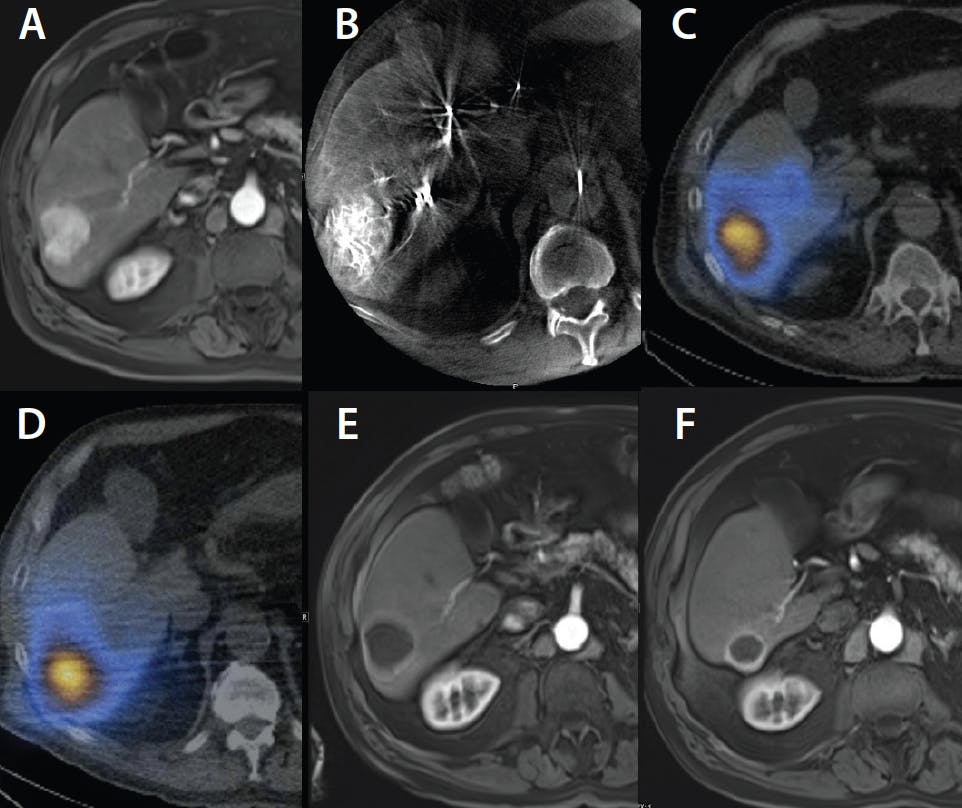
Figure 1. Pretreatment, avid arterial enhancement of 3.9- X 4.2-cm HCC tumor in segment 6/7 (A). CBCT ensured complete coverage of the tumor from the location of the microcatheter where the MAA and future Y-90 was to be administered from (B). Tc99m MAA SPECT/CT confirmed the complete coverage of the targeted tumor within segment 6/7 and absence of extrahepatic activity (C). Y-90 bremsstrahlung SPECT/CT confirmed the complete coverage of the targeted tumor within segment 6/7 and absence of extrahepatic activity (D). Posttreatment MRI arterial phase images at 6 weeks and 6 months, respectively, demonstrated complete response without recurrence of disease (E, F).
Given its maximum diameter of > 3 cm, the decision was made to use 3-day precalibrated resin microspheres with partition model planning set to achieve a tumor dose of at least 200 Gy.12 Please note, however, that the optimal tumoricidal dose for radiation segmentectomy with resin radiomicrospheres is not clearly established. According to one study evaluating ablative transarterial Y-90 RE for patients with HCC and portal vein thrombus, ablative Y-90 RE was defined as > 70 Gy via the partition model to the liver parenchyma.13 Compared to conventional Y-90 RE, ablative Y-90 RE was found to have a longer median overall survival and posttreatment survival. According to international recommendations for personalized Y-90 RE using resin microspheres, > 150 Gy mean absorbed dose was suggested for radiation segmentectomy.14
Postprocedural analysis of the Tc-99m MAA SPECT/CT images yielded a pulmonary shunt of 3.5% and a planned activity of 45 mCi to be delivered to segment 6/7 of the right lobe. Three days after the Tc-99m MAA shunt study, the patient underwent a Y-90 segmentectomy procedure using the same microcatheter type and position as during the Tc-99m MAA shunt study—thereby successfully delivering 46.8 mCi of resin Y-90 microspheres into segment 6/7. Subsequent Y-90 bremsstrahlung SPECT/CT imaging confirmed complete HCC tumor coverage within the targeted area and absence of extrahepatic activity (Figure 1D). No acute complaints or toxicities were noted immediately postprocedurally or at the 6-week postprocedural clinic visit. Dynamic contrast-enhanced MRI 6 weeks posttherapy demonstrated complete response of the targeted tumor (Figure 1E). At 6-month imaging follow-up, the patient continued to demonstrate nonviable tumor without recurrence of disease (Figure 1F).
CASE 2: Y-90 RE BISEGMENTECTOMY OF A COLORECTAL CANCER HEPATIC METASTATIC FOCI, WITH RESIN MICROSPHERES AND PARTITION MODEL PLANNING
A man in his late 50s presented with moderately differentiated stage IV adenocarcinoma of the sigmoid colon status following lower anterior resection complicated by proton emission tomography avid bilobar liver lesions that were resected with partial wedge hepatectomy of segments 8, 4a, and 2. An unresected segment 8 lesion continued to enlarge despite ongoing FOLFOX/bevacizumab therapy. The patient was otherwise considered to have a complete response. Interventional radiology (IR) was consulted for liver-directed therapy of this enlarging lesion. During the IR clinic visit, the patient was without acute complaints and ECOG 1. Preintervention labs included sodium 134 mmol/L, creatinine 0.97 mg/dL, albumin 4.4 g/dL, total bilirubin 0.5 mg/dL, INR 0.9, and carcinoembryonic antigen 1.6 ng/mL, classifying him as a CP A5, MELD 11, and ALBI grade 1. Present comorbidities were noncontributory toward the planning or delivery of Y-90–based transarterial therapy. Because there was great baseline liver function and the segment 8 lesions were the only viable tumor, the decision to treat the patient with curative intent was made. The patient was then evaluated for Y-90 RE of the 3.4- X 4.2-cm segment 8 lesion (Figure 2A). Given that the patient’s home was > 4 hours away from the treatment center, the decision was made to perform same-day mapping and therapy with resin Y-90 microspheres.
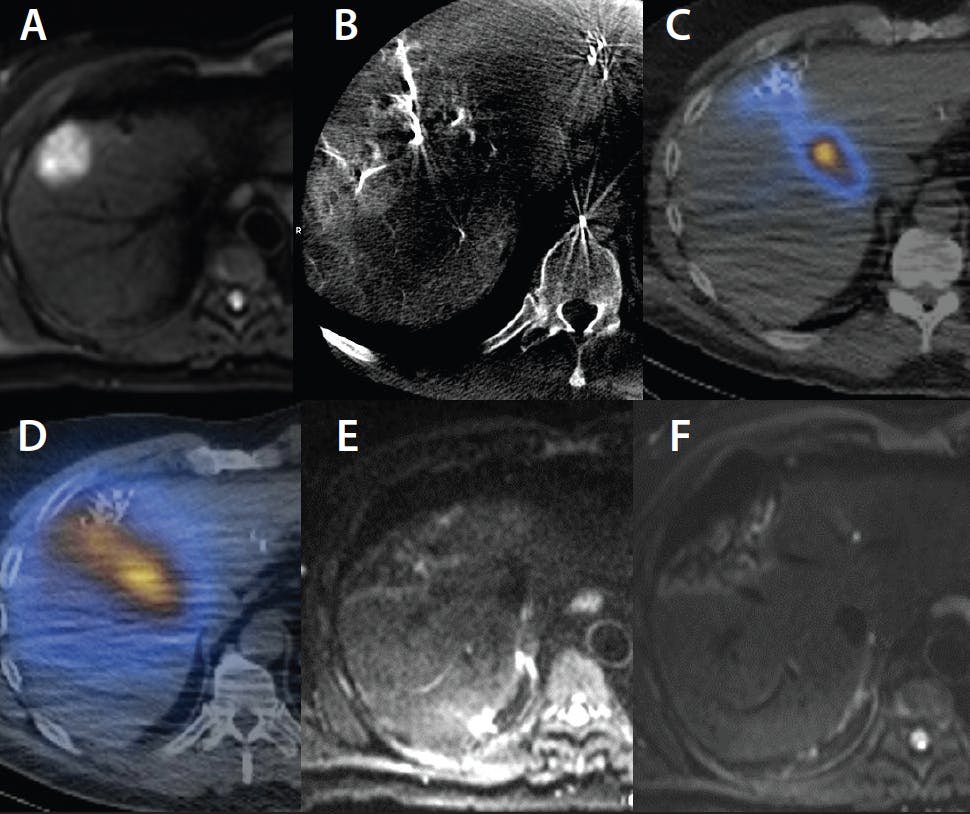
Figure 2. Pretreatment, metastatic colorectal cancer foci exhibited restricted diffusion and measured 3.4 X 4.2 cm within segment 8 (A). CBCT demonstrated that segment 5 and segment 8 hepatic arteries supplied the segment 8 lesion. CBCT also ensured complete coverage of the tumor from the location of the microcatheter where the MAA and future Y-90 was to be administered from (B). Tc99m MAA SPECT/CT confirmed the satisfactory coverage of the targeted tumor within segment 8 and absence of extrahepatic activity (C). Y90 bremsstrahlung SPECT/CT confirmed the complete coverage of the targeted tumor within segment 8 and absence of extrahepatic activity (D). Posttreatment MRI diffusion-weighted images at 6 and 12 months, respectively, demonstrated the absence of mass-like restricted diffusion within the treatment zone (E, F).
During the Tc-99m MAA shunt study, a CBCT found that the segment 8 lesion was primarily supplied by two separate segment 5 and segment 8 hepatic arteries (Figure 2B). Planning was further complicated by the early branching pattern of the anterior division of the right hepatic artery just distal to the anterior/posterior right hepatic artery bifurcation (Figure 3A and 3B). To conduct a subselective delivery of the Tc-99m MAA radioisotope into the segment 5 and segment 8 hepatic arteries, a straight tip 2.4-F microcatheter with a compliant occlusion balloon was placed at the common trunk of the segment 5 and segment 8 hepatic arteries (Figure 3C). After delivering the radioisotope, subsequent Tc-99m MAA SPECT/CT images (Figure 2C) showed satisfactory and selective tumor coverage without extrahepatic activity—thereby confirming the tumor’s amenability to Y-90 RE bisegmentectomy.
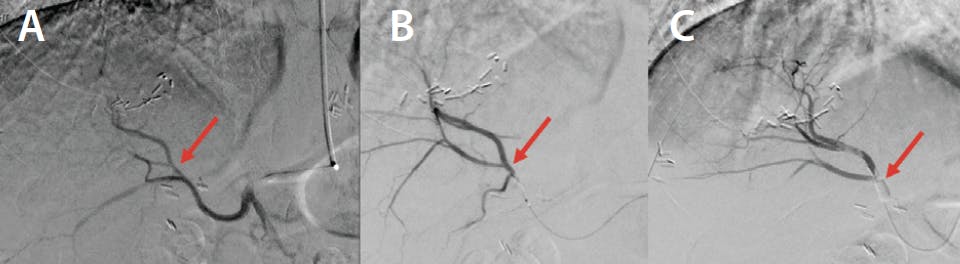
Figure 3. Digital subtraction angiography images demonstrated, with desired position for radioisotope delivery highlighted with red arrows. Early branching pattern of the anterior division of the right hepatic artery just distal to the anterior/posterior right hepatic artery bifurcation (A). Microcatheter subselective angiography demonstrated a prominent segment 6 artery near the desired radioisotope delivery position (arrow, B). Balloon microcatheter-assisted occlusion of the segment 6 and posterior division of the right hepatic arteries permitted a proper subselective delivery of the resin Y90 microspheres into the targeted segment 5 and segment 8 hepatic arteries (C).
Several studies have demonstrated a dose-response relationship when treating colorectal cancer metastatic disease with Y-90 RE, with lesions receiving > 100 Gy having a higher likelihood of complete metabolic response when utilizing resin microspheres.15,16 Per the international recommendations for personalized Y-90 RE by Levillain et al, a minimum mean absorbed dose cut-off of 100 to 120 Gy is proposed for metastatic colorectal cancer to achieve tumor ablation/complete response.14 With this in mind and given the relatively large, targeted area, the decision was made to use 2-day precalibration resin microspheres with partition model planning set to achieve a tumor dose of at least 100 Gy.
Postprocedural analysis of the Tc-99m MAA SPECT/CT images yielded a pulmonary shunt of 6.4% and a planned activity of 38 mCi to be delivered to the segment 5/8 of the right liver lobe. After the Tc-99m MAA shunt study, the patient underwent Y-90 RE bisegmentectomy using the same microcatheter type and position as during the Tc-99m shunt study—thereby successfully delivering 46.8 mCi of resin Y-90 microspheres into segment 5/8. Subsequent Y-90 bremsstrahlung SPECT/CT imaging confirmed complete HCC tumor coverage within the targeted area and absence of nontargeted extrahepatic activity (Figure 2D). A follow-up dynamic contrast-enhanced MRI performed at 6 months demonstrated complete response of the targeted tumor (Figure 2E). No acute complaints or toxicities were noted at follow-up clinic visits. At 12-month imaging follow-up, the patient continued to have nonviable Y-90–treated tumor without recurrence of disease (Figure 2F).
CASE 3: Y-90 RE LOBECTOMY OF RIGHT LOBE AND HCC, WITH RESIN MICROSPHERES AND MIRD PLANNING
A man in his mid 60s presented with a history of alcohol hepatitis, without cirrhosis, complicated by a solitary 8.5- X 8.1-cm biopsy-proven HCC in segment 5/6 (Figure 4A). Although technically a surgical candidate, the patient specifically requested from the transplant team to undergo a nonsurgical procedure that would permit him treat the HCC tumor while also facilitating his wish to remain a surgical candidate for as long as possible. The patient was then recommended to be evaluated by IR, where he was found to be without acute complaints, ECOG 0, and with comorbidities that were otherwise noncontributory toward the planning or delivery of Y-90–based transarterial therapy. Preintervention labs included sodium 136 mmol/L, creatinine 0.7 mg/dL, albumin 2.8 g/dL, total bilirubin 1.5 mg/dL, INR 1.4, and AFP 13.3 ng/mL, classifying him as a CP A6, MELD 15, and ALBI grade 2.
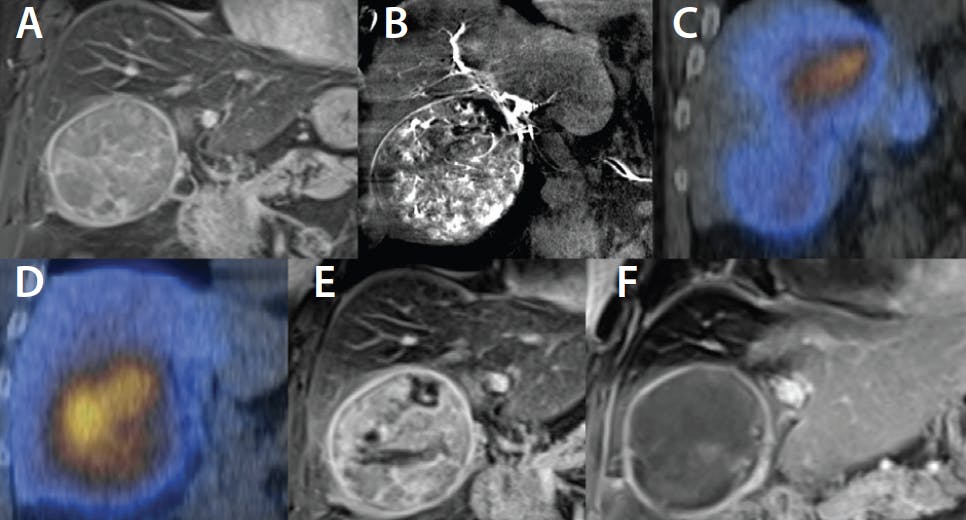
Figure 4. Pretreatment, delayed phase images of the solitary 8.5-X 8.1-cm HCC tumor within segment 5/6 (A). CBCT demonstrated complete coverage of the tumor from the location of the microcatheter where the MAA and future Y90 was to be administered from (B). Tc99m MAA SPECT/CT confirmed the complete coverage of the targeted tumor within the targeted right lobe and absence of extrahepatic activity (C). Y-90 bremsstrahlung SPECT/CT confirmed the complete coverage of the targeted tumor and absence of extrahepatic activity (D). Posttreatment MRI delayed phase images at 4 weeks demonstrated > 50% tumor necrosis/response (E). Posttreatment MRI delayed phase images at 6 weeks after the second stage of therapy demonstrated complete response without recurrence of disease (F).
Given the slightly decreased liver function, the decision to conduct a curative-intent staged right lobe Y-90 lobectomy was made. Please note, however, that optimal dosing and sphere count to achieve radiation lobectomy effectively and safely with either Y-90 product is not known. Existing literature can cause confusion as published studies are generally small, heterogeneous (eg, primary vs metastatic and different tumor morphology), have different follow-up intervals and methods of measuring hypertrophy, different Y-90 products and dosimetric calculations, and prior liver therapies. When utilizing resin microspheres, a mean absorbed dose to the nontumoral liver of > 70 Gy for ablative therapy has been proposed.14 In a retrospective study of 73 HCC patients being treated with glass microspheres, maximum hypertrophy occurred when normal parenchymal liver dose was > 88 Gy. For larger tumors, a tumoral dose > 205 Gy was associated with greater hypertrophy.17
During the Tc-99m MAA shunt study, a 2.8-F Progreat microcatheter was placed in a position able to simultaneously provide complete coverage of the targeted tumor within the right lobe and avoid unnecessary RE of the left lobe parenchyma. CBCT confirmed proper microcatheter positioning and target coverage prior to Tc-99m MAA delivery (Figure 4B). After delivering the radioisotope, subsequent Tc-99m MAA SPECT/CT images (Figure 4C) reconfirmed a satisfactory right lobe and HCC tumor coverage without extrahepatic activity. After review of the Tc-99m MAA SPECT/CT images, we chose to utilize day of calibration resin microspheres with partition model planning to deliver 300 Gy to the relatively large right lobe parenchymal volume in two stages. During stage I, the right lobe would be given a dose of 150 Gy, which has been shown to produce contralateral liver hypertrophy with glass microspheres17 and has provided excellent results with resin microspheres in our experience. The patient would then be followed-up clinically for 1 month, with relevant labs being used to ensure proper liver function and candidacy to undergo the next stage of the procedure. During stage II, another 150 Gy would be delivered into the right lobe to complete the 300 Gy total dose to the right liver—thereby ensuring that the tumor receives a dose > 190 Gy (a dose previously associated with a higher probability of achieving a complete response with glass Y-90 microspheres18,19).
The reason to choose resin over glass microspheres for this case was related to size of the tumor and the objective to attain uniform tumor coverage able to achieve a complete tumor response—although, there are little data regarding this theory. Postprocedural analysis of the Tc-99m MAA SPECT/CT images yielded a pulmonary shunt of 5.9% and a planned activity of 89 mCi to be delivered to the right lobe to achieve a 150 Gy dose to the right hepatic lobe using the MIRD model. Three days after the Tc-99m MAA shunt study, the patient underwent Y-90 radiation lobectomy using the same microcatheter type and position as during the Tc-99m MAA shunt study—thereby successfully delivering 89 mCi of resin Y-90 microspheres into the right lobe. Subsequent Y-90 bremsstrahlung SPECT/CT imaging confirmed complete HCC tumor coverage within the targeted right lobe and absence of nontargeted extrahepatic activity (Figure 4D). Dynamic contrast-enhanced MRI 4 weeks posttherapy demonstrated > 50% tumor necrosis/response with mild interval hypertrophy of the left lobe (Figure 4E). No acute complaints or toxicities were noted immediately postprocedurally or at the 4-week postprocedural clinic visit. One-month postintervention labs included sodium 135 mmol/L, creatinine 0.9 mg/dL, albumin 3.8 g/dL, total bilirubin 1.5 mg/dL, INR 1.2, and AFP 4.4 ng/mL, classifying him as a CP A5, MELD 14, and ALBI grade 2. The decision to proceed to stage two of right lobe Y-90 lobectomy was made.
Repeat treatment with the same prescribed activity of 89 mCi was performed using the same microcatheter location. However, because a slight decrease in intra-arterial flow was noted during angiography, we decided to exchange our usual Progreat microcatheter for a straight tip 2.4-F microcatheter with a compliant occlusion balloon that would help us ameliorate the risk of reflux into nontargeted liver parenchyma. After a technically successful delivery of the Y-90 microparticles, subsequent Y-90 bremsstrahlung SPECT/CT confirmed complete HCC tumor coverage within the targeted right lobe and absence of nontargeted extrahepatic activity. No acute complaints or toxicities were noted immediately postprocedurally or at the next 6-week postprocedural clinic visit. At the 6-week imaging follow-up after the second stage of the therapy, there was complete response of the targeted tumor, atrophy of the right lobe, and excellent hypertrophy of the left lobe (Figure 4F).
CASE 4: Y-90 RE SEGMENTECTOMY OF HCC WITH TUMOR THROMBUS, WITH GLASS MICROSPHERES AND MIRD MODEL PLANNING
A man in his late 60s with decompensated HCV cirrhosis complicated by multifocal HCC thus far treated with CT-guided microwave ablation and Y-90 RE involving the right lobe presented with a new infiltrative HCC lesion with tumor thrombus within segment 3 (Figure 5A and 5B). The patient was without acute complaints and ECOG 0. Preintervention labs included sodium 136 mmol/L, creatinine 1.0 mg/dL, albumin 3.8 g/dL, total bilirubin 0.4 mg/dL, INR 1.1, and AFP 5.5 ng/mL, classifying him as a CP A5, MELD 11, and ALBI grade 1. The patient’s present comorbidities were noncontributory toward the planning or delivery of Y-90–based transarterial therapy. Because there was unremarkable baseline liver function and the HCC was contained within segment 3 and its portal vein branches, the decision to treat the HCC with curative intent was made. During the Tc-99m MAA shunt study, a 2.8-F Progreat microcatheter was utilized to subselect the segment 3 hepatic artery. After delivering the radioisotope, subsequent Tc-99m MAA SPECT/CT images (Figure 5C) showed satisfactory and selective HCC tumor coverage without extrahepatic activity—thereby confirming the HCC tumor’s amenability to Y-90 RE segmentectomy.
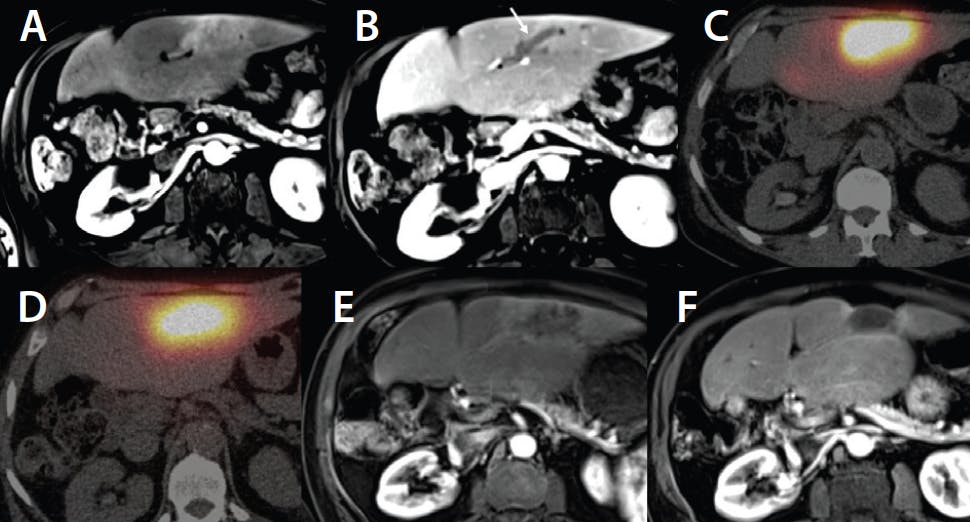
Figure 5. Pretreatment, intrahepatic left portal vein thrombosis (arrow) with subtle arterial enhancement and washout, measuring 8.4 X 3.2 cm, within the vein as well as the geographic area of segment 3, consistent with HCC (A, B). Tc99m MAA SPECT/CT confirmed the complete coverage of the targeted tumor within segment 2 and absence of extrahepatic activity (C). Y-90 bremsstrahlung SPECT/CT confirmed the complete coverage of the targeted tumor within segment 3 and absence of extrahepatic activity (D). Posttreatment MRI arterial phase images at 6 weeks and 7 months, respectively, demonstrated complete response without recurrence of disease (E, F).
Dose thresholds for radiation segmentectomy with glass radiomicrospheres are evolving as more data are being published. In this case, the dose used to target the HCC is based on an HCC radiology-pathology correlation study from 2014 that demonstrated more pathologic complete necrosis occurred when > 190 Gy was utilized.20 In the more recent LEGACY study that evaluated glass Y-90 RE for the treatment of solitary unresectable HCC,21 a subset of patients who underwent hepatic resection/transplantation were found to have complete pathologic necrosis when the dose to tumor-bearing tissue was > 400 Gy, establishing this as the new threshold dose for ablative Y-90 RE. With this in mind and the relatively small, targeted volume and infiltrative nature of the segment 3 HCC, the decision was made to use first-week dose glass microspheres with MIRD planning set to achieve 190 Gy to segment 3.
Postprocedural analysis of the Tc-99m MAA SPECT/CT images yielded a pulmonary shunt of 5.4% and a planned dose of 82 mCi to be delivered. Eleven days after the Tc-99m MAA shunt study, the patient underwent Y-90 RE segmentectomy procedure using the same microcatheter type and position as during the Tc-99m shunt study—thereby successfully delivering 82 mCi of glass Y-90 microspheres into segment 3. Subsequent Y-90 bremsstrahlung SPECT/CT imaging confirmed complete HCC tumor coverage within the targeted area and absence of nontargeted extrahepatic activity (Figure 5D). No acute complaints or toxicities were noted immediately postprocedurally or at the 6-week postprocedural clinic visit. Dynamic contrast-enhanced MRI 6 weeks posttherapy demonstrated complete response of the targeted tumor (Figure 5E). At the 7-month imaging follow-up, the patient continued to have a nonviable treated tumor without recurrence of disease (Figure 5F).
CONCLUSION
In patients with primary and metastatic liver disease treated with Y-90 RE, treatment planning with personalized dosimetry has been shown to improve tumor response and patient survival. It is incumbent for treating interventional radiologists to be familiar with the dosimetry planning models and dosimetry literature to partake a more active role in the treatment planning for their patients.
1. Garin E, Tselikas L, Guiu B, et al. Personalised versus standard dosimetry approach of selective internal radiation therapy in patients with locally advanced hepatocellular carcinoma (DOSISPHERE-01): a randomised, multicentre, open-label phase 2 trial. Lancet Gastroenterol Hepatol. 2021;6:17-29. doi: 10.1016/S2468-1253(20)30290-9
2. Hermann AL, Dieudonné A, Ronot M, et al. Relationship of tumor radiation–absorbed dose to survival and response in hepatocellular carcinoma treated with transarterial radioembolization with 90Y in the SARAH study. Radiology. 2020;296:673-684. doi: 10.1148/radiol.2020191606
3. SIR-Spheres® Y-90 resin microspheres [instructions for use]. Woburn (MA): SIRTeX Medical Limited: 2017. https://www.sirtex.com/media/155126/ssl-us-13.pdf. Accessed March 30, 2020.
4. TheraSphere Yttrium-90 Microspheres Package Insert. Boston Scientific Corporation. https://www.accessdata.fda.gov/cdrh_docs/pdf/h980006c.pdf. Accessed September 29, 2021.
5. Gulec SA, Mesoloras G, Stabin M. Dosimetric techniques in 90Y-microsphere therapy of liver cancer: the MIRD equations for dose calculations. J Nucl Med. 2006;47:1209-1211.
6. Braat AJAT, Smits MLJ, Braat MNGJA, et al. 90Y hepatic radioembolization: an update on current practice and recent developments. J Nucl Med. 2015;56:1079-1087. doi: 10.2967/jnumed.115.157446
7. Elsayed M, Loya M, Galt J, et al. Same day yttrium-90 radioembolization with single photon emission computed tomography/computed tomography: An opportunity to improve care during the COVID-19 pandemic and beyond. World J Gastrointest Oncol. 2021;13:440-452. doi: 10.4251/WJGO.V13.I5.440
8. Fischman AM, Swinburne NC, Patel RS. A technical guide describing the use of transradial access technique for endovascular interventions. Tech Vasc Interv Radiol. 2015;18:58-65. doi: 10.1053/j.tvir.2015.04.002
9. Beyer AT, Ng R, Singh A, et al. Topical nitroglycerin and lidocaine to dilate the radial artery prior to transradial cardiac catheterization: A randomized, placebo-controlled, double-blind clinical trial: The PRE-DILATE Study. Int J Cardiol. 2013;168:2575-2578. doi: 10.1016/j.ijcard.2013.03.048
10. Kwok CS, Rashid M, Fraser D, et al. Intra-arterial vasodilators to prevent radial artery spasm: a systematic review and pooled analysis of clinical studies. Cardiovasc Revascularization Med. 2015;16:484-490. doi: 10.1016/j.carrev.2015.08.008
11. Villalobos A, Soliman MM, Majdalany BS, et al. Yttrium-90 radioembolization dosimetry: what trainees need to know. Semin Intervent Radiol. 2020;37:543-554. doi: 10.1055/s-0040-1720954
12. Malhotra A, Liu DM, Talenfeld AD. Radiation segmentectomy and radiation lobectomy: a practical review of techniques. Tech Vasc Interv Radiol. 2019;22:49-57. doi: 10.1053/j.tvir.2019.02.003
13. Cardarelli-Leite L, Chung J, Klass D, et al. Ablative transarterial radioembolization improves survival in patients with HCC and portal vein tumor thrombus. Cardiovasc Intervent Radiol. 2020;43:411-422. doi: 10.1007/s00270-019-02404-5
14. Levillain H, Bagni O, Deroose CM, et al. International recommendations for personalised selective internal radiation therapy of primary and metastatic liver diseases with yttrium-90 resin microspheres. Eur J Nucl Med Mol Imaging. 2021;48:1570-1584. doi: 10.1007/s00259-020-05163-5
15. Van Den Hoven AF, Rosenbaum CENM, Elias SG, et al. Insights into the dose-response relationship of radioembolization with Resin 90Y-Microspheres: a prospective cohort study in patients with colorectal cancer liver metastases. J Nucl Med. 2016;57:1014-1019. doi: 10.2967/jnumed.115.166942
16. Levillain H, Duran Derijckere I, Marin G, et al. 90Y-PET/CT-based dosimetry after selective internal radiation therapy predicts outcome in patients with liver metastases from colorectal cancer. EJNMMI Res. 2018;8:60. doi: 10.1186/s13550-018-0419-z
17. Palard X, Edeline J, Rolland Y, et al. Dosimetric parameters predicting contralateral liver hypertrophy after unilobar radioembolization of hepatocellular carcinoma. Eur J Nucl Med Mol Imaging. 2018;45:392-401. doi: 10.1007/s00259-017-3845-7
18. Salem R, Padia SA, Lam M, et al. Clinical and dosimetric considerations for Y90: recommendations from an international multidisciplinary working group. Eur J Nucl Med Mol Imaging. 2019;46:1695-1704. doi: 10.1007/s00259-019-04340-5
19. Cheng B, Sethi I, Villalobos A, et al. Determination of tumour dose response threshold and implication on survival in patients with HCC treated with Y90 radiation segmentectomy: a simple semi-quantitative analysis. Nucl Med Commun. 2021;42:892-898. doi: 10.1097/MNM.0000000000001420
20. Vouche M, Habib A, Ward TJ, et al. Unresectable solitary hepatocellular carcinoma not amenable to radiofrequency ablation: multicenter radiology-pathology correlation and survival of radiation segmentectomy. Hepatology. 2014;60:192-201. doi: 10.1002/hep.27057
21. Salem R, Johnson GE, Kim E, et al. Yttrium-90 radioembolization for the treatment of solitary, unresectable HCC: the LEGACY study. Hepatology. Published online March 19, 2021. doi:10.1002/hep.31819
Advertisement
Advertisement