Advertisement
Advertisement
October 2021
Ablation Modalities in Interventional Oncology
A summary of the techniques, advantages, and future applications of available ablation options.
By Govindarajan Narayanan, MD; Raihan Noman, MD; Uchechukwu Uzomah, MD; and Ripal T. Gandhi, MD
Interventional oncology (IO) provides nonsurgical treatment options for various cancers using image guidance. Broadly classified into transarterial and ablative treatment options, these minimally invasive procedures can be used to treat patients with primary and secondary tumors, patients who are nonsurgical candidates, or those with comorbidities that render them poor surgical candidates. Image-guided ablation started with percutaneous injection of ethanol and has grown over the last few decades to include thermal ablation options, including radiofrequency ablation (RFA), microwave ablation (MWA), cryoablation, and nonthermal ablation using irreversible electroporation (IRE), and it continues to evolve constantly with innovations. This article offers an overview of the different ablation modalities available to treat these tumors and their associated techniques, advantages, and future applications.
RADIOFREQUENCY ABLATION
RFA is a thermal ablative technique that uses alternating current to induce cell death. The patient is a part of a closed-loop circuit that includes an RFA generator, grounding pads, and a needle electrode.1 The needle is connected to a radiofrequency (RF) generator that creates an alternating current that travels between the needle and the grounding pads on the patient’s thighs/legs. The alternating current creates ionic agitation in the treatment zone, creating frictional heat that denatures the tumor. The heating causes protein coagulation and irreversible damage to mitochondria and systolic cell enzymes while maintaining a well-demarcated RF field.1
Depending on the size of the tumor, ablation zones between 2 to 5 cm can be created in 10 to 30 minutes. RFA devices use temperature- or impedance-based treatment algorithms (Figure 1). RFA has a very small zone of active tissue heating and depends on the conduction of heat through the tissue for most of the ablation zone. Therefore, factors such as tissue conductivity, impedance, and blood perfusion impact the ablation zone. An important limitation of RFA is the “heat-sink effect.” Thermal energy dissipates from the target site due to blood flow in nearby blood vessels. This leads to less thermal energy for the destruction of tumor cells and insufficient ablation. In addition, the shape and size of the ablation zone in RFA may be unpredictable, which can lead to insufficient ablation zones.2
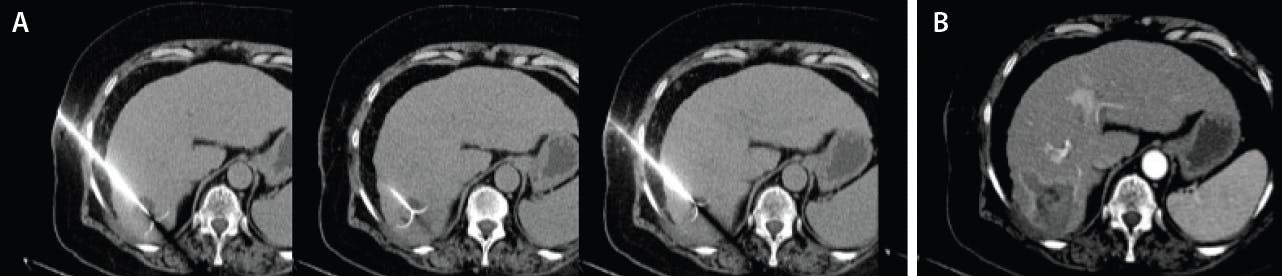
Figure 1. RFA of HCC involving the right lobe of the liver creating overlapping spheres (A). Final contrast-enhanced CT image postablation demonstrated the ablation zone and tract ablation (B).
Although RFA is being replaced by MWA in the United States, it remains a widely used and viable ablation option in several countries. Newer applications of RFA include use in thyroid nodules. Investigations have been published on the use of RFA in treating benign nonfunctioning thyroid nodules, autonomously functioning thyroid nodules, primary small low-risk papillary thyroid cancer, and recurrent thyroid cancer.3 Data from meta-analyses anticipate the routine use of RFA to treat these conditions. However, more robust prospective trials performed on diverse populations are needed to completely validate the efficacy of RFA in treating benign and malignant nodules of the thyroid.3
MICROWAVE ABLATION
MWA is based on dielectric heating. Electromagnetic microwaves heat matter by agitating water molecules in the surrounding tissue, which produces friction and then heat that initiates denaturation of intracellular proteins and melting of their cell membranes, ultimately causing coagulation necrosis.4 Current commercial microwave generators operate at 915 or 2,450 Mhz. Compared to RFA, MWA creates a larger zone of active heating, and larger tumors can be treated in a shorter time.
The use of MWA on liver tumors has shown many promising advantages, with some limitations. This technique is more suitable for large tumors and tumors close to many and/or large vessels (Figure 2). It can also produce better demarcated and more predictable ablation zones than other techniques.4 MWA can also heat tumors to higher temperatures and at a faster rate than other thermal ablative techniques.
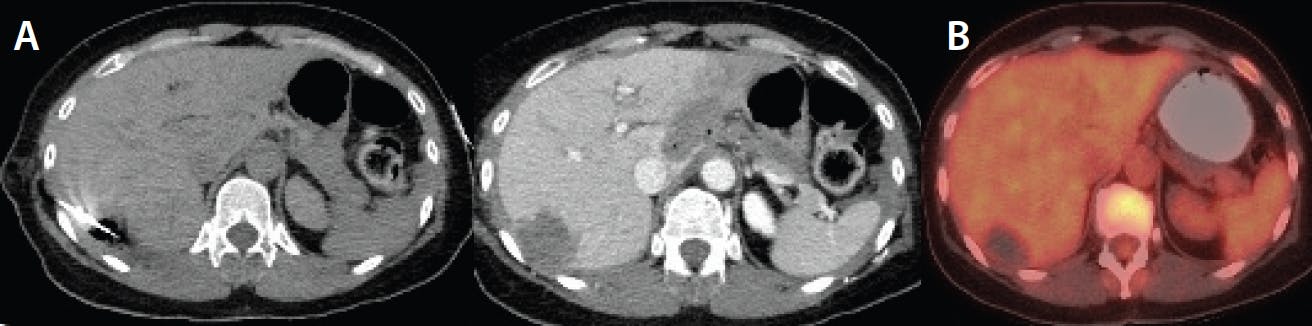
Figure 2. MWA of metastatic colorectal cancer involving the right lobe of the liver and postablation contrast-enhanced CT (A). Postablation follow-up positron emission tomography scan demonstrated no fluorodeoxyglucose uptake in the ablation zone (B).
MWA has equal efficacy to surgical tumor resection in primary and metastatic tumors of the liver, lung, and kidney.5 More recently, the efficacy of MWA in breast and bone malignancies is being evaluated. MWA achieved satisfactory effect in treating breast tumors and higher cosmetic satisfaction in comparison to standard methods, such as nipple-sparing mastectomy.6
Regarding bone malignancies, MWA has more recently been used for primary bone sarcomas and metastatic tumors in the pelvic girdle where surgical resection is difficult or impossible due to the depth of the region, the complicated anatomy, and increased risk rate of complications (ie, recurrence and infection).2 Ongoing investigations are being done to assess MWA and its efficacy in treating metastatic and primary adrenal tumors.7
CRYOABLATION
Cryoablation is another thermal ablation technique that has been in use since the mid-19th century to treat various tumors of the breast, cervix, and skin via induction of cold temperatures.8 The modern era of IO uses cryoprobes to achieve optimally low temperatures for tumor death through the Joule-Thompson effect. This effect is a property of adiabatic (ie, no heat transfer into or out of a system) real gases that move from a high- to a low-pressure system, causing gas expansion and consequent decrease in gas temperature.9 The cryoprobe functions as a high-pressure, closed-loop system primarily covered with a thermal insulation shell that establishes adiabatic conditions.9
The distal tip of the cryoprobe is free of thermal insulation, allowing for the transfer of cool or hot temperatures to its metallic walls.10 By placing one or multiple probes in a particular malignant tumor using image guidance, an ice ball forms around the distal end of the cryoprobe, which kills the tumor via a freezing-thawing mechanism. Argon gas is used in the freezing phase because it is a high-pressure gas in room air, while high-pressure helium gas is used in the thawing phase due to its unique property of temperature increase with gas expansion. Rapid cooling causes intracellular ice crystal formation, and thawing causes melting of extracellular ice crystals, creating a hypotonic environment and cellular swelling. The damaged mitochondria induce apoptosis (seen in the periphery of the ablation zone), while cold-induced tissue ischemia results in coagulative necrosis within the ablation zone after several weeks.10
Cryoablation boasts certain advantages over other thermal ablation modalities. One of the main differences is that the ablation zone can be visualized in real-time using ultrasound, CT, and/or MRI.10 In addition, cryoablation is less painful due to the anesthetic effect of cooling tissues and can be performed outpatient under moderate sedation. Because no electricity is used, there is no interference with imaging machines. Also, there is a strong immune response seen that consists of antibody production against tumor-specific antigens that reside in tissues postablation. However, disadvantages include systemic inflammatory response syndrome (cryoshock), bleeding complications due to lack of cautery effects, and the large expense associated with purchase and storage of argon and helium gas.11
With regular improvements made to cryoablation equipment and supplemental immunotherapy, the future horizon of treatment indications looks promising. Beyond the treatment of renal cell carcinoma (RCC; Figure 3) and hepatocellular carcinoma (HCC), cryoablation has also been effective in treating fibroadenomas for more than a decade, as well as unifocal ductal cancer, with a 92% success rate.12 Stage I prostate cancer has been effectively treated, especially with recurrence after radiation therapy. Stage IA non–small-cell lung cancer may also be treated and has been associated with lower pain levels. There is no indication for primary melanoma treatment, but unresectable melanoma metastasis has been shown to slow tumor growth; most recently, the multicenter MOTION study published findings on the role of cryoablation for palliative pain treatment in patients with painful bone metastases.13 As ablation technology continues to make advancements, cryoablation will continue to broaden its role in IO.
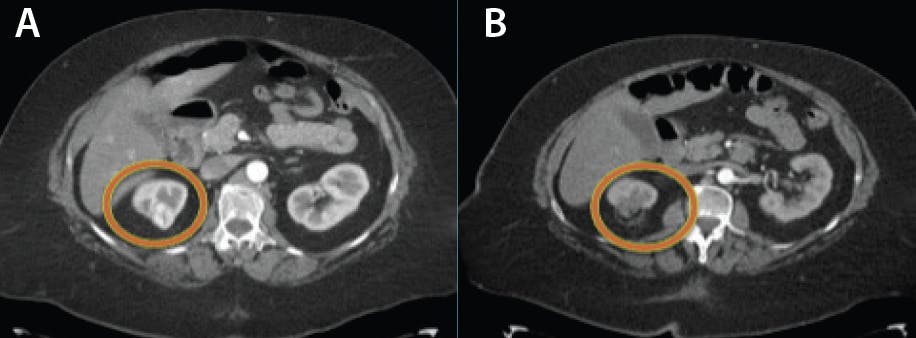
Figure 3. Cryoablation of RCC (A). Follow-up at 9 months demonstrated no enhancement (B).
IRREVERSIBLE ELECTROPORATION
The concept of IRE was initially viewed as a deleterious side effect of electrochemotherapy (cancer drug delivery via electric field–induced cell membrane pores) but was redefined in 2005 when it was first proposed as a technique for ablating soft-tissue tumors.14 The mechanism of action is described by pore formation theory. The lipid bilayer of cell membranes is constantly moving in a fluid-like manner that allows for hydrophobic nanopores to appear spontaneously at random and then close within milliseconds.15 However, in the presence of an external electric field, the nanopores become stabilized and hydrophilic, allowing them to remain open for minutes to hours. IRE induces several electrical pulses of sufficient amplitude that disrupt the homeostatic equilibrium of the cell and, thus, it depletes adenosine triphosphate, which can affect Na+/K+-ATPase channels that lead to eventual cell death.15
IRE is performed with imaging guidance via CT or ultrasound and uses a generator, monopolar probes, and the AccuSync device (AccuSync Medical Research Corporation; Figure 4).16 Use of general anesthesia is mandatory with complete muscle relaxation. The soft-tissue tumor being treated is visualized using imaging to determine the number of probes, trajectory, and size of the ablation zone. A minimum of two probes is necessary, but up to six may be used depending on the size of the lesion being treated. The probes are placed in a parallel fashion under image guidance, and the distal tip of each probe can be exposed from 1 to 3 cm to reveal the active tip. The generator then emits several pulses of low-voltage, high-energy, direct current that is conducted between each probe pair; the lethal threshold is typically from 300 to 1,000 V/cm given 100 pulses.15 The spacing between the probes should be between 1.5 and 2 cm for optimal ablation volume. The AccuSync device tracks the R wave in the patient’s cardiac cycle to induce a 0.05-second delay that ultimately times each generator pulse with the patient’s refractory period to prevent ventricular arrhythmias.16
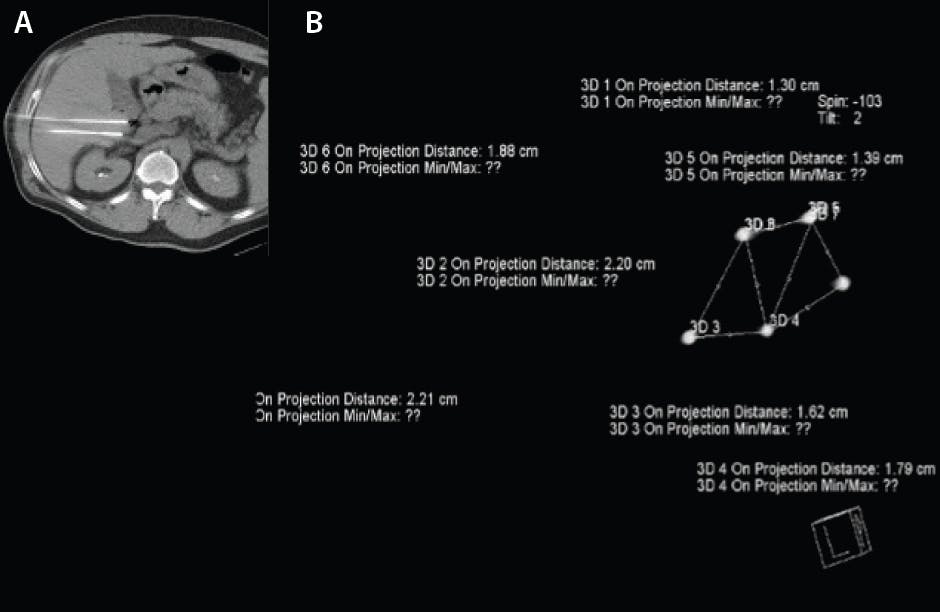
Figure 4. IRE of HCC adjacent to the gall bladder (A) with three-dimensional construction following probe placement (B).
The nonthermal technique has advantages over RFA and MWA in treating tumors found near large vessels and ducts. This has made treatment of prostate cancer particularly effective given the presence of neurovascular bundle, lower urinary sphincter, and urethra.17 Similarly, treatment of unresectable locally advanced pancreatic cancer (LAPC) has seen an increase in survival of up to 27 months due to the proximity of the celiac trunk, hepatic artery, and superior mesenteric vessels that make LAPC practically inaccessible from a surgical standpoint.18 Moving forward, high-frequency IRE has shown potential with uniform ablation of heterogeneous tissue without electrocardiography synchronization.15
FUTURE DIRECTIONS
As ablation tools have become an invaluable tool in the world of oncology, technical advances continue at a rapid pace. The use of ablation in the thyroid, pancreas, and prostate has expanded the role of ablation, and randomized controlled trials and registries are helping secure a role for ablation in guidelines and treatment algorithms. Navigation systems and ablation confirmation software are some of the recent advances in the use of the existing technologies. On the horizon are the next generation of fusion imaging to help with accuracy and histotripsy, which is a new noninvasive ablative technology that uses high-intensity focused ultrasound (HIFU) for tissue ablation. The continuous application of HIFU creates a bubble cloud, leading to cavitation and tissue destruction. Histotripsy is currently being studied in the United States in the HOPE4LIVER multicenter prospective trial.
1. McDermott S, Gervais DA. Radiofrequency ablation of liver tumors. Semin Intervent Radiol. 2013;30:49-55. doi: 10.1055/s-0033-1333653
2. Fan QY, Zhou Y, Zhang M, et al. Microwave ablation of primary malignant pelvic bone tumors. Front Surg. 2019;6:5. doi: 10.3389/fsurg.2019.00005
3. Tufano RP, Pace-Asciak P, Russell JO, et al. Update of radiofrequency ablation for treating benign and malignant thyroid nodules. The future is now. Front Endocrinol (Lausanne). 2021;12:698689. doi: 10.3389/fendo.2021.698689
4. Vogl TJ, Nour-Eldin A, Hammerstingl RM, et al. Microwave ablation (MWA): basics, technique and results in primary and metastatic liver neoplasms – review article. Rofo. 2017;189:1055-1066. doi: 10.1055/s-0043-117410
5. Hernández JI, Cepeda MFJ, Valdés F, et al. Microwave ablation: state-of-the-art review. Onco Targets Ther. 2015;8:1627-1632. doi: 10.2147/OTT.S81734
6. Yu J, Han Z-Y, Li T, et al. Microwave ablation versus nipple sparing mastectomy for breast cancer ≤ 5 cm: a pilot cohort study. Front Oncol. 2020;10:546883. doi: 10.3389/fonc.2020.546883
7. Donlon P, Dennedy MC. Thermal ablation in adrenal disorders: a discussion of the technology, the clinical evidence and the future. Curr Opin Endocrinol Diabetes Obes. 2021;28:291-302. doi: 10.1097/MED.0000000000000627
8. Mahnken AH, König AM, Figiel JH. Current technique and application of percutaneous cryotherapy. Rofo. 2018;190:836-846. doi: 10.1055/a-0598-5134
9. Song, K. D. Percutaneous cryoablation for hepatocellular carcinoma. Clin Mol Hepatol. 2016;22:509-515. doi: 10.3350/cmh.2016.0079
10. Erinjeri JP, Clark TW. Cryoablation: mechanism of action and devices. J Vasc Interv Radiol. 2010;21(8 Suppl):S187-191. doi: 10.1016/j.jvir.2009.12.403
11. Chapman WC, Debelak JP, Blackwell TS, et al. Hepatic cryoablation-induced acute lung injury: pulmonary hemodynamic and permeability effects in a sheep model. Arch Surg. 2000;135:667-673. doi: 10.1001/archsurg.135.6.667
12. Aarts BM, Klompenhouwer EG, Rice SL, et al. Cryoablation and immunotherapy: an overview of evidence on its synergy. Insights Imaging. 2019;10:53. doi: 10.1186/s13244-019-0727-5
13. Jennings JW, Prologo JD, Garnon J, et al. Cryoablation for palliation of painful bone metastases: the MOTION multicenter study. Radiol Imaging Cancer. 2021;3:e200101. doi: 10.1148/rycan.2021200101
14. Davalos RV, Mir ILM, Rubinsky B. Tissue ablation with irreversible electroporation. Ann Biomed Eng. 2005;33:223-231. doi: 10.1007/s10439-005-8981-8
15. Aycock KN, Davalos RV. Irreversible electroporation: background, theory, and review of recent developments in clinical oncology. Bioelectricity. 2019;1:214-234. doi: 10.1089/bioe.2019.0029
16. Narayanan G. Irreversible electroporation. Semin Intervent Radiol. 2015;32:349-355. doi: 10.1055/s-0035-1564706
17. Ong S, Leonardo M, Chengodu T, et al. Irreversible electroporation for prostate cancer. Life (Basel). 2021;11:490. doi: 10.3390/life11060490
18. Kwon W, Thomas A, Kluger MD. Irreversible electroporation of locally advanced pancreatic cancer. Semin Oncol. Published online February 18, 2021. doi: 10.1053/j.seminoncol.2021.02.004
Advertisement
Advertisement