Advertisement
Advertisement
October 2021
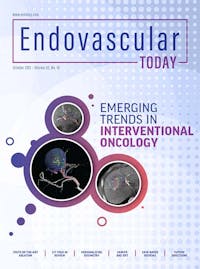
Emerging Trends in Interventional Oncology
By Ripal T. Gandhi, MD, FSIR, FSVM, and David M. Liu, MD, FRCPC, FSIR

Interventional oncology (IO) continues to evolve and innovate at a relentless pace. With more therapeutic technologies and more evidence to support these therapies, we have truly become the “fourth pillar” of cancer care. Alongside our partners in medical oncology, surgical oncology, and radiation oncology, we are conversant in how to cure, optimize, and palliate diseases of the liver, kidney, lung, pancreas, and bone. However, with all these advancements, we must be reminded that multidisciplinary care is the key to managing a patient’s cancer journey and that clinical management is a collaborative and patient-focused team sport. This issue of Endovascular Today is composed of articles that attest to the contributions that the contemporary interventional oncologist will make within this context.
We begin our coverage with Govindarajan Narayanan, MD; Raihan Noman, MD; Uchechukwu Uzomah, MD; and Ripal T. Gandhi, MD, offering a look at the various ablation modalities in use for IO. They provide a summary of associated techniques, advantages, and future applications of radiofrequency ablation, microwave ablation, cryoablation, and irreversible electroporation.
Next, Alexander Villalobos, MD; Dr. Gandhi; and Nima Kokabi, MD, share their current understanding of yttrium-90 radioembolization based on their experiences using it in treatment. It is a practical review of patient selection considerations, as well as a collection of technical and intraprocedural tips presented over a series of real-world cases.
Drs. Eric Wehrenberg-Klee, Sara Smolinski-Zhao, and Gloria Salazar, then offer an interventional radiology roadmap to managing acute venous thromboembolism in cancer patients, a condition oftentimes overlooked and underdiagnosed.
Also, we bring back a popular article format that looks back at the most significant IO articles published in the past year. Rahul A. Sheth, MD, and Suvranu “Shoey” Ganguli, MD, take up the review this year, offering a summary of key findings and the importance each article may have for IO.
Ravjot Dhatt, MD; Anastasia Hadjivassiliou, MBBS; Stephen G. F. Ho, MD; Darren Klass, MBChB; and David M. Liu, MD, then discuss the role, indication, technical considerations, and potential risks of common regional nerve block techniques used at their institution during percutaneous ablation.
Siddharth A. Padia, MD, oversees presentations of case-based approaches to complications of IO procedures. Cases are presented by Drs. Cynthia De la Garza-Ramos, Beau B. Toskich, and Andrew R. Lewis from the Mayo Clinic; Drs. Shimwoo Lee, Alireza Sedarat, and Justin P. McWilliams from UCLA Medical Center; Drs. David Zucker and Scott Genshaft from UCLA Medical Center; Drs. Nora Tabori and Eric You from MedStar Georgetown University Hospital; and Drs. Arthie Jeyakumar and Guy E. Johnson from the University of Washington.
Finally, we close our feature on IO with Dr. Jean-Francois H. Geschwind, MD, providing insight into what the future may hold for IO within the larger world of oncology care.
Elsewhere, we speak with Vincent L. Rowe, MD, about the importance of ensuring diversity, equity, and inclusion within the Society for Vascular Surgery and among physicians generally, the highlights of a multidisciplinary approach to limb salvage, and more.
On behalf of the editorial team, authors, and contributors, we hope that this issue will serve as a reference and a resource for the readership and your patients.
Ripal T. Gandhi, MD, FSIR, FSVM
David M. Liu, MD, FRCPC, FSIR
Guest Chief Medical Editors
Advertisement
Advertisement