Advertisement
Advertisement
October 2021
Sponsored by Inari Medical
The Pursuit of Bloodless Thrombectomy
How Inari Medical’s purpose-built venous portfolio allows for complete thrombus extraction unimpeded by blood loss concerns.
With Duke Duncan, MD; Orestis Pappas, MD; Bennet George, MD; and Clarence Gill, MD
In the world of venous thromboembolism (VTE), extracting thrombus matters. When left behind by conservative or inefficient treatment modalities, residual thrombus can result in long-term complications and a diminished quality of life for patients after an acute pulmonary embolism (PE) or deep vein thrombosis (DVT) event.1-3 Although there are many modalities that attempt to remove thrombus burden, mechanical and aspiration thrombectomy are some of the newest and most promising modalities because they avoid the use of thrombolytics and its associated bleeding risks. However, for all the good that these new devices offer, there is one issue plaguing the modality: blood loss.
The benefits of removing thrombus are clear, but there exists a trade-off between capturing all the thrombus and aspirating too much blood. The need to minimize blood loss during mechanical thrombectomy procedures forces physicians to end cases before all thrombus has been removed. Physicians may need to stop before their desired result is achieved to avoid complications from major bleeding events that could lead to transfusion or prompt additional interventions.4
At the heart of this issue is the mechanism of action in aspiration thrombectomy, which has the potential to suction and remove large volumes of blood quickly. Many devices were designed for arterial thrombectomy and repurposed for venous thrombectomy, and their constant aspiration design can lead to a high volume of blood loss when used to aspirate large amounts of thrombus. In contrast, the Inari mechanical thrombectomy devices were purpose-built for venous anatomy and have the ability to accommodate large volumes of thrombus through large-lumen catheters without using constant aspiration, therefore minimizing blood loss.
FLOWTRIEVER SYSTEM
The FlowTriever System (Inari Medical; Figure 1) is intended for use in the peripheral vasculature for the treatment of PE. Two main components make up the system: the FlowTriever catheter and the Triever aspiration catheter, which is a highly trackable catheter that can navigate tortuous venous anatomy. The FlowTriever System uses a large-bore syringe and stopcock to limit blood loss to 60 mL per aspiration. When used together with the FlowSaver Blood Return System (Inari Medical), both devices have the potential to reduce blood loss substantially.
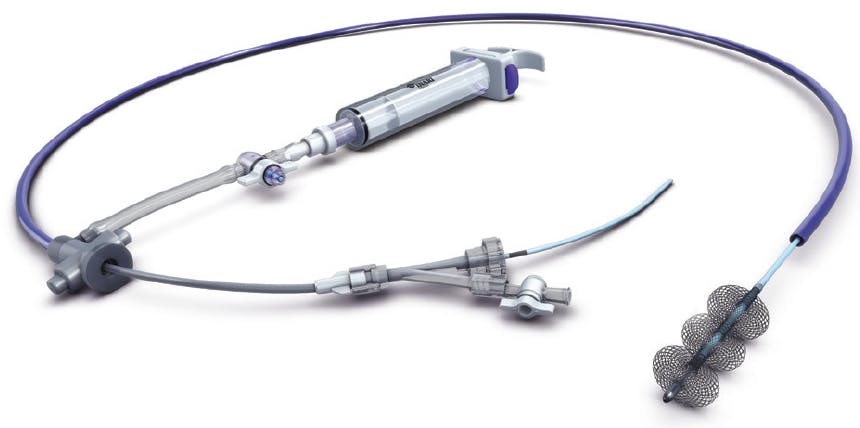
Figure 1. FlowTriever System.
FLOWSAVER BLOOD RETURN SYSTEM
The FlowSaver Blood Return System (Figure 2) is indicated for use with Triever catheters for autologous blood transfusion. A 60-mL large-bore syringe used during aspiration thrombectomy connects to the side port of the FlowSaver, and the contents of the syringe are passed through a 40-µm filter, capturing thrombi and removing them from the filtered blood with negligible hemolysis. The filtered blood is reintroduced to the patient’s vascular system through a sheath or catheter. Physicians can evacuate the contents of the filter, examine the aspirated thrombus, and reuse the cleared filter for subsequent filtrations.
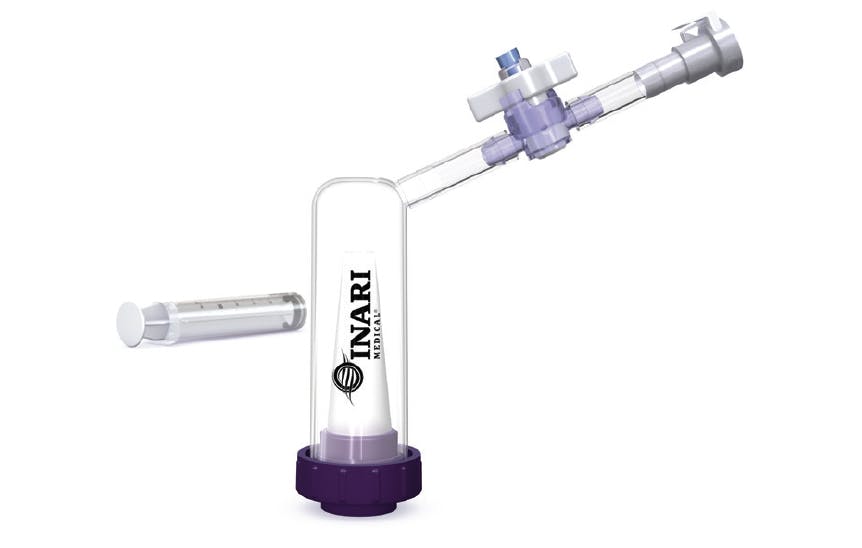
Figure 2. FlowSaver Blood Return System.
FlowSaver allows physicians to focus on thrombus extraction and patient outcomes. With the ability to reinfuse blood, physicians can perform more aspirations, resulting in a larger volume of removed thrombus.
FlowSaver is also especially beneficial in anemic patients or those with other issues where blood loss can be a concern, as well as patients who cannot receive blood transfusions for religious reasons, such as Jehovah’s Witnesses. FlowSaver reduces or eliminates the need for blood transfusions and minimizes the strain on health care resources when complications arise from blood loss.
CLOTTRIEVER SYSTEM
Although the FlowTriever System in conjunction with FlowSaver allows for near-bloodless aspiration thrombectomy, the mechanical mechanism of action of the ClotTriever System (Inari Medical; Figure 3) allows for an essentially bloodless procedure on its own. It is designed for use in the peripheral vasculature for the treatment of DVT in a single session, without the need for thrombolytics or monitoring in an intensive care unit (ICU). It has two main components: the ClotTriever catheter, with an atraumatic nitinol coring element and a mesh collection bag, and the ClotTriever sheath, with an integrated funnel to facilitate thrombus removal. When the ClotTriever catheter is introduced through the ClotTriever sheath and advanced over a guidewire beyond the thrombus, the nitinol coring element and mesh collection bag are expanded into the vessel. As the ClotTriever is retracted, the coring element dislodges thrombus from the vessel wall, capturing it in the collection bag and removing it from the patient.
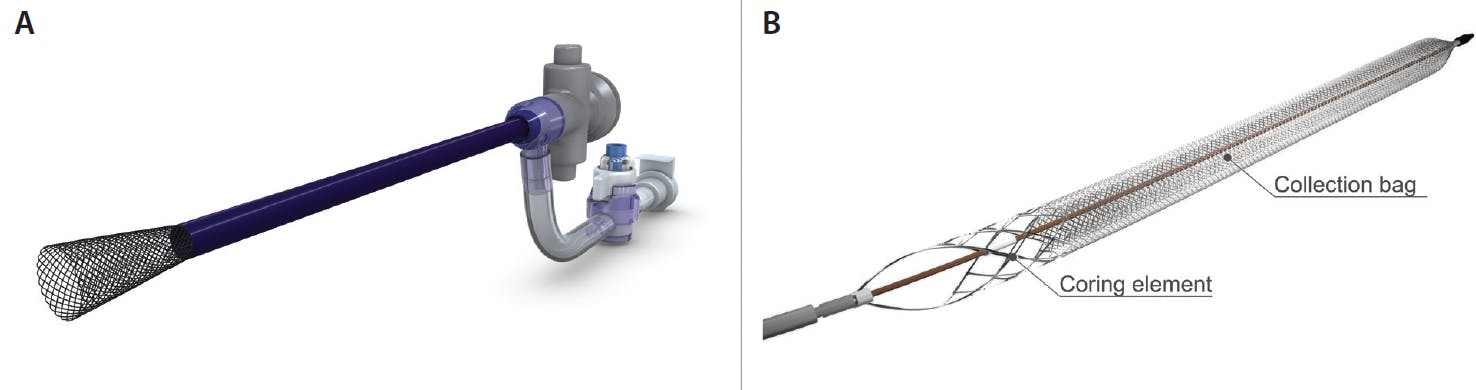
Figure 3. ClotTriever sheath (A) and catheter (B).
The ClotTriever System does not use aspiration, and its mechanism of action innately limits blood loss. A recent interim analysis of the first 250 patients enrolled in the CLOUT registry showed that the median estimated blood loss during a ClotTriever procedure was only 50 mL.5 This low blood loss was accompanied by complete or near-complete thrombus removal in 85.3% of patients, as adjudicated by an independent core laboratory. When patients were left without residual thrombus, 92.2% of patients were free from moderate or severe postthrombotic syndrome, and patients had a median 100% reduction in pain at 6 months.
Extracting thrombus matters. This article highlights three diverse cases in which physicians were able to extract thrombus, unimpeded by concern for excessive blood loss.
1. Comerota AJ, Grewal N, Martinez JT, et al. Postthrombotic morbidity correlates with residual thrombus following catheter-directed thrombolysis for iliofemoral deep vein thrombosis. J Vasc Surg. 2012;55:768-773. doi: 10.1016/j.jvs.2011.10.032
2. Dronkers CEA, Mol GC, Maraziti G, et al. Predicting post-thrombotic syndrome with ultrasonographic follow-up after deep vein thrombosis: a systematic review and meta-analysis. Thromb Haemost. 2018;118:1428-1438. doi: 10.1055/s-0038-1666859
3. Sista AK, Miller LE, Kahn SR, Kline JA. Persistent right ventricular dysfunction, functional capacity limitation, exercise intolerance, and quality of life impairment following pulmonary embolism: systematic review with meta-analysis. Vasc Med. 2017;22:37-43. doi: 10.1177/1358863X16670250
4. Abou Ali AN, Cherfan P, Zaghloul MS, et al. Catheter-directed interventions for pulmonary embolism: institutional trends over a decade, 2010 to 2019. J Vasc Surg Venous Lymphat Disord. Published August 2, 2021. doi: 10.1016/j.jvsv.2021.06.024
5. Beasley R. An update on the CLOUT registry. Presented at: New Cardiovascular Horizons. June 4, 2021; New Orleans, Louisiana.
Blood Loss is No Longer a Barrier: Aggressive Thrombus Removal in a High-Risk Submassive PE Patient

PATIENT PRESENTATION
A man in his mid-50s with hypertension, type 2 diabetes, and super morbid obesity (body mass index > 50 kg/m2) presented to the hospital after 3 days of severe shortness of breath and a syncopal episode. He was tachycardic and hypoxic with elevated B-type natriuretic peptide (550 pg/mL), D-dimer (8 ug/mL), and troponin (35 ng/mL) levels.
The interventional radiology (IR) department manages both acute and chronic pulmonary artery interventions and received a call for a high-risk submassive PE with extensive thrombus burden and evidence of right heart strain on CT scan (Figure 1A-1D). The patient was evaluated urgently and found to be at high risk for hemodynamic collapse. He was also at risk of severe chronic thromboembolic pulmonary hypertension (CTEPH). He was brought to the IR suite for immediate intervention with the FlowTriever System to remove thrombus and the FlowSaver Blood Return System to immediately reinfuse blood aspirated during thrombus removal.
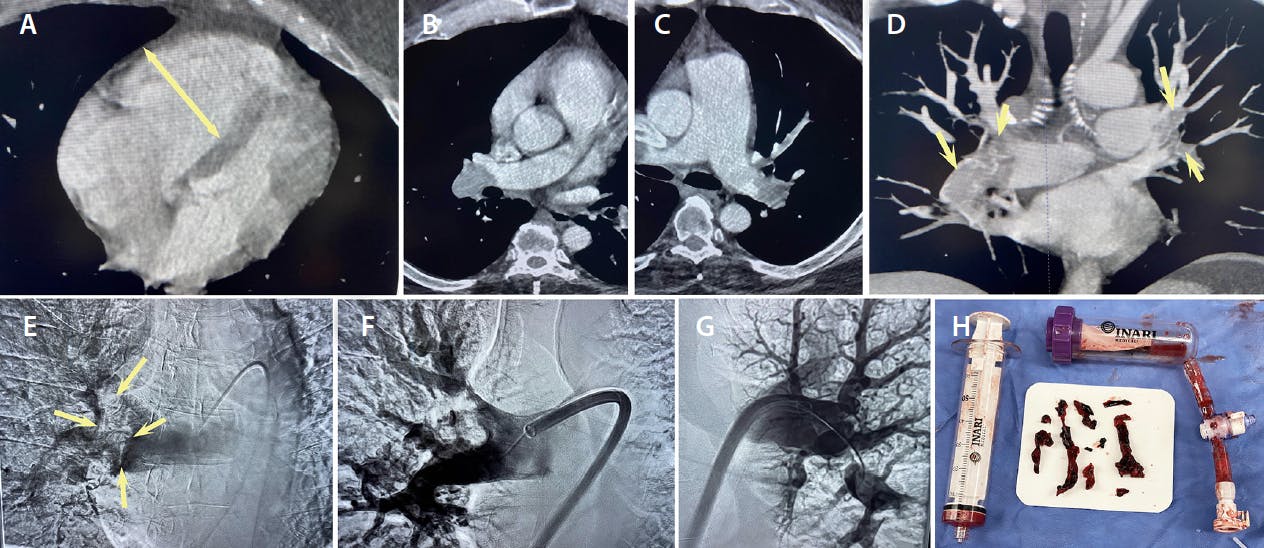
Figure 1. A CT scan showed evidence of right ventricular (RV) enlargement and right heart strain (A). CT pulmonary arteriography in axial view demonstrated thrombus in the right (B) and left (C) pulmonary arteries. The coronal view showed thrombus in the left and right pulmonary arteries (D). Limited pulmonary arteriography demonstrated thrombus in the right lower lobe (E). A 24-F Triever24 aspiration catheter was advanced to the right interlobar pulmonary artery, where the first aspiration was performed (F). Following several aspirations on the right, the Triever24 was advanced into the truncus anterior and left pulmonary artery branches for additional aspirations (G). Extracted thrombus is shown alongside the FlowSaver Blood Return System and a 60-mL large-bore syringe (H).
PROCEDURAL OVERVIEW
The patient arrived in the IR suite on a heparin drip. He was placed on the angiography table at approximately 30° reverse Trendelenburg because he was unable to tolerate flat positioning and received light, moderate sedation. Micropuncture access was gained, and a lower extremity venogram was obtained to ascertain safe access and vascular anomalies. A stiff wire was placed, and a 24-F sheath was advanced to the intrahepatic inferior vena cava. The right heart was traversed with a pigtail catheter to prevent chordae entrapment, and pulmonary artery pressures were found to be elevated at 71/18/40 mm Hg. Limited pulmonary arteriography was performed with hand injections to reduce hemodynamic alterations, and the right lower lobe pulmonary artery was selected (Figure 1E). The stiff wire was exchanged for a short-tipped, stiff guidewire, and the 24-F Triever24 aspiration catheter (Inari Medical) was then advanced to the right interlobar pulmonary artery, where the first aspiration was performed over the wire (Figure 1F).
After aspiration, the contents of the 60-mL large-bore syringe were emptied into the FlowSaver Blood Return System, and the collected filtered blood was immediately returned through the side arm of the access sheath and flushed with a 20-mL syringe. Aspirations and reinfusion continued in this region until a satisfactory volume of thrombus had been removed. Repeated hand-injection pulmonary arteriography confirmed clearance in each vessel region.
As estimated blood loss was negligible, the team was able to be more aggressive at thrombus removal than usual. The Triever24 catheter was moved into the truncus anterior and left pulmonary artery branches (Figure 1G), with each aspiration filtered through the FlowSaver System and liquid blood products returned as described. Following 16 aspirations and subsequent reinfusion of blood with FlowSaver, the patient described on-table resolution of shortness of breath, and his tachycardia and hypoxia had resolved. Repeat pulmonary artery pressures showed drastic reductions to 45/17/21 mm Hg; the devices were then removed and hemostasis was achieved.
An estimated 90% of thrombus was removed (Figure 1H), with a total procedural blood loss of 30 mL (960 mL aspirated; 930 mL reinfused). The patient was transferred to a regular hospital bed as there was no need for a stay in the ICU. The heparin drip was continued overnight. After hematology evaluation in the morning, he was transitioned to a direct oral anticoagulant. The patient was discharged to home 48 hours after he arrived in the emergency department. There was no need for rehabilitation or home health services.
DISCUSSION
A patient in his mid-50s with high-risk submassive PE, evidence of right heart strain, and extensive thrombus burden was at grave risk of hemodynamic collapse. He underwent mechanical thrombectomy with the FlowTriever System to extract the thrombus, in conjunction with the FlowSaver Blood Return System to reinfuse blood after each aspiration. When used with the FlowTriever System, FlowSaver is the first device that truly allows the full extent of thrombectomy to proceed until real-time clinical endpoints are met; blood loss is no longer the limiting factor.
This patient had a large volume of thrombus, and the quick and efficient reinfusion of blood made it possible to continue performing aspirations until all thrombi had been removed. In the end, a high number of aspirations were required; however, the estimated blood loss was negligible at 30 mL. When proficient with FlowTriever and FlowSaver, physicians can continue treating PE patients until on-table improvements in objective clinical parameters are achieved. In addition, removal of all thrombus burden prevents long-term sequelae associated with leaving residual thrombus behind, such as CTEPH and post-PE syndrome.
Anemic PE Patient Relieved of Extensive Thrombus Burden With Negligible Blood Loss

PATIENT PRESENTATION
A man in his late 70s with a history of head and neck cancer presented to the emergency department following a syncopal episode that resulted in a sizable laceration to the head. He was found to have acute bilateral PE with right heart strain and acute cor pulmonale, acute DVT, and a hemoglobin level of 10.3 g/dL. Additional labs showed a white blood cell count (WBC) of 8,200/µL, hematocrit of 30.4%, platelet count of 302,000/µL, and troponin level of 0.053 ng/mL. He was saturating at 92% on 8 L of O2 by face mask. Given that the patient was anemic with a head trauma and laceration, bleeding risks were considerable, and therefore he was not a candidate for thrombolysis. The interventionalist resolved to pursue mechanical thrombectomy of the intermediate-high-risk PE with the FlowTriever System in conjunction with a first-time use of the FlowSaver Blood Return System to filter and immediately reinfuse the patient’s own blood during the procedure.
PROCEDURAL OVERVIEW
The patient was brought to the cardiac catheterization lab and placed prone under moderate conscious sedation. Access to the right common femoral vein was gained under ultrasound guidance, and an 8-F sheath was placed. A pigtail catheter was advanced to the right heart, where preprocedure pulmonary artery pressures were determined to be 47/15/28 mm Hg with a cardiac index of 2.8 L/min/m2.
Selective bilateral pulmonary angiography confirmed a large amount of thrombus in the right (Figure 1A) and left main pulmonary arteries. The interventionalist decided to address the right main pulmonary artery first.
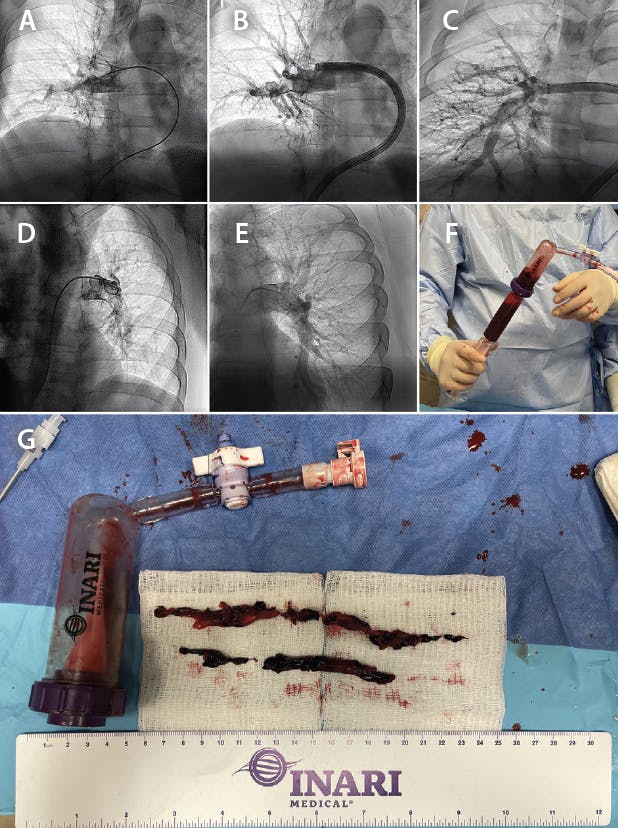
Figure 1. Selective bilateral pulmonary angiography confirmed extensive thrombus in the right pulmonary artery (A). The Triever24 was advanced into the right pulmonary artery, and a first aspiration was completed (B). Repeat angiography confirmed patency of the right PA after three aspirations (C). Angiography demonstrated thrombus in the left pulmonary artery (D). After four aspirations, repeat angiography demonstrated patency of the left pulmonary artery (E). The FlowSaver Blood Return System was used to filter the aspirated thrombus from the blood (F). Extracted thrombus (G).
A J-wire was advanced to gain purchase, distal to the thrombus. A multipurpose catheter was then exchanged over the J-wire, and a long, stiff Amplatz wire with a 1-cm soft tip was placed over the multipurpose catheter. A 24-F DrySeal sheath (Gore & Associates) was upsized in the groin and advanced over the Amplatz wire.
A 24-F Triever24 aspiration catheter was then advanced through the DrySeal sheath into the right pulmonary artery, and a first aspiration was completed (Figure 1B), filling the 60-mL large-bore syringe. The FlowSaver Blood Return System was used to filter the aspirated thrombus from the blood (Figure 1F), and the filtered blood was immediately reinfused into the patient using a standard luer lock port. Two additional aspirations with the Triever24 removed the entirety of the thrombus, made up of acute and subacute thrombus, with all filtered blood returned to the patient following each aspiration. After completion of these three aspirations, repeat angiography confirmed patency of the right pulmonary artery (Figure 1C).
Due to minimal blood loss thus far, a decision was made to continue into the left pulmonary artery. Angiography confirmed the location of the thrombus (Figure 1D). After four aspirations with the Triever24 and subsequent reinfusions with FlowSaver, repeat angiography confirmed patency of the left pulmonary artery (Figure 1E). One hundred percent of thrombus had been extracted (Figure 1G). Normal flow was restored, and pulmonary artery pressures improved to 35/14/23 mm Hg.
A decision was made to treat the patient’s large right femoral DVT on a subsequent basis.
The case was completed in 55 minutes, with a total device time of 15 minutes. The patient’s oxygen saturation increased to 98% on 2 L of O2 by nasal cannula. Blood aspirated was estimated to be 420 mL, of which 390 mL were returned to the patient, resulting in a total estimated blood loss of 30 mL.
The patient tolerated the procedure very well. No complications were observed, and no blood transfusion was required. He returned to the ICU for an overnight stay on a heparin drip before being transferred to the floor for the remainder of the weekend. The day after the procedure, his labs showed improvement: WBC, 7,400/µL; hemoglobin, 11.1 g/dL; hematocrit, 32.7%; and platelets, 364,000/µL.
The next Monday, the patient returned to the catheterization lab for mechanical thrombectomy of the right femoral DVT with the ClotTriever System. Three passes with ClotTriever extracted 90% of the thrombus in a procedure that lasted 35 minutes, with a total device time of 5 minutes. The patient was discharged home on novel oral anticoagulants the next day. He returned for follow-up in 30 days with complete resolution of his symptoms of dyspnea, lightheadedness, and lower extremity edema.
DISCUSSION
A cancer patient in his mid-70s with bilateral PE, massive head laceration, and low hemoglobin had a successful mechanical thrombectomy procedure with negligible blood loss due to use of the FlowSaver Blood Return System. For patients with malignancies, an interoperative blood transfusion may have a negative impact on outcomes by stimulating tumor growth, tethering and/or disseminating cancer cells, or compromising a patient’s immune defenses. Without the ability to immediately reinfuse this anemic cancer patient’s own blood, he may have required a transfusion, adding risk to the patient and burden to hospital resources.
Immediate reinfusion also gave the interventionalist latitude to pursue and extract all known thrombus. Encouraged by quick and efficient reinfusion with FlowSaver, a decision was made to advance into the left pulmonary artery once the right had been cleared. As a result, thrombus was extracted that might have otherwise been left behind out of concern for excessive blood loss.
ClotTriever Restores Bilateral Venous Patency With Negligible Blood Loss After Other Therapies Fail
PATIENT PRESENTATION
A man in his mid-30s with a history of DVT presented to the hospital with 3 days of right lower extremity swelling, mild dyspnea, and tachycardia. He had been discharged recently from Memorial Hermann Southwest, where he was treated for a new diagnosis of type 2 diabetes. Venous duplex ultrasound confirmed the presence of extensive DVT in the right common femoral vein and below. CT was nondiagnostic for PE due to poor timing of the contrast bolus; however, RV strain suggested bilateral PE. Although the patient’s PE Severity Index score was considered low risk at 64 points, the medical team decided to proceed with catheter-directed thrombolysis (CDT) given his tachycardia and RV strain.
The patient was transferred to the cardiac catheterization lab where EKOS catheters (Boston Scientific Corporation) were placed in the right femoral vein and the left and right pulmonary arteries, and thrombolysis was initiated. The catheters and access sheaths were sewn in place, and the patient was transferred out of the catheterization lab to the ICU, where alteplase infusion continued for 6 hours. The patient returned to the cardiac catheterization lab the next day; all catheters were removed, and the right leg was reassessed. Peripheral venography of the right femoral vein revealed significant residual thrombus, so the team decided to perform mechanical thrombectomy with a Penumbra Indigo Lightning 12 aspiration catheter (Penumbra, Inc.).
Multiple passes with the Lightning 12 were performed, but repeat angiography still showed significant residual thrombus. Given the patient’s anemia and 150-mL blood loss during the procedure thus far, the decision was made to forego additional passes.
The patient was eventually discharged on apixaban; however, less than 1 week later, he returned to the emergency department with worsening swelling, now in his left lower extremity. He was found to have extensive DVT within the left common femoral vein extending down below the knee vessels.
Given that the previous treatments had minimal result, the team decided to perform mechanical thrombectomy on the left lower extremity with the ClotTriever System the next day. The patient was transitioned from enoxaparin to a heparin drip in preparation.
PROCEDURAL OVERVIEW
The patient was transferred to the cardiac catheterization lab and placed under moderate sedation with 5 mg midazolam and 150 mcg fentanyl. Under direct ultrasound guidance and using a micropuncture technique, the left popliteal vein was accessed, and an 8-F sheath was placed. Venography confirmed extensive thrombus in the common femoral vein. After serial dilation, a 13-F ClotTriever sheath was positioned in the femoral vein. The ClotTriever catheter was then introduced through the sheath, advanced over an Amplatz Super Stiff guidewire (Boston Scientific Corporation) beyond the location of the thrombus, and expanded into the vessel. As the catheter was retracted, thrombus was captured in the ClotTriever collection bag and removed from the patient. After a total of five passes, repeat venography demonstrated patent flow throughout the common femoral vein with no significant stenosis. All devices were removed, and a purse-string suture was placed over the access site to provide hemostasis. The patient tolerated the procedure well and was transferred out of the cardiac catheterization laboratory without any immediate complication.
On the next day, the right femoral DVT was assessed. The patient was once again placed under moderate sedation, and a 6-F sheath was placed in the right popliteal vein under direct ultrasound guidance. Venography confirmed extensive thrombus in the right common femoral vein (Figure 1A), and after serial dilation, a 13-F ClotTriever sheath was positioned and the ClotTriever catheter introduced. After five passes, repeat venography demonstrated patent flow throughout the common femoral vein (Figure 1B). Extensive thrombus was extracted (Figure 1C). All devices were removed, and a purse-string suture was used to achieve hemostasis.
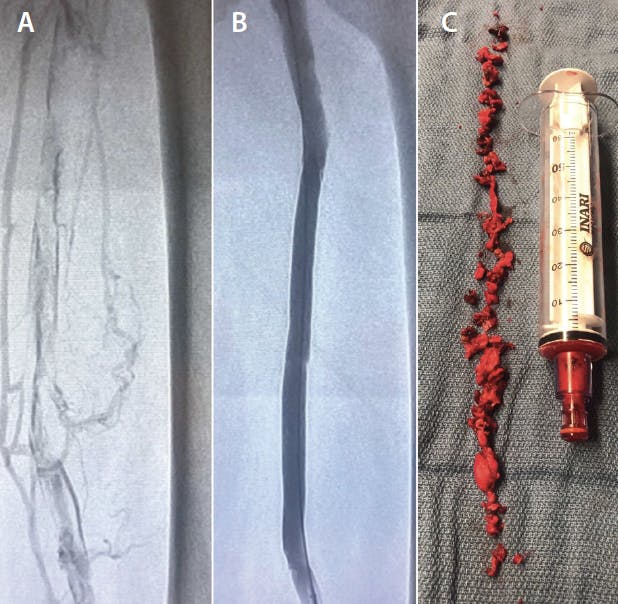
Figure 1. Venography confirmed that extensive thrombus remained in the right common femoral vein following treatments with EKOS and the Indigo Lightning 12 aspiration catheter (A). Repeat venography demonstrated patent flow throughout the common femoral vein after treatment with the ClotTriever System (B). Thrombus extracted from the right lower common femoral vein (C).
In both procedures, > 90% of thrombus was removed with negligible blood loss and the patient experienced complete resolution of his DVT symptoms. After routine postcardiac catheterization care, the patient was discharged the next day on anticoagulation. He was seen in the clinic for a 6-month follow-up and was doing great.
DISCUSSION
A man in his mid-30s with a history of VTE and a new diagnosis of type 2 diabetes presented with a submassive PE and right lower extremity DVT. He was initially treated with CDT (EKOS) therapy, but repeat venography revealed that significant thrombus remained. He was then treated with the Indigo Lightning 12 aspiration catheter with minimal result and blood loss that prevented the interventional team from performing additional passes with the device. The patient was eventually treated successfully with the ClotTriever System, a treatment that made it possible for the interventional team to perform all necessary passes and extract all thrombus from the right and left lower extremities with negligible blood loss and no need for thrombolytics. Even though the patient had undergone multiple recent treatments for the DVT, the mechanical mechanism of action of ClotTriever meant that blood loss was not a concern for bringing the patient back to the catheterization lab for an additional treatment.
Advertisement
Advertisement