Advertisement
Advertisement
September 2021
Sponsored by AngioDynamics, Inc.
Introduction to the PATHFINDER Registry and Complex Endovascular Cases With the Auryon Atherectomy System
By Pedro Martinez-Clark, MD; Srinidhi Shanmugasundaram, BS; Michele Corbet, MS; and John H. Rundback, MD
Peripheral artery disease (PAD) affects an increasingly high number of patients with a spectrum of symptoms. The Auryon laser atherectomy system (AngioDynamics, Inc.) is a solid-state platform with a unique wavelength of 355 nm and short pulse width of 10 to 25 ns that has been demonstrated to provide effective plaque reduction and associated durable clinical results across a wide range of arterial distribution and lesion morphologies, including in-stent restenosis (ISR) and moderate arterial calcification.1,2 However, little is known about the real-world use of the laser system or how safe and effective it is when treating a more complex patient cohort.
CLINICAL EVIDENCE
Rundback et al showed that the Auryon system (previously called the B-Laser) was safe and effective across all lesion types, with no device-related embolizations, perforations, dissections requiring stenting, amputations, or pseudoaneurysms.2 The PATHFINDER registry explores the periprocedural, intermediate, and long-term safety and efficacy of the Auryon system in the treatment of patients with PAD in a real-world setting.3 One hundred four patients with Rutherford class 2 to 5 PAD were prospectively enrolled in this postmarket registry. Permissible lesion location included all infrainguinal arteries; de novo, restenotic, and ISR lesions were allowed. The first patient was enrolled in August 2020, and enrollment was completed in March 2021. The primary efficacy endpoint was defined as ≤ 30% final stenosis after laser atherectomy using the Auryon system and adjunctive therapy (if used), as assessed by a core lab. The primary safety endpoint was freedom from periprocedural major adverse events. Secondary endpoints include freedom from major adverse events, patency, and clinical outcomes (ankle-brachial index [ABI], Walking Impairment Questionnaire, Rutherford class) at 6, 12, and 24 months.
Ultimately, the goal of PATHFINDER is to observe the utilization of the Auryon laser by physicians in outpatient labs, hospitals, and ambulatory surgery centers to better understand the use of the device and explore future research questions. PATHFINDER serves as an exploratory study and structures the future data collection surrounding the Auryon laser. This case report further validates the successful utilization of the Auryon system in a real-world setting.*
CASE 1
The patient is a woman in her late 80s known to the practice for several years. The patient has a history of hypertension but no significant coronary artery disease and has preserved systolic function. Her first arterial ultrasound was obtained in mid 2018, which demonstrated inflow abnormalities of her left limb. Pulse wave velocities were elevated in her left common femoral artery (CFA) and proximal superficial femoral artery (SFA) at 220 and 247 cm/sec, respectively, before dropping to 97 cm/sec in the mid SFA. At the time, the patient experienced atypical symptoms of PAD, so conservative therapy consisting of an optimized medical regimen and recommended daily exercise therapy was pursued.
The patient followed-up at regular intervals to be examined for progression of PAD. A duplex ultrasound conducted in early 2020 demonstrated progression of PAD with pulse wave velocity of the CFA of 456 cm/sec before dropping to 68 cm/sec in the SFA. Additionally, exercise ABI was obtained, which showed a change in left ABI from 0.85 to 0.67 after exercise. Despite progression of PAD, the patient did not have symptoms consistent with claudication, and conservative therapy was continued.
The patient returned to the clinic approximately 1 year later in early 2021 where she underwent an exercise electrocardiogram to determine the claudication threshold. The patient underwent a Bruce protocol stress test in mid 2021 during which exercise was stopped at 1 minute due to bilateral lower extremity pain. Based on the patient’s low exercise tolerance and her concurrent complaints of lower extremity numbness, the patient was referred for an angiogram of the bilateral lower extremities.
Bilateral lower extremity angiography was performed 1 month later. Ultrasound-guided access was achieved in the right CFA and a 6-F sheath was placed. A 5-F contra flush catheter was advanced to the suprarenal aorta for aortography (Figure 1). The right and left common iliac arteries had severe calcification without critical lesions. The internal iliac arteries were patent bilaterally, and the external iliac arteries had significant calcification without significant stenosis. Luminal irregularities were noted in the left CFA. The catheter was advanced to the left CFA, and selective angiography of the left lower extremity demonstrated severe calcification in the proximal left SFA with a hazy appearance that appeared to be a calcified lesion at the ostium (Figure 2). The left mid and distal SFA had no significant atherosclerosis, and the popliteal artery had no significant flow limitations. Below-the-knee angiography revealed three-vessel runoff to the foot.
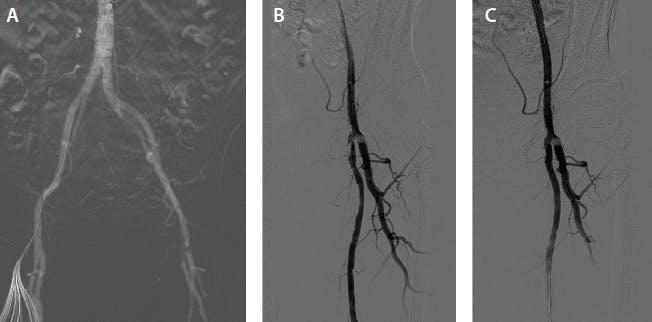
Figure 1. Baseline aortogram showing patent iliac arteries bilaterally, with luminal irregularities in the left distal CFA and proximal SFA (A). Baseline selective angiogram of the left CFA and SFA showing a severely calcified ostial lesion of the SFA (B). Final angiogram demonstrating resolution of the ostial left SFA lesion with no residual stenosis (C).
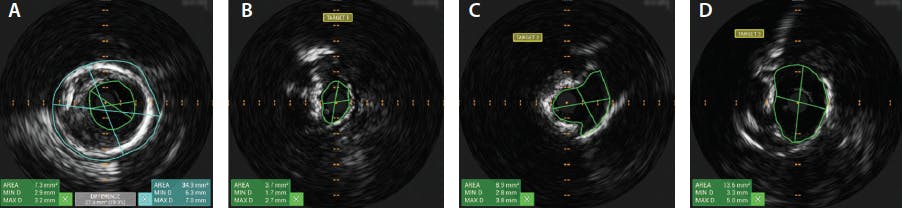
Figure 2. IVUS demonstrating a 6-mm reference vessel diameter with a severe lesion (A). Extension of the lesion from the distal CFA through the ostium and into the proximal SFA (B-D).
The decision was made to proceed with evaluation of the proximal segment of the SFA. The sheath was upsized for a 6-F Destination sheath (Terumo Interventional Systems), and heparin was given for anticoagulation. We advanced the sheath to the left CFA and inserted a 0.014-inch Asahi Sion black wire (Asahi Intecc Co Ltd.), which was advanced into the SFA to perform intravascular ultrasound (IVUS) of the SFA. IVUS demonstrated a mid SFA with no significant atherosclerosis but a 90% heavily calcified proximal SFA stenosis that extended into the ostium and the proximal CFA. The reference vessel diameter was 6 mm. The profunda artery also had severe atherosclerosis.
We decided to intervene on the ostial SFA lesion with atherectomy, and a 2-mm Auryon laser atherectomy catheter was inserted and advanced to the lesion. The lesion was treated with two passes, one with fluency set to 50 mJ/mm2, followed by a second pass at 60 mJ/mm2. We then performed angioplasty using a 6- X 80-mm EverCross percutaneous transluminal angioplasty catheter (Medtronic) inflated to 6 atm for 2 minutes. Angiography after angioplasty demonstrated excellent results with no residual stenosis, no complications, and normal flow.
This case demonstrates the successful application of the Auryon laser atherectomy catheter for the treatment of a severely calcified ostial SFA lesion that extended into the distal CFA and proximal SFA. Heavily calcified lesions present a challenge to operators, and the ability to safely debulk may prove to be an essential tool for the treatment of PAD.
CASE 2
A woman in her early 60s with diabetes, dyslipidemia, hypertension, and a smoking history presented with Rutherford class 3 PAD in the right leg with debilitating claudication, unimproved by exercise and medical therapy. The patient had a prior angioplasty of the right CFA and proximal SFA during which a proximal Supera stent (Abbott) was placed. Arterial duplex ultrasound revealed monophasic waveforms in the right CFA through to the P2 segment and a short-segment popliteal occlusion along with monophasic waveforms throughout three tibial vessels to the foot. Imaging demonstrated CFA and femoral ISR, a 10-cm-long tandem de novo stenosis in the mid SFA, and a short-segment popliteal occlusion in a previously untreated segment.
After ultrasound-guided retrograde left femoral access, a 6-F sheath was inserted over the aortic bifurcation, and right lower extremity arteriography demonstrated small caliber but widely patent right common iliac, hypogastric, external iliac, CFA, and profunda femoral arteries (Figure 3A). A prior Supera stent extended from the external iliac artery across the CFA into the upper third of the SFA, and an additional stent was present in the profunda femoral artery (Figure 3B). The external iliac and CFA segments as well as profunda femoral segments were patent; however, there was severe ISR of the upper portion of the Supera stent in the SFA as well as the mid to distal native SFA, with patency of the P1 segment, and complete occlusion of the P2 and P3 segments and tibioperoneal trunk. Runoff reconstituted at the anterior tibial, peroneal, and posterior tibial arteries, with the posterior tibial artery occluding at the level of the ankle.
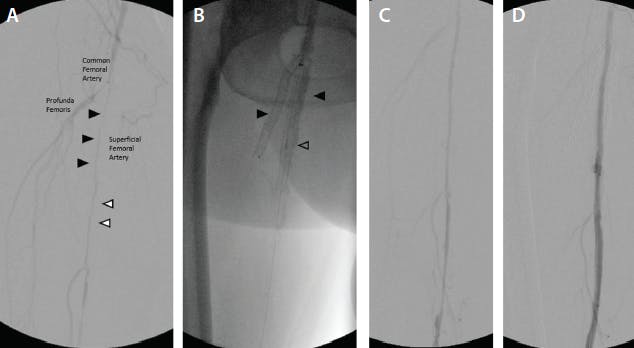
Figure 3. Baseline angiogram demonstrating severe ISR of the Supera stent in the upper portion of the SFA (black arrowheads) as well as native stenosis in the remainder of the SFA down to the level of the adductor canal (white arrowheads) (A). Angiogram demonstrating Auryon laser (open arrowhead) positioned within the stenosed intraluminal region. Supera stents (black arrowheads) are visible extending from the external iliac artery across the CFA into the upper third of the SFA and an additional stent in the profunda femoral artery (B). Angiogram after a single pass with Auryon laser atherectomy system (C). Final angiogram after angioplasty demonstrating restored unobstructed SFA flow (D).
The femoral stenoses were crossed to the level of the P1 segment, but the popliteal occlusion could not be traversed intraluminally from this approach. Therefore, the posterior tibial artery was accessed in a retrograde fashion, and a 0.014-inch Command wire (Abbott) and 2.6-F microcatheter were placed, allowing retrograde crossing of the popliteal occlusion and wire rendezvous. IVUS demonstrated intraluminal positioning of the wire throughout (Figure 4). Laser atherectomy was performed with a 2-mm Auryon laser atherectomy catheter with aspiration throughout the occluded segments, and angiography showed substantial luminal gain from atherectomy alone (Figure 3C). Subsequent angioplasty was performed with a 6-mm plain balloon in the femoropopliteal segment and a 3.5-mm balloon extending to the posterior tibial artery (Figure 3C). A single 5.5-mm Supera stent was then deployed across the popliteal artery for flow-limiting dissection. Completion angiography demonstrated a restored wide femoropopliteal patency and runoff (Figure 3D). Hemostasis was achieved with a closure device. There were no immediate complications.
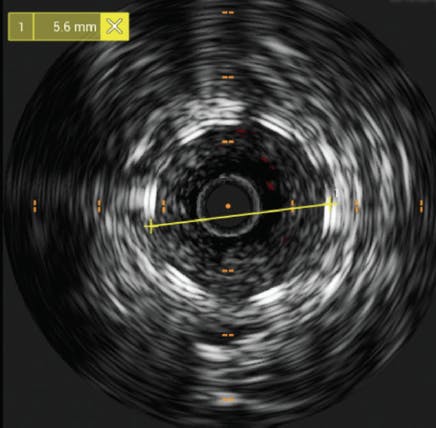
Figure 4. IVUS demonstrating intraluminal positioning of the Auryon laser atherectomy system in the stenotic lesion. The yellow line demonstrates the diameter of vessel, which determined appropriate sizing of the balloon for postatherectomy angioplasty.
This case illustrates how the Auryon laser atherectomy system can be utilized to restore patency in tandem ISR and native femoral artery stenoses in an office-based lab setting, demonstrating the versatility and safety of the Auryon laser atherectomy system in addressing lesions of varying tissue morphologies.
CONCLUSION
Initial experiences from the investigational device exemption study and real-world experiences demonstrated the Auryon system to be safe and effective in both the office-based lab and hospital settings. The cases clearly show that the Auryon system is easy to use with excellent patency. Postmarket data from the PATHFINDER study and future studies will validate the safety and efficacy of the Auryon device and its ability to treat all lesion types and calcifications above and below the knee.
The AURYON Atherectomy System is indicated for use in the treatment, including atherectomy, of infrainguinal stenoses and occlusions, including in-stent restenosis (ISR).
US/PA/MS/1125 Rev 01 08/2021
*These cases are not part of the PATHFINDER registry.
1. Herzog A, Oszkinis G, Planer D, et al. Atherectomy using a solid-state laser at 355 nm wavelength. J Biophotonics. 2017;10:1271-1278. doi: 10.1002/jbio.201600209
2. Rundback J, Chandra P, Brodmann M, et al. Novel laser-based catheter for peripheral atherectomy: 6-month results from the Eximo Medical B-Laser™ IDE study. Catheter Cardiovasc Interv. 2019;94:1010-1017. doi: 10.1002/ccd.28435
3. Post-market registry of AURYON™ atherectomy device in subjects affected with infrainguinal peripheral artery disease (PATHFINDER-I). Clinicaltrials.gov website. Accessed August 24, 2020. https://clinicaltrials.gov/ct2/show/NCT04229563




Advertisement
Advertisement