Advertisement
Advertisement
September 2021
Sponsored by Veryan Medical
BioMimics 3D: Impacting Outcomes Through Stent Design
Gary Ansel, MD; John H. Rundback, MD; and Thomas Zeller, MD, share their experience with the femoropopliteal stent with the innovative 3D helical centerline.



Dr. Ansel, you have been involved in the development of BioMimics 3D, including advising on clinical trial design. Could you explain the purpose of the innovative three-dimensional (3D) helical centerline design and why swirling flow positively affects outcomes?
Dr. Ansel: The BioMimics 3D stent (Veryan Medical) has an innovative 3D helical centerline, which imposes a helical curvature onto the vessel. This helical curvature not only elevates wall shear stress due to the swirling flow it creates, but it also allows for improved biomechanical compatibility; as the vessel moves, the helical centerline allows the stent to shorten and move freely with the vessel, which means that stent fracture could pretty much be a thing of the past with this stent. Most of us interventionalists were unaware of this phenomenon until Veryan ran the first clinical trial, which was a validation of the theory that nonplanar curvature promotes natural swirling blood flow (Figure 1), elevating wall shear stress, which is protective to the vessel wall. What’s great is that the clinical results are now validating the scientific theory; it’s very satisfying.

Figure 1. BioMimics 3Dstent with swirling flow.
Professor Zeller, you have been involved in several of the clinical trials that have studied the performance of BioMimics 3D. Can you share what data impress you most?
Prof. Zeller: The first study I was involved in was the MIMICS-RCT randomized study in which patients received either BioMimics 3D or the best-in-class femoropopliteal stent of that time, the LifeStent (BD). What impressed me was this was a pilot study with a relatively small number of patients, just 50 patients in the BioMimics arm, and it was therefore not designed to show a difference between the two arms; however, despite this, at 2 years, there was a significant difference favoring BioMimics 3D. This was the case for both patency and freedom from reintervention when using a landmark analysis looking at the period between 12 and 24 months. In fact, there was no clinically driven target lesion revascularization (CD-TLR) in any BioMimics stent in that period, and this, along with the better clinical and technical outcomes for BioMimics 3D, was very impressive.
Since then, Veryan has completed two larger-scale clinical studies: MIMICS-2, a single-arm investigational device exemption study of 271 patients, which successfully supported regulatory approval of BioMimics 3D in the United States and Japan; and MIMICS-3D, a 507-patient pan-European real-world registry. Both studies had a 3-year follow-up. The good news is that the results align with the first MIMICS-RCT study, but in even more complex lesions and sicker patients.
Prof. Zeller and Dr. Ansel, these clinical results are comparable to those of the paclitaxel-eluting stents currently available for the femoropopliteal indication. How important is that, particularly right now?
Prof. Zeller: There are of course some specific indications for which a drug-eluting stent is the right choice. Aside from these, however, my feeling is that if we can achieve comparable patency and freedom from CD-TLR results with a bare-metal stent such as BioMimics 3D (Figure 2), then why do we need to add a drug? Adding a drug onto a stent usually extends the need for dual antiplatelet therapy (DAPT) out to 3 months, 6 months, or even longer to avoid stent thrombosis, whereas the DAPT requirement for a bare-metal stent is just 4 weeks, which is a safety benefit (reduced potential bleeding risk) as well as a cost benefit.
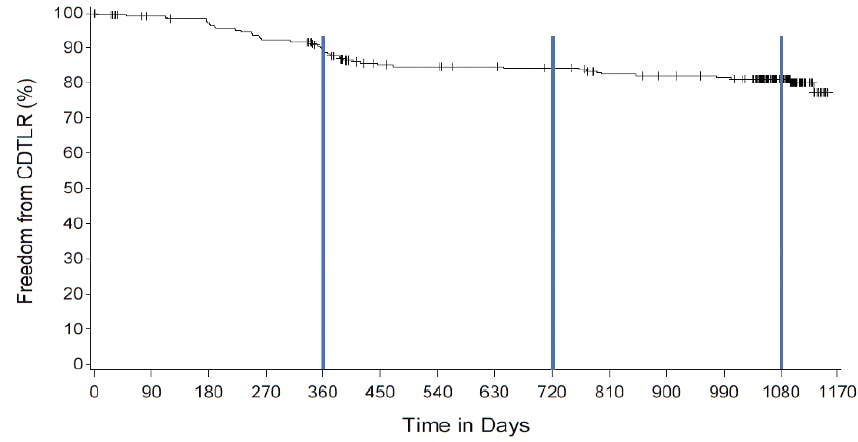
Figure 2. The MIMICS-2 study. Freedom from CD-TLR at 3 years.
Dr. Ansel: From my perspective, being able to treat patients efficiently and keep them out of the health care system is really important right now. The most costly thing that can happen is for the patient to come back for reintervention. BioMimics 3D has a relatively flat restenosis curve, which means that the likelihood of patients needing a reintervention is reduced; this is great for them because it limits their exposure to the health care system, which is really important at the moment, and it also decreases long-term hospital costs. With BioMimics 3D, we’ve finally reached a similar stage to where we are with coronary intervention, clever stent design specific to the indication.
Prof. Zeller, you have access to any technology you want, and you routinely use the BioMimics stent. Why is that, and how does it fit into your current treatment paradigm?
Prof. Zeller: We follow the guidance here in Germany as much as possible, which means that our primary approach is good vessel preparation followed by balloon angioplasty with a drug-coated balloon (DCB). However in practice, many lesions, in particular complex ones, cannot be treated with DCBs alone: dissection, recoil, or long lesions all require a stent, and BioMimics is the stent we choose in combination with DCBs because of its hemodynamic benefits and biomechanical compatibility. In addition, for frail, elderly patients with concomitant disease who do not ambulate, it’s really important to achieve acute restoration of blood flow with a good likelihood of a moderate- to long-term patency and a low risk of reintervention. DCBs are good, but we never know if there will be delayed dissection or subacute occlusion, and BioMimics can achieve a really good acute outcome while maintaining moderate- to longer-term patency in a patient population with limited life expectancy. Why use BioMimics and not a drug-eluting stent? Well, the clinical outcomes are comparable, but we want to avoid long-term DAPT, especially as these patients will also be on oral anticoagulation and we want to avoid a bleeding risk. The ideal is a single-shot stent treatment, and we achieve that with BioMimics.
Dr. Rundback and Dr. Ansel, how do you see the use of drug-based devices and BioMimics panning out in the United States?
Dr. Rundback: In the United States, we have office-based labs that are very cost-conscious, and given its compelling clinical results, I can see BioMimics becoming really popular in that setting as it can provide a predictable, reproducible drug-like result but without the price tag.
Dr. Ansel: Personally, if I can avoid using a drug when I don’t need to, then that is my preference because it just adds another variable that has to be considered. With DCBs, the clinical benefit is really blunted after 3 years, and so I’m really excited to see the clinical benefits of BioMimics in the 3- to 5-year time frame.
Dr. Rundback, you implanted one of the first commercial BioMimics stents in the United States and are an investigator for the MIMICS-3D US registry. What first interested you about the device, and nearly a year after that first implantation, what are your impressions now?
Dr. Rundback: I originally found the science behind the device intriguing and then seeing the clinical data was the game changer. The concept of the 3D helical centerline is so different from anything else, and it really does make sense when you think about it that being able to shorten, elongate, and twist with the artery as it moves can only be a good thing. What’s fascinating is that even when used in severely calcified lesions, long lesions, and occlusions, patency and CD-TLR are not affected; this is not normally the case. The device is very easy to use, with very accurate stent placement, and the fracture rate is practically zero, so I am currently very happy to use it routinely in my practice. Prof. Michael Lichtenberg recently presented compelling evidence from a real-world registry in the European Union supporting the device’s performance in challenging lesions. We are currently enrolling patients in a comparable study in the United States and eagerly await those data.
All data on file at Veryan Medical.
PAM 289 Version 1.0
Advertisement
Advertisement