Advertisement
Advertisement
April 2022
Sponsored by Shape Memory Medical
Shape Memory Polymer: A New Solution for AAA Endoleak Management?
Andrew Holden, MBChB, FRANZCR, EBIR, and Michel M.P.J. Reijnen, MD, PhD, discuss their clinical experience with shape memory polymer—a novel embolic material—for endoleak management and evaluating it for active abdominal aortic aneurysm sac management.
Ultra-low-density polyurethane shape memory polymer (SMP) is a novel embolic material. The crimped form of the polymer enables catheter delivery, and the expanded structure is a porous, compliant, biocompatible matrix that supports the rapid formation of organized thrombus throughout its structure (Figure 1). Over time, the polymer will gradually absorb while stimulating thrombus remodeling and healthy tissue formation.
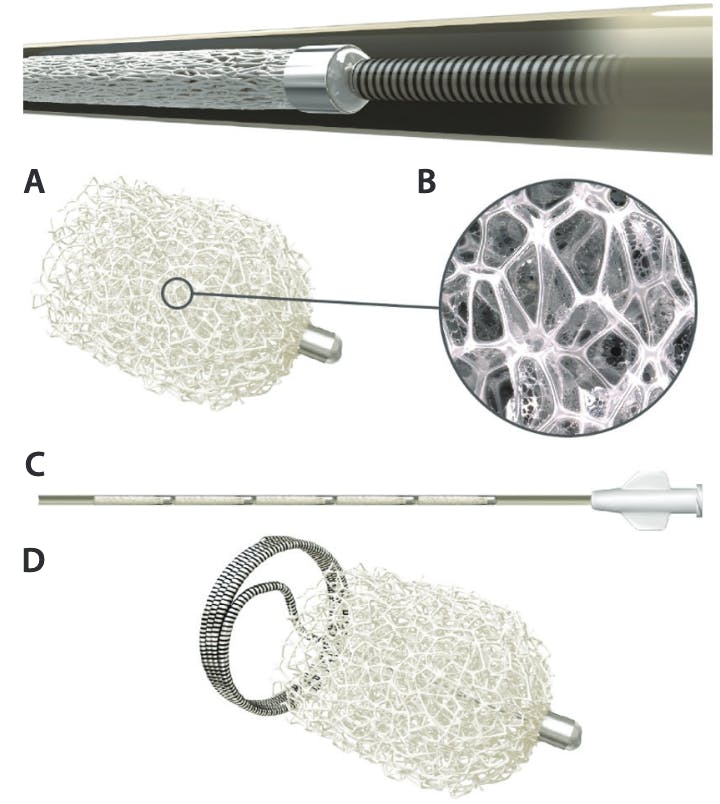
Figure 1. The IMPEDE-FX Embolization Plug is a SMP plug with a proximal radiopaque marker (A). A microscope image of the expanded, porous form of the SMP in the IMPEDE Embolization Plug product family (pores are ~1,000-2,000 µm) (B). The IMPEDE-FX RapidFill device with five plugs preloaded in a cartridge (C). The IMPEDE Embolization Plug with a distal anchor coil (D). The IMPEDE Embolization Plug family are pushable devices.
How would you describe SMP to clinicians?
Dr. Reijnen: SMP is a new concept in medical devices. It is easy to think of it as a space-filling technology. But it is also important to realize expanded SMP devices are porous, which means the devices fill a large volume in a vessel, but the amount of foreign material is low. The porous polymeric matrix is first hemostatic, supporting thrombus formation throughout its structure, and then supports natural healing processes.
Dr. Holden: From a clinical use perspective, the expanded polymer is soft and compliant when you hold it in your fingers—it really is a porous matrix and reminds you of a sponge structure. The polymer is radiolucent, and device delivery is guided by small proximal radiopaque markers. The chemistry of the polyurethane polymer is published, as is a description of the mechanical and biochemical properties of the material.1 The preclinical animal work suggesting the material supports a rapid conversion of thrombus to collagen2,3 and aneurysm shrinkage4 is intriguing, and we are exploring the endovascular application of these observations in clinical trials.
What was your first clinical experience with SMP devices?
Dr. Holden: The company approached me in 2017 about a first-in-human (FIH) study of the original peripheral embolization device developed with SMP (the IMPEDE Embolization Plug, Shape Memory Medical; Figure 1). I remember thinking at the time that the polymer is very unique to what was being developed and on the market. Originality and unmet need are two of our key criteria when deciding whether to participate in an early stage trial.
We recently presented the results of that FIH study, and the majority of cases were associated with endovascular aneurysm repair (EVAR): inferior mesenteric artery, accessory renal artery, and internal iliac artery embolization during EVAR and endoleak management (internal iliac artery and subclavian artery embolization). We also treated varicoceles via gonadal vein embolization and performed profunda artery embolization before hypervascular tumor excision. We did a retrospective review of any available longer-term imaging for the presentation—over an average of about 2 years postprocedure—and could not see any evidence of recanalization. The SMP is bioabsorbable, but it does not absorb very quickly, so a stable occlusion has time to form before the supporting matrix absorbs. The FIH study supported an initial safety evaluation, and the company set up a postmarket registry to collect more data on peripheral vessel embolization.5
But it’s really exciting and rewarding that if we fast forward 5 years from my first experience with the technology, here we are participating in a new FIH trial of active abdominal aortic aneurysm (AAA) sac management with the SMP at the same time as EVAR, a truly unmet need, and collaborating with vascular surgery and industry colleagues on novel procedure development.
Dr. Reijnen: Our first case was a false lumen of an infrarenal postdissection aneurysm.6 We chose the IMPEDE-FX Embolization Plug (Shape Memory Medical) for its high-volume filling properties and the potential for lower recanalization risk, an important aspect in false lumen treatment. I have also been using the IMPEDE-FX Embolization Plug to treat type II endoleaks post EVAR (Figure 2). In some cases, I have used the IMPEDE-FX RapidFill (Shape Memory Medical) product, where five individual devices are preloaded in a cartridge, so a greater volume of embolic material can be delivered quickly. The devices lend themselves well to endoleak treatment because they fill volume quickly and the radiolucency of the SMP means it is easy to see the contrast exclusion to confirm success. In a case to treat a type I endoleak secondary to a Nellix stent (Endologix) fracture, I relined the Nellix stent and then implanted 23 IMPEDE-FX Embolization Plugs within the gutter endoleak and into the AAA sac; that is a total of nearly 30 mL of embolic material when the devices are fully expanded (Figure 3). It is now 12 months postrepair, and the patient remains asymptomatic.
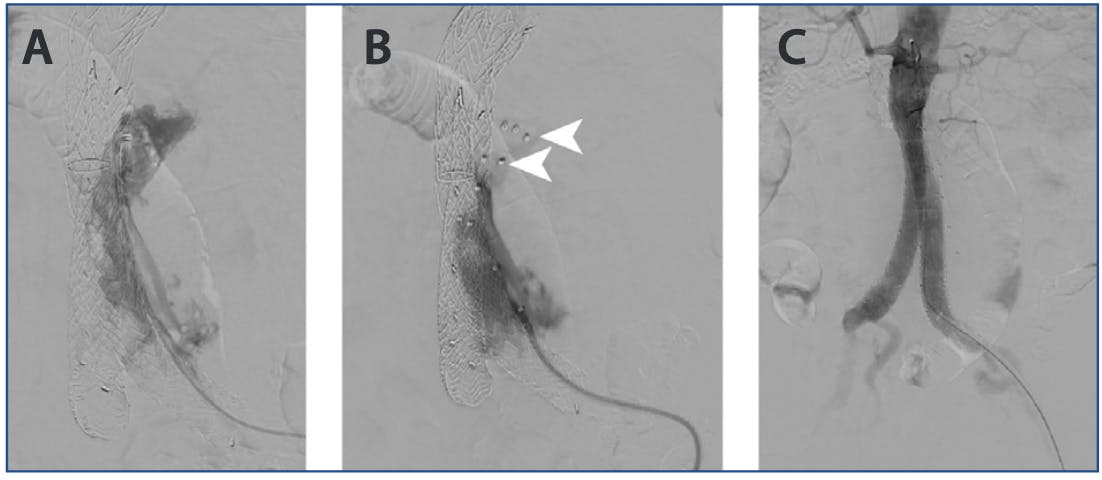
Figure 2. A persistent type II endoleak with a growing aneurysm (A). A total of five plugs (arrows show the location of select radiopaque markers) were implanted via a perigraft approach, using the IMPEDE-FX RapidFill device (B). Completion angiography showed complete obliteration of the aneurysm sac and no type II endoleak (C).
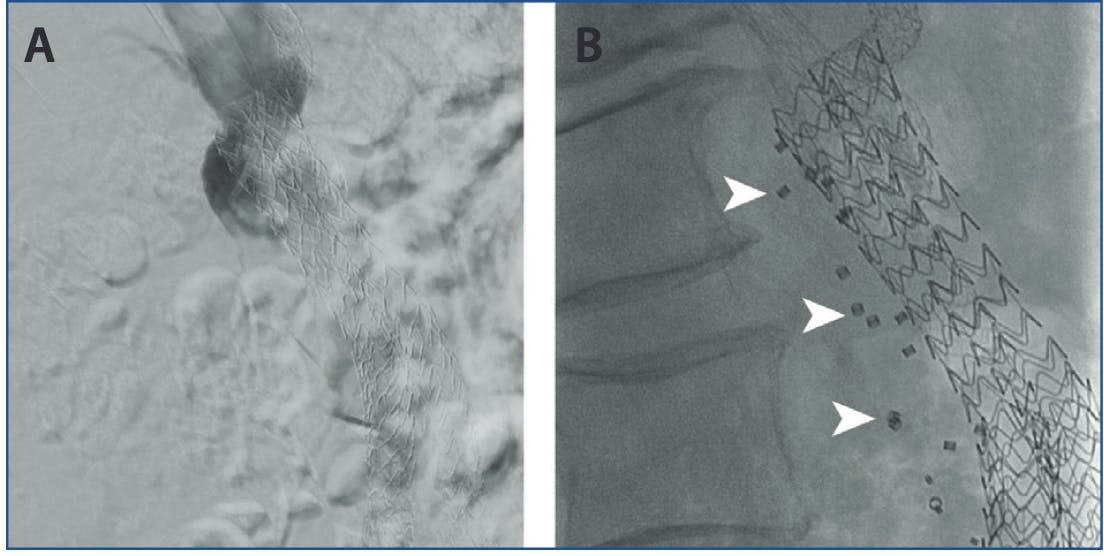
Figure 3. A type I gutter endoleak following relining of a Nellix stent in a patient previously treated with Nellix-in-Nellix and parallel grafts (A). Intraoperative frame after implantation of IMPEDE-FX Embolization Plugs (arrows show the location of select radiopaque markers) (B). A total of 23 plugs (~30 mL when the devices are fully expanded) and two detachable coils were implanted via a transbrachial approach. Completion angiography showed resolution of the endoleak.
How are you applying SMP devices to active AAA sac management?
Dr. Holden: The prospective AAA-SHAPE FIH trial in New Zealand (NCT04227054) is evaluating the safety and efficacy of EVAR with concomitant sac filling using SMP devices. The idea of filling the sac with embolic material at the same time as EVAR has been explored before,7-9 including at our center.10 But the concept of altering the biology of the AAA sac with highly compliant SMP is new and intriguing. In the AAA-SHAPE trial, we are determining the residual flow volume outside of the stent graft based on preprocedural imaging and then implanting SMP to at least 100% of the residual flow volume, thereby filling the sac. We have developed a technique where we jail a delivery catheter behind the stent graft during deployment and then insert the SMP devices (IMPEDE-FX RapidFill) in a quadrant-by-quadrant technique. This enables us to distribute the embolic devices throughout the sac (Figure 4). We have gained experience and have implanted between 38 and 113 mL of embolic material, based on the volume of the fully expanded SMP. In a recent case, we delivered 50 plugs in 20 minutes using the IMPEDE-FX RapidFill device. We insert devices to the point where a completion contrast run—a sacogram as we call it—indicates we have filled the sac with embolic material.10 It took a few cases to finesse the procedure, but we feel we have a good technique now. We are following our patients per our center’s standard of care with CT imaging through 2 years in the study. We are currently working out our methodology to analyze the sac diameter and volume postprocedure, but the results are promising and all the sacs we have treated so far have regressed within 6 months.
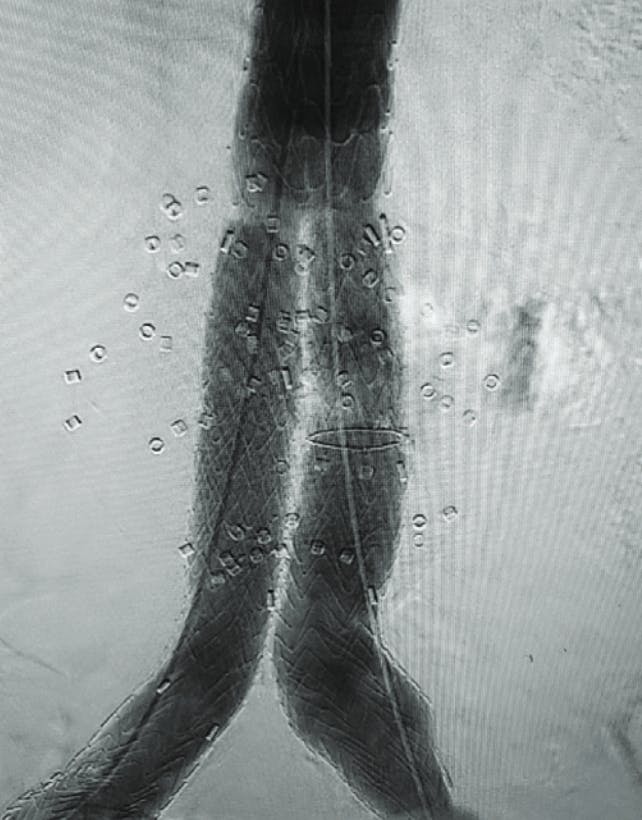
Figure 4. Completion angiography of an AAA-SHAPE case after implantation of 85 IMPEDE-FX Embolization Plugs equating to an expanded SMP device volume of 106 mL.
Dr. Reijnen: The AAA-SHAPE_NLD trial in the Netherlands (NCT04751578) has identical eligibility criteria to the New Zealand trial. We were lucky enough to join the effort after Dr. Holden had eight cases under his belt in New Zealand. We are recruiting at three centers and using the technique Dr. Holden described to standardize the approach. We are approaching 6-month follow-up in our first patients and are excited to see if we get similar results to New Zealand.
What’s next for SMP in the angio suite?
Dr. Reijnen: I continue to use the devices in my EVAR practice. I am also aware that a Dutch interventional radiologist colleague is leading an effort to investigate the use of SMP devices in pulmonary arteriovenous malformations. This is a very specific application, where recanalization rates are historically high and frequent embolization is required. My advice to clinicians thinking of trying the IMPEDE-FX Embolization Plug is to first treat a low-flow scenario—endoleaks or vessel embolization at the same time as EVAR are ideal first cases—and use the IMPEDE Embolization Plug for high-flow situations because the anchor coil secures the polymer in the vessel.
Dr. Holden: As we near enrollment completion of the AAA-SHAPE safety studies in New Zealand and the Netherlands, we will have good insight into the safety of active sac management using these SMP devices. We have been talking about active sac management over the years, but I think we have not yet had the optimal tool in our hands. The recent insights into the fact that the failure of an aneurysm sac to regress is linked to long-term mortality mean that I am optimistic we will have a lot more to talk about when we are able to publish the 1-year follow-up results of the AAA-SHAPE studies.
In countries recognizing CE marking, the IMPEDE Embolization Plug, the IMPEDE-FX Embolization Plug, and IMPEDE-FX RapidFill are indicated to obstruct or reduce the rate of blood flow in the peripheral vasculature.
In the United States, the IMPEDE Embolization Plug is indicated to obstruct or reduce the rate of blood flow in the peripheral vasculature and the IMPEDE-FX Embolization Plug is indicated for use with the IMPEDE Embolization Plug to obstruct or reduce the rate of blood flow in the peripheral vasculature. The IMPEDE-FX RapidFill device is not approved for sale in the United States.
1. Landsman TL, Bush RL, Glowczwski A, et al. Design and verification of a shape memory polymer peripheral occlusion device. J Mech Behav Biomed Mater. 2016;63:195-206. doi: 10.1016/j.jmbbm.2016.06.019
2. Jessen SL, Friedemann MC, Ginn-Hedman AM, et al. Microscopic assessment of healing and effectiveness of a foam-based peripheral occlusion device. ACS Biomater Sci Eng. 2020;6:2588-2599. doi: 10.1021/acsbiomaterials.9b00895
3. Chau SM, Herting SM, Noltensmeyer DA, et al. Macrophage activation in response to shape memory polymer foam-coated aneurysm occlusion devices. J Biomed Mater Res B Appl Biomater. Published online January 28, 2022. doi: 10.1002/jbm.b.35015
4. Horn J, Hwang W, Jessen SL, et al. Comparison of shape memory polymer foam versus bare metal coil treatments in an in vivo porcine sidewall aneurysm model. J Biomed Mater Res B Appl Biomater. 2017;105:1892-1905. doi: 10.1002/jbm.b.33725
5. Morgan RA, Loftus I, Ratnam L, et al. Clinical experience with a shape memory polymer peripheral vascular embolisation plug: a case series. CVIR Endovasc. 2021;4:29. doi: 10.1186/s42155-021-00214-w
6. Jansen AS, van Schaik PM, Martens JM, Reijnen M. Embolization of the false lumen using IMPEDE-FX embolization plugs as part of treatment of an infrarenal post-dissection aneurysm: a case report. CVIR Endovasc. 2020;3:91. doi: 10.1186/s42155-020-00183-6
7. Walker SR, Macierewicz J, Hopkinson BR. Endovascular AAA repair: prevention of side branch endoleaks with thrombogenic sponge. J Endovasc Surg. 1999;6:350-353. doi: 10.1583/1074-6218(1999)006<0350:EARPOS>2.0.CO;2
8. Lehmann JM, Macierewicz JA, Davidson IR, et al. Prevention of side branch endoleaks with thrombogenic sponge: one-year follow-up. J Endovasc Ther. 2000;7:431-433. doi: 10.1177/152660280000700515
9. Piazza M, Squizzato F, Zavatta M, et al. Outcomes of endovascular aneurysm repair with contemporary volume-dependent sac embolization in patients at risk for type II endoleak. J Vasc Surg. 2016;63:32-38. doi: 10.1016/j.jvs.2015.08.049
10. Muthu C, Maani J, Plank LD, et al. Strategies to reduce the rate of type II endoleaks: Routine intraoperative embolization of the inferior mesenteric artery and thrombin injection into the aneurysm sac. J Endovasc Ther. 2007;14:661-668. doi: 10.1177/152660280701400509
Advertisement
Advertisement