Advertisement
Advertisement
August 2022
Coil Embolization of Type II Endoleak
Moderator: Kimberly Malka, MD, PhD;
Panelists: Clayton J. Brinster, MD; Bill Parkhurst, MD; and Jessica P. Simons, MD, MPH
CASE PRESENTATION
A male patient in his late 70s presented to the clinic after undergoing endovascular repair of a 6.5-cm abdominal aortic aneurysm (AAA) approximately 2 years prior. Approximately 1 year ago, his graft was relined due to a type III endoleak. It was believed that graft separation occurred as a result of aneurysm expansion from a known type II endoleak. On the current surveillance duplex ultrasound, there was no evidence of type I or III endoleak, but an ongoing type II endoleak was identified with sac expansion.
What would be your initial imaging modality of choice?
Dr. Brinster: After a detailed color duplex ultrasound (CDUS), I would proceed with CTA with fine cuts given the presence of type II endoleak and documented sac expansion. The requirement of his previous early reintervention, current large sac size, persistent leak, and evidence of expansion are all factors that would qualify this patient as high risk for aneurysm-related complications.
Dr. Parkhurst: In any circumstance involving a possible or confirmed endoleak, my first stop is always CTA. Ultrasound (or even contrast-enhanced ultrasound) is reasonable as a screening tool, but it simply cannot reliably evaluate for stent graft fracture, migration, separation, or additional feeding vessels.
By CTA, I am referring to an endoleak protocol with noncontrast, arterial, and delayed phases. Noncontrast is used mainly for troubleshooting subtle findings, such as calcified thrombus versus small perigraft leak. The arterial phase is best for determining perigraft flow. Lastly, delayed phase does increase sensitivity and gains a better understanding of the flow dynamics of the leak. However, CTA is not the beginning. I have found that careful examination of previous angiography often gives key insight to the origin of the endoleak and helps with procedural planning.
Dr. Simons: My preferred modality is triple-phase CTA of the abdomen and pelvis (precontrast, arterial, and delayed phases). This generally can demonstrate the nidus and the feeding vessels quite well, while also allowing me to consider my technical approach. In many cases, I will use this CT for intraoperative fusion as well.
CASE CONTINUED
CTA was performed and demonstrated a 6.7-cm AAA with an endograft in good position and no evidence of type I or III endoleak. However, an active type II endoleak from paired upper lumbar vessels was seen (Figure 1).
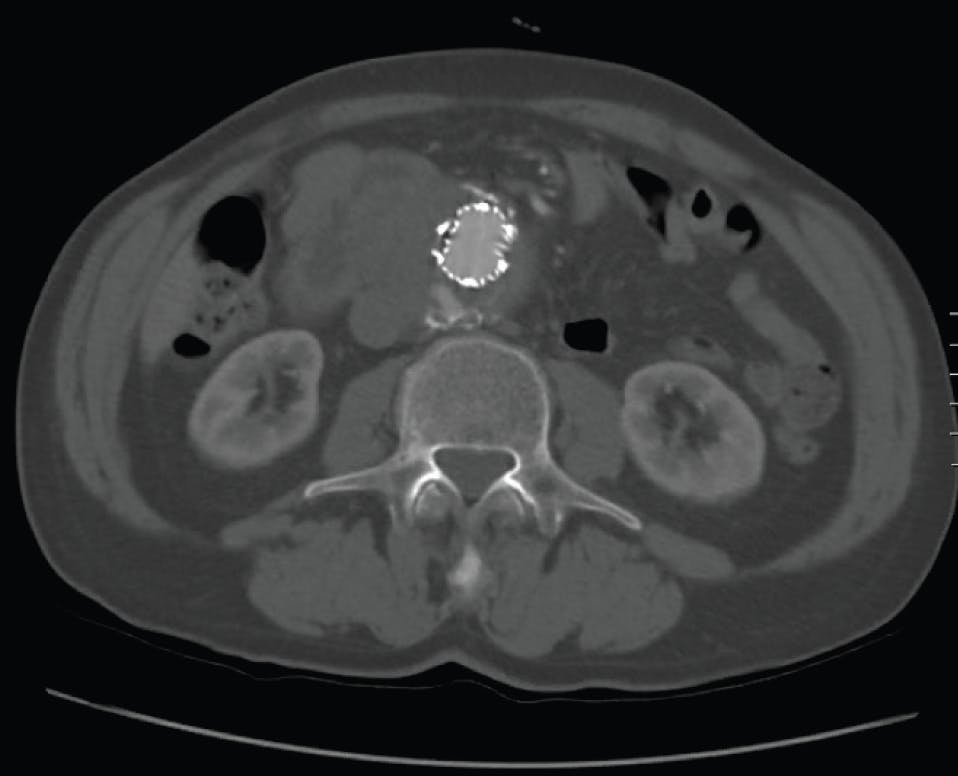
Figure 1. CTA demonstrating type II endoleak from paired lumbar arteries after EVAR. Note the proximity of the IVC to the aneurysm sac.
Given the findings on CTA and sac expansion, how would you treat the type II endoleak?
Dr. Parkhurst: To take a step back, I usually perform initial arteriography to completely exclude type I or III endoleaks before I proceed with treatment of a type II endoleak. It also gives me a good opportunity to see if the excluded sac is easily accessible via a transarterial route. In my experience, feeding vessels from the lumbar arteries are quite difficult to access transarterially, so I would likely treat this endoleak via a translumbar route.
I would access the endoleak sac/channel using a MAK-NV introducer system (Merit Medical Systems, Inc.) in conjunction with cone-beam CT and needle-guidance technology. The 4-F inner diameter of the introducer system allows for stable access and the ability to navigate the sac using a 4-F Kumpe catheter (Cook Medical) and microcatheter. Digital subtraction angiography is performed to help me map out the channel and outflow track of the endoleak. I then navigate to the outflow track and coil embolize the outflow vessel. A framework of coils is laid throughout the sac—typically, numerous Ruby Standard coils or Packing Coils (Penumbra, Inc.). I then use a liquid embolic such as Onyx (Medtronic) to finish the embolization. The translumbar/retroperitoneal approach allows me to then easily remove the access without too much worry about bleeding.
Dr. Simons: Based on this single slice, I would attempt direct sac puncture via a transcaval approach. The advantage of that approach is that I can access transarterially at the same time if needed because the patient is supine. A translumbar approach for direct sac puncture also appears feasible based on this cut.
Dr. Brinster: The presence of type II endoleak and sac expansion in this patient certainly warrants intervention rather than continued observation. Although the paired lumbar arteries should be addressed with any type of intervention, their proximal location potentially obscures a concomitant type Ia endoleak. In addition, the patient's history of another nidus of endoleak and the reported incidence of occult type Ia or type III leak in over 20% of patients with suspected type II endoleak and sac expansion1 should raise suspicion of a concurrent proximal leak. In this situation, it is critical to perform a detailed review of the CTA and respective delayed images in multiple planes, with attention to the proximal seal zone. Also, magnification aortography of the proximal seal zone in various obliquities should be performed at the time of any planned intervention.
Several well-established options could be used to treat this apparent lumbar-mediated endoleak. Given the apposition of the inferior vena cava (IVC) to the aneurysm sac at the anatomic level of the lumbar vessels in question, I would proceed with transcaval embolization using one of the commercially available, prepackaged transjugular intrahepatic portosystemic shunt (TIPS) access kits.
CASE CONTINUED
Based on the preoperative CTA and the fact that the patient’s aneurysm sac was expanding, we elected to proceed with transcaval embolization of the patient’s type II endoleak. However, we believed that direct sac puncture and embolization via the iliolumbar route would have been good options also.
Can you describe the technique for your preferred method of treatment for type II endoleaks?
Dr. Simons: Generally speaking, I favor direct sac puncture over transarterial approaches. The translumbar approach is appealing because it facilitates very precise access to the sac under fluoroscopic guidance. I use fusion imaging and fluoroscopic guidance in our hybrid operating suite. I prefer this operating room (OR) setting merely because it is logistically simpler at our institution to engage the anesthesia team for intubation and prone positioning in the OR. For case planning, it is simplest when the nidus is to the right of midline and not too deep in the pelvis. That allows for an approach pathway that avoids the cava and iliac crests without necessitating a path that is beyond limit of the 20-cm Chiba needle we stock.
For patients who are at high risk for intubation and proning, I would either perform a transcaval direct sac puncture, use a transarterial approach, or do both. The transcaval approach requires that the aneurysm sac abuts the cava and is relatively free of calcium where I will access the sac. For transarterial access to the sac, I prefer to get parallel to the iliac limb and access retrograde in that fashion to allow for simpler interrogation of both an inflow and outflow artery than a retrograde inferior mesenteric artery (IMA) approach.
Once I have access to the sac, I use directional catheters through a sheath with a radiopaque tip to select the nidus identified and marked with fusion imaging. I obtain a sacogram to identify and select the feeding vessels. I use a variety of coil types depending on various characteristics of the vessels and the nidus; I treat both whenever possible. If more than one nidus was identified on preoperative CTA, I repeat the same procedure for each nidus. I don’t favor the approach of nonspecifically trying to fill the entire sac; I don’t believe this is as successful as treating the nidus specifically. I also avoid liquid embolic agents that will obscure that area on future imaging.
Dr. Parkhurst: I mostly treat type II endoleaks with a translumbar approach. The technique allows for a smaller-bore access, with no closure device needed, the ability to treat without running out of microcatheter length, and the ability to treat both the inflow and outflow with relative ease. As described previously, I would ideally treat the outflow, sac, and inflow using a combination of coils and liquid embolics. I prefer Onyx rather than glue because I do not necessarily need to lose my access as I embolize the sac.
I occasionally employ a transarterial approach if I can easily identify a well-defined and presumably fairly easily traversed route by either CTA or prior angiography to the sac.
Dr. Brinster: At the Ochsner Aortic Center, we have adopted the transcaval technique for anatomically suitable type II endoleaks and for complex gutter leaks after chimney endovascular aneurysm repair (chEVAR) with good early success. Right common femoral vein (CFV) access is achieved for the intervention and for intravascular ultrasound evaluation of the IVC/sac interface with simultaneous left common femoral arterial access for aortography. The preferred access to the aneurysm sac, if possible, is achieved in a manner that reduces the acuity of the angulation required for successful target vessel cannulation, with use of a steerable sheath within the standard TIPS delivery system (commonly 10 F), if needed. We preferentially use coil or plug embolization versus other thrombotic materials.
In patients without adequate apposition of the IVC and aortic sac for transcaval access, we have also used transmesenteric and translumbar approaches based on each patient’s respective anatomic characteristics, the location and size of the target vessels, the patient’s body habitus, and the patient’s ability to maintain a lateral decubitus or prone position. Standard embolization coils are suitable for many anatomic situations; however, we preferentially use detachable coils for gutter leaks after chEVAR and for challenging target vessels in the setting of type II endoleak given the increased precision and security that detachable systems provide.
CASE CONTINUED
Ultrasound-guided access was achieved to the patient’s right common femoral artery using an 18-gauge access needle. A J-wire was inserted into through the needle, and a 5-F sheath was inserted over the J-wire. We advanced an Omni-Flush catheter (AngioDynamics) into the patient’s abdominal aorta and obtained an angiogram to ensure there was no type I or type III endoleak. When this was confirmed, we accessed the patient’s right CFV with an 18-gauge access needle. We advanced a J-wire into the patient’s IVC and upsized to a 10-F sheath. A Rösch-Uchida sheath (Cook Medical) was advanced to the IVC at the level where the aneurysm sac abutted the cava. The needle stylette was inserted and used to puncture into the aneurysm sac. The needle was removed, and a stiff Glidewire (Terumo Interventional Systems) and Kumpe catheter were advanced into the aneurysm sac. At that time, angiography was able to identify the lumbar feeding vessels. We elected to use Ruby and Packing coils. We also instilled thrombin into the aneurysm sac in divided doses. Completion angiography demonstrated resolution of the endoleak, and completion cavagraphy demonstrated no evidence of arteriovenous fistula (Figure 2). A closure device was used for the arterial access site, and manual pressure was held on the venous access site.
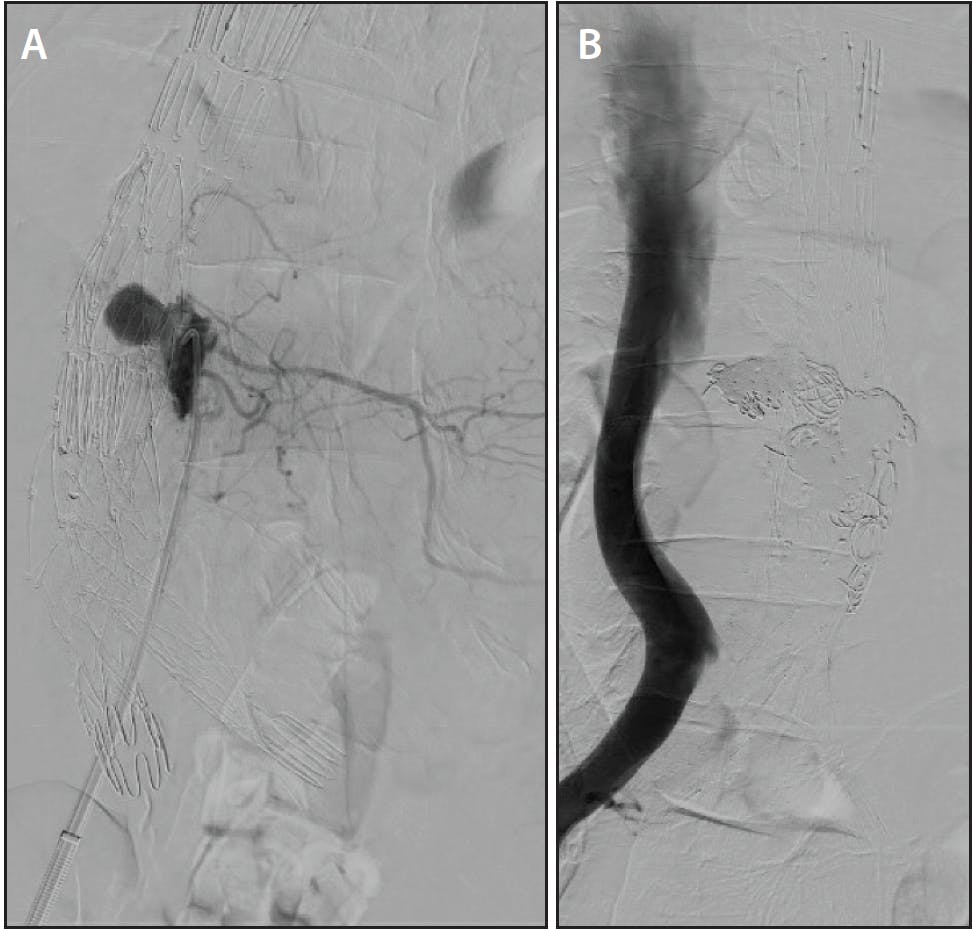
Figure 2. Intraoperative angiogram of the patient’s aneurysm sac after puncture into the sac through the IVC (A).
Completion cavagram demonstrating absence of arteriovenous fistula and coils in the aneurysm sac (B).
What is your postoperative surveillance algorithm after treatment of an endoleak?
Dr. Brinster: Although early success is common with a variety of well-established techniques to treat type II endoleak, recurrence is frequent regardless of the chosen approach. Close follow-up is imperative, especially in patients with multiple reinterventions and larger aneurysm sacs, as seen with this case. If the patient has adequate renal function, we perform CTA at 1 month. For patients with stage 3b or 4 chronic kidney disease who require the detail of CTA versus CDUS, we place a transradial angiographic catheter proximal to the aortic pathology under fluoroscopy and then perform a specially gated CTA, using only about 40% of the contrast volume required with standard CTA. Assuming no endoleak is seen at 1 month, we then follow patients with CDUS at 6 months and then yearly thereafter. If recurrent endoleak and/or sac expansion is noted at any time on CDUS, CTA is performed.
We are fortunate at Ochsner Health to have a team of experienced technologists in our dedicated vascular laboratory, which is within our division geographically as well. For complex cases, we commonly review the images in real time with the technologist performing the study. We adopted this collaborative team approach several years ago when our complex aortic volume increased significantly, and we have seen a clear benefit in diagnostic accuracy and efficiency, especially in cases of challenging anatomy and/or complex EVAR.
Dr. Parkhurst: I treat follow-up of an endoleak repair much like follow-up after the original stent graft placement; I follow-up with our CTA endoleak protocol at 1 month, 6 months, 1 year, and then yearly. For patients who do not qualify for CTA for some reason, such as those with renal disease, I am fortunate to be at an institution with a robust contrast-enhanced ultrasound program.
Dr. Simons: I arrange for outpatient follow-up in 1 month with a repeat triple-phase CTA of the abdomen and pelvis. If artifact from the coils makes interpretation difficult, I will proceed with duplex ultrasound because it is sensitive for type II endoleak, even if it can’t provide as much anatomic detail as CTA. We do not have contrast-enhanced ultrasound at my institution, but that is an attractive option if it were.
If the 1-month study indicates that the endoleak has been eliminated, I would resume a normal post-EVAR surveillance protocol with repeat imaging in 6 months, at 1 year, and then annually thereafter.
If the 1-month study suggests that the endoleak persists or a new one is present, I would consider reattempting to embolize it. However, if multiple attempts have not successfully resolved it, I would have a low threshold for consideration of explanting the endograft.
I have been intrigued by some of the recent literature suggesting that sac regression may be a more desirable endpoint of therapy than mere sac stability.2,3 Certainly, if that were to become the dominant thinking, our algorithm for managing endoleaks would change markedly.
CASE SUMMARY
CTA performed at 1-month postintervention demonstrated coils in good position, with no further evidence of endoleak. For this reason, we elected to follow the patient with aortic duplex ultrasound at 6 months, which also demonstrated no evidence of endoleak or sac growth. We plan to follow the patient with a repeat aortic duplex ultrasound at 1 year and then yearly thereafter unless there is evidence of endoleak or sac growth, at which point a CTA would be obtained.
APPROACH OF THE MODERATOR
Although EVAR has expanded the number of patients who can undergo repair of an AAA to those with comorbidities that would prohibit open repair, lifelong surveillance is required to detect the presence of endoleak and sac expansion. This case is an excellent example of that. The patient underwent graft relining 1 year after his initial EVAR for a type III endoleak that was found on surveillance imaging. At 1 year after his reline, we detected a type II endoleak with sac expansion on surveillance imaging. We generally do most of our surveillance with CDUS, but we do routinely obtain triple-phase CT scans for preoperative planning in patients who have an endoleak identified.
This patient had a type II endoleak from paired lumbar arteries. Additionally, he had an excellent window for transcaval embolization, which is how we elected to proceed. We do feel that translumbar embolization would also be appropriate, but given our expertise in transcaval embolization, this is our preferred approach. For type II endoleaks arising from the IMA, we prefer radial arterial puncture and gaining access to the sac by navigating through the superior mesenteric artery to the IMA.
For our transcaval embolizations, we generally access the patient’s right CFV and use a Rösch-Uchida sheath to achieve access to the aneurysm sac as described previously. Generally, we use detachable coils to embolize the feeding arteries and areas of endoleak. Rarely, we will also inject thrombin into the aneurysm sac.
This patient underwent our standard follow-up schedule, which is triple-phase CT at 1 month after the procedure. If there is no evidence of endoleak, as was the case in this patient, we obtain a CDUS at 6 months and 1 year from the procedure. If there is no evidence of endoleak at 1 year and the sac is stable or regressing, we proceed to yearly surveillance using CDUS. If there is a continued type II endoleak with no sac expansion, we continue with 6-month surveillance using CDUS. If there is sac growth or evidence of a type I or III endoleak, we will proceed with another CTA. Fortunately, this patient has experienced resolution of his endoleak, with no sac expansion since his last procedure.
1. Madigan MC, Singh MJ, Chaer RA, et al. Occult type I or III endoleaks are a common cause of failure of type II endoleak treatment after endovascular aortic repair. J Vasc Surg. 2019;69:432-439. doi: 10.1016/j.jvs.2018.04.054
2. O'Donnell TFX, Deery SE, Boitano LT, et al. Aneurysm sac failure to regress after endovascular aneurysm repair is associated with lower long-term survival. J Vasc Surg. 2019;69:414-422. doi: 10.1016/j.jvs.2018.04.050
3. Antoniou GA, Alfahad A, Antoniou SA, Torella F. Prognostic significance of aneurysm sac shrinkage after endovascular aneurysm repair. J Endovasc Ther. 2020;27:857-868. doi: 10.1177/1526602820937432
Advertisement
Advertisement