Advertisement
Advertisement
August 2022
Central Venous Occlusion of the Upper and Lower Extremities in a Young ESRD Patient on Hemodialysis
Moderator: Ulka Sachdev, MD, FACS;
Panelists: Yana Etkin, MD, FACS; Mark L. Lessne, MD, FSIR; and Theodore H. Yuo, MD, MSc
CASE PRESENTATION
A female patient in her late 40s with end-stage renal disease (ESRD) on hemodialysis for more than 20 years presented with multiple thrombotic episodes involving a left femoral artery–to–femoral vein polytetrafluoroethylene loop graft. In addition to graft thrombosis, the patient also complained of severe pain and heaviness associated with varicose veins involving both legs and the pelvis and reported significant bleeding from the varicosities in the past. Past medical history was significant for congestive heart failure, insulin-dependent diabetes mellitus, factor V Leiden positivity, hypertension, hypothyroidism, and a 30 pack-year smoking history.
Of note, she had known central venous occlusion (CVO) involving the superior vena cava (SVC), both iliac veins, and the inferior vena cava (IVC). She had a mediport in the left internal jugular vein (IJV), but it recently became dislodged, and remnants of it were retained in an occluded innominate vein on the left. On two separate occasions, attempts were made to recanalize the iliac veins and the innominate veins for placement of either a tunneled dialysis catheter or Hero catheter (Merit Medical Systems, Inc.), but on the latest venogram, only a small portion of the IVC was patent before entering the right atrium (RA). Venograms performed via access of the right brachial veins and both femoral veins are shown in Figure 1. CT was performed, which demonstrated varicosities (Figure 2). The patient resides in a nursing home but manages basic activities of daily living independently.
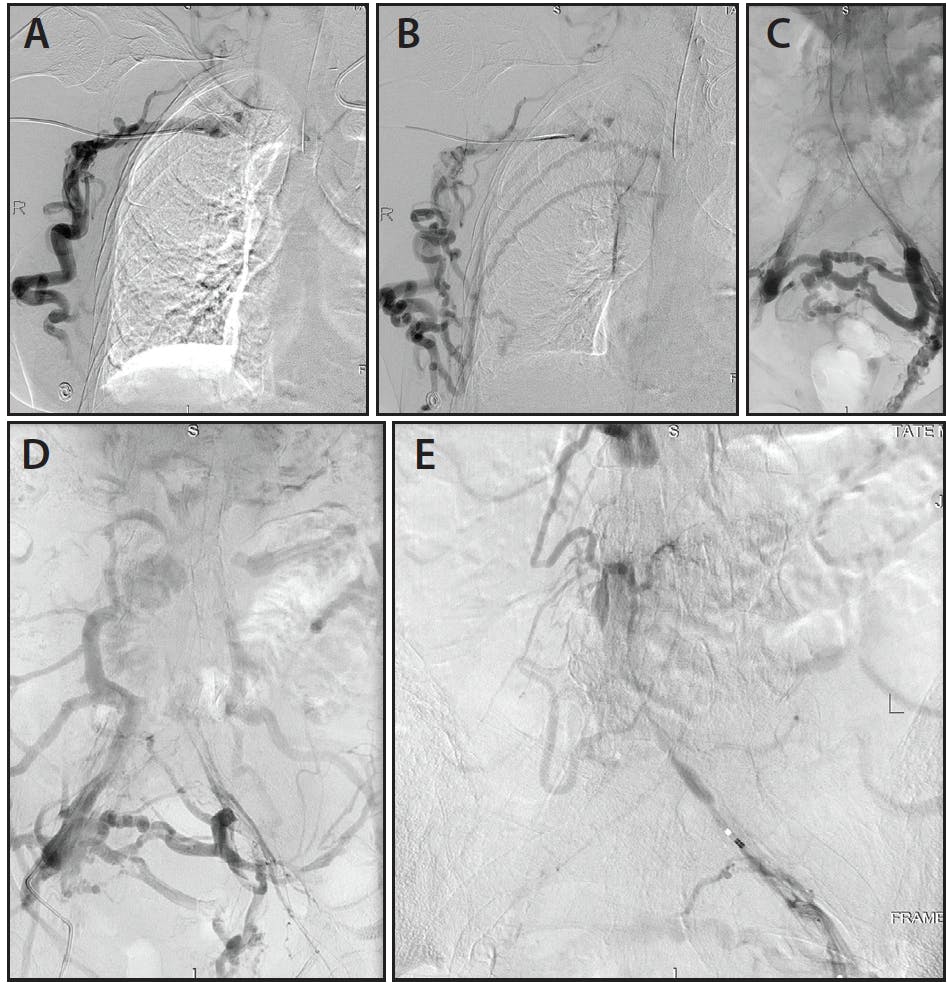
Figure 1. Venograms demonstrating CVO involving the SVC and IVC. Venogram obtained through ultrasound-guided puncture of the right brachial vein showing occlusion of the distal subclavian vein, innominate vein, and SVC venous outflow (A); later images from panel A showing marked cross-chest collateralization but no opacification of the SVC (B). Attempted recanalization of the left iliac venous occlusion (C); later images from panel C showing marked cross-pelvic collateralization, without opacification of the IVC but with filling of robust collaterals (D). The IVC is occluded but demonstrates one patent segment that does not connect directly with the RA (E).
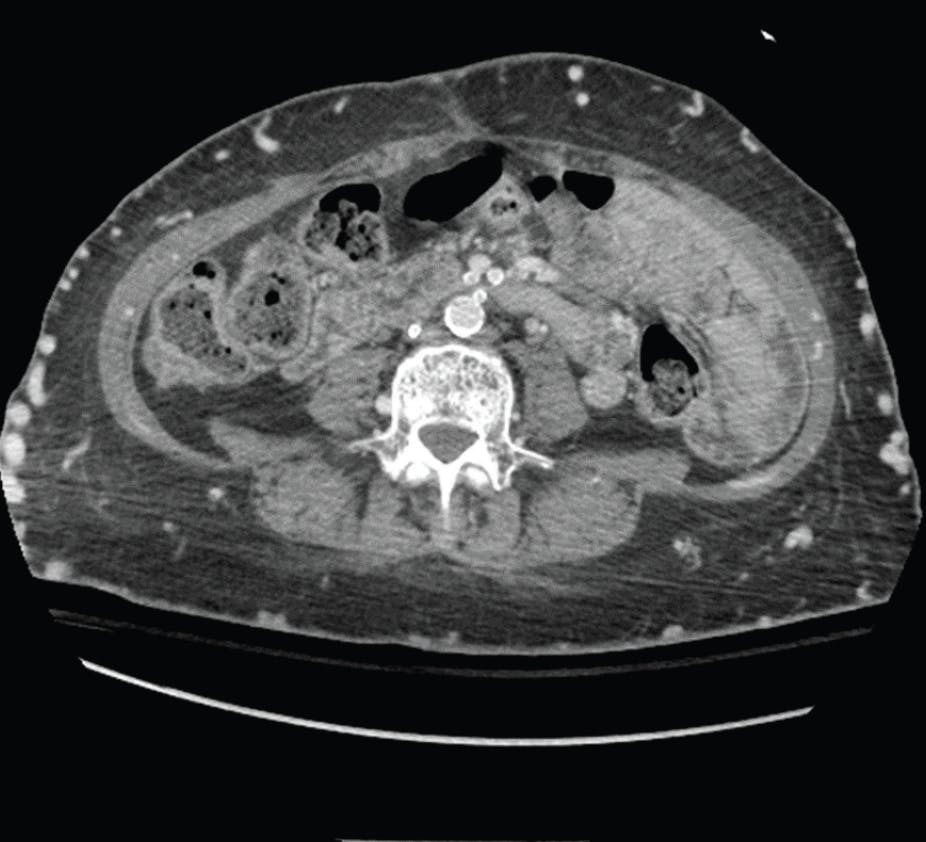
Figure 2. Cross-sectional CT of the abdomen and pelvis demonstrating an occluded IVC and body wall venous collaterals.
The physical exam was notable for significant varicose veins in both lower extremities associated with left leg swelling. Both upper extremities had evidence of prior grafts that were thrombosed on marked venous hypertension. She had evidence of abdominal and chest wall venous collateralization across the chest and abdominal and pelvic walls anteriorly and posteriorly and had mild facial swelling. In the left groin, a femoral artery–to–femoral vein loop arteriovenous graft (AVG) was palpable with a thrill. A bruit was detectable, and duplex ultrasound demonstrated flow volumes of approximately 400 mL/min.
Assuming the CVO should be treated, what techniques would be most beneficial?
Dr. Etkin: Due to prolonged bleeding and signs of venous hypertension in the leg, I think recanalization of the IVC and iliac system should be attempted. It is usually beneficial to access both common femoral veins and an IJV, which allows for through-and-through access. This case is especially challenging due to concomitant IVC and SVC occlusion. I would begin by recanalizing the iliac veins and IVC through a bilateral femoral approach using a 0.035-inch stiff hydrophilic guidewire such as the stiff, angled Glidewire (Terumo International Systems) combined with a 5-F hydrophilic catheter (Glidecath, Terumo International Systems). As the wire is advanced, it’s useful to perform intermittent contrast injections through a catheter to identify channels within the vein and use it as a guiding map. This also allows for identification of any perforations in the vein, which usually are not clinically significant. If this fails, sharp recanalization techniques can be employed such as using the rigid end of a guidewire. In this case, if the IVC occlusion is crossed but the wire does not advance into the SVC from below, I would leave a “marker” (catheter or balloon) in the nubbin of the SVC from below. Then, proceed to establish right IJV access and attempt SVC recanalization, again utilizing blunt recanalization techniques first (crossing the occluded vessel with a hydrophilic wire and catheter). If that fails, sharp recanalization can be considered, such as using the rigid end of the wire. Other sharp recanalization technique includes using a Chiba biopsy needle (Cook Medical), which is inserted via IJV access and used to puncture the occluded vein under the multiple-angle fluoroscopic guidance, aiming for a “marker” placed in the SVC via transfemoral access. Once the needle crosses the lesion, wire access is established and the needle is removed. This allows for through-and-through wire access (“flossing”), which facilitates reconstruction (angioplasty and stenting) of the chronically occluded veins. After the occlusion is crossed, sequential dilation followed by stenting of SVS, IVC, and iliac system should be done.
Dr. Lessne: Dr. Sachdev presents a very challenging patient with severe end-stage venous disease, but sadly, this is not an uncommon situation. Before pursuing any treatment, the goals of therapy must be well defined. In the patient presented, there are two predominant objectives: (1) maintaining life-sustaining access for hemodialysis and (2) ameliorating severely symptomatic lower extremity venous insufficiency.
If the patient’s femoral loop graft is sufficient to maintain adequate hemodialysis, then central thoracic venous recanalization is less pressing; however, if/when the loop graft is lost, then the patient will present with an access emergency, so having a backup access plan ready to implement is paramount. Here, I would evaluate the abdominal CT to determine feasibility of a transhepatic catheter access that could be placed if the femoral graft thromboses irreparably. However, given the thigh graft has already had multiple thrombotic episodes, it is reasonable and prudent to proceed with central thoracic venous recanalization.
For these potentially complex procedures, proper technique will dictate their success and safety. Initially, all patients should receive a chest CT venogram (CTV) for procedural planning, which will often yield more information than catheter-based venography because patent but hibernating veins central to an obstruction may not be visible on a conventional venogram. In this patient, a transhepatic access may be needed to facilitate bidirectional thoracic venous recanalization, and I would choose my additional accesses (either arm, groin, or neck) based on CTV. During the recanalization procedure, robust support with at least a triaxial system (sheath, guide catheter, crossing catheter) is mandatory. Many patients are referred to me with failed attempts at recanalization by operators who do not adhere to this principle. For crossing, I rely heavily on 0.035- and 0.018-inch hydrophilic wires but have found 30-gf chronic total occlusion wires very useful. Sharp or radiofrequency-assisted recanalization is an important technique for those managing patients with thoracic chronic venous obstructions/occlusions, but operators must be properly trained to use these devices given their potential hazards. Finally, any attempts at complex thoracic venous recanalization must include preparation for emergent complications with balloon occlusion catheters and stent grafts readily available; if SVC recanalization is planned, pericardiocentesis trays should be available in the room and the chest should be marked and prepped ahead of time to prepare for the possibility of cardiac tamponade.
Dr. Yuo: This is a very challenging patient who is clearly reaching the end stage of dialysis access options. Percutaneous access to the venous limb of the AVG may enable recanalization of the entire system. Although this was attempted previously, given the patient’s history and the lack of any other easy options, an additional endovascular attempt is warranted. I typically use a coaxial system, including a 6-F, 45-cm sheath to provide support to a 5-F Glidecath and an 0.035-inch Glidewire. Smaller weighted-tip wires along with a Quick-Cross support catheter (Philips) may also be useful. Once the lesions have been crossed and a wire is placed into the RA, sequential balloon angioplasty would proceed as usual. I find that starting with a small, 5-mm balloon is quite safe, and then I can upsize as clinically indicated.
Finally, a multidisciplinary approach with intraprocedural input from both vascular surgery and interventional radiology can be advantageous, as different specialists can bring their differing experiences to bear on the problem at hand.
If recanalization of the iliac system on the left is successful, would stenting be indicated, and if so, what could be used?
Dr. Lessne: The same principles to cross a chronic thoracic venous occlusion outlined previously apply for the iliac veins as well: robust support, hydrophilic wires, and good pre- and intraprocedural imaging. If/when successful crossing is achieved, stent placement in this case is mandatory with angioplasty alone offering essentially zero durable patency. Stent sizing and placement should be guided by angiography and intravascular ultrasound (IVUS) to ensure that stents extend from healthy vein to healthy vein. In this case, if the long-segment IVC occlusion is recanalized, a long stent complex will be required. There are multiple options to stent reconstruct the IVC and iliofemoral veins, and this will depend on if the right iliac veins can be recanalized at the same time, allowing for preservation of the iliac venous confluence. In general, my practice has shifted almost entirely to using dedicated venous stents in the IVC and iliac veins, although for a large-diameter IVC, Gianturco Z-stents (Cook Medical) are sometimes placed.
Dr. Yuo: In this case, placement of a stent graft would be indicated given the high likelihood of vessel reocclusion with balloon angioplasty alone. Covered stent grafts like the Viabahn (Gore & Associates) and Covera (BD Interventional) have been approved for use in the dialysis access circuit for peripheral lesions, but their use in the central venous segment has not been studied extensively. The Wrapsody stent graft (Merit Medical Systems, Inc.) is being studied for treatment of central venous occlusive lesions in the dialysis access circuit, but this is only available in the United States in the context of an investigational device exemption trial. Although noncovered stents like the Abre (Medtronic), Venovo (BD Interventional), and Zilver Vena (Cook Medical) have been approved for use in the venous system, these were not studied in a dialysis access circuit, and it is not clear that their performance will be satisfactory in this setting. Uncovered stents perform poorly in the peripheral segment of the dialysis access circuit due to aggressive intimal hyperplasia. In this case, since the IVC and iliac veins were occluded originally, covering or jailing branches is not a significant concern. As such, in this setting, I would favor placement of a covered stent graft if recanalization were successful. Regardless of whether a covered or uncovered stent is placed, this would clearly be a high-risk system due to the length that would be required; close surveillance to ensure continued functionality would be warranted.
Dr. Etkin: If recanalization of the left iliac system and IVC is successful, stenting should be performed to improve long-term patency. It is also potentially easier to reintervene on occluded stents, as they serve as a target for recanalization. Self-expanding, noncovered stents are generally used. IVUS should be used for more accurate sizing of the venous stents. The goal diameter should be 18 to 22 mm in IVC, 16 mm in common iliac veins, and 12 to 14 mm in external iliac veins. A large stent (20-22 mm) should be placed in the suprarenal IVC and kissing stents should be deployed in a “double-barrel” fashion extending from the IVC down to external iliac veins. There are several FDA-approved venous stents that can be used, such as Abre, Venovo, and Zilver Vena. Size can be one of the limitations of these stents. Abre and Venovo are available in 20 mm, and the largest Zilver Vena available is 16 mm. Wallstent (Boston Scientific Corporation) can be used if a large size is required.
Given that this patient has survived 20 years on hemodialysis and assuming continued longevity, should an attempt be made to create a new access in the upper extremity to prevent bleeding episodes related to venous hypertension in the leg? Why or why not?
Dr. Etkin: This patient is young, and I would attempt to keep the lower extremity access working as long as possible. This might mean repeated interventions to manage venous hypertension and maintain patency. Upper extremity access in this case would not be easy because she already had multiple failed grafts in both arms. Patency and function of upper extremity access will be compromised by SVC occlusion and the venous hypertension will be further exacerbated. I would only attempt to create new arm access if the SVC occlusion can be successfully treated first.
Dr. Lessne: An important point here is that the decision to proceed with any intervention should be made with the patient’s overall condition in mind: This patient with heart failure, hypercoagulability, and ongoing smoking should be evaluated with a multidisciplinary team to establish life expectancy and the patient’s ability to tolerate complex procedures. However, assuming reasonable longevity, the most compelling reason to pursue thoracic vein recanalization and upper extremity access is in case of femoral AVG failure, which would result in a dialysis access emergency if an alternative access plan is not already in place. Ligation of a currently functional femoral AVG only to alleviate venous hypertension symptoms is not advisable in a patient with this degree of end-stage venous disease. That said, if the patient’s lower extremity venous hypertension is resulting in sufficiently severe symptoms—as measured by objective scales such as Villalta score or Venous Clinical Severity Score—then iliocaval recanalization and stent reconstruction is the most effective way to alleviate these symptoms. As a less aggressive measure for bleeding, selective targeted treatment of symptomatic superficial veins could be helpful.
Dr. Yuo: The patient’s bilateral upper extremity CVO predisposes an upper extremity AV access to severe arm swelling that could be painful and disfiguring. Compounding the issue, the AV access may be impossible to use. However, in our practice, there are examples of patients who have had acceptable patency rates even with complete CVO. This patient’s history suggests that her lower extremity varicosities are severe and associated with significant pain and swelling. As such, and after discussing the possible complications with the patient in full, I feel that an upper extremity access is a reasonable solution if salvage of the current left thigh AVG is not possible.
What options are available if the left groin AVG permanently fails?
Dr. Yuo: Peritoneal dialysis has not yet been discussed for this patient, and if it is an option, it should be explored. Similarly, transplant is an option that should also be considered. However, in many cases, hemodialysis is the only realistic option. In that case, if recanalization from the left lower extremity is impossible, another option is recanalization of the right iliac system and IVC up to the RA. If successful, a crossover bypass from the left to the right venous system could then be constructed and may provide enough venous outflow to improve the patient’s left lower extremity symptoms. Separately, the venous access from the right femoral vein would allow for use of the Surfacer Inside-Out access catheter system (Merit Medical Systems, Inc.), which would enable inside-out recanalization of the right innominate vein and IJV. This would be a first step to placement of a Hero system. Another solution involves surgical exposure of the RA and creation of a right brachial artery to right atrial AVG. Although this is clearly a very aggressive approach, reasonable patency rates have been described, and this patient may benefit if she is otherwise healthy.
Finally, if all AV access options have been exhausted, a transhepatic tunneled dialysis catheter is the ultimate option. However, these are associated with very high rates of dislodgment, bleeding, and infection and should be reserved as an absolute last resort.
Dr. Etkin: The patient should be evaluated for peritoneal dialysis because it will offer an option that is not impacted by CVOs. Options to consider for hemodialysis access include upper arm access if SVC reconstruction is possible. Endovascular SVC recanalization and reconstruction should be considered first, as described previously. Another option to consider is a brachial vein–to-atrial bypass as an outflow for upper arm access. However, this patient might be a poor candidate for this procedure based on comorbidities, and the fact that she lives in a nursing home indicates her poor overall condition.
The Surfacer Inside-Out access catheter system can also be considered, which allows a placement of chest wall hemodialysis catheter in patients with occluded SVS. A transhepatic catheter can also be considered.
Dr. Lessne: This is a great question, and delineation of alternative hemodialysis access options as well as peritoneal dialysis and transplant evaluation must be a constant consideration when treating patients with ESRD, especially those with complex venous occlusions. For this patient, I think transhepatic venous dialysis catheter placement is an appropriate choice if emergency access is required. More exotic (and higher risk) accesses such as obturator vein, renal vein, or direct right atrial access have been described but are rarely performed in practice. In this patient with already tenuous access, I would pursue thoracic venous recanalization with an aim at placing a tunneled dialysis catheter that could be converted to a Hero graft if the patient is a candidate. It is important to keep in mind that recanalization of all jugular, subclavian, and brachiocephalic veins is not necessarily required for catheter or Hero graft placement because direct brachiocephalic or SVC access (which may be through an extravascular, transmediastinal route) could be feasible. Dr. Sachdev’s case nicely illustrates the many challenges inherent in treating patients with complex venous disease and highlights the many opportunities we have as a community to provide life-improving and life-sustaining therapies.
APPROACH OF THE MODERATOR
Thank you to Drs. Etkin, Lessne, and Yuo for their expert opinions on this difficult case. We made two separate attempts to recanalize the left iliac system and the innominate/SVC to no avail. Despite the multiple episodes of thrombosis, the AVG in the left femoral region remained usable. For this reason, the patient was managed with occasional declot procedures as needed and compression therapy to help with the effects of venous hypertension in the leg. Unfortunately, the patient was admitted elsewhere with cellulitis involving the left thigh, as well as thrombosis of the graft, and this became an access emergency, as Dr. Lessne predicted. A plan was made to remove the graft, temporize with a temporary catheter, treat with intravenous antibiotics, and determine whether the graft could be replaced in the same side but routed in such a way as to avoid the previously infected area. If so, she will be maintained on suppressive antibiotics. We will also discuss goals of care and determine whether a transhepatic catheter is feasible given the configuration of her IVC. She has failed peritoneal dialysis in the past. This case highlights the fact that patients on dialysis often outlive published life expectancies, and we must be prepared to engage creative solutions for difficult problems such as this. Limiting catheter use can obviously help maintain long-term options for the future but is not always realistic or feasible.
Advertisement
Advertisement