Advertisement
Advertisement
August 2022
Laser In-Situ Fenestration for Repair of a Symptomatic Extent I Thoracoabdominal Aortic Aneurysm
Moderator: Sammy Siada, DO;
Panelists: Ravi N. Ambani, MD, MBA; Jeniann A. Yi, MD, MSCS, RPVI; and Sara L. Zettervall, MD, MPH
CASE PRESENTATION
A female patient in her mid-80s presented to the emergency department with a 1-day history of severe back and chest pain and mild shortness of breath. She was hypertensive, with a systolic blood pressure (BP) of 180 mm Hg, and had a normal heart rate. She was awake and conversant, and her pain improved with aggressive BP control. CTA demonstrated a 10-cm extent I thoracoabdominal aortic aneurysm (TAAA) with stranding around the aorta and bilateral pleural effusions (Figure 1, Figure 2, and Figure 3). Her hemoglobin was 12 g/dL, which was stable when compared to the hemoglobin level obtained 12 hours prior at the referring hospital. Her serum creatinine was 1.1 mg/dL, and the remainder of her laboratory tests were unremarkable.
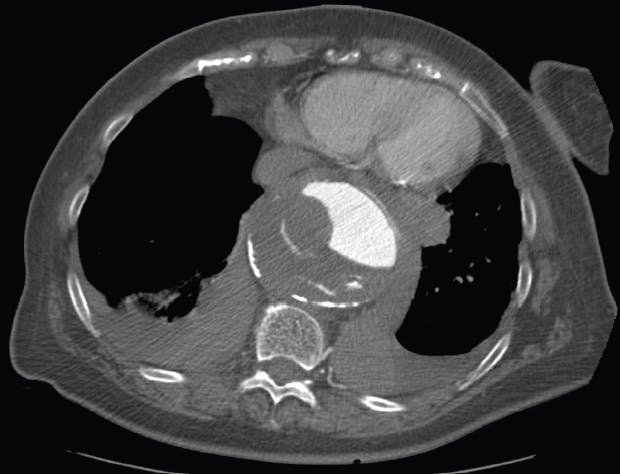
Figure 1. Axial CT view of the aneurysm in the distal thoracic aorta with significant mural thrombus, bilateral pleural effusions, and compression of the heart.
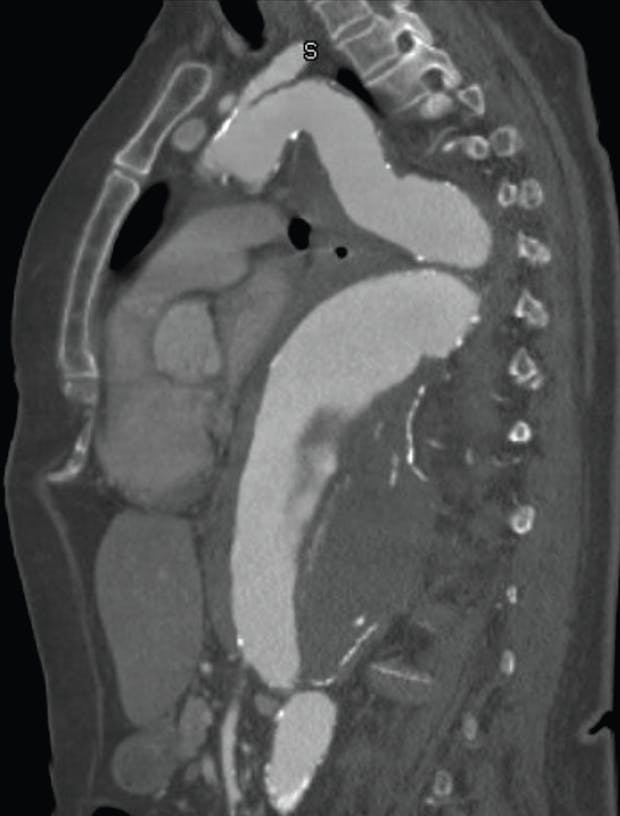
Figure 2. Sagittal CT view of the aneurysm.
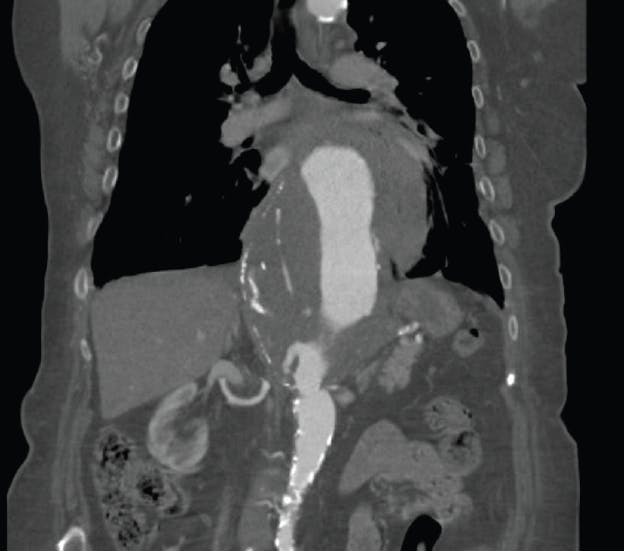
Figure 3. Coronal CT view of the aneurysm.
How do you approach off-label repair of complex aortic aneurysms in the urgent/emergent setting?
Dr. Ambani: In the urgent/emergent setting, I tend to approach complex aortic aneurysms with one thought in mind: What is the safest and quickest way I can get this patient out of the operating room with the skill set that I possess? I tend to avoid off-label use of devices due to my current practice setting, but there are ways to address these pathologies while staying within the confines of FDA regulations, which include hybrid approaches combining open surgical and endovascular techniques.
Dr. Yi: At our hospital, we do not have an investigational device exemption (IDE) for physician-modified endovascular aortic repair; however, we often do these repairs in the elective setting with complex TAAAs. Therefore, in an urgent/emergent setting, if I think it is amenable to endovascular repair, I would perform a thorough informed consent process with the patient. Specifically, they should understand that while I have experience with these surgeries and feel comfortable attempting repair using an endovascular approach, this is an off-label use of a device that is not approved by the FDA. I make sure they understand that open repair is still possible and may be necessary prior to proceeding. I also mention other potential complications and have a thorough discussion of their personal risk factors.
Dr. Zettervall: When approaching patients with TAAAs (whether elective or symptomatic), data have shown that branched or fenestrated endovascular aneurysm repair (B/FEVAR) in high-volume centers leads to superior perioperative mortality and morbidity as compared with open TAAA repair in appropriately selected patients.1,2 Given this, for patients aged > 70 years and those with extensive comorbidities, I favor B/FEVAR in patients with suitable anatomy, regardless of elective or urgent symptom status.
When assessing these patients, my approach is always uniform. I start by getting a full picture of their current state of health. This includes review of their clinical frailty score and metabolic equivalents (METs), discussion of their day-to-day activity to get an understanding of their functional status and cognitive baseline, and consideration of comorbidities. I find that 80 years of age looks very different from patient to patient, as are the goals for the remaining years of their lives.
After that assessment, the most critical step is a frank discussion involving the patient and their family to ensure that everyone has a complete picture of what life may ultimately look like in both the best- and worst-case scenarios after repair, as well as in the event of rupture. I think it is incredibly important to be clear that even though we have the skill set to fix these aneurysms percutaneously, there are still significant life-altering risks. That being said, in robust octogenarians, we have achieved excellent results treating extent I to IV TAAAs even in the urgent setting.
Based on the patient’s age, anatomic factors, and acuity, would you offer this patient repair? If so, what would your approach entail?
Dr. Ambani: Initially, her advanced age makes me hesitate to offer any definitive operation because the risks, no matter the approach, are quite high. I would perform a thorough evaluation of her functional status to assess her level of frailty, and if she was truly a high-functioning, independent octogenarian, then I would have a frank discussion with her about the risks, benefits, and options for repair prior to proceeding. However, with the stranding and size, I would not delay care very long. I would offer her a hybrid repair with renovisceral debranching based off the iliac arteries and TEVAR from the left subclavian artery through the paravisceral segment.
Although this would involve an abdominal operation, visceral debranching is well tolerated and would allow me to reestablish flow to each mesenteric vessel and the renal arteries with minimal ischemia time to the associated organs, all while avoiding an aortic cross-clamp. The aneurysm would then be excluded with TEVAR coverage from healthy proximal descending thoracic aorta, through the paravisceral aorta, and terminating in the infrarenal abdominal aorta.
Dr. Yi: Assuming reasonable access and after a thorough discussion of risks and goals of care, I would offer physician-modified endograft repair if the patient is truly stable after BP control. I would plan for four vessel fenestrations (but if technically challenging would be willing to sacrifice the celiac) to achieve seal in the proximal descending thoracic aorta. An alternative would be laser fenestration rather than back-table modification, in which case, prestenting would help tremendously. I would plan for arm access as well to help with vessel cannulation, particularly given the abrupt narrowing of the aorta below the aneurysm that could make cannulation and graft manipulation difficult.
Dr. Zettervall: If this patient wishes to go forward and is functionally independent and healthy, I would offer repair. To approach this, I would use centerline reformatting to ensure that her visceral vessels are of sufficient caliber and there is a proximal and distal landing that is parallel and healthy, even if that requires a carotid-subclavian transposition. In patients where healthy proximal seal is not achievable, I consider further staging with open or endovascular arch treatment, followed by thoracic endovascular aortic repair (TEVAR) extension and definitive repair if the patient is robust enough to tolerate this multistaged approach.
In patients with sufficient seal distal to the left common carotid artery (such as this patient), I use a staged approach beginning with a TEVAR landing 1 to 2 cm above the celiac artery. I then plan for definitive repair with a four-branched device. This approach may deviate somewhat from the traditional desire to fix the entire aorta in one setting due to presenting back pain, but I have found that if the back pain was an isolated event, the benefit of a staged procedure outweighs the relatively low risk of rupture. However, if the pain returns at any time, I complete the repair immediately. In my practice, I am fortunate to have access to the t-Branch (Cook Medical), as part of our independent physician-sponsored IDE, which provides excellent and durable results and can be used in nearly all aortic anatomies due to the 34- to 18-mm-diameter taper. If I did not have that available at the time, I would plan for a physician-modified TEVAR device using four branches, with a distal bifurcated device given the size of her aneurysm in the visceral segment.
If you were to offer the patient endovascular repair, would place a lumbar cerebrospinal fluid (CSF) drain? What is your algorithm for CSF drain placement in the setting of TAAA?
Dr. Ambani: Yes, I would plan to place a lumbar CSF drain on this patient for my hybrid repair due to the length of thoracic aorta that I would be covering, which includes coverage of the artery of Adamkiewicz, intercostal arteries, and lumbar arteries.
Anytime I’m covering > 15 cm of thoracic aorta, I routinely have a preoperative lumbar CSF drain placed. Although this may be a conservative approach, my practice pattern is partially dictated by my institution. I fully acknowledge that there are risks associated with drain placement, but as there is no in-house provider to place a drain if a neurologic event were to occur, I tend to drain these patients preoperatively. Intraoperatively and postoperatively, strict BP parameters are maintained with mean arterial pressure (MAP) > 80 mm Hg while the drain is in place. In the end, we all know that an extended period of time between a neurologic event and drain placement can lead to devastating long-term consequences, and whatever drainage strategy allows for the best patient outcome should be employed.
Dr. Yi: Typically, I do not preemptively use a lumbar drain, especially if I can preserve the left subclavian and hypogastric arteries. Generally, my algorithm is to use neuromonitoring in the operating room, as well as serial neurologic exams with increased MAP goals postoperatively and selective drainage for symptomatic patients. However, I would consider it for this patient given how high in the chest I would need to cover to obtain seal.
Dr. Zettervall: For this patient, who has 100% aortic coverage from the common carotid artery through the iliac vessels, I would place a prophylactic spinal drain, although this remains a topic of much debate, with great need for a randomized trial.
For most patients undergoing TAAA with B/FEVAR, I proceed without prophylactic spinal drain placement. Instead, directed management is initiated intraoperatively, including MAP elevation to > 90 mm Hg on placement of all aortic components, with strict avoidance of hypotension. All patients are then extubated at the end of the procedure and assessed, with any lower extremity weakness leading to lumbar drain placement before leaving the operating room. Of equal importance is the ongoing permissive hypertension in the postoperative period, which we continue through 1-month follow-up. The current exception to this rule is patients with hypogastric or subclavian artery occlusion, prior spinal cord injury, or complete aortic coverage from the left carotid to the common iliac arteries, as would be the case for this patient.
APPROACH OF THE MODERATOR
Given the patient’s age, frailty, and complex anatomy, an endovascular approach was favored. When it comes to off-label use of endovascular devices for aortic aneurysm, as part of obtaining informed consent, it is important to be transparent with patients and their families that the procedure will be off label. In the elective setting, patients must be given the option to receive their care at a regional aortic center with an IDE. In this case, a meeting was had with the patient and her family regarding the options. Consideration for transfer was discussed given that she was hemodynamically stable, but she opted to remain local for surgery because of the concern for impending rupture and her preference to remain close to family.
The patient was taken to the hybrid operating room, and bilateral percutaneous femoral access was achieved after induction of general anesthesia. A lumbar spinal drain was not placed because the patient had patent subclavian and internal iliac vessels, as well as several patent large lumbar arteries. The first step was prestenting of the visceral vessels, which was done using balloon-expandable, bare-metal stents, landing the stents flush with their respective ostia. The celiac artery proved to be the most difficult due to its sharp downward angle and severe stenosis at its origin.
Two thoracic stent grafts were then deployed sequentially starting just distal to the subclavian artery and ending about 2 cm below the renal arteries. One of the major challenges of this case was a “napkin-ring” stenosis of the aorta at the level of the renal arteries, where it measured about 14 mm in diameter, making use of a steerable sheath a major challenge. Therefore, it was decided to perform balloon angioplasty with an aortic occlusion balloon at this segment of the aorta to facilitate easier cannulation of the renal arteries.
A steerable sheath was then positioned at the level of the superior mesenteric artery (SMA) ostium, using the stent as the target, as confirmed on two orthogonal views. A 2-mm laser atherectomy catheter was used to create a fenestration in the graft fabric, and an 0.018-inch wire was then advanced into the target vessel. The fenestration was first dilated with a 2.5-mm cutting balloon, followed by a 4-mm cutting balloon, and finally a 6-mm plain balloon. A covered balloon-expandable stent was then deployed with a flare in the aortic component of the stent. This technique was repeated for the renal arteries. The celiac artery was sacrificed after confirming patency of the gastroduodenal artery on the SMA angiogram. Completion angiography demonstrated complete exclusion of the aneurysm, patency of the stented visceral vessels, and an absence of any endoleaks.
1. Coselli JS, LeMaire SA, Preventza O, et al. Outcomes of 3309 thoracoabdominal aortic aneurysm repairs. J Thorac Cardiovasc Surg. 2016;151:1323-1337. doi: 10.1016/j.jtcvs.2015.12.050
2. Motta F, Oderich GS, Tenorio ER, et al; United States Aortic Research Consortium. Fenestrated-branched endovascular aortic repair is a safe and effective option for octogenarians in treating complex aortic aneurysm compared with nonoctogenarians. J Vasc Surg. 2021;74:353-362.e1. doi: 10.1016/j.jvs.2020.12.096
Advertisement
Advertisement