Advertisement
Advertisement
August 2022
Type B Aortic Dissection and Delayed Mesenteric Ischemia
Moderator: Rana Afifi, MD;
Panelists: Javairiah Fatima, MD, FACS, RPVI, DFSVS; Aleem K. Mirza, MD; and Eanas S. Yassa, MD, FACS, FSVS
CASE PRESENTATION
A male patient in his mid-70s presented to the emergency department (ED) with sudden sharp back and abdominal pain, as well as left lower extremity pain. The patient had a history of ascending aortic aneurysm repair with aortic valve repair, hypertension, obstructive sleep apnea (on bilevel positive airway pressure at home), and atrial fibrillation. On physical examination, the patient was obese, the abdomen was soft with minimal tenderness, his leg pain had resolved, and he had palpable femoral pulses. His white blood cell count was 9,400 µL and his lactic acid level was 1.2 µmol/L.
What would be your initial imaging modality of choice, and why?
Dr. Fatima: Given prior aortic aneurysm repair and his clinical presentation, suspicion for aortic aneurysm/dissection is high on the differential. For aortic pathology, CTA is my preferred imaging modality for multiple reasons. A CTA provides contrast-enhanced, high-resolution images of the aorta, allowing for coronal and sagittal reconstructions along with three-dimensional, volume-rendered, maximal intensity projection views that are instrumental for preoperative planning. It is readily available and can be rapidly acquired in a very short time, even in a hemodynamically labile patient. Additionally, it can be used to create a centerline of flow that can be used for precise aortic diameter and distance measurements if treatment is pursued.
Dr. Mirza: In this patient with sudden-onset back pain and prior history of ascending aortic aneurysm repair, I would be concerned for aortic dissection and recommend performing a CTA of the chest, abdomen, and pelvis. This patient may have malperfusion due to dynamic compression of the true lumen resulting in abdominal and left lower extremity pain. A high-resolution CTA with thin (1-mm) slices will also permit accurate planning for any potential endovascular intervention.
Dr. Yassa: Given the patient’s relatively benign physical examination and lab findings, it is feasible to imagine that someone like this may have been discharged from the ED with muscle relaxants and nonsteroidal anti-inflammatory drugs. The astute clinician, however, should recognize that the patient’s history of ascending aortic aneurysm repair and valve replacement are suggestive of a possible aortic etiology for the chest and back pain. If the patient's back pain was in his low back, a bedside ultrasound in the ED would be my first choice to ensure he did not have a ruptured abdominal aortic aneurysm and allow me to quickly mobilize my operating room team while further imaging is being obtained. If there is upper back pain, or based on results of the ultrasound, I would then proceed with performing a CTA of the chest, abdomen, and pelvis dissection protocol. Our institution has systole-gated imaging; however, this is not available at all institutions, so at least ensuring a noncontrast, arterial, and delayed phase is critical.
CASE CONTINUED
CTA was completed, which showed type B aortic dissection (B1-9) with a dissection flap extending into the SMA with thrombosis of the false lumen (Figure 1). In this initial CTA, flow was noted in the SMA distal to the thrombosis, and the bowel appeared normal with no signs of bowel ischemia.
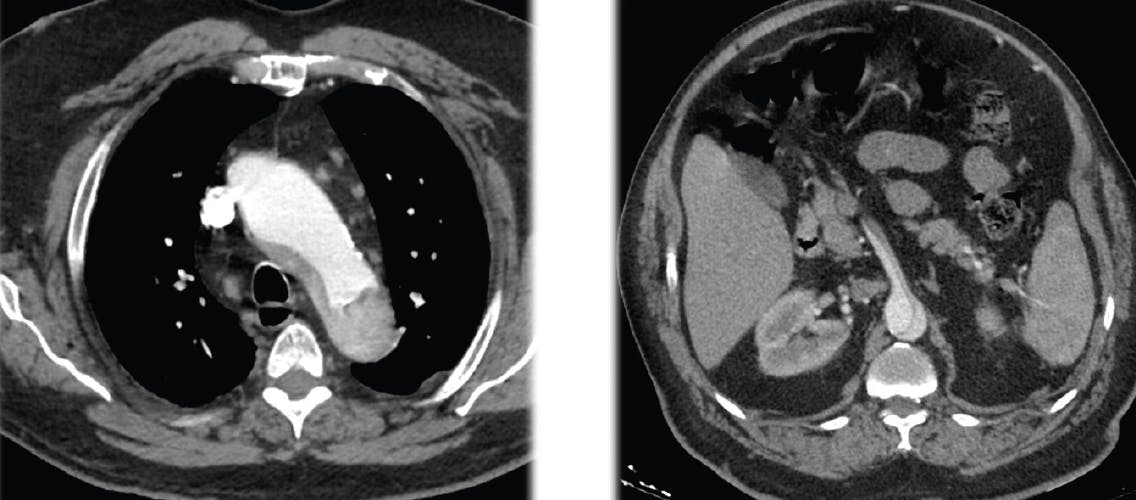
Figure 1. Axial CTA images of the chest and abdomen, with dissection flaps extending into the aortic arch and superior mesenteric artery (SMA) with thrombosis of the false lumen.
Given these findings, how would you manage this patient?
Dr. Yassa: The new grading system is so helpful here because it makes it clear across institutions and physicians that the flap begins proximal to the left subclavian artery (LSA) and terminates in the infrarenal aorta. The patient’s labs do not suggest critical malperfusion of the viscera. If his exam is also not suggestive of acute mesenteric ischemia and he is making urine, moving his legs, and has an intact distal vascular exam, I would begin with medical management. I would arrange for admission to the intensive care unit (ICU) with a focus on impulse control with Β blockade and blood pressure (BP) control. I typically have a Foley catheter placed, so a drop in urine output suggestive of renal malperfusion is immediately noted. In the ICU, we have an order set that includes hourly neurovascular checks, including leg raises to assess for spinal cord malperfusion.
Dr. Fatima: I would consider treatment with carotid subclavian bypass and thoracic endovascular aortic repair (TEVAR) up front. It appears that the patient’s initial presentation was consistent with at least a transient malperfusion to the lower extremity as well as the SMA as manifested by abdominal pain in the setting of dissection extension into the SMA. This is likely secondary to a dynamic flap that increases the risk of a recurrent episode or worsening malperfusion with hemodynamic fluctuations. The goal of TEVAR would be to cover the proximal tear, and although the dissection flap may extend to zone 1, previous repair of the ascending aorta is protective from the risk of retrograde type A aortic dissection. I would extend the TEVAR (covered stent) to just above the level of the celiac artery. I find intravascular ultrasound (IVUS) critical to evaluate true lumen expansion, especially at the level of the visceral vessels in these situations. If adequate true lumen expansion is established along with brisk opacification of the SMA on digital subtraction angiography (DSA), no further intervention is warranted. However, if the true lumen remains severely compressed or with significant dynamicity of the flap and suboptimal SMA opacification, I would consider extension utilizing the PETTICOAT (provisional extension to induce complete attachment) technique with the Zenith dissection uncovered stent (Cook Medical) to the terminal aorta. If this does not optimize SMA perfusion, SMA stenting into the true lumen would be the next step; however, it is rarely necessary.
Dr. Mirza: This patient presents with an acute type B aortic dissection with extension into the SMA. Due to the presence of abdominal pain, I would be concerned about malperfusion and have a high index of suspicion that there was a dynamic compression of the true lumen, resulting in mesenteric ischemia. However, this patient has proximal extension into zone 1 with dilatation of the aortic arch and likely the ascending aorta based on the select images of his CTA, which may complicate intervention. Anti-impulse therapy with strict BP control would be initiated in the ED, and if his mild abdominal pain resolved and the serial laboratory evaluation was normal, medical management and close observation could be continued. However, I would have a low threshold for early operative intervention if pain recurred or labs worsened. A mesenteric duplex ultrasound could also be performed to provide objective information on the quality of SMA perfusion. We would repeat the CTA no later than 24 to 48 hours to reassess.
CASE CONTINUED
Based on the benign abdominal examination, normal laboratory testing results, and reconstitution of flow in the SMA distal to the dissection flap in CTA, the decision was made to treat medically without vascular intervention.
A few days after his admission, the patient was intubated due to respiratory failure, the abdominal exam changed, lactate was around 3 µmol/L, and the patient required the addition of pressors to maintain normal BP. Small bowel ileus was noted on repeat CTA with the same findings of the dissection.
How would you treat the patient at this point?
Dr. Mirza: The main concern given the patient’s initial presentation and CTA findings is mesenteric ischemia due to false lumen pressurization and compression/collapse of the true lumen. Although the dissection extends from zone 1 to 9, the primary goal of intervention would be true lumen expansion to restore flow to the viscera and lower extremities. As such, management would depend on the location of the proximal entry tear. If situated in zone 2 or distal, I would utilize the PETTICOAT technique (without initial LSA revascularization if zone 2 deployment was required) to depressurize the false lumen with proximal entry tear coverage using a short stent graft and expand the true lumen distally with self-expanding, bare-metal stents (BMSs) to the aortic bifurcation. Stenting to the aortic bifurcation usually requires the use of two BMSs. Once the stent graft has been deployed, I typically place a long distal BMS first that extends from the aortic bifurcation to above the celiac axis. This is followed by placement of the proximal BMS, avoiding overlap of the two bare-metal components across the paravisceral segment in an effort to reduce difficulty of future procedures, such as fenestrated-branched repair, that require renal-mesenteric stenting.
IVUS is used routinely prior to stent placement to ensure true lumen placement of the aortic wire and demonstrate the degree and level of true lumen collapse as well as the dynamic behavior of the septum. IVUS is utilized again after stent placement to assess the improvement of true lumen expansion. Selective angiography of the SMA could also be considered because the dissection extended into this vessel. Finally, this patient also had a lactic acidosis and new vasopressor requirement. I would consider evaluation of bowel viability with a diagnostic laparoscopy.
Dr. Fatima: At this point, it is clear that the patient has mesenteric ischemia secondary to malperfusion from a dynamic acute dissection and needs urgent operative intervention. I would proceed with endovascular intervention with a zone 2 TEVAR as described in my previous response. I would use IVUS and DSA imaging of the SMA to guide the need for PETTICOAT extension across the visceral vessels and possible need to stent the SMA, along with Doppler and direct SMA assessment and bowel perfusion on exploratory laparotomy, with a plan for interval reevaluation of the bowel in 24 to 48 hours prior to closure.
Dr. Yassa: At this point, I would be concerned that this dissection has moved from “uncomplicated” to complicated. I would immediately start by allowing the BP to rise if at all possible, even if it meant lightening up on the sedation. The concept behind this is that if the distal SMA is being dominantly fed by the false lumen, differential luminal filling as a result of BP management may be contributing to some gut malperfusion. This would be a temporizing measure while arrangements are made for the operating room with a plan for endovascular intervention on the dissection. My first priority with a CT scan showing an ileus is to restore visceral perfusion before irreversible ischemia sets in. I would discuss with general surgery that the patient would benefit from a diagnostic laparoscopy after the malperfusion has been corrected.
Based on the report of the dissection extending proximal to the left common carotid artery (B1-9), I would be concerned about obtaining adequate proximal seal with minimal risk of retrograde dissection. I typically plan for IVUS to assess for any large fenestrations with special attention to what may be the entry fenestration. If the entry fenestration is more distal with a retrograde component to the dissection, I would focus attention on covering the entry tear with a covered stent graft. My preference is to use the Zenith dissection stent system with the TXD proximal covered stent graft and then the BMS PETTICOAT technique to support true lumen expansion through the paravisceral segment.
The information obtained from the IVUS would be critical to determine if I have a stent option without needing to proceed with arch reconstruction. If LSA coverage is needed to address the proximal fenestration, then my practice has evolved to include intraoperative laser fenestration of the LSA. If left carotid coverage is also needed, zone 1 TEVAR may be necessary in which case a prestent subclavian-to-carotid bypass, carotid-carotid bypass, or possible left carotid laser fenestration versus parallel graft would be considered. Finally, I would also be mindful that there is still value in primary fenestration of the dissection flap if no safe stent option exists. This would still accomplish getting the patient out of the acute ischemic state and allow for future planning for dissection treatment when a suitable proximal landing zone can be created.
When using the dissection stent system, it is important to avoid overlapping BMSs in the paravisceral segment in case branch vessel intervention is needed.
CASE CONTINUED
The patient was taken to the operating room. Due to the worsening tenderness and guarding in the abdominal physical exam, an exploratory laparotomy was performed. A “dusky” small bowel was found, which seemed reversible. We proceeded with endovascular treatment, using the PETTICOAT technique with a Zenith TX2 dissection endovascular graft and two Zenith TX2 dissection endovascular stents. The dissection flap extended to zone 1, and the entry tear was close to but distal to the LSA.
Taking into account the previous ascending repair (protective against retrograde type A), dissection flap that extends into zone 1, the urgency of the procedure, and the hemodynamic and respiratory instability of the patient, we did not place a lumbar drain and opted to proceed with the simplest, fastest procedure and avoid coverage of the LSA. We landed the proximal covered stent graft in zone 3 just distal to the LSA, and two Zenith TX2 stents were used with the distal landing zone above the aortic bifurcation. We ensured that the overlap between the BMSs was proximal to the visceral vessels.
We had two concerns with this approach. The first one was that the proximal stent graft would not cover the entry tear, which may lead to a collapse of the stent. In that case, we were ready to extend our coverage to zone 2 and perform LSA revascularization. The second concern would be that despite the expansion of the true lumen, the flow in the SMA is still compromised by the thrombosed false lumen, in which case we would proceed with the stenting of the SMA.
Completion angiography and IVUS demonstrated a good expansion of the true lumen and brisk filling of the SMA.
How would you manage the SMA dissection?
Dr. Yassa: I would not anticipate a need to intervene on the SMA if I am able to treat the primary aortic dissection. Reexpansion of the true lumen is typically adequate to restore normal gut perfusion. I would plan to obtain a selective mesenteric angiogram and possibly even transduce pressure in the distal SMA if needed. In rare cases, I have had to stent into a branch vessel at the time of TEVAR, but I would not expect to have to do this.
I would ask that general surgery perform a diagnostic laparoscopy after reperfusion is restored to confirm no frankly ischemic segments of the bowel needed to be resected.
Dr. Mirza: In cases where the dissection flap extends into the visceral vessels, addressing aortic true lumen compression frequently improves visceral and renal flow. After coverage of the proximal entry tear and the PETTICOAT technique, I would interrogate the SMA with selective angiography. If there was any evidence of continued malperfusion, I would proceed with SMA stenting, carefully using a balloon-expandable stent proximally and a self-expanding stent distally if required.
Other useful adjuncts are rotational DSA and cone-beam CT, which allow accurate on-table assessment with dynamic and static images, respectively. This can be performed both pre-SMA stenting to help in the assessment of SMA flow and after stenting for evaluation of the entire repair.
Dr. Fatima: Expansion of true lumen is usually sufficient to have favorable hemodynamics in the SMA without any need for further intervention. TEVAR with a covered stent to the celiac artery often gets the job done; however, when necessary, a PETTICOAT extension is a great tool to ensure adequate true lumen expansion and visceral perfusion as it tacks back the intima across visceral and renal vessels in acute dissection. In the event that malperfusion persists despite these interventions, an SMA stent can be a useful adjunct to reestablish SMA perfusion.
CASE SUMMARY
We proceeded with cannulating the SMA, and selective angiography was performed, which demonstrated a patent artery with no evidence of stenosis or occlusion. Therefore, we opted not to stent the SMA and finish the endovascular repair. The abdomen was reexplored, the bowel seemed to be recovering, there was an excellent Doppler signal at the base of the mesentery, and the abdomen was closed with a negative pressure dressing. The patient improved clinically, nasogastric output decreased, the abdominal examination improved, he was off pressors, and the lactate level returned to normal. The patient was taken back to the operating room for abdominal washout and closure, the bowel recovered completely, and abdomen was closed on postoperative day 1.
Advertisement
Advertisement