Advertisement
Advertisement
December 2022 Supplement
Sponsored by Surmodics™
Tackling Acute-to-Chronic Thrombus and Embolus
A conversation with Drs. J. Michael Bacharach and Thekla Bacharach.
J. Michael Bacharach, MD, FACC, FSCAI, MPH, specializes in vascular medicine and peripheral vascular invention at North Central Heart in Sioux Falls, South Dakota. Thekla Bacharach, MD, specializes in vascular surgery at Sanford Vascular Associates in Sioux Falls, South Dakota.
You’ve now become familiar with the Pounce™ Thrombectomy System in clinical use. What do you think the device can do that other thrombectomy devices cannot?
Dr. Mike Bacharach: The Pounce™ System is excellent at removing organized thrombus, not just soft thrombus. In this respect, it outperforms any other thrombectomy device I’ve used. Importantly, it does this without aspiration. It’s able to squeeze the liquid from the thrombus, so you’re not removing a lot of normal blood along with the clot.
Dr. Thekla Bacharach: I would add that reducing the size of the clot this way allows the device to remove a large amount of organized material using only a 7 Fr sheath. That’s fantastic, especially with elderly patients. Occasionally, you can get a good result with an aspiration device, but the occlusion has to be all acute material. In most cases, you can’t have acute-on-chronic thrombus. If you use an aspiration device and intravascular ultrasound afterward, you see that there is still a lot of material outside the flow channel that aspiration didn’t catch. I’ve seen no other device that removes organized thrombus the way that the Pounce™ Thrombectomy System does.
Aside from capturing organized material, what has been your experience removing large volumes of thrombus with the Pounce™ Thrombectomy System?
Dr. Mike Bacharach: Initially, we thought it would perform best for short embolic events or segments of thrombus. But early in my experience—I think it was the first or second case I did with the Pounce™ device—we were facing an occlusion of the entire superficial femoral artery (SFA) (see case study). I was concerned about overwhelming the device with too much thrombus, but it worked fine. We placed the baskets quite far distally, close to the popliteal past the thrombus, and placed the collection funnel proximal to the thrombus. We made a few passes, identified the culprit lesion, and got the thrombus out. This exceeded all our expectations. The device is highly efficient at dehydrating clot.
I should mention that as we were dragging the clot back, we had an embolic event to the profunda femoris artery (PFA) because we were in the early learning phase. After we got the clot out of the SFA, we wired the PFA and pulled out the clot. The focal embolic event in the PFA was easily removed. We were very pleased with this case.
You mentioned the limitations of aspiration thrombectomy in comparison to the Pounce™ Thrombectomy System. Can you describe them?
Dr. Thekla Bacharach: I’ll give you an example. Before I had access to the Pounce™ Thrombectomy System, I had a case of a chronic occlusion in a gentleman who presented with a heart attack. The next day, I was asked to come in for a consult because he had a cold leg that was partially due to heart failure. I attempted to open the occluded vessel in the leg and was able to cross pretty easily, meaning it was probably acute or subacute. I used two different aspiration thrombectomy devices but couldn’t really get anything out other than a flow channel. Once I had the flow channel, I was able to stent and reestablish flow. I was pleased with the result. However, a small amount of chronic material ended up in the common femoral artery (CFA). I tried everything to suck it out because you can’t stent that area, but that didn’t work. At that point, I didn’t have access to the Pounce™ Thrombectomy System, and I had to take this patient to the operating room. It was very frustrating. When they were putting the patient under anesthesia, he became unstable. Luckily, he did fine overall. If I had a device like the Pounce™ Thrombectomy System that could have pulled out that chronic organized thrombus, it would have been game-changing.
Dr. Mike Bacharach: This is a key point. Embolization is a major problem that occurs with all kinds of procedures. If you embolize chronic material into a vessel after you open a total occlusion, you’ve now taken a successful revascularization and managed to make it more complicated. Lytics are not a great option. In the past, this is when people turned to surgical rescue. Providing a percutaneous option to remove emboli makes the Pounce™ Thrombectomy System really valuable.
The Pounce™ Thrombectomy System is indicated for removal of emboli as well as thrombi. Have you used it for embolectomy unrelated to thrombus removal?
Dr. Mike Bacharach: One of our cases was an acute embolic occlusion to the arm from an atrial fibrillation in an elderly patient (see case study). That’s a case that normally would have gone to the operating room for a brachial arteriotomy and thrombectomy. We used the Pounce™ device with femoral access, came up from below, wired it, and identified the embolus. We made one pass with the Pounce™ Thrombectomy System and immediately restored circulation. We were done. We didn’t have to balloon anything, didn’t have to stent anything, and the patient was placed back on anticoagulation and went home the next day. No operation, no anesthesia, no incisions. Certainly, this was much more cost-effective and much easier for the patient. That’s not a case that responds to aspiration thrombectomy or lytic therapy because atrial fibrillation–related occlusions are likely to be organized clot or plaque. We now have a catheter-based mechanism for these types of cases.
Can you describe other cases you’ve done with the Pounce™ Thrombectomy System that would have been difficult or impossible with other percutaneous thrombectomy devices?
Dr. Mike Bacharach: One would be a superior mesenteric artery dissection that resulted in a thrombotic occlusion (see case study). It sputtered along for a few days and the patient worsened. Normally, that’s a case that would have gone to an emergent open laparotomy. Previously, there was no percutaneous device that could capture and remove that kind of thrombus. If you try to use lytic therapy and it embolizes distally, now you’ve made the patient worse. Without the Pounce™ Thrombectomy System, I wouldn’t have taken that case on. Because I had the Pounce™ device, I was able to do it and had good results.
What has been your experience with the Pounce™ Thrombectomy System for chronic total occlusions (CTOs)?
Dr. Mike Bacharach: We’ve performed cases requiring recanalization of CTOs in the aortoiliac segment. This is generally uncomplicated; you can get through the occlusion above or below. These patients almost always require some form of stent. The problem is that some of these patients have been chronically occluded for a long time and the occlusions are very hard. Some patients have gone from having a CTO to a more heterogeneous mix of debris and material, some organized, some not. This is a minefield. You get through the occlusion, stent it, and if there’s soft plaque, you just stent it up against the side wall. Occasionally, passing through that, you release some of the soft plaque, and where does it go? To the CFA, and now it obstructs everything. You went from being the hero to being the zero. With the Pounce™ Thrombectomy System, you can remove much more of this mixed, organized material before stenting, and if needed, you can remove any embolization further down without a surgical rescue.


Case Report: Successful Removal of Brachial Embolus With the Pounce™ Thrombectomy System
By J. Michael Bacharach, MD, FACC, FSCAI, MPH, and Thekla Bacharach, MD
Patient Presentation
After discontinuation of anticoagulation for a dental procedure, an 84-year-old woman with a history of chronic atrial fibrillation developed sudden onset of a cold, painful right upper extremity. She was transferred from the neighboring community hospital and was immediately administered heparin.
Diagnostic Findings
The initial angiogram revealed a tortuous brachial artery with an embolus obstructing flow into the radial and ulnar arteries (Figure 1).
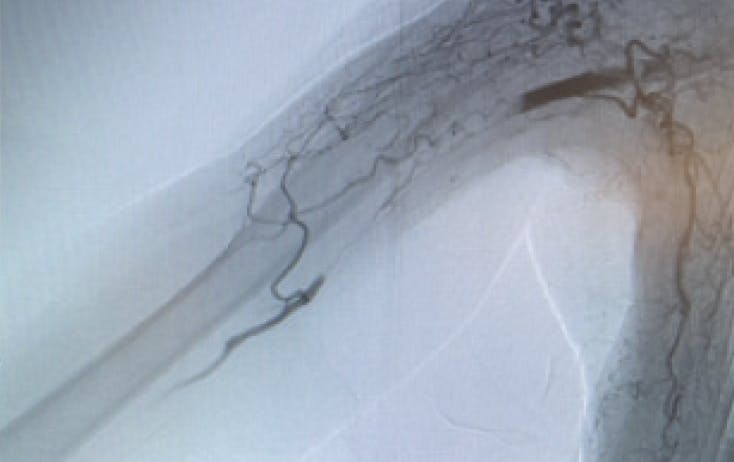
Figure 1. Right brachial embolus.
Treatment
Due to the patient’s level of ischemia, intervention took place promptly after the diagnosis. The Pounce™ Thrombectomy System was prepared and one pass was made with the device. The Pounce™ Thrombectomy System successfully removed the embolus in the brachial artery (Figure 2) and reestablished flow into her radial and ulnar arteries (Figure 3). No further treatment (eg, drug-coated balloon or stent) was considered necessary.
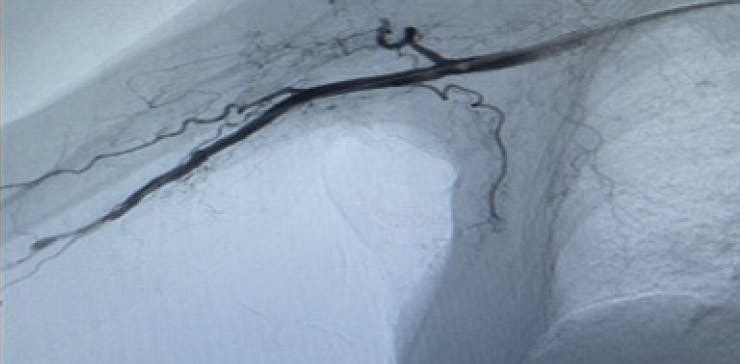
Figure 2. Embolus removed from the right brachial artery after one pass with the Pounce™ Thrombectomy System.
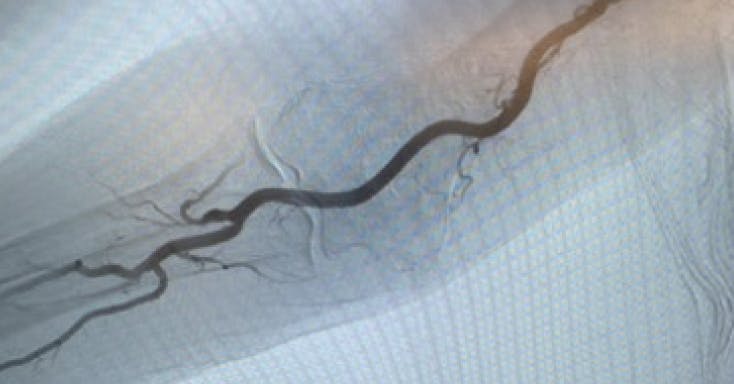
Figure 3. Flow reestablished into right radial and ulnar arteries after one pass with the Pounce™ Thrombectomy System.
Post Procedure Outcome
The patient was discharged shortly after the procedure without a surgical intervention or any use of thrombolytics.
Case Report: Successful Use of the Pounce™ Thrombectomy System to Remove a Superior Mesenteric Artery Thrombus
By J. Michael Bacharach, MD, FACC, FSCAI, MPH, and Thekla Bacharach, MD
Patient Presentation
A 49-year-old man presented with 3- to 4-day history of worsening abdominal pain that acutely worsened the night of presentation at the hospital. The patient was initially put on heparin and prepared for diagnostic imaging.
Diagnostic Findings
Left brachial access was obtained and an initial angiogram was taken that demonstrated an occlusion of the super mesenteric artery (SMA) (Figure 1). After the guidewire passed through the occlusion, indicating thrombus, the Pounce™ Thrombectomy System was prepared for use.
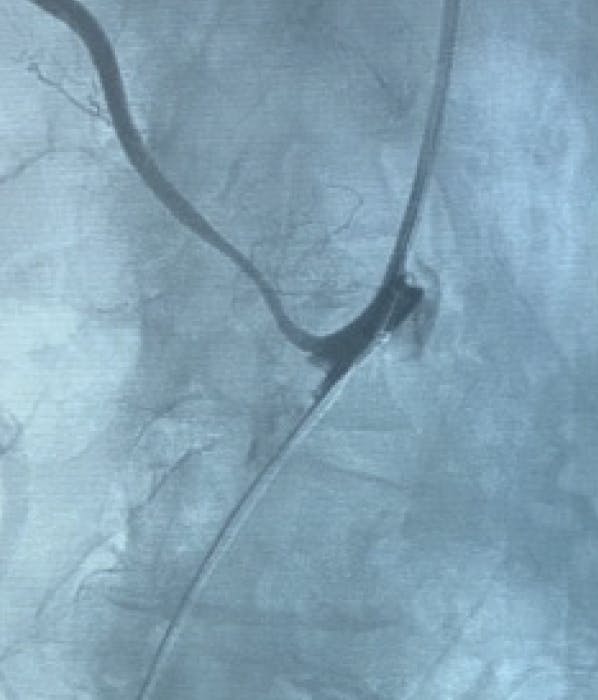
Figure 1. Left SMA obstruction.
Treatment
The clinical presentation was suggestive of an SMA dissection with subsequent thrombotic occlusion. The absence of an acute abdominal finding on examination and absence of air in the bowel wall or free air suggested that an endovascular approach could be attempted in hopes of saving the patient from an abdominal surgical procedure. Two successful passes were made with the Pounce™ Thrombectomy System, removing a moderate amount of thrombotic material (Figure 2). The vessel became patent but revealed an underlying lesion, which was stented with a 7.0 X 18 mm self-expanding stent. A final angiography was taken, revealing a widely patent SMA (Figure 3).
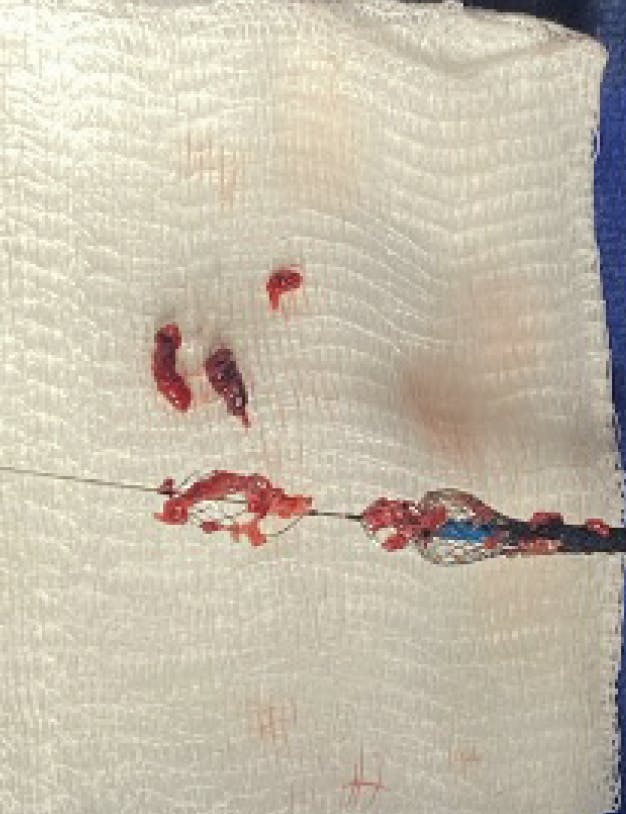
Figure 2. Thrombus removed after second pass with the Pounce™ Thrombectomy System. (Used with permission of the author.)
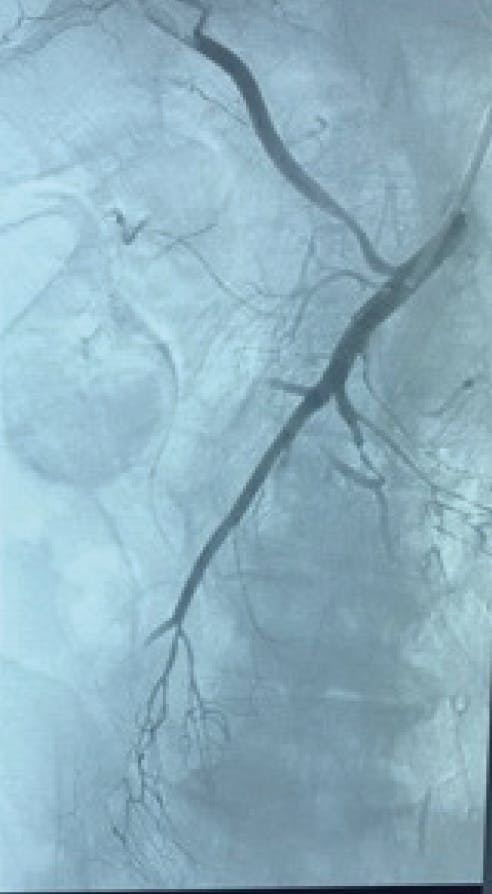
Figure 3. Widely patent SMA post procedure.
Post Procedure Outcome
The patient was discharged shortly after the intervention. The Pounce™ Thrombectomy System gave us the ability to quickly remove thrombus percutaneously and mechanically and promptly treat the underlying lesion, avoiding the need for an abdominal procedure.
Case Report: Successful Removal of 20 cm SFA Thrombus With the Pounce™ Thrombectomy System
By J. Michael Bacharach, MD, FACC, FSCAI, MPH, and Thekla Bacharach, MD
Patient Presentation
A 52-year-old woman presented to the emergency department with a cold and painful lower left leg. The pain started suddenly 6 days prior to presentation. Her past medical history included chronic lung disease. She was admitted to the hospital, started on intravenous heparin, and deemed to be a candidate for angiography.
Diagnostic Findings
An initial noninvasive study showed an ankle-brachial index (ABI) of 0.5 on the left side. The right common femoral artery (CFA) was accessed using ultrasound guidance, and a 6 Fr sheath was placed. An aortogram and left lower extremity angiogram were obtained, demonstrating patent infrarenal aorta and bilateral iliac arteries, CFA, and profunda femoral artery (PFA). However, the superficial femoral artery (SFA) was occluded with thrombus just beyond the origin, with reconstitution of the distal SFA via PFA collaterals (Figure 1). The lower leg was perfused with two-vessel runoff via the anterior tibial (AT) and peroneal arteries.
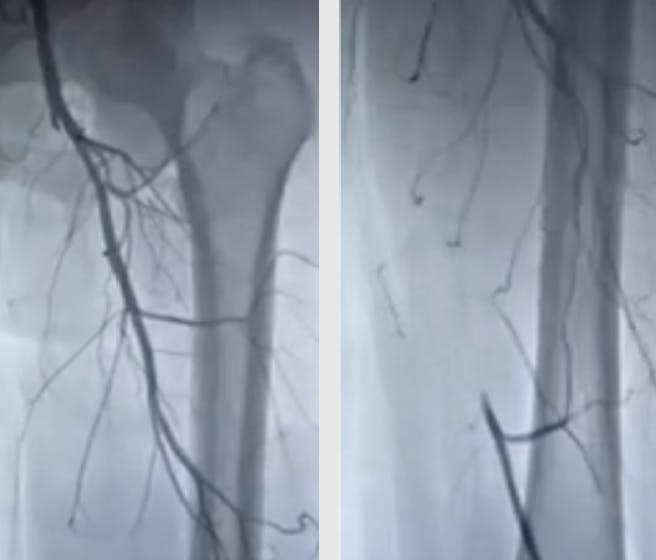
Figure 1. Occluded SFA with thrombus.
Treatment
A 7 Fr sheath was introduced into the right femoral access and advanced to the left CFA. From there, the SFA occlusion was crossed using a .018 NaviCross® Support Catheter and an .018 Glidewire Advantage® Peripheral Guidewire. The NaviCross® Support Catheter was removed from the vasculature, and the Pounce™ Thrombectomy System, which consists of a delivery catheter, a basket wire, and a funnel catheter, was prepared. The delivery catheter was advanced past the thrombus, and the basket wire was then advanced through the delivery catheter and deployed in the mid popliteal artery. The funnel catheter was advanced to the ostium of the SFA and deployed. The baskets were then pulled back along the length of the SFA (approximately 20 cm) into the funnel, and the funnel and baskets were removed through the 7 Fr sheath.
The first pass removed a significant amount of well-organized, firm thrombi and emboli (Figure 2). After this initial pass, an angiogram revealed a widely patent proximal SFA with a high-grade lesion in the mid portion of the SFA. A small section of the thrombus embolized into a large PFA branch due to the funnel being positioned proximal to the ostium of the PFA (Figure 3). The thrombus was easily crossed with an .018 Glidewire Advantage® Peripheral Guidewire, and the delivery catheter was placed into the mid PFA. The basket wire and funnel catheter were deployed in the mid PFA and ostial PFA, respectively.
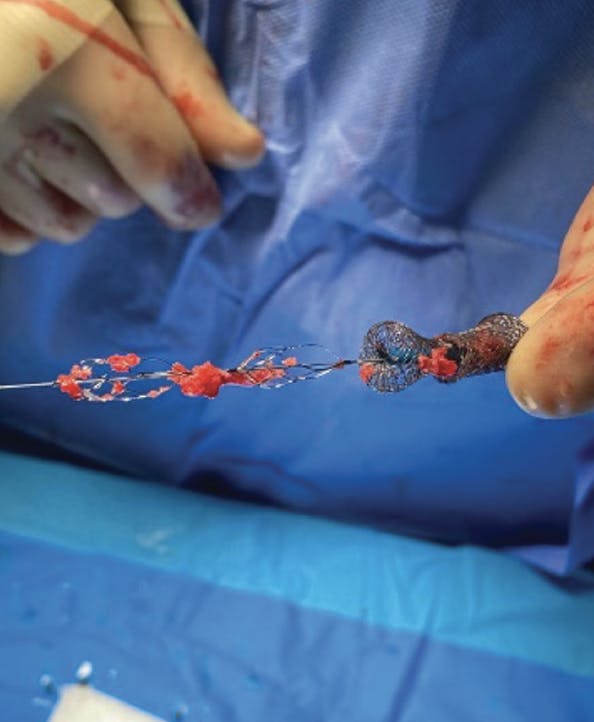
Figure 2. SFA thrombi and emboli removed after one pass. (Used with permission of the author.)
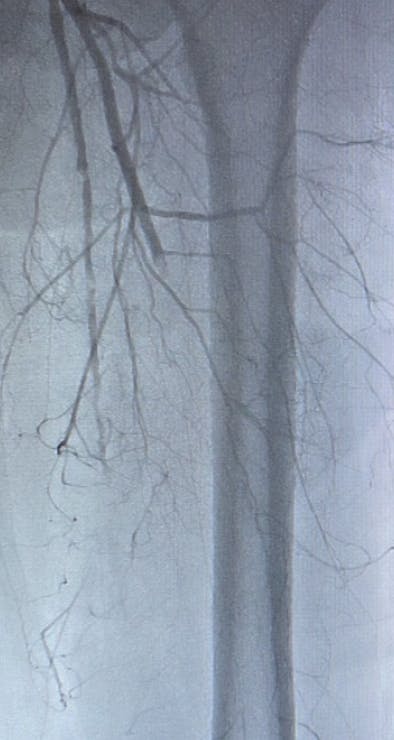
Figure 3. PFA embolus.
The baskets were retracted into the funnel, the system was externalized through the sheath, and the clot was successfully removed from the body. Angiography demonstrated normal PFA branches with no evidence of distal embolization (Figure 4). One final pass was performed using the Pounce™ Thrombectomy System to further clean out the SFA. Repeat angiography revealed complete thrombus removal in the SFA, with evidence of a mid SFA atherosclerotic lesion that appeared to have been the etiology of the arterial thrombosis. A 5 mm X 250 mm IN.PACT™ Admiral™ Drug-Coated Balloon was deployed and inflated at the site of the lesion. A final complete angiogram was conducted, demonstrating a widely patent left CFA, SFA, and PFA (Figure 5). The left popliteal artery was patent with two-vessel runoff to the foot via the AT and peroneal with no evidence of distal embolization.
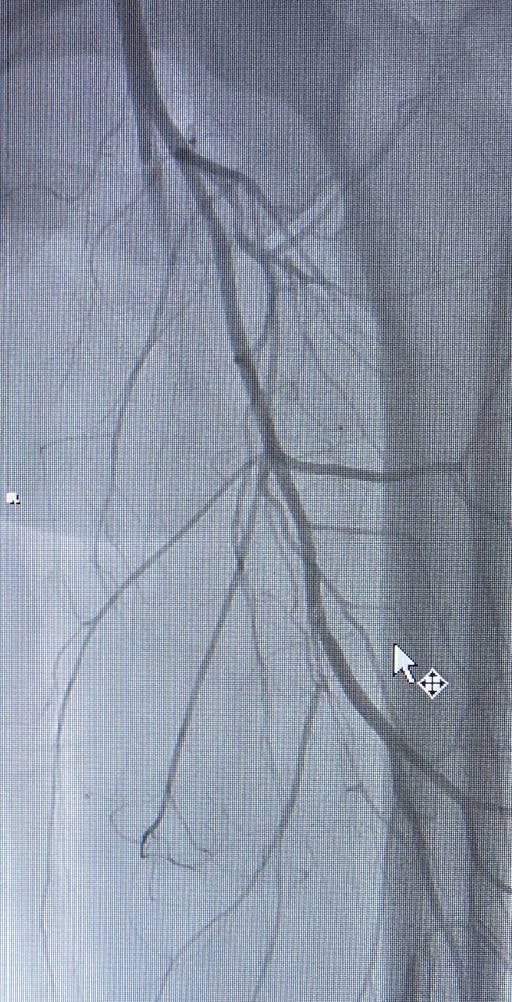
Figure 4. Patent PFA after one pass.
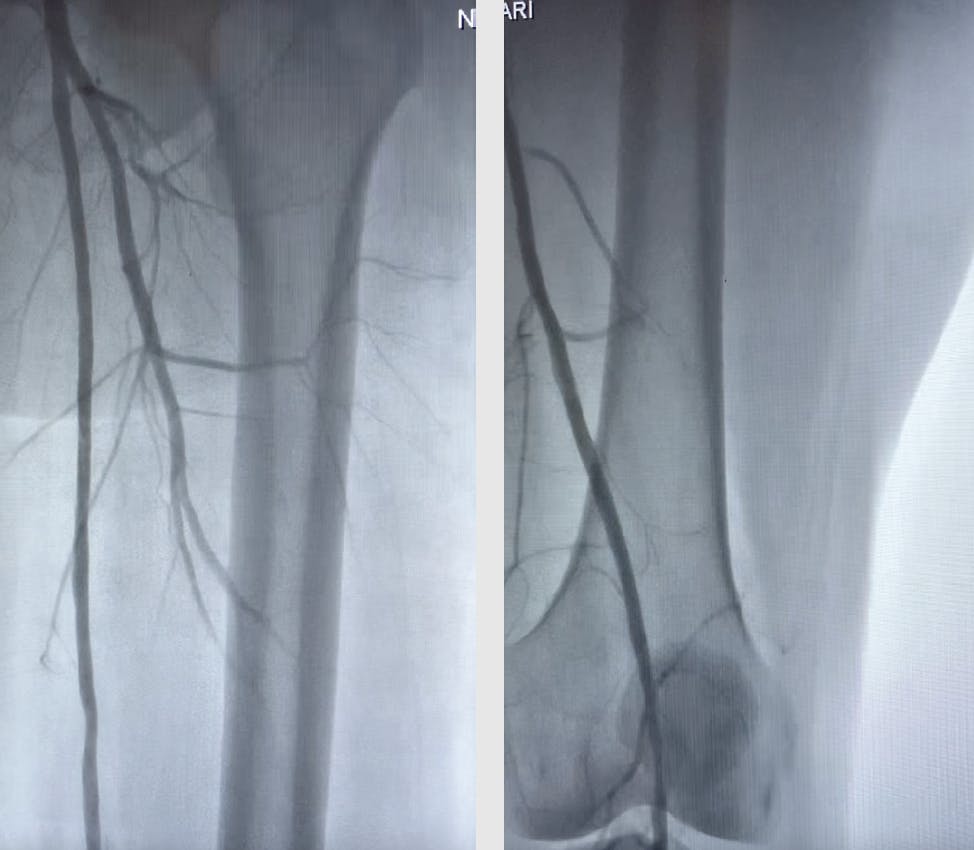
Figure 5. Final angiogram demonstrates a widely patent left CFA, SFA, and PFA.
Post Procedure Outcome
The patient was discharged home 12 hours after the procedure with dual antiplatelet therapy and encouraged to quit smoking. The follow-up arterial duplex ultrasound 1 month later demonstrated no evidence of stenosis with a normalization of the ABI to 1.0 on the left side.
The Pounce™ Thrombectomy System provided a first-line treatment for the long-length thrombotic occlusion in the diseased SFA. The quick restoration of flow both in the SFA and PFA avoided the need for thrombolytic therapy, further surgical revascularization, or any intensive care unit bed time.
Caution: Federal (US) law restricts the Pounce™ Thrombectomy System to sale by or on the order of a physician. Please refer to the product Instructions for Use for indications, contraindications, warnings, and precautions.
SURMODICS, POUNCE, and SURMODICS and POUNCE logos are trademarks of Surmodics, Inc. and/or its affiliates. Third-party trademarks are the property of their respective owners.
Advertisement
Advertisement