Advertisement
Advertisement
February 2022
An Institutional Approach to Pulsatile Tinnitus Evaluation and Management
How neurointerventionalists at UCSF identify and treat the underlying causes of this life-altering condition.
By Kazim Narsinh, MD; Keerthi Valluru, MSE; David Saloner, PhD; and Matthew R. Amans, MD, MSc
Pulsatile tinnitus (PT) refers to an abnormal perception of rhythmic sound without an extracorporeal source. PT can have a debilitating impact on patients, leading to insomnia, anxiety, depression, and poor concentration. PT can also be a harbinger of serious health problems, such as stroke or blindness. Therefore, looking for an underlying cause of PT is essential. Some underlying causes of PT need to be treated to eliminate risk of stroke or blindness. Other causes of PT are sometimes treated to address the symptom itself or the depression and anxiety that often accompany it.
CLINICAL EVALUATION
Careful attention to a patient’s history and examination can often lead to a correct diagnosis. During our evaluation at the University of California, San Francisco (UCSF), we record the patient’s PT onset, progression, severity, exacerbating or mitigating positions, movements, and other factors. We also record any associated symptoms, particularly, hearing loss, headache (also including any positional component), vision changes, vertigo, anxiety, and depression, and, crucially, we assess the impact on the patient’s life. For example, in patients with history of recent neck manipulation, an arterial dissection may have occurred, and one might initiate low-dose aspirin for stroke prevention, even if the diagnosis is not yet confirmed. The PT itself should be further characterized by synchronicity with the patient’s heartbeat and pitch. Low-pitch PT (buzzing or humming) is frequently venous, while higher-pitch PT (whooshing, hissing, or fetal heartbeat) is frequently arterial, and very high–pitch PT (ringing or a continuous high pitch that takes breaks with each heartbeat) is not likely to be vascular. Detailed otologic history is also helpful, including hearing loss, prior ear surgery, ear infections, and ear pain or drainage.
We also spend considerable time performing a detailed physical examination during our clinical evaluation at UCSF. We auscultate the entire calvarium and neck in addition to the precordium. High-flow vascular malformations of the scalp—such as arteriovenous malformations (AVMs) or arteriovenous fistulas (AVFs)—can produce PT, so the entire frontal and temporal calvarium is auscultated. Manual compression of the cervical blood vessels can exacerbate or improve vascular PT. Specifically, jugular vein compression, occipital artery compression, and head turning can be very helpful maneuvers. For example, a low-pitch, pulse-synchronous hum that improves with ipsilateral jugular compression or Valsalva maneuver suggests a venous cause of PT. Higher-pitched PT heard over a dural venous sinus with a bounding pulse palpable in a scalp artery is suspicious for a dural AVF (dAVF). These maneuvers are of course performed in conjunction with a complete neurologic, cranial nerve, and otoscopic examination. The otoscopic exam should particularly assess for impacted cerumen, middle ear fluid, cholesteatoma, and glomus tumor, among other abnormalities. If intracranial hypertension is suspected, fundoscopic examination should also be performed to evaluate for papilledema, especially if the patient has an abducens nerve palsy, headaches that are worse when supine, history of vitamin A analog ingestion, sleep apnea, obesity, or PT that is worse in the morning.
IMAGING AND THREE-DIMENSIONAL MODELS
We use MRI as the first-line diagnostic imaging modality for PT evaluation. MRI has the highest sensitivity for detecting the most dangerous causes of PT. MRI exams must be very high quality, and we use specific MRI protocols at UCSF for evaluating PT.1 We sometimes also use advanced MRI protocols to research cerebrovascular hemodynamics (doi: 10.1136/neurintsurg-2021-018015).2 For example, we use four-dimensional flow MRI to assess flow velocity, turbulent kinetic energy (TKE), vorticity, and other hemodynamic metrics to understand an individual patient’s blood flow and model sound propagation (Figure 1). We also build patient-specific, three-dimensional (3D)–printed models to test the effects of intervention on an individual’s blood flow profile (Figure 2).3 These 3D-printed models allow us to predict whether a specific intervention will be effective.
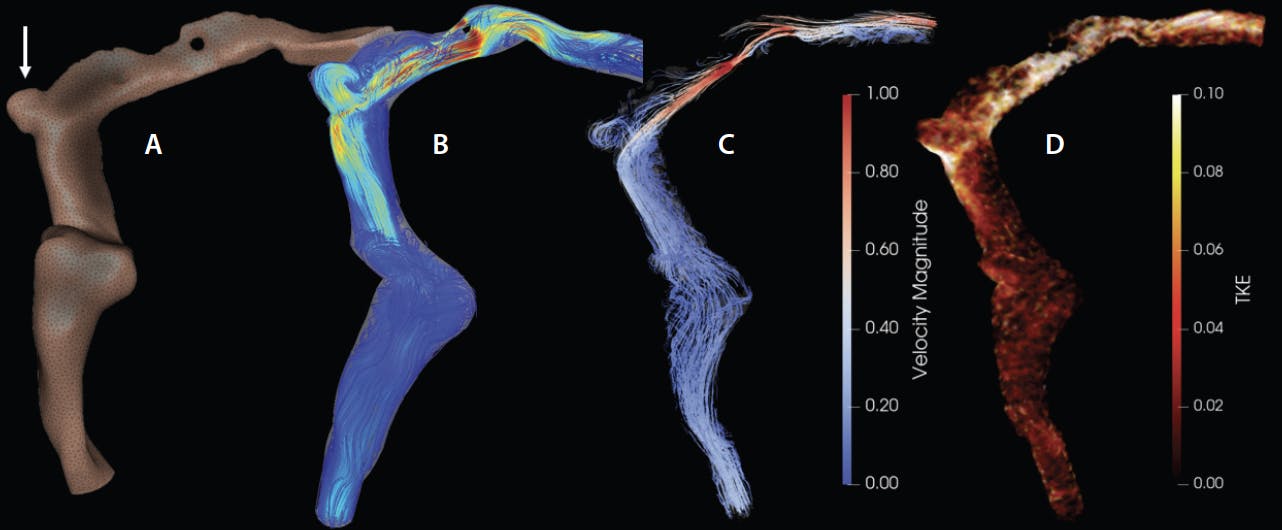
Figure 1. Noninvasive measurement of hemodynamics in a sigmoid sinus diverticulum assessed using four-dimensional flow MRI. Surface rendering of right sigmoid sinus with diverticulum (arrow) (A), computational fluid dynamic model (B), flow velocity profile (C), and TKE profile (D).
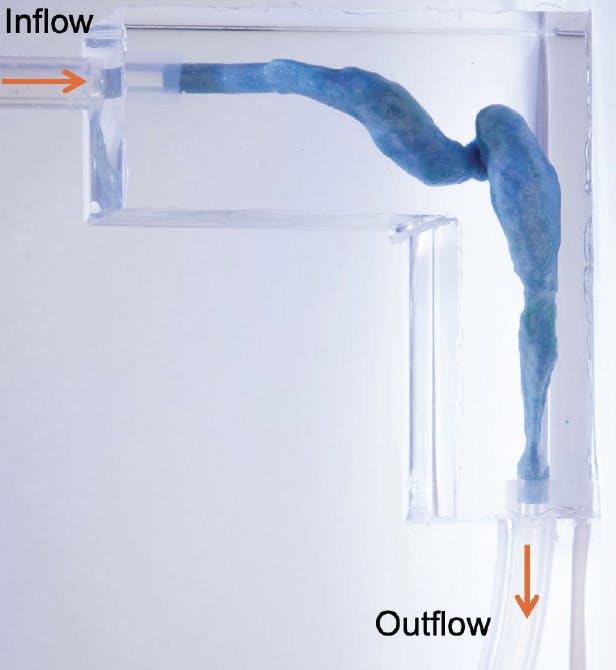
Figure 2. Patient-specific 3D-printed model of a high-riding jugular bulb.
For patients with hearing loss and no cause of PT identified on MRI, temporal bone CT can be helpful to assess for superior canal dehiscence, sigmoid wall abnormalities, and other structural abnormalities of the hearing apparatus. Diagnostic cerebral angiograms are obtained if an arterial cause of PT or dAVF is suspected based on history, physical examination, or imaging. Image-guided lumbar puncture (LP) with recording of opening pressure is performed if idiopathic intracranial hypertension (IIH) is suspected. We also have specific protocols for diagnostic cerebral angiograms and image-guided LPs for PT patients. These protocols ensure the examination is performed at a high quality and enable us to perform further research on PT—for example, by assessing MR venograms before and after cerebrospinal fluid (CSF) removal.
VASCULAR CAUSES OF PT
We specialize in treatment of the vascular causes of PT, which can be subdivided into arterial and venous causes. Arterial causes of PT have characteristic features in the history, physical examination, and imaging. Arterial causes of PT include carotid artery stenosis, dissection, fibromuscular dysplasia, aneurysm, aberrant internal carotid artery, and AVF. The presence of a carotid bruit on neck auscultation typically signifies atherosclerotic disease in the elderly or fibromuscular dysplasia or dissection in the young, with noninvasive imaging playing a pivotal role in establishing the diagnosis. Aortic stenosis in an elderly patient is heard as a systolic murmur and typically causes right PT. Aneurysms of the vertebral or internal carotid artery can also lead to turbulent blood flow and PT. Venous causes of PT are suspected when patients have a low-pitched, pulse-synchronous sound that improves with ipsilateral jugular vein compression. These can result from turbulent flow in diverticula of the sigmoid sinus or jugular bulb; enlarged condylar veins; stenoses in the transverse sinus, sigmoid sinus, and internal jugular vein; or a high-riding jugular bulb. We can perform various endovascular treatments to address these abnormalities.
Idiopathic Intracranial Hypertension
IIH is commonly associated with bilateral stenoses of the transverse-sigmoid sinuses and is a common cause of PT. Characteristic clinical features include a headache worse with dependent positioning (eg, when bending over to tie shoes), transient or gradual vision loss, and low-pitch, pulse-synchronous PT. Elevated intracranial pressure due to a mass or AVF must be excluded, as part of the modified Dandy criteria, prior to diagnosis of IIH. MRI findings are often suggestive, but LP opening pressure is needed to establish diagnosis. For most patients with IIH, first-line treatment consists of weight loss and acetazolamide. For medically refractory patients with worsening papilledema and/or vision loss, venous sinus stenting can be performed and offers a favorable risk-to-benefit ratio compared to optic nerve sheath fenestration, CSF diversion, or bariatric surgery.
Arteriovenous Fistulas
AVFs are abnormal connections between arteries and veins. dAVFs are typically between dural arteries and a venous sinus, most commonly at the transverse-sigmoid sinus, marginal sinus/condylar veins, cavernous sinus, or vertebral venous plexus. dAVFs are sometimes associated with venous sinus thrombosis, which may occur after an infection, trauma, or surgery. dAVF with cortical vein reflux carries a high risk of intracranial hemorrhage, with high potential for death or permanent disability if untreated. Thus, high-risk dAVF is the most dangerous possible underlying cause of PT and cannot be missed during the diagnostic evaluation. Therefore, at UCSF, imaging evaluation of PT must include MRI with arterial spin labeling and time-of-flight MRA sequences to evaluate for these dangerous causes of PT. Endovascular treatment is first-line therapy for AVFs, as determined by cervicocerebral angiography. Rarely, AVMs can cause PT as well.
OTHER CAUSES OF PT
At UCSF, we categorize causes of PT into different structural, metabolic, and vascular groups. This categorization facilitates appropriate and practical diagnostic evaluation, referral, and treatment; it keeps the focus on the patient and the patient’s experience, and it optimizes the chances that appropriate help will be given. For example, structural causes of PT are detectable on MRI or CT of the head and neck and include neoplasms and temporal bone pathology. The most common neoplasms causing PT are paragangliomas and schwannomas.
Non-PT with “pauses” can sometimes masquerade as PT, and the cause is sometimes metabolic. Metabolic causes of non-PT are many. Within this large category, we sometimes find it difficult to pin down a single entity as the cause of an individual patient’s tinnitus. For example, tinnitus is often caused by ototoxic medications. A comprehensive list of ototoxic medications can be found from the American Tinnitus Association.4 The most common offending agents are antibiotics such as oral aminoglycosides and chemotherapeutic agents such as cisplatin.
CONCLUSION
PT can be a maddening symptom with a debilitating psychiatric impact, and it has myriad causes—some of which pose significant risk to neurologic or ocular health. Organizing causes of PT into structural, metabolic, and vascular groups facilitates appropriate testing, referral, and treatment. Nuanced history, physical examination, and imaging evaluation can often lead to a reasonable diagnosis. A complete clinical evaluation of PT should include a detailed history, assessment of psychiatric impact, provocative maneuvers during physical examination, and MRI to assess for dangerous structural or vascular causes. The creation of a PT clinic with well-defined, innovative diagnostic and treatment pathways has improved care for patients at UCSF.
1. Cummins DD, Caton MT, Shah V, et al. MRI and MR angiography evaluation of pulsatile tinnitus: a focused, physiology-based protocol. J Neuroimaging. Published online December 15, 2021. doi: 10.1111/jon.12955
2. Amans MR, Haraldsson H, Kao E, et al. MR venous flow in sigmoid sinus diverticulum. AJNR Am J Neuroradiol. 2018;39:2108-2113. doi: 10.3174/ajnr.A5833
3. Valluru K, Parkhill J, Gautam A, et al. Sound measurement in patient-specific 3D printed bench models of venous pulsatile tinnitus. Otol Neurotol. 2020;41:e7-e14. doi: 10.1097/MAO.0000000000002452
4. American Tinnitus Association. Prescription drugs, herbs, & chemicals associated with tinnitus. Accessed January 14, 2022. https://www.ata.org/sites/default/files/Drugs%20Associated%20with%20Tinnitus%202013.pdf
Advertisement
Advertisement