Advertisement
Advertisement
January 2022 Supplement
Sponsored by Silk Road Medical
Patient Selection in My Practice
How adding TCAR to my carotid disease treatment algorithm has changed my practice.

I should begin by saying that transcarotid artery revascularization (TCAR) has changed the whole work-up process for carotid patients in my practice. My evaluation of patients with critical and/or symptomatic stenosis who need revascularization now will always include the performance of a dedicated CTA of the head and neck.
When I began practice in 2008, we were operating often (particularly with asymptomatic patients) based on the duplex alone. This would come with measurements from the sternal notch to the carotid to bifurcation, as well as the angle of the mandible. So, we did have an idea about what lesions were higher lesions. But, again, many carotid endarterectomies (CEAs) and transfemoral carotid angioplasty and stent implantations were performed without a CTA being part of the imaging workup.
Patient selection involves careful consideration of patient anatomy; one initial factor being whether there is an adequate length of healthy common carotid artery for safe access. Obviously, higher (more distal) lesions are preferable. Lesions with an appropriate “runway” are more ideal than patients with a lower bifurcation and < 5 cm of common carotid artery (short runway) although, as stated by Dr. Shah, techniques to extend the runway are being explored and may be employed by experienced operators. These patients are, in general, likely better suited for open endarterectomy.
There are other anatomic features to consider. The most notable is prohibitive calcification. Highly calcified lesions with areas of dense circumferential calcium ≥ 3 mm thick are not good candidates. Conversely, patients with the less calcified “softer” lesions are more preferable for TCAR.
Extreme tortuosity noted in the carotid artery within the intended treatment area, and/or just proximal or distal to these areas, may also result in a less than desirable outcome. In my opinion, these atomic features often deter me from TCAR in such patients.
Other concerns involve a patient’s medical risk factors, with a preference toward TCAR if patients are older with more comorbidities. I will admit there is an unfounded prejudice toward doing CEA on younger patients.
Pharmacologic considerations are also important to patient selection for TCAR. The need for patients to be placed on dual antiplatelet therapy (DAPT) (in particular ticagrelor, which has increasingly been our practice) is noteworthy. Although most of the physicians in our practice place patients on aspirin and clopidogrel for CEA, the need for DAPT in TCAR patients is clearly more definitive. And, with the potential need for ticagrelor and the absolute need to be maintained on DAPT for at least 1 month after stent placement, patient selection for TCAR may be affected if patients are known to be resistant to clopidogrel.
Access to (and cost of) ticagrelor and/or potential need for other invasive procedures that require patients to be off of antiplatelet therapy can make TCAR less appropriate in some patients and the same considerations would also apply to patients who have coronary drug-eluting stents.
What We Talk About When We Talk About TCAR

I have been excited about TCAR since I completed my fellowship in 2011, but I did not perform my first TCAR until 2019. My proficiency in this technique has significantly improved my ability to deliver excellent care to my patients with carotid disease.
PATIENT CARE PLAN
Patients with carotid disease are usually referred to me by cardiologists and primary care physicians. They typically arrive with printed reports stating a percentage of stenosis and description of the plaque. Often absent from these reports are the criteria for stenosis and a report of the velocities. Thus, in some of these patients, I will repeat the carotid duplex ultrasound. If the duplex ultrasound the patient brings in is reliable and I am considering intervention, I will order CTA (if the patient is able to receive contrast).
At the first patient visit, I will talk with my patients about my philosophy and approach to carotid disease. I will explain the difference between symptomatic and asymptomatic disease. And, while sitting with the patient, I sketch the carotid bifurcation on a sheet of paper and talk about the anatomy. I shade in plaque on the drawing to demonstrate > 50% and > 80% stenoses.
During the first visit, I also discuss four treatment options with the patient and let them know which ones we should consider. These options are (1) CEA, (2) TCAR, (3) transfemoral stenting, and (4) best medical therapy. Once I have the CT angiogram and a reliable carotid duplex ultrasound, the patient and I review all available treatment options.
Patients with > 50% symptomatic carotid stenosis and > 80% asymptomatic carotid stenosis are evaluated for treatment. I look at cardiac, pulmonary, and neurologic status to determine if they can tolerate monitored anesthesia care or general anesthesia. A patient who is considered to be at prohibitive surgical risk by a cardiologist or pulmonologist is generally treated with medical therapy and an evaluation by my neurointerventional radiology colleagues for transfemoral stenting. Patients who are not suitable for TCAR due to common carotid disease or low bifurcation who have acceptable aortic arch are referred for transfemoral carotid stenting. Patients with prohibitive aortic arch disease or circumferential calcification are managed with best medical therapy.
CHOOSING TCAR
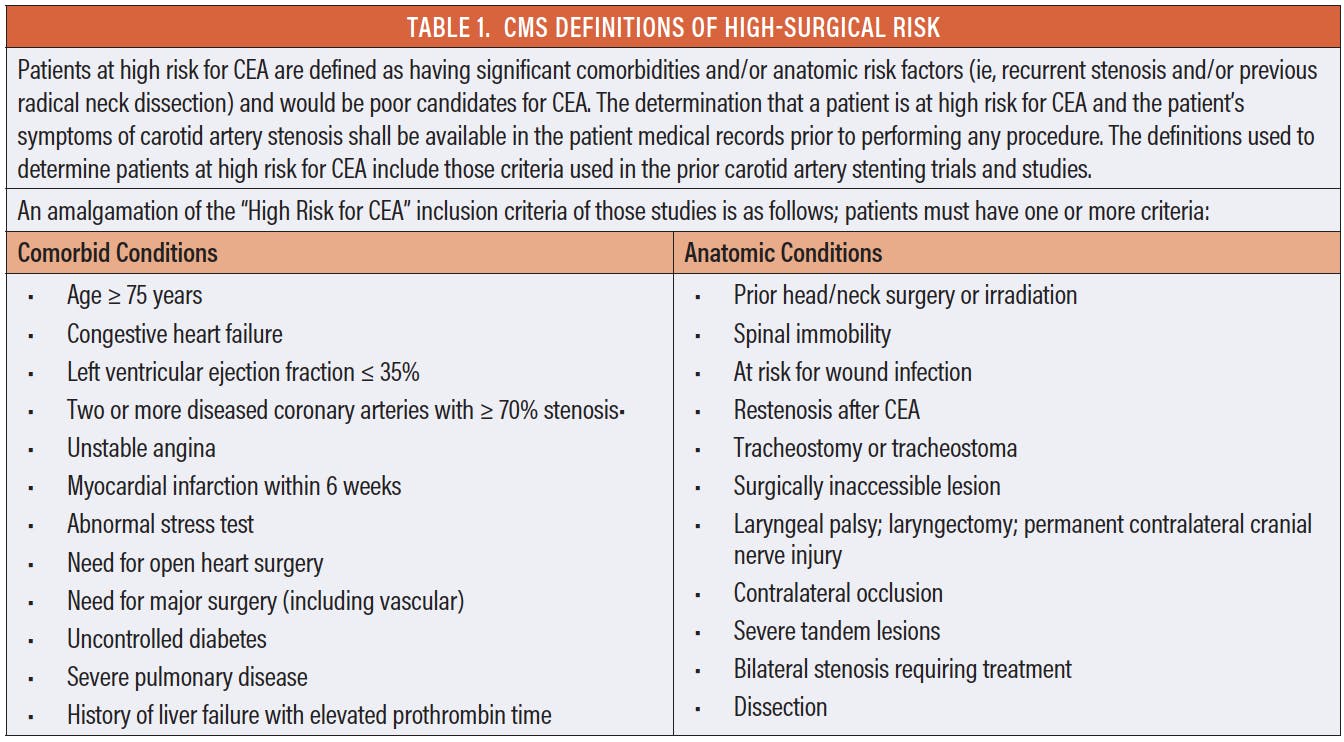
I follow the Centers for Medicare & Medicaid Services (CMS) definition for high surgical risk (Table 1)1 to determine whether patients should undergo CEA or TCAR. Comorbid conditions that will determine a patient to be high risk for CEA include age > 75 years, unstable angina, abnormal stress test, congestive heart failure, uncontrolled diabetes, and others. The anatomic risk factors include surgically inaccessible lesion, recurrent carotid stenosis, previous neck irradiation, spinal immobility, high risk for wound infection, and contralateral occlusion. If patients meet any of these criteria, and the anatomy is acceptable, I will offer TCAR as the first option.
Patients being considered for TCAR must be able to receive dual antiplatelet therapy (DAPT) for 30 days postprocedure and not have a metal allergy. Triple therapy is defined as anticoagulant and DAPT. If the patient is on anticoagulant therapy, there is an increased risk of spontaneous bleeding, surgical bleeding, and intracranial bleeding (including reperfusion hemorrhage) with triple therapy. The American College of Cardiology has issued an expert consensus decision pathway for patients requiring anticoagulant and DAPT.2 Recommendations state that the duration of triple therapy shall not exceed 30 days. Additionally, gastrointestinal prophylaxis should be utilized and anti-inflammatory medications avoided. Direct oral anticoagulants are preferred over vitamin K antagonists.
Patients with carotid disease with known hypercoagulable state, recent history of venous thromboembolism, or atrial fibrillation with a CHADS2 score of ≥ 4 who are prescribed an anticoagulant are all evaluated on an individual basis to determine the risk/benefit ratio of TCAR versus CEA.3 TCAR may require a 30-day course of triple therapy. Patients undergoing CEA will restart anticoagulation 24 hours after surgery and a 30-day course of single antiplatelet therapy (aspirin, 81-mg dose). I discuss these risks with each patient—the risks and consequences of a neck hematoma after CEA (infection/airway compromise) versus the risk of intracranial bleeding after TCAR requiring 30 days of triple therapy. Symptomatic patients with documented stroke who are considered for TCAR are also individually evaluated with the help of neurology and my neurointerventional colleagues. Usually, these patients will be restarted on anticoagulation prior to intervention when cleared by neurology and will require interval imaging to evaluate for hemorrhagic transformation of the stroke. To arrive at the optimal treatment plan for each individual patient requires a thoughtful discussion between the surgeon and patient, as well as input from the involved cardiologists and neurologists. This can be the most rewarding aspect of the preoperative experience.
CONCLUSION
So, how has TCAR changed how I approach carotid disease? The cases that are challenging for surgery—high bifurcations, patients who have undergone neck radiation, and posteriorly located carotid arteries—are now straightforward TCAR cases. Patients who were previously poor surgical candidates due to medical comorbidities are very reasonable TCAR candidates. In the past, I’ve turned down these patients with significant comorbidities for surgery and referred them for transfemoral stenting. However, a significant number of these patients have a diseased arch and are at increased risk for intraprocedural stroke. That risk is lowered by avoiding the arch and establishing flow reversal before crossing the lesion during TCAR.
There is still a role for CEA in my practice. I have patients who have previously undergone contralateral CEA and were pleased with the outcome. I have had patients with aspirin and metal allergy unable to be treated with a stent. With expanded treatment options, carotid disease patients have been thoughtfully screened and the surgically challenging cases have been offered TCAR. So, by definition, the patients undergoing CEA have better anatomy and fewer comorbidities. Outcomes, patient satisfaction, and surgeon satisfaction are improved all around. This is the benefit of adding TCAR to my treatment algorithm.
1. silkroadmed.com/healthcare-professionals/tcar-reimbursement/Insert inclusion criteria comorbid conditions & anatomic conditions. Accessed August 18, 2021.
2. Kumbhani DJ, Cannon CP, Beavers CJ, et al. 2020 ACC expert consensus decision pathway for anticoagulant and antiplatelet therapy in patients with atrial fibrillation or venous thromboembolism undergoing percutaneous coronary intervention or with atherosclerotic cardiovascular disease: a report of the American College of Cardiology Solution Set Oversight Committee [Epub ahead of print]. J Am Coll Cardiol. 2021;77:629-658. doi: 10.1016/j.jacc.2020.09.011
3. Gage BF, Waterman AD, Shannon W, et al. Validation of clinical classification schemes for predicting stroke: results from the National Registry of Atrial Fibrillation. JAMA. 2001;285:2864-2870.
Advertisement
Advertisement