Advertisement
Advertisement
July 2022 Supplement
Sponsored by The PERT Consortium™
PERTs Around the World
Pulmonary embolism experts share how pulmonary embolism response teams have changed pulmonary embolism care globally.
By Rachel P. Rosovsky, MD, MPH; Karen Breen, MD, MRCPI, FRCPATH; Menno V. Huisman, MD, PhD, FESC; Beverley J. Hunt, OBE; David Jiménez, MD, PhD, FERS; Barry Kevane, MB, BCh, BAO, PhD, MRCPI, FRCPath; Frederikus A. Klok, MD, PhD, FESC; Carlos Elzo Kraemer, MD, PhD; Jose Montero-Cabezas, MD, PhD; and Fionnuala Ní Áinle, MD, PhD

Pulmonary embolism (PE) is a major cause of morbidity and mortality worldwide.1,2 Over the past decade, numerous therapeutic tools and strategies have been developed to treat patients with PE. Despite these advances, PE remains a potentially serious disease, killing four to 10 people per 100,000 population in the Western world.3,4 To address this crisis, pulmonary embolism response teams (PERTs) have been developed to coordinate and expedite the diagnosis and treatment of PE. These teams immediately and simultaneously engage multiple different specialists to decide on the best course of action for each patient.5 Since the launch of the first PERT in 2012, hundreds of PERTs have formed throughout the world (Figure 1). With this expansion, a growing body of evidence has emerged, demonstrating that the implementation of a PERT improves the time to PE diagnosis and initiation of therapy, cost of care, length of stay, and, in some studies, even mortality.6-9 In line with these findings, the 2019 European Society of Cardiology/European Respiratory Society guidelines recommended setting up PERTs for management of patients with intermediate- and high-risk PE when resources and expertise are available because they address the needs of modern system-based health care (class IIa recommendation).10 PERTs have the potential to transform PE care, and in this article, PE experts from Ireland, Spain, the United Kingdom (UK), and the Netherlands share how PERTs have changed the care of PE patients in their countries.
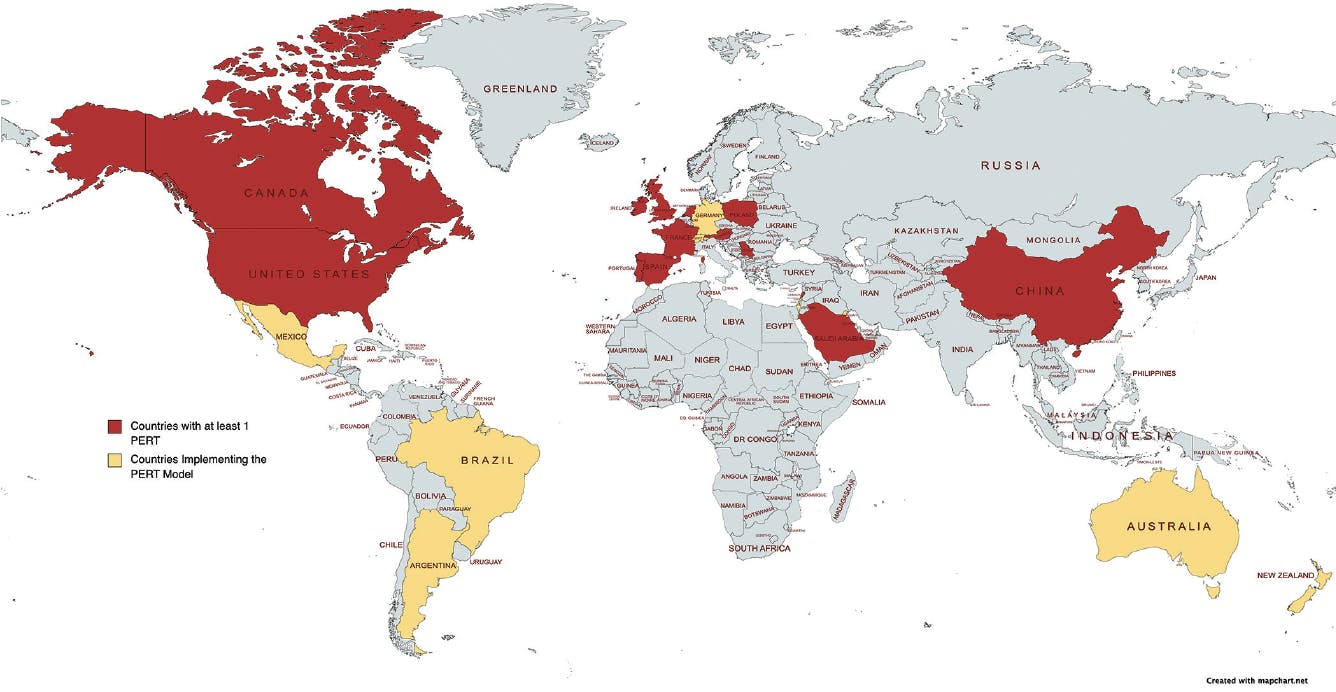
Figure 1. PERTs around the world.*
*This map is constantly evolving as new PERT sites are developed.
PERT Perspectives in Ireland


In the years since the launch of the first PERT in the United States in 2012, clinicians and other stakeholders in the Republic of Ireland have become increasingly aware of the potential for this model of care to revolutionize the management of acute PE. Although one would expect the broad implementation of such a treatment model across all hospitals and hospital networks in this country to be challenging in the short term, we have seen a progressive stepwise approach to the development of PERTs in a number of large centers in Ireland.
In recent years, improving outcomes for patients with venous thromboembolism (VTE) has become a priority for the Ireland East Hospital Group (IEHG), the largest hospital network in the Republic of Ireland, serving a population of > 1 million individuals. In collaboration with the patient organization Thrombosis Ireland, the IEHG VTE team (comprising clinicians, scientists, data analysts, and allied health professionals) has worked toward improving all aspects of VTE care within the IEHG network. A PERT was established in 2018 within the Mater Misericordiae University Hospital (MMUH; a large academic center within the IEHG). The establishment of this formalized PE management pathway within the hospital has forged strong working relationships between all various stakeholders involved in PE care at this institution. Moreover, this collaborative approach to PE management has also provided us with opportunities to more effectively advocate for patients with complex care requirements. The development of a PERT has also served to highlight the complexity underlying PE care to other health care providers and hospital administrators across the institution. In line with the overarching goals of the IEHG and with the support of international PERT colleagues, an expansion of the MMUH PERT is currently underway to provide guidance in a hub-and-spoke model to other hospitals that may lack the same level of expertise and resources. This initiative will proceed in parallel with the establishment of the Centre for Integrated Thromboembolism Care at the MMUH site.
Achieving further advancements in PE care in the future will require high-quality data generated through the conduct of high-quality clinical trials. Conducting clinical trials in acute PE management is seen as potentially challenging in this country in light of the heterogeneity of PE care (particularly with respect to the access to expertise in interventional techniques) that may exist between hospitals and within the various disciplines of internal medicine. It has been our experience in the MMUH that the establishment of a PERT has also served to lay the foundation for the necessary infrastructure required to allow us to participate in such clinical trials.
As we look to the future of PE care in Ireland and as the evidence in support of the PERT model continues to accumulate, we are confident that PERTs will become the norm in this country and will lead to improved interdisciplinary collaboration and patient outcomes.
PERT Perspectives in Spain

The development of specialized PERTs has been a landmark innovation in the care of patients diagnosed with acute PE.10 However, the theoretic advantages and growing scientific evidence supporting PERT to provide clinical attention for patients with acute PE do not correspond to the level of practical implementation in Spain. In fact, only a few hospitals in Spain have PERTs. A number of reasons might explain why the PERT concept is not growing rapidly in our country: (1) initial lack of definitive evidence supporting the benefits for patients with PE11,12; (2) lack of robust information about the cost-effectiveness of the PERT model; and (3) lack of proper infrastructure, resources (ie, endovascular devices), and medical expertise required to manage these patients.
In 2017, Hospital Ramón y Cajal in Madrid was the first Spanish center to activate Code PERT (Figure 2), which is ready 24 hours per day to quickly evaluate patients with suspected and/or confirmed PE and initiate interventions. This innovative process brings together a team of highly trained respirologists, cardiologists, cardiovascular surgeons, intensivists, and radiologists who specialize in PE diagnosis and treatment, along with emergency department physicians, to ensure that the most appropriate management is initiated as quickly as possible. Our specialists not only provide treatment for complex patients (ie, intermediate and high risk) with acute PE but also accept transfers from hospitals that are challenged in caring for these cases. In addition, the team is available to colleagues at other centers to discuss therapeutic strategies or management of treatment-associated complications over the phone. Since its institution in 2017, our Code PERT has attended to 157 patients with acute symptomatic PE (36 patients with high-risk PE, 98 with intermediate-high–risk PE, and 23 with diagnostic or therapeutic challenges such as pregnancy or absolute and relative contraindications to anticoagulation) (Jiménez D, unpublished data, 2022). Particularly in the era of COVID-19, our PERT has played an important role in the diagnosis and management of patients with COVID-19 pneumonia and suspected and/or confirmed thrombotic complications.

Figure 2. Code PERT at Ramón y Cajal Hospital in Madrid, Spain.
Currently, health authorities in Madrid are updating the process of care for patients with suspected, confirmed acute PE according to the best available evidence,13 and PERTs will play a central role in this process.
PERT Perspectives in the United Kingdom


In England, the National Institute for Health and Care Excellence set the standard of care for patients with acute PE by providing evidence-based guidance and quality standards for diagnosis and management.14 However, while National Health Service (NHS) England has this exemplary system, political devolution has meant that each country in the UK has its own health care units (ie, NHS England, NHS Scotland, NHS Wales, NHS Northern Ireland). As a result, there is no standard approach to PE care across the nations. Furthermore, which clinical specialty manages PE has fallen to one of many different specialties, which in turn is dependent on the institution and their available facilities. Increasingly, the management of acutely unwell patients with PE is falling to general physicians, respiratory clinicians, or cardiologists 24/7, with input from intensivists for those requiring ventilatory or circulatory support, and clinical hematologists are playing a larger role, especially in outpatient follow-up.
The goal of establishing PERTs at a number of centers is to provide a multidisciplinary team to care for patients presenting with intermediate PE, focusing on their management and, more specifically, acting as a forum to discuss the potential need for advanced interventions, such as embolectomy, thrombolysis (systemically or catheter directed), and, occasionally, the role of adjunctive therapies such as extracorporeal membrane oxygenation (ECMO) in high-risk PE. Low-risk PE management is usually straightforward, although it is recognized that management can often be suboptimal. Care of patients with intermediate-high–risk PE can often be particularly disjointed. A 2019 National Confidential Enquiry into Patient Outcome and Death report suggested that areas of improvement for PE management in the UK include timely access to imaging, commencement of anticoagulation, and establishment of PERT networks to help offer access to interventional therapies.15
The PERT concept is evolving in the UK. Some larger regional centers are already providing a PERT service. At Guy’s and St Thomas’ in London, we’ve had a PERT service since 2017 and have received > 150 referrals from within the region. Preliminary patient outcomes have shown decreased morbidity and risk of chronic thromboembolic pulmonary hypertension (CTEPH) at 6-month follow-up postpresentation (Hunt BJ and Breen K, unpublished data, 2022).
However, major obstacles to setting up PERTs in the UK remain. Perhaps the most important is that busy clinicians are reluctant to engage with thrombolysis for intermediate-risk PE given the evidence concerning lack of improved clinical outcomes in the medium to longer term. Additionally, UK clinical services are crippled by staffing shortages across all disciplines and services. Moreover, lack of resources, limited funding, and determining ownership of the service are current blocks to PERT service development. These problems have been intensified given the strains on the NHS due to COVID-19. Going forward, it may be more practical to have the support of a regional PERT network where smaller centers can refer their patients. We feel that now is the time to try to empower and educate clinicians to establish PERT networks throughout the UK given the potential shown in the United States for PERT to improve PE care.6
PERT Perspectives in the Netherlands


In the Netherlands, acute and chronic care for patients with acute PE is provided by pulmonologists (approximately 60% of all patients) and internists (approximately 40% of all patients). Cardiologists are much less involved because of a historic focus on primary cardiac disease. Reperfusion therapy is primarily reserved for patients with high-risk PE who present in shock and mainly consists of full-dose thrombolysis. The age-standardized annual PE-related mortality rate in the Netherlands is among the lowest in Europe, at 3.0 deaths per 100,000 population in 2014—compared to 8.9 per 100,000 in the UK, 4.6 per 100,000 in Spain, 5.0 per 100,000 in France, and 9.1 per 100,000 in Germany.3
The development of PERTs in the United States, the first evidence on the use of catheter-directed therapy, and the wider availability of ECMO treatment has resulted in the introduction of multidisciplinary teams in the Netherlands focused on ad hoc decisions regarding optimal management of severe PE cases. These teams are called ALERT (in Dutch, acute longembolie response team) or EXPERT-PE teams, and they are currently emerging foremost in academic medical centers.16 These teams may consist of cardiologists, internists, pulmonologists, intensivists, and emergency physicians.
Reasons for activation of the EXPERT-PE teams differ. In our hospital, the team is led by internal (vascular) medicine and activated on presentation of patients with (suspected) PE in shock; patients with proven acute PE who are at high risk of hemodynamic decompensation or are respiratory compromised and may require admission to the medium/intensive care unit; or patients with proven PE in which other important treatment dilemmas occur, such as strong contraindication for initiation of anticoagulant therapy. A high risk of decompensation is defined by gestalt or a high national early warning score.17,18
On activation, the team assesses the patient and, if relevant, performs additional diagnostic tests, such as point-of-care ultrasound of the heart. After initial actions to stabilize the patient (ie, volume resuscitation, initiation of inotropics or ECMO) and the start of anticoagulant treatment, the team discusses whether the patient requires admittance to the intensive care unit and, if so, whether the patient may benefit from advanced reperfusion therapy. The need and timing for reassessment by the team is decided on and noted in the patient chart. During out-of-office hours, the discussion is done online via a secure application, and the patient assessment is performed by the attending intensivist. The team is kept updated on the clinical course of the patient by the physician responsible for the patient at that time, and all patients are followed for 3 to 6 months at a dedicated thrombosis outpatient clinic. There, patient-reported outcomes are used: the post-VTE functional status scale to capture recovery milestones and the presence of persistent functional limitations, the PE Quality of Life Questionnaire to capture quality of life, and the Medical Research Council dyspnea scale to assess persistent dyspnea.19-21
We expect that EXPERT-PE teams will continue evolving in the Netherlands with the anticipated standardization of team composition and thresholds for decision-making in the Dutch national guidelines for antithrombotic therapy. Collaboration between the Dutch EXPERT-PE teams may also be a very suitable platform to perform the much-needed randomized trials in severe PE and provide the evidence necessary to develop strong guideline recommendations for optimal application of reperfusion techniques in PE patients.
Conclusion
By Rachel P. Rosovsky, MD, MPH
The treatment of PE is evolving with the emergence of PERTs, which are currently forming throughout the world. In this article, we learned how PERTs in four different European countries are affecting the care of PE patients. From our PE experts in Ireland, we heard how PERTs have led to the development of strong working relationships between the many providers who care for PE patients, the improvement in advocacy for these complex patients, and the formation of the infrastructure to carry out much-needed clinical trials in this space. From our colleague in Spain, we were informed that despite the initial challenges in adopting the PERT concept, PERTs played an important role in the COVID era in the diagnosis and management of these patients, and they will likely play a central role in the process of updating the operational care for PE patients in this country. In England, our experts described how the concept of PERTs is evolving in the UK, detailed the advantages of having a multidisciplinary team to care for PE patients, listed the barriers to developing a PERT service, and shared preliminary outcome data from Guy’s and St Thomas’ in London demonstrating how the implementation of PERT decreased morbidity and risk of CTEPH. Finally, our PE experts in the Netherlands outlined the various specialists involved in PE care and the process of activating their PE team (EXPERT-PE), as well as discussed how collaboration between Dutch PERTs could inform and carry out important PE trials, which would allow for strong guideline recommendations regarding interventions for these patients.
PERTs are not only changing the way patients with PE are treated but also helping form stronger relationships among specialists, offer a venue for collaboration, and provide a platform to advance our understanding of PE care through research, clinical care and education, with the ultimate goal of improving outcomes.
1. Wendelboe AM, Raskob GE. Global burden of thrombosis: epidemiologic aspects. Circ Res 2016;118:1340-1347. doi: 10.1161/CIRCRESAHA.115.306841
2. Huisman MV, Barco S, Cannegieter SC, et al. Pulmonary embolism. Nat Rev Dis Primers. 2018;4:18028. doi: 10.1038/nrdp.2018.28
3. Barco S, Mahmoudpour SH, Valerio L, et al. Trends in mortality related to pulmonary embolism in the European Region, 2000-15: analysis of vital registration data from the WHO mortality database. Lancet Respir Med. 2020 Mar;8(3):277-287. doi: 10.1016/S2213-2600(19)30354-6
4. Barco S, Valerio L, Ageno W, et al. Age-sex specific pulmonary embolism-related mortality in the USA and Canada, 2000-18: an analysis of the WHO mortality database and of the CDC multiple cause of death database. Lancet Respir Med. 2021;9:33-42. doi: 10.1016/S2213-2600(20)30417-3
5. Rosovsky R, Zhao K, Sista A, et al. Pulmonary embolism response teams: purpose, evidence for efficacy, and future research directions. Res Pract Thromb Haemost. 2019;3:315-330. doi: 10.1002/rth2.12216
6. Wright C, Goldenberg I, Schleede S, et al. Effect of a multidisciplinary pulmonary embolism response team on patient mortality. Am J Cardiol. 2021;161:102-107. doi: 10.1016/j.amjcard.2021.08.066
7. Wiske CP, Shen C, Amoroso N, et al. Evaluating time to treatment and in-hospital outcomes of pulmonary embolism response teams. J Vasc Surg Venous Lymphat Disord. 2020;8:717-724. doi: 10.1016/j.jvsv.2019.12.077
8. Chaudhury P, Gadre SK, Schneider E, et al. Impact of multidisciplinary pulmonary embolism response team availability on management and outcomes. Am J Cardiol. 2019;124:1465-1469. doi: 10.1016/j.amjcard.2019.07.043
9. Annabathula R, Dugan A, Bhalla V, et al. Value-based assessment of implementing a pulmonary embolism response team (PERT). J Thromb Thrombolysis. 2021;51:217-225. doi: 10.1007/s11239-020-02188-3
10. Konstantinides SV, Meyer G, Becattini C, et al. 2019 ESC guidelines for the diagnosis and management of acute pulmonary embolism developed in collaboration with the European Respiratory Society (ERS). Eur Heart J. 2020;41:543-603. doi: 10.1093/eurheartj/ehz405
11. Rosovsky R, Chang Y, Rosenfield K, et al. Changes in treatment and outcomes after creation of a pulmonary embolism response team (PERT), a 10-year analysis. J Thromb Thrombolysis. 2019;47:31-40. doi: 10.1007/s11239-018-1737-8
12. Carroll BJ, Beyer SE, Mehegan T, et al. Changes in care for acute pulmonary embolism through a multidisciplinary pulmonary embolism response team. Am J Med. 2020;133:1313-1321.e6. doi: 10.1016/j.amjmed.2020.03.058
13. Jiménez J, Sánchez-Camacho J, Moreno F, et al. C*-BODIPYs: exploring a new strategy to transfer chirality towards BODIPY chiroptics†. Proc West Mark Ed Assoc Conf. 2019;41:53. doi: 10.3390/ecsoc-23-06610
14. NICE: National Institute for Health and Care Excellence. Venous thromboembolic diseases: diagnosis, management and thrombophilia testing. Published March 26, 2020. Accessed June 3, 2022. https://www.nice.org.uk/guidance/ng158/chapter/Recommendations
15. National Confidential Enquiry into Patient Outcome and Death. Know the score. A review of the quality of care provided to patients aged over 16 years with a new diagnosis. Accessed June 3, 2022. https://www.ncepod.org.uk/2019pe/PE_Full%20report.pdf
16. Huisman MV, Montero Cabezas JM, Klok FA. Longembolie-interventieteams [Pulmonary embolism response teams: what is the added value for patients with acute pulmonary embolism?]. Ned Tijdschr Geneeskd. 2017;161:D1570.
17. Liu VX, Lu Y, Carey KA, et al. Comparison of early warning scoring systems for hospitalized patients with and without infection at risk for in-hospital mortality and transfer to the intensive care unit. JAMA Netw Open. 2020;3:e205191. doi: 10.1001/jamanetworkopen.2020.5191
18. Smith GB, Prytherch DR, Meredith P, et al. The ability of the National Early Warning Score (NEWS) to discriminate patients at risk of early cardiac arrest, unanticipated intensive care unit admission, and death. Resuscitation. 2013;84:465-470. doi: 10.1016/j.resuscitation.2012.12.016
19. Boon GJAM, Barco S, Bertoletti L, et al. Measuring functional limitations after venous thromboembolism: optimization of the post-VTE functional status (PVFS) scale. Thromb Res. 2020;190:45-51. doi: 10.1016/j.thromres.2020.03.020
20. Klok FA, Cohn DM, Middeldorp S, et al. Quality of life after pulmonary embolism: validation of the PEmb-QoL questionnaire. J Thromb Haemost. 2010;8:523-532. doi: 10.1111/j.1538-7836.2009.03726.x
21. Bestall JC, Paul EA, Garrod R, et al. Usefulness of the medical research council (MRC) dyspnoea scale as a measure of disability in patients with chronic obstructive pulmonary disease. Thorax. 1999;54:581-586. doi: 10.1136/thx.54.7.581
Advertisement
Advertisement