Advertisement
Advertisement
July 2022 Supplement
Sponsored by The PERT Consortium™
Pulmonary Embolism Research Collaborative (PERC™): A New Initiative to Standardize Pulmonary Embolism Care Internationally
An overview of the inaugural PERC™ meeting, which tasked participants with developing consensus regarding components of clinical care and outcomes that should be tracked in PE care.
By Terry R. Bowers, MD; Kenneth Rosenfield, MD, MHCDS; and Eleni Whatley, PhD
The inaugural meeting of PERC™, the Pulmonary Embolism Research Collaborative, was convened in Washington, DC, on April 22, 2022, bringing together an international group of experts in pulmonary embolism (PE) to work in collaboration with the United States FDA, patient representatives, and industry leaders to explore gaps in recognition, diagnosis, and treatment of patients with acute PE. The National Pulmonary Embolism Response Team (PERT) Consortium™ has been at the center of this “movement,” promoting the concept of high-quality, multidisciplinary team–based care; educating the medical community, patients, and other stakeholders regarding the state of the art in PE care; and establishing a robust quality assurance data registry that has rapidly expanded to include > 35 participating institutions in the United States. The National PERT Consortium™ sponsored the inaugural PERC™ meeting, tasking participants to develop consensus regarding the components of clinical care and outcomes that should be tracked in PE care. The PERC™ initiative aims to standardize data collection in PE patients undergoing evaluation and treatment and thus establish the foundation for an expanding evidence base that may inform future care for acute PE. The hope is that the development of a more robust evidence base for PE diagnosis and treatment will enable better identification, ensure more accurate risk stratification, facilitate appropriate triage, and enhance consistency in employing escalation of care strategies. Evidence produced through PERC™ promises to eventually reduce the high degree of variation in PE management and foster treatment of the right patient at the right time with the right therapy. Uniform data collection with standardized definitions is a powerful tool that will inform treatment strategies for PE patients, enhancing clinical care, quality assurance, and research endeavors, including clinical trials and regulatory oversight.
PARTICIPANTS AND MEETING ORGANIZATION
The PERT Consortium™ Board of Directors selected Drs. Terry Bowers and Kenneth Rosenfield as Co-Chairs for the inaugural PERC™ meeting, also inviting Dr. Eleni Whatley to serve as a Co-Chairs in her capacity as an FDA representative from the Center for Devices and Radiological Health. The co-chairs then assembled a steering committee, which in turn identified the various stakeholders to invite as participants. These included diverse international physician experts from multiple specialties involved in PE management, as well as regulatory partners active in the venous thromboembolism (VTE)/PE space, industry collaborators, sister VTE organizations, and patient advocacy groups. All invitees enthusiastically accepted the opportunity to participate, underscoring the timeliness and importance of this PERC™ initiative.
The PERC™ Steering Committee met to establish goals and objectives for the inaugural meeting. These goals centered around expanding data collection in patients with PE and identifying the most appropriate data to collect, while at the same time streamlining processes to encourage sites to enter data on their patients. Perhaps most important was the mandate to standardize data elements and their definitions. Ultimately, PERC™ intends to establish a consensus set of data elements and standard definitions for these elements.
MORNING FOCUS: ESTABLISHING THE DATA ELEMENTS TO COLLECT DURING THE PE PATIENT’S JOURNEY
The first half of the PERC™ meeting was dedicated to critically reviewing the current data typically collected on PE patients and brainstorming what other data might be useful or important to obtain to complete the evidence base that will inform future management of PE. Acknowledging the enormity of this task, the steering committee established five working groups, each responsible for identifying the relevant data to be collected from each of five distinct stages during the timeline of a patient’s PE journey, starting with initial presentation and ending with long-term outpatient follow-up. Group leaders were then appointed based on their expertise in various aspects of the PE treatment spectrum, and invitees were placed in the various groups with the intent of creating diverse perspectives. This strategy proved to be a tremendous success, with all PERC™ members contributing significantly to a spirited discussion within their working groups. The topics for groups 1 through 5 and their assigned leaders are listed in Table 1.
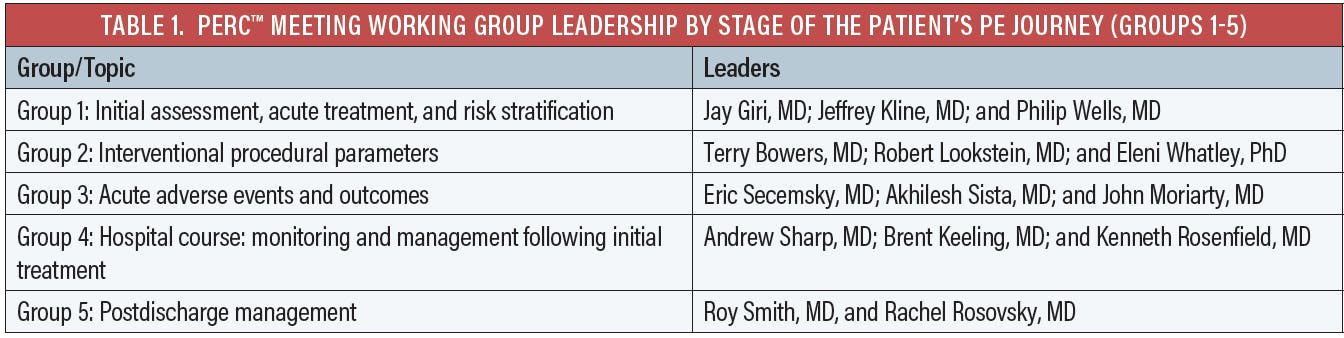
Each working group met several times during the 4 weeks prior to the inaugural PERC™ meeting in Washington, DC, to review and discuss all of the potential data elements that might be collected for their respective phase of the PE journey. Groups were instructed to have an open mind and cast a big net—to consider novel parameters not collected in previous databases or investigational device exemption trials, which nonetheless might influence decision-making and outcomes for PE. During the preparatory meetings, each group achieved consensus regarding the appropriate data elements to collect for their respective PE timeline and summarized these findings for presentation to the larger group of experts. An enormous number of data elements were ultimately suggested by each group, and there was overlap in data points across groups, as expected. All parties recognized that it would be challenging to collect and enter all desired data into The PERT Consortium™ PE Registry for each patient. Accordingly, the groups were tasked with identifying “core” elements versus those that might be part of an “enhanced” data collection. Core data elements are those deemed essential to collect on every single patient, because they are well established as important data points that inform treatment strategies and outcomes. Enhanced data elements are those that are considered interesting and potentially useful for decision-making and might influence outcome, but their contribution is yet to be defined. Exhaustive lists were generated in each category for each working group, with the goal of incorporating these as data elements in the next version of The PERT Consortium™ PE Registry. Importantly, we aim to publish a list of these data elements, as well as the overall proceedings of PERC™, as part of an expert consensus document in the future. The intent is to provide a template for data collection internationally for all patients with PE.
AFTERNOON FOCUS: HOT TOPICS/KEY FACTORS THAT GUIDE DECISION-MAKING AND TREATMENT RECOMMENDATIONS
Importantly, it was not the goal of this inaugural PERC™ meeting to arrive at consensus regarding specific algorithms of care for PE. Rather, the focus was to clarify what information should be collected and analyzed to ultimately inform therapeutic decisions and best practices. Accordingly, and in keeping with the themes of (1) critically evaluating the definitions and true value of existing data elements and (2) broadening the scope to include additional potentially important factors, the afternoon sessions of the PERC™ meeting were dedicated to addressing specific critical aspects of PE care in more depth. Five topics were selected that represent opportunities for refinement of data and/or expansion of evidence to be collected. The afternoon groups were tasked with identifying key questions that remain unanswered regarding their assigned topic and proposing data collection necessary to address these issues in the future. The group topics and their assigned leaders are listed in Table 2.
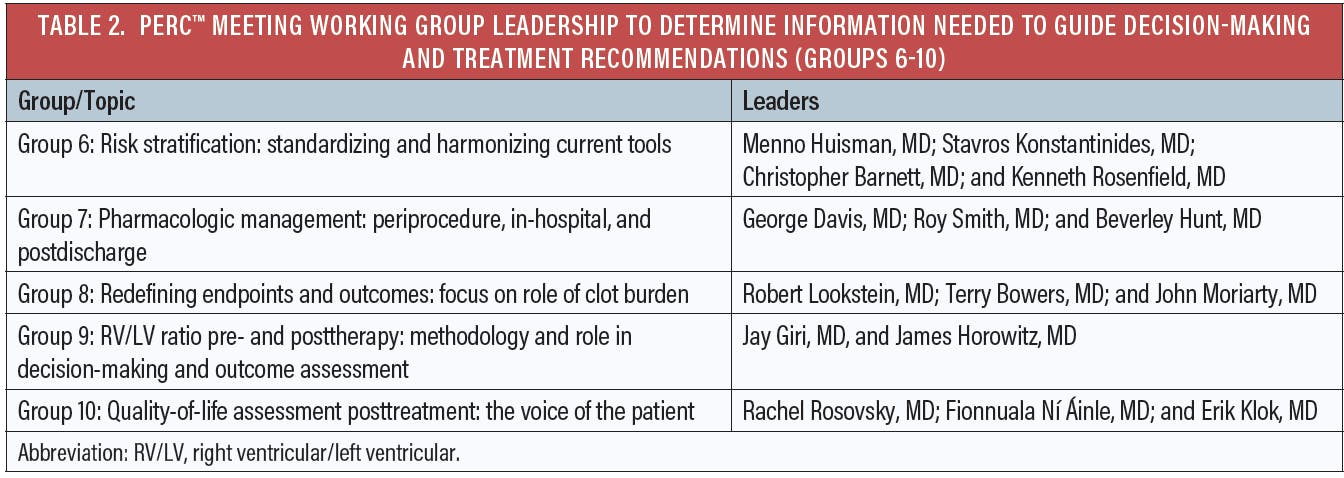
Several important gaps in the existing PE knowledge base were identified by each of these groups. Notable discussion topics included: how to consolidate the numerous risk-scoring algorithms available; determining the metrics required to inform decisions regarding escalation of care, for both current and future therapies; data points regarding pharmacologic therapy (eg, specific agents and doses) necessary to provide insight into outcome variations based on the dosing scheme and adjunctive therapies; and measurement and tracking of outcomes posttherapeutic intervention. Dedicated discussions also focused on the value of clot burden reduction as a credible and measurable endpoint; the methodology used, and the reliability of CT and echocardiography in assessing right ventricular/left ventricular ratio; and establishing standardized quality-of-life metrics and their standardization moving forward. Specific outcomes of these discussions and recommended data points will be provided in the white paper consensus document.
CONCLUSIONS AND FUTURE STEPS
PERC™ provides an important starting point to achieve standard data acquisition to populate The PERT Consortium™ PE Registry and other research in PE. Significant headway was made toward identifying important core data elements, standardized definitions, and needs for additional data to inform patient care. Recognizing the mandate to address the evidence gap in PE and spurred by the enthusiasm generated and momentum gained from this inaugural meeting, PERC™ leadership has begun the process of publishing a white paper to disseminate this important information. Notably, a byproduct of this inaugural PERC™ meeting—and perhaps what may be most consequential—has been that PE stakeholders and leaders have been able to network and exchange ideas and align regarding shared goals to reduce the impact of PE worldwide. Expanding and standardizing data collection should help fill the evidence gap that exists for PE management. Information obtained from a uniform data collection effort will inevitably lead to improved care and better outcomes for all patients with PE worldwide.


Advertisement
Advertisement