Advertisement
Advertisement
June 2022
How I Secure a Tunneled Hemodialysis Catheter
Physicians share their methods, as well as tips and tricks for success.
By Scott O. Trerotola, MD; Theodore F. Saad, MD; and Bart Dolmatch, MD, FSIR

Securing a tunneled dialysis catheter (TDC) does not get the attention it deserves. How to do so depends on the device as well as the tunnel length vis-à-vis the catheter. We order our TDC without a suture wing because a suture wing that rotates accompanied by an incorporated cuff can result in twisting of the TDC in the tunnel and subsequent dysfunction. Ideally, a TDC should be secured with suture on the reinforced portion as shown in Figure 1 so as not to constrict the catheter. The registered nurses in our units have asked that the TDC not be tightly bound to the skin so it can be cleaned easily—another reason not to use a suture wing. Using the skin knot to close the incision tightly can help prevent oozing and still allow catheter mobility for cleaning. If the TDC extends too far from the exit site, the same approach is taken but with suturing directly to the catheter. By testing for flow1 after suturing, we can ensure it is not too tight; but as a rule of thumb, the suture should barely visibly indent the catheter, and no indentation should be visible fluoroscopically. Perhaps most importantly, when the cuff is incorporated (usually 2-3 weeks except after over-the-wire exchange [OTWE]), the suture is superfluous and should be removed so it does not become a nidus for infection. However, because dislodgment is more common after OTWE,2 long-term suturing is usually needed after OTWE.
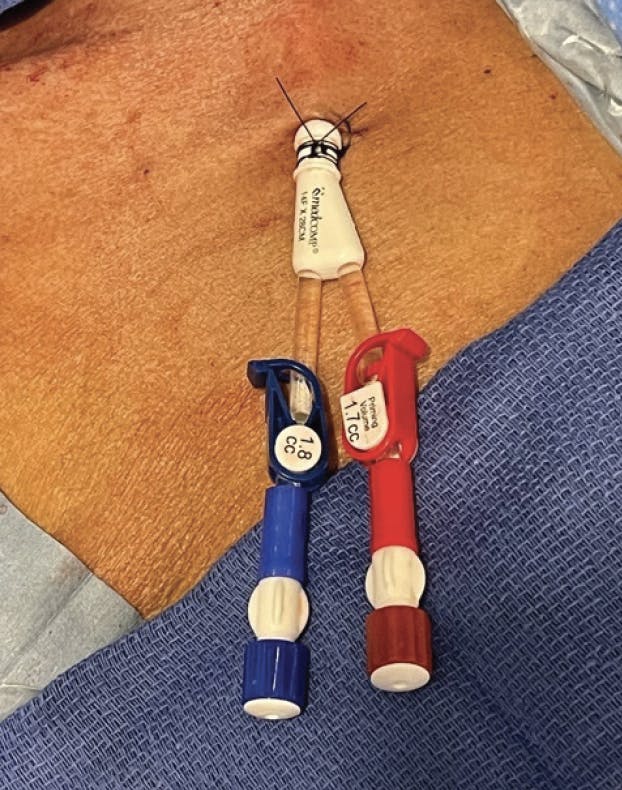
Figure 1. A TDC secured with single skin suture to allow mobility for cleaning. Note that the suture is attached to the reinforced portion of the catheter to prevent a too-tight suture that could result in catheter dysfunction.
1. Smith JC, Sullivan KL, Michael B. Postprocedural aspiration test to predict adequacy of dialysis following tunneled catheter placement. Cardiovasc Intervent Radiol. 2006;29:576-579. doi: 10.1007/s00270-004-0302-3
2. Matsumoto MM, Chittams J, Quinn R, Trerotola SO. Spontaneous dislodgement of tunneled dialysis catheters after de novo versus over-the-wire-exchange placement. J Vasc Interv Radiol. 2020;31:1825-1830. doi: 10.1016/j.jvir.2020.03.008

My practice is to always place a suture at the TDC exit site and generally not use any other suture or securement device. There are two purposes for a suture at the exit site: control exit-site bleeding and secure the catheter. My technique is to make the exit site as small as possible and tunnel the first 2 to 3 cm very superficially to catch some subdermal tissue and not have the cuff “floating” deep in subcutaneous fat. I place a 2-0 nylon suture from lateral-inferior to lateral-superior, corresponding to 7- and 11-o’clock positions. This is tied firmly, with sufficient tension to draw the skin snugly around the catheter but not so tight as to cause skin breakdown or necrosis. I prefer nylon for this rather than Prolene suture (Ethicon, a Johnson & Johnson company) because it is less elastic, but any strong nonresorbable monofilament suture should do (never place braided suture external to the skin). I tie eight knots to create a chain extending away from the exit site. Then, I wrap the suture around the catheter four times and tie down with just enough tension to hold the catheter without compressing the shaft. Being away from the exit site allows for good healing and easy cleaning of the site, without the suture becoming embedded or trapping debris at the exit site. This provides a very secure anchor for most patients, as any traction applied to the catheter will tighten the suture like a lasso (Figure 1).
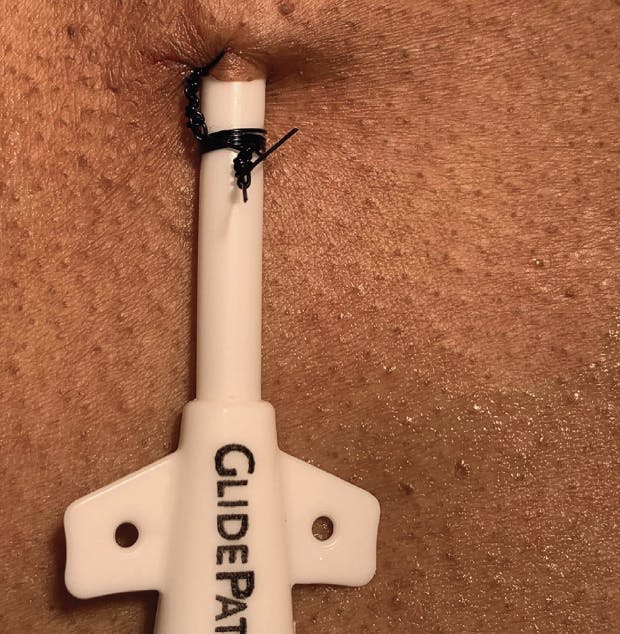
Figure 1. Catheter exit site with “lasso” suture providing hemostasis and anchoring catheter, while leaving the exit site accessible for cleaning and application of an anti-infective ointment or patch.
Some worry about the wrapped suture being overly tight, to the point of compressing the catheter and compromising the lumens. Although this can occur, it is quite easy to avoid simply by applying the right amount of tension on the suture. This can be checked by fluoroscopy postsuture if there is any concern. This method also has the advantage of not allowing any traction to be transmitted to the cuff. For this reason, I don’t like to suture the catheter wings to the chest, where movement is inevitable, and traction can be transmitted directly to the cuff, thus delaying or preventing healing and incorporation. This is a particular problem in patients with ample chest or breast tissue. In these patients, making the exit site just a few centimeters below the clavicle will minimize the impact of chest tissue movement.
When I have a patient for whom I am particularly concerned about catheter dislodgement (ie, poor skin integrity, extreme advanced age, corticosteroid use, agitation), in addition to the exit-site suture as described, I will anchor the suture wings to the chest with 2-0 nylon but advance the cuff 4 cm into the tunnel, leaving a very short external segment and less opportunity for traction.
Finally, after placing a chlorhexidine patch at the exit site, I apply a strongly adhesive clear dressing, which further anchors the catheter to the chest wall and limits traction being transmitted to the cuff. I consider this occlusive dressing to be an integral component of the catheter anchoring technique.
We are often asked when the exit-site suture should be removed. There is no absolute answer for this. Most patients will incorporate the cuff sufficiently to prevent catheter dislodgement in 3 to 4 weeks. However, for some patients this takes much longer or never occurs at all. Unfortunately, the only way to tell is to remove the suture and apply gentle manual traction to the catheter. If the catheter moves, it is not incorporated! Obviously, this maneuver would be problematic at an outpatient dialysis clinic, where the suture cannot readily be replaced if necessary. We are sometimes asked to do this at our access center and are prepared to replace sutures if we determine the catheter cuff is not securely incorporated.

There are many ways to secure a TDC, and each practitioner will tell you that their method is optimal. But whatever method you use, the most important factors are to confirm that you’ve placed the catheter tip and subcutaneous cuff exactly where you want them and then to confirm that there is adequate flow through the catheter for hemodialysis. To achieve this, I place all my de novo TDCs using a retrograde tunneling approach. I know I’m in the minority, but it’s worth considering. Beyond that, a TDC should be secured with the intent of:
- Preventing dislodgment and maintaining the tip and cuff where you’ve placed them
- Avoiding constriction of the catheter lumens that could compromise flow during dialysis
- Making the entry site easy to keep clean to avoid infection
- Reducing disfigurement and improving the patient’s level of comfort
- Making the “securing method” easily removable
For 30 years, I’ve used the following method. After catheter insertion has been completed, I place a generous (1-1.5 cm) “anchor” stitch using 2-0 nonabsorbable monofilament suture immediately adjacent to the catheter entry site. This stitch is neither loose nor tight, and it should slightly cinch the tissues adjacent to the catheter entry site so that there is less chance of oozing where the catheter enters the subcutaneous tract. Then, I braid the two sutures twice around the catheter, passing each one through the holes on the catheter’s hub, entering from the underside to the side facing away from the skin. If there are no holes on the hub, it is easy to braid the sutures around the stems that lead to the luer connectors. Once the sutures are around the hub or through the holes, I tie a knot five times and trim the remaining suture to about 2 to 3 mm from the knot. The knot should be atop the hub (not beneath it) so that the knot and sutures do not irritate the skin. The final result is shown in Figure 1.
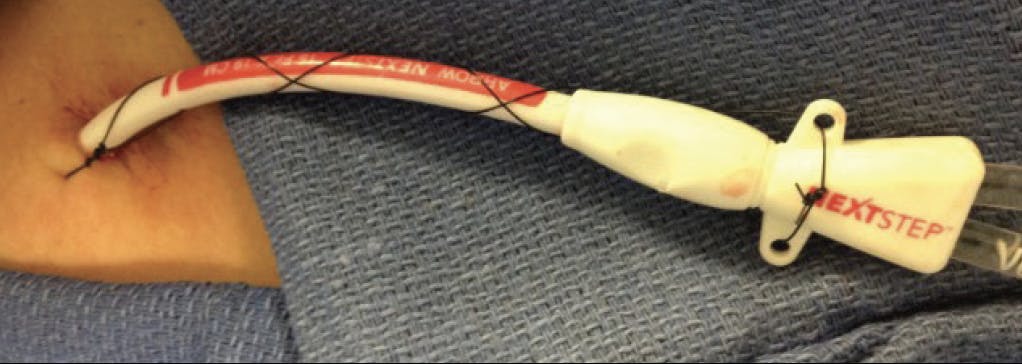
Figure 1. I secure my TDCs with an anchor stitch adjacent to the catheter exit site, then I braid the sutures around the catheter and use the holes on the hub to tie the knot on the side away from the skin.
Using this technique, the catheter cannot be dislodged, there is minimal disfigurement or skin irritation, and it is easy to clean around the catheter and, if desired, place an antimicrobial disc around the catheter at the tract insertion site. There is no constriction of the catheter lumens, and once there has been healing of the subcutaneous cuff (which will secure the catheter), the stitch can be easily removed.
On a final note, I wonder why many practitioners advise patients to never allow their TDC to get wet after a period of healing. All you need to do is look at a TDC that has not been allowed to get wet after a few months, and you will see a lot of adherent adhesive and debris that pose ongoing risk of infection. My opinion is that after the TDC cuff has been incorporated into the subcutaneous tissues (after at least 1 month), it is okay if the catheter gets wet as long as the site is then dried and a clean dressing applied. Randomized study, anyone?
Advertisement
Advertisement