Advertisement
Advertisement
June 2022
Modified Seldinger Peritoneal Dialysis Catheter Insertion: A Game Changer in Renal Replacement Therapy
A step-by-step review of the modified Seldinger peritoneal dialysis technique.
By Jan “John” Swinnen, MD, FRACS (Gen), FRACS (Vasc), DDU (Vasc); Ingemar Davidson, MD, PhD; and Luke Baker, MBBS, FRANZCR, EBIR
Peritoneal dialysis (PD) is one of four modalities for managing patients with kidney failure (KF); the others are hemodialysis (HD), kidney transplantation, and medical management (which is only a partial therapy). It is well recognized that PD is grossly underused worldwide and especially in the United States.1-3 Although transplantation remains the most effective and cheapest option for treating KF, PD should be considered in the majority of patients requiring dialysis. The correct ratio of PD to HD is not established but should range from 50% to 60%. In Hong Kong, 75% of patients are on PD, whereas this percentage is 30% in New Zealand, 18% in Australia, and 13% in the United States.3 The cardinal benefits of PD as compared with HD are4:
- Preservation of residual renal function, out to 2 years
- A much cheaper “home therapy” than in-center HD; in Australia (a public health care system), PD costs A$45,000 per patient per year, while in-center HD costs A$100,000 per patient per year5
- The avoidance of HD-related complications from arteriovenous (AV) fistulas, AV grafts, and central venous catheters
Delivering PD care to patients in KF requires three initiatives: (1) an acceptance and recognition by nephrologists and patients that it is often the optimal treatment for KF; (2) a method of placing the PD catheter safely, effectively, and cost efficiently; and (3) a nursing infrastructure to support this patient-delivered home therapy.
Currently, most PD catheters are placed laparoscopically, almost always under general anesthesia, but alternative methods for placement include open surgery, peritoneoscopic techniques, and Seldinger PD (SPD).6 SPD has been around for at least 20 years, but it has been practiced in a widely disparate way, with a questionable safety and efficacy profile.
This article describes the modified SPD (mSPD), which is a rigorous, safe, effective, and cost-efficient procedure that can be performed as a day case under local anesthesia. It can be done in the sickest patients, including those with recent myocardial infarction and on full anticoagulation. The entire procedure is performed through a single 5-mm incision and catheter tract. The PD catheter can be used for full-volume PD immediately after insertion without dialysate leak for urgent start PD (USPD). The results of our first 65 cases with this technique (now out to 105) have been published.6 A similar technique was described in 2014 by Abdel-Aal et al.7
One of the most important features of mSPD is that it places the skill set for this procedure in the hands of the endovascular proceduralist, most often the vascular surgeon. The procedure targets the peritoneal cavity rather than the vascular lumen, but mSPD utilizes familiar techniques and devices. Thus, mSPD is performed by those who often perform HD access procedures and does not require cross-referral.
PATIENT SELECTION FOR PD/mSPD
Correct patient selection is crucial, considering a number of medical and social factors. The indications for PD/mSPD include:
- To preserve residual renal function in patients with acute or acute-on-chronic renal failure. This is very important with respect to “health span.”* In most countries, this represents most patients presenting in KF (ie, elderly diabetic patients)
- HD access failure due to cardiac disease, peripheral vascular disease, central vein occlusion, or failure of venous points of access
- SPD to initiate USPD
Contraindications to mSPD include peritoneal membrane failure; a large, muscular patient where PD may be inadequate; a large incisional, umbilical, or inguinal-scrotal hernia; a hostile abdomen; and inadequate personal-social circumstance. mSPD can be considered in patients on anticoagulation, including full anticoagulation at the time of surgery; those unfit for general anesthetic; obese patients, including severe morbid obesity; and those with minor hernias or past abdominal surgery, excluding the hostile abdomen.5
TECHNIQUE
There are eight steps to the mSPD technique: (1) preoperative evaluation with ultrasound; (2) reverse mapping of the PD catheter onto the abdominal wall (Figure 1); (3) safe access to the peritoneal cavity, at the correct place and along the correct sloping tract (the crucial maneuver!); (4) local anesthesia to the operative zone; (5) tract dilatation and PD catheter insertion through the sheath; (6) inner cuff placement; (7) reverse exit site tunneling; and (8) completion peritoneography and saline flush. All of this must be done under high-quality ultrasound guidance as well as x-ray and contrast radiologic control. A more detailed description, along with supporting images and videos demonstrating the steps and pitfalls, can be found on the Kidney Academy website (www.kidneyacademy.com).
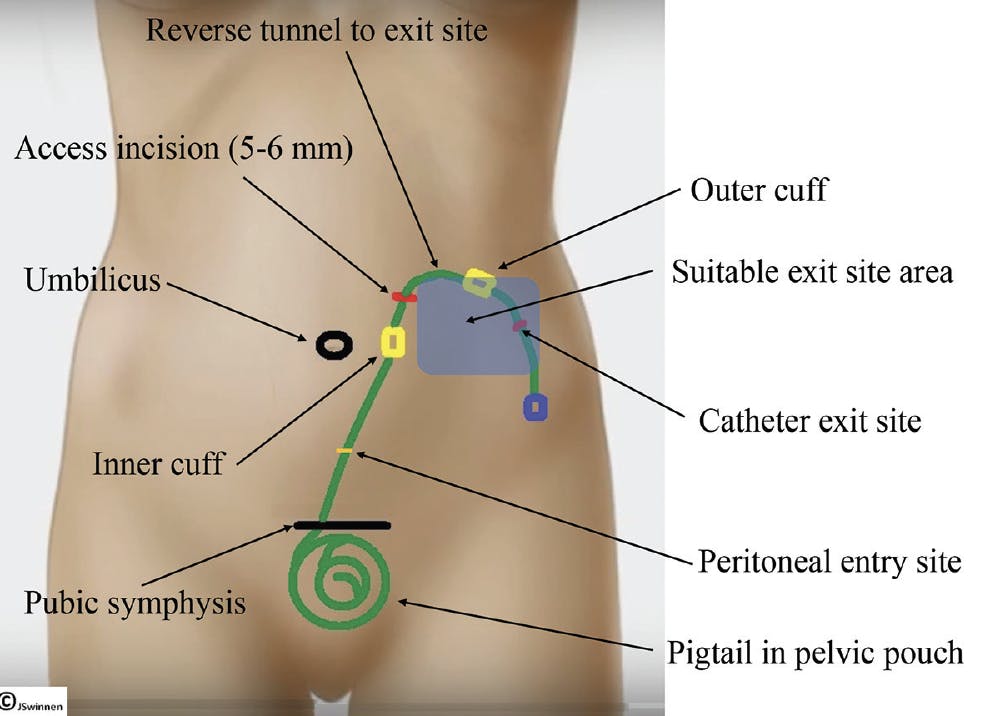
Figure 1. Preoperative mapping of the PD catheter. Note the catheter is mapped in reverse, starting with the pigtail in the pelvic pouch and working backward to the PD catheter exit site. The exit site must lie in an appropriate part of the abdomen, accessible to the patient and away from fat folds or belt lines.
Courtesy of www.kidneyacademy.com.
Step 1: Preoperative Ultrasound
This step gathers three important pieces of information.
- The state of the urinary bladder, which should contain < 100 mL of urine. This should always be checked even though all patients are asked to void immediately prior to procedure. A useful trick in placing a Foley bladder catheter is to inflate the balloon with air or dilute contrast, which provides an excellent marker for the bladder on subsequent x-ray.
- “Peritoneal slide” and clear delineation of the parietal peritoneum at the site of proposed peritoneal entry site. A linear probe of approximately 8 to 18 MHz yields better images, but in the more obese patient, a curvilinear 4-MHz probe will be needed.
- The position of the inferior epigastric artery with respect to the proposed catheter tract; this can be a large vessel (4-5 mm) and must be avoided.
Step 2: Reverse Mapping
Reverse mapping was described by Dr. John Crabtree8 and slightly modified by us. The catheter pigtail should be placed in the correct position (the pelvic pouch is ideal, although the true pelvis is acceptable), with the desired catheter tract and a tension-free exit site convenient to the patient (Figure 1). We use the Argyle PD catheter (Medtronic), which comes in two lengths (57 and 62 cm), so be sure to reverse map with the correct catheter length.
Step 3: Peritoneal Access and Correct Catheter Tract
Peritoneal access must be achieved in a graduated fashion, starting with a 22-gauge needle, then a micropuncture sheath (6-F outer diameter), and finishing up with a 16.5-F sheath. Ultrasound (Figure 2) and radiocontrast guidance (Figure 3) are essential for this at each step. The size of the access incision and catheter tract must be kept to a minimum (skin incision, 5 mm and catheter tract, 16.5 F). This prevents bleeding, sepsis, and dialysate leakage with USPD.
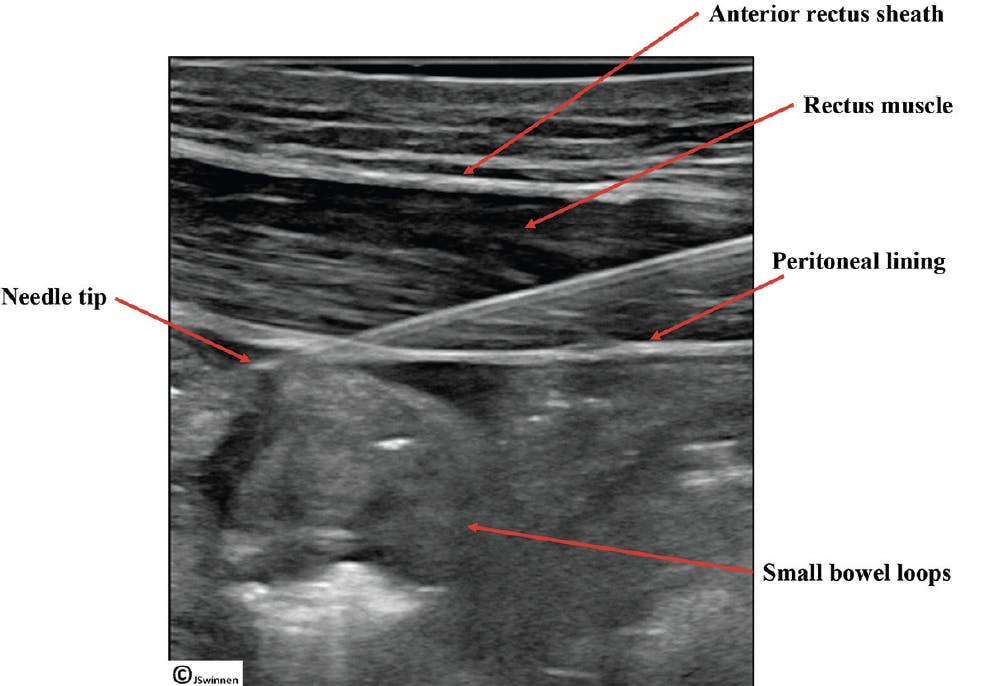
Figure 2. The pertinent abdominal wall structures by ultrasound appearance are marked. The bright (parietal) peritoneal lining is the key layer.
Courtesy of www.kidneyacademy.com.
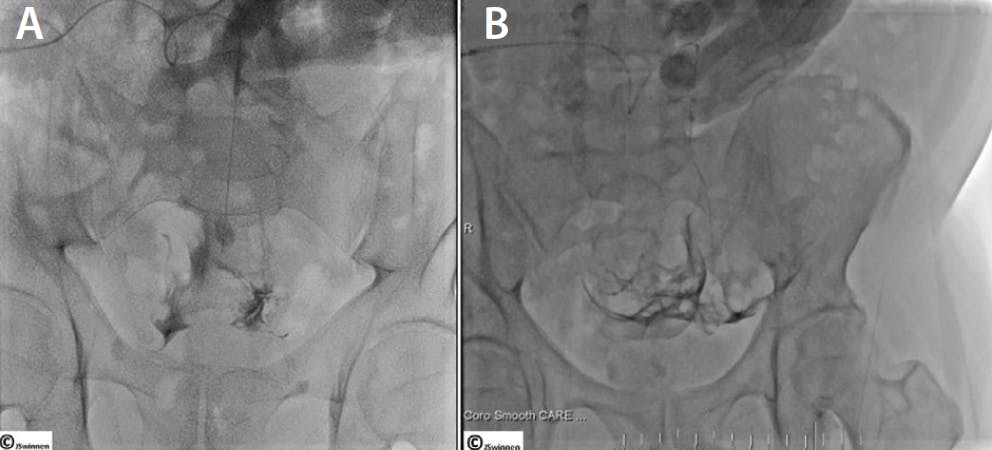
Figure 3. Correct peritoneography with the 22-gauge access needle (A) and the 6-F (outer diameter) microsheath (B).
Courtesy of www.kidneyacademy.com.
Correct catheter tract is essential to maximize the effectiveness of the procedure. The features of correct catheter tract are:
- The catheter tract must be correctly placed in the mediolateral plane (Figure 4) so that the pigtail ends up in the pelvic pouch.
- The catheter tract must be placed correctly in the anteroposterior (AP) plane (Figure 4) so that there is a graduated, sloping tract through the abdominal wall, which acts like a “flap valve” to prevent dialysate leak.
- The catheter tract must enter the peritoneal cavity after traversing the abdominal wall low (cephalad) to prevent catheter tip migration (Figure 5). However, if the peritoneal entry is too low, the angle between the transabdominal tract and the pelvic pouch can become very acute and lead to the rigid dilators and sheath “prolapsing” into the preperitoneum, in front of the bladder. A lateral abdominal x-ray is very useful in identifying and correcting this problem.
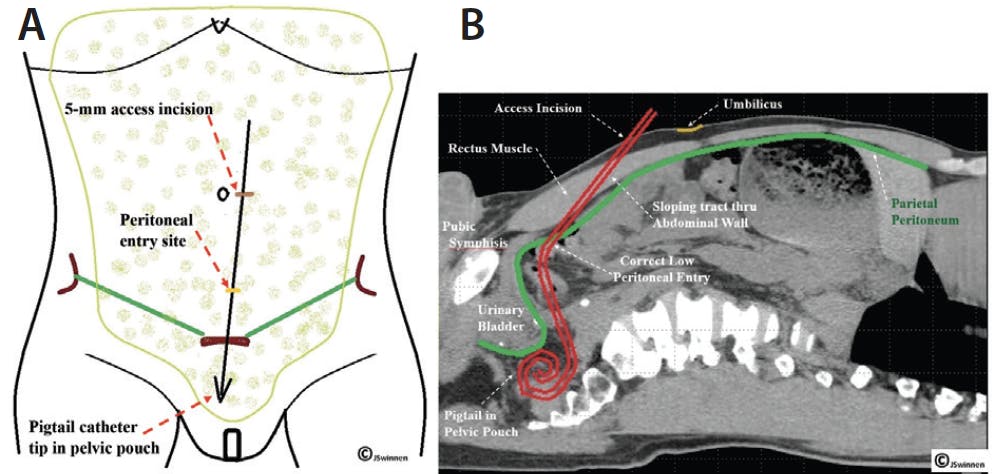
Figure 4. The catheter tract in the correct mediolateral plane into the pelvic pouch (A). The catheter in the correct AP plane with a low angle, creating a “flap valve” to prevent dialysate leak (B).
Courtesy of www.kidneyacademy.com.
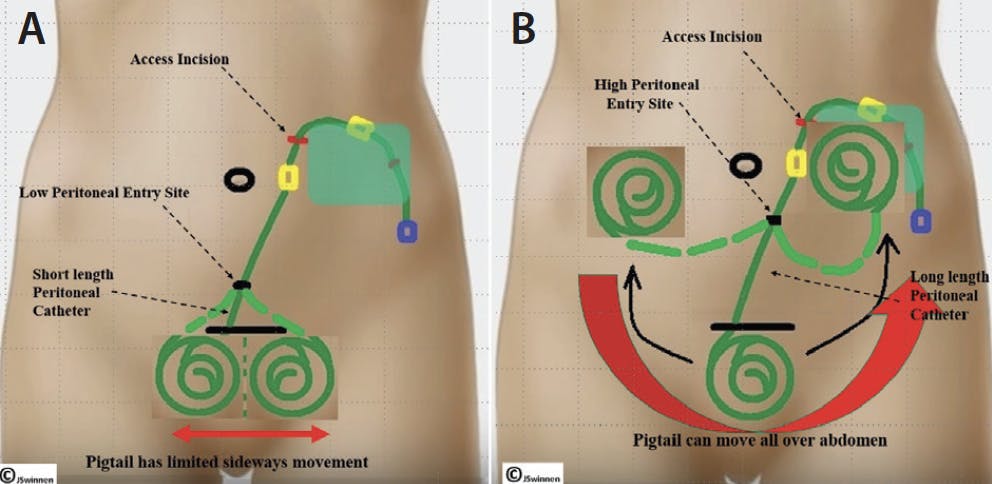
Figure 5. A low entrance into the abdomen prevents catheter dislocation (A), while a higher entrance allows the catheter to rotate up inside the abdomen (B).
Courtesy of www.kidneyacademy.com.
Step 4: Local Anesthesia
Three areas need to be anesthetized to perform SPD. Sedation is a helpful adjunct because most of these patients are anxious and new to KF treatment. The presence of an anesthetist is useful when managing very sick patients for USPD. First, local anesthetic should infiltrate the skin of the access incision, reverse tunnel, and exit site. Next, anesthetic infiltration of the parietal peritoneum of the peritoneal cavity is performed by injecting local anesthetic down the microsheath. Finally, anesthetic is injected in the catheter tract through a 5-F sheath under contrast x-ray guidance. A rectus sheath block is a good alternative used by some operators.
Step 5: Tract Dilatation and PD Catheter Insertion
Tract dilatation and PD catheter insertion must be performed in a graduated fashion with radiologic and contrast control at each step. The tract must be straight from access incision to pelvic pouch. The pelvic pouch lies posterior to the tract through the abdominal wall; as stiffer and larger dilators are introduced, these can “prolapse” into the bladder wall/preperitoneal space. When this happens, it is poorly appreciated on the AP radiologic view. A lateral view makes this clear and is useful in both diagnosing the problem of anterior prolapse as well as correcting it. The dilators are passed in sequence, in and out until they pass relatively freely. Then, the 16.5-F sheath is inserted. Catheter insertion down the sheath is generally straightforward.
Step 6: Inserting the Inner Cuff
In this mSPD technique, the inner cuff is not a “sealing” mechanism; it is a secondary anchoring mechanism (together with the outer cuff). Sealing of the tract is achieved by its sloping nature (a “flap valve” for the peritoneal cavity) and because the tract is very tight, the same size as the catheter. One operator grasps the inner cuff with correctly placed nontooth forceps or a hemostat and pushes the cuff 1 to 3 cm into the tract as the second operator withdraws the peel-away sheath.
Step 7: Reverse Tunneling
Reverse tunneling is performed in all PD insertions, regardless of technique used. Note the following points:
- As with all PD insertions, the exit curved tunnel should be down-sloping, and the exit site should be easily accessed by the patient.
- The exit incision should be performed with a scalpel blade to produce a 1- to 2-mm cut, which should then be stretched with a hemostat to 2 to 3 mm, but no more than that. This is important to prevent exit site bleeds, which are common in patients with uremic platelet failure (all your dialysis patients) and those on antiplatelet agents or full anticoagulation.
- The use of a sharp trocar to cut an exit for the catheter leads to exit site bleeding.
- The exit hole must not be > 3 mm as this can lead to exit site problems, particularly sepsis.
Step 8: Final Check
Completion peritoneography (Figure 6) is performed to assess three things: (1) the tip of the PD catheter in the pelvic pouch, (2) free flow from the catheter into the pelvic pouch and pelvic peritoneum, and (3) to ensure there is no kinking or twisting anywhere in the catheter tract. A 500-mL warm saline flush is done to establish free entry and exit of fluid from the catheter. We generally leave several 100 mL of saline in the peritoneal cavity to minimize postinsertion peritoneal irritation.
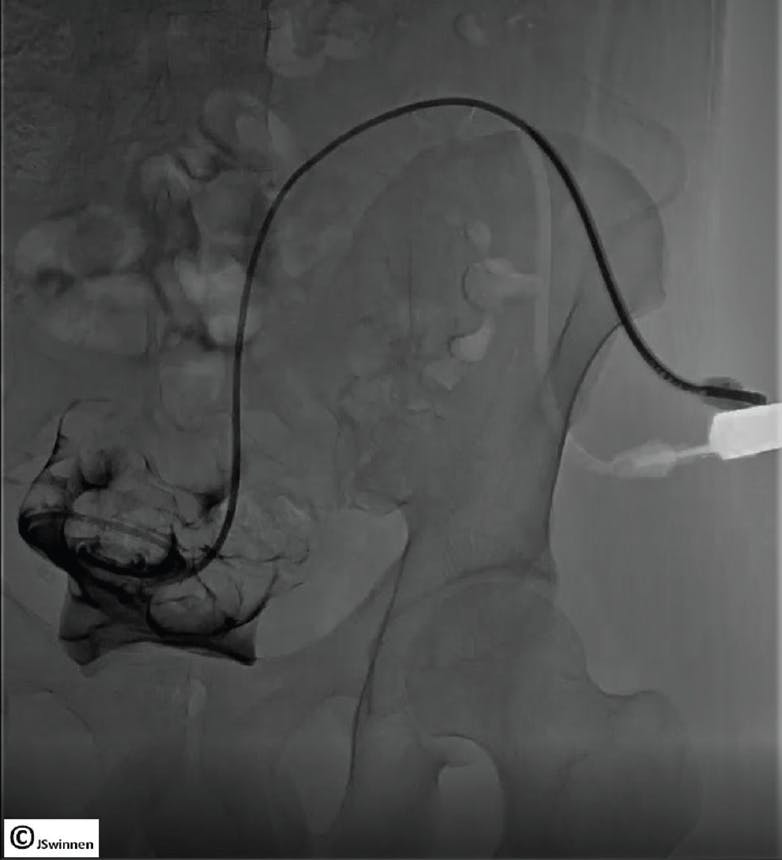
Figure 6. Completion peritoneography confirms the PD catheter tip location in the pelvic pouch, free flow through the catheter, and absence of kinks along the catheter tract.
Courtesy of www.kidneyacademy.com.
SUMMARY
The mSPD described can dramatically improve PD access for renal failure patients. It is a very safe procedure that can be done under local anesthetic in the sickest patients, in patients with obesity, and in fully anticoagulated patients. It places the catheter tip reliably in the correct position and keeps it there. Because of the minimal incision and tight, sloped catheter tract, mSPD allows for immediate, full-volume USPD, preventing the many problems associated with acute HD, particularly the destruction of residual renal function and central veins. Finally, it puts PD into the same skill set as HD, allowing the endovascular specialist to deliver both forms of renal replacement therapy without cross-referral.
*Life span is how long a person lives, whereas health span is how long a person lives in good health, able to enjoy life. Increasing a patient’s life span without giving them an acceptable quality of life does not increase their health span.
1. Norvak M, Bender F, Piraino B. Why is peritoneal dialysis underutilized in the United States? Dial Transplant. 2008;37:90.
2. Asif A, Byers P, Gadalean F, et al. Peritoneal dialysis: the impact of an interventional nephrology peritoneal dialysis access program. Semin Dial. 2003;16:266-271. doi: 10.1046/j.1525-139x.2003.16051.x
3. Liu FX, Gao X, Inglese G, et al. A global overview of the impact of peritoneal dialysis first or favoured policies: an opinion. Perit Dial Int. 2015;35:406-420. doi: 10.3747/pdi.2013.00204
4. Chaudhary K, Sangha H, Khanna R. Peritoneal dialysis first: rationale. Clin J Am Soc Nephrol. 2011;6:447-456. doi: 10.2215/CJN.07920910
5. ANZData registry. Chapter 4: haemodialysis. Australia and New Zealand dialysis and transplant registry. Accessed September 28, 2020. https://www.anzdata.org.au/wp-content/uploads/2019/09/c04_haemodialysis_2018_ar2019_v2.0_2020619.pdf
6. Swinnen JJ, Baker L, Burgess D, et al. Changing the peritoneal dialysis access algorithm with a precise technique of percutaneous Seldinger PD catheter placement. J Vasc Access. Published online February 14, 2022. doi: 10.1177/11297298221077607
7. Abdel-Aal AK, Dybbro P, Hathaway P, et al. Best practices consensus protocol for peritoneal dialysis catheter placement by interventional radiologists. Perit Dial Int. 2014;34:481-493. doi: 10.3747/pdi.2013.00029
8. Implantation techniques for peritoneal dialysis catheters. YouTube page. Accessed May 24, 2022. https://www.youtube.com/watch?v=p19rJvxALzc
Advertisement
Advertisement