Advertisement
Advertisement
June 2022
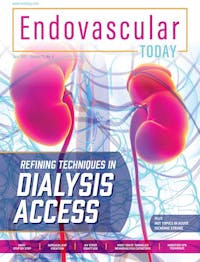
Refining Techniques in Dialysis Access
Plus, a series of articles reviewing current topics in acute ischemic stroke.

In past years, the annual dialysis access issue of Endovascular Today has mostly addressed changing patterns of care for patients with renal failure. Those issues featured clinical trial outcomes, new technologies, and evolving (and improved) ways to treat people with end-stage kidney disease. This year, we go back to the basics and focus on technical considerations that physicians face when creating and maintaining dialysis access. In this issue, you will find topics that range from the burgeoning new field of percutaneous arteriovenous fistula (pAVF) creation to the mundane (yet controversial) method of securing a newly placed tunneled hemodialysis catheter.
To kick off our feature, Robert Shahverdyan, MD, reviews patient candidacy and procedural tips for the two available pAVF devices and outlines the steps to pAVF success, emphasizing the importance of planning and sharing his ultrasound mapping and vascular access creation algorithms. Joshua Gabel, MD, and Richard F. Neville, MD, follow that theme of keys to success, sharing a step-by-step how-to for AVF creation and considering appropriate patient selection based on a patient’s individualized end-stage kidney disease life-plan.
We then spoke with Dheeraj K. Rajan, MD, about arteriovenous stent graft use and placement, with topics including candidacy, planning, key pitfalls, current and future data, and the Kidney Disease Outcomes Quality Initiative guidelines.
For our next article, we called upon Scott O. Trerotola, MD, and Theodore F. Saad, MD, to join me in sharing our methods for securing a tunneled hemodialysis catheter. It’s interesting that three seasoned practitioners can adopt such different methods.
Concluding our cover stories is an article by Jan “John” Swinnen, MD; Ingemar Davidson, MD; and Luke Baker, PhD, walking us through their eight steps to the modified Seldinger peritoneal dialysis technique, a rigorous, safe, effective, and cost-efficient procedure.
Alongside our dialysis coverage, we have a series of articles dedicated to current topics in acute ischemic stroke (AIS). Anurag Sahoo, MD; Mohamad Abdalkader, MD; and Thanh N. Nguyen, MD, start us off by compiling significant recent papers on AIS and large vessel occlusion, offering a summary of key findings and the importance of each article to the field. We asked a group of experts—Thabele (Bay) Leslie-Mazwi, MD; Ashutosh P. Jadhav, MD; Justin M. Cappuzzo, MD; Elad I. Levy, MD; Waleed Brinjikji, MD; and Demi Dawkins, MD, to ponder what the next breakthrough in AIS therapy should be, with responses ranging from technology and technique improvements to bigger-picture issues like increasing access and new models of care. Finally, Dorothea Altschul, MD, and Stav Tjoumakaris, MD, answer a series of questions on the role of artificial intelligence in stroke triage and communications, touching on the impact of futile transfer, key data unknowns, and implementation challenges.
Also in this issue is a featured interview with Lee Kirksey, MD, on his efforts to address health care disparities throughout the pandemic and generally in vascular care, needs for trials studying complex peripheral artery disease, plans for the Center for Multicultural Cardiovascular Care at Cleveland Clinic, and more.
Along with all the contributors, I hope that this edition of Endovascular Today will provide the reader useful and provocative updates that lead to better care for our renal failure, neurovascular, and peripheral vascular patients.
Bart Dolmatch, MD, FSIR
Guest Chief Medical Editor
Advertisement
Advertisement