Advertisement
Advertisement
May 2022
An Interview With Mohamad Hamady, MBChB, FRCR, EBIR, FSIR
Prof. Hamady discusses his work in robotic intervention, plans for the upcoming IDEAS meeting, the fight for recognition of IR as a specialty in the United Kingdom, and more.
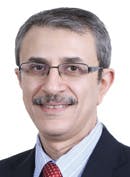
You are a pioneer in the field of robotic intervention, performing the first robotic endovascular aortic invention, the first robotic uterine fibroid embolization (UFE), and the United Kingdom’s first robotic prostate embolization. How did you get into robotics and virtual/augmented reality technology, and can you share any plans in these areas?
Robotic guidance is a developing field in various aspects of surgery. I have done substantial research work in endovascular robotics, as proof of concept, in various territories with great success.
Precision, enhanced technical performance and a significant reduction in radiation doses are the main advantages of robotic endovascular technology. The major current challenge in this field is to establish an economically viable model that will enhance practitioners’ uptake and encourage the industry to invest in the field.
One focus of your work in the last few years has been uterine artery embolization (UAE), including a 2020 meta-analysis on UAE for giant versus nongiant fibroids.1 Based on those findings, what are important factors to consider when determining whether a giant fibroid should be treated with UAE?
UFE is one of the most successful and evidence-based endovascular procedures in the field of interventional radiology (IR). The biggest advantage of UFE is to improve the quality of life while preserving the uterus. Therefore, patient selection is of paramount importance. For a long time, giant fibroids have been a no-go area. However, my experience and the evidence in the literature as demonstrated in this systematic review prove that giant fibroids, in the right patient, will respond favorably and safely to embolization. However, it is important that interventionalists exercise close follow-up and careful management of postprocedure recovery.
If you were given a grant to pursue a research or development initiative of your choosing in the area of embolization, what would you choose?
I am part of the landmark EMBIO trial for bariatric patients randomizing between embolization of left gastric artery and sham. I am looking forward to seeing dedicated embolic particles that work specifically for left gastric embolization.
You also have an interest in aortic intervention, with a recent focus on aortic arch repair. What are the current pressing needs for innovation and/or further research for aortic arch pathologies?
Aortic arch is particularly challenging to repair endovascularly due to a range of physiologic, anatomic, and pathologic factors. Endovascular technology and experience have significantly evolved in the last decade or so. The available technology with dual or triple branches, as well as custom-made scallops and fenestration, have enabled us to treat a wide range of patients. However, device profile, conformability, and optimal radial force are among the areas that would benefit from further refinement. This technologic development in main stent grafts and bridging stents will help ongoing focused clinical research on stroke prevention and patient selection.
What do you hope meeting attendees take away from the upcoming IDEAS (Interdisciplinary Endovascular Aortic Symposium) in September, for which you are Chairperson?
IDEAS has been one of the fastest- and largest-growing, multidisciplinary, noncommercial, aortic meetings. It covers a wide range of aortic pathologies and technology and valuable myriad experience. The organizing committee has been consistent over the years in looking for a progressive and interactive approach to provide delegates with rich technical, clinical, research, and up-to-date knowledge and enable participants to exchange their experiences and ideas in an open and friendly atmosphere.
Can you share an update on your collaborative project on stroke prevention for thoracic endovascular aortic repair? What are your strategies for improving safety and reducing risk?
Our research at Imperial College, as well as other researchers’ work, have confirmed that stroke, particularly silent infarcts, represent a significant risk during thoracic endovascular aortic repair cases. We have been systematically investigating a few preventive strategies, including saline flushing alone and combined CO2 and saline flushing, as well as filters for great vessels. Owing to the multifactorial nature of neurologic injuries, a bespoke approach will likely be needed, and the evidence is slowly but steadily building up in this area.
Throughout your career, you’ve held numerous prominent leadership positions—at the Cardiovascular and Interventional Radiological Society of Europe, British Society of Interventional Radiology, and Pan Arab Interventional Radiology Society, to name a few. One such position is your role as the Pan London Training Program Director for IR at Health Education England. What does this role entail, and what have been your goals?
I have been the Lead for IR training in Greater London for the last 3 years. I am pleased that IR training has grown substantially in number and quality. I have overseen the implementation of the new IR curriculum, with an emphasis on clinical training. I have worked with trainers and trainees to implement and assess competency targets, and I also managed to increase collaborative work among centers to reduce variations in training. Over the last few years, and even throughout the COVID-19 pandemic, our region managed to deliver simulation and online training in various aspects of vascular and nonvascular IR, which proved to be successful. Facilitating simulation and hands-on courses for junior trainees was another task that was delivered effectively, offering junior trainees the opportunity to test their aptitude for the IR lifestyle and skills.
A common thread found in your published work and presentations is issues concerning the field of IR—notably, the fight for the recognition of IR as a specialty in the United Kingdom. What are the biggest hurdles to this, and how would you like to see the field move forward?
IR is an established field in the medical arena that offers minimally invasive interventions in almost every facet of medicine. It is widely agreed that the best clinical care is offered by clinicians who are equipped with technical as well as clinical skills. IRs are in a unique position where they can offer their patients not only high skillful procedures and accompanying clinical care but also in-depth knowledge of radiologic imaging, which helps diagnosis and follow-up.
The growth in knowledge and technology in the IR field needs a tailored training program, as well as proper recognition. The needs of trainees and established IR practitioners are somehow different from diagnostic radiology. To continue offering safe patient care and stay up to speed with research and development in the field, IR needs to be a standalone specialty.
This specialty has three pillars: diagnostic radiology, clinical care, and image-guided interventions. The two main hurdles are (1) lack of understanding among diagnostic colleagues about the challenges and opportunities facing IR and (2) that we are “hardwired” to resist change. The good thing is that coming generations are determined to move in the right direction.
1. Llewellyn O, Patel NR, Mallon D, et al. Uterine artery embolisation for women with giant versus non-giant uterine fibroids: a systematic review and meta-analysis. Cardiovasc Intervent Radiol. 2020;43:684-693. doi: 10.1007/s00270-019-02359-7
Advertisement
Advertisement
Interested in reading more interviews?
To read more interviews with thought leaders in the vascular field, check out our Profiles & Perspectives hub.
Read More