Advertisement
Advertisement
May 2022
Sponsored by Cagent Vascular
Serrate and Inflate: Treating CLTI Using the Serranator® PTA Serration Balloon Catheter
With Trelawny Zimmermann, DO; Daniel A. Leung, MD, FSIR; and Michael C. Siah, MD
Chronic limb-threatening ischemia (CLTI) is a challenging disease process requiring a diverse skill set and endovascular toolbox. Endovascular specialists are becoming more aggressive in treating below-the-knee (BTK) arterial disease to provide patients with optimal wound healing, limb salvage, and quality-of-life potential. CLTI patients often have narrow-caliber vasculature, long-segment occlusions, and heavily calcified lesions requiring a tailored approach.
Over the years, many innovative technologies have been introduced to the field in an attempt to address these challenging cases. One such technology is the Serranator® PTA Serration Balloon Catheter (Cagent Vascular), which is a semi-compliant balloon with three or four longitudinal serrated scoring strips. The serrated scoring technology is designed to apply > 1,000 times the point force of plain old balloon angioplasty (POBA), thus delivering more controlled and predictable vessel dilation using lower inflation pressures. In our experience, Serranator PTA has provided CLTI patients with durable luminal gain when compared to POBA alone, while avoiding dissections and vessel recoil that may otherwise require bailout stent placement. This article presents three case studies outlining the successful treatment of patients with CLTI using this tool as a primary treatment modality.
Case 1: Serranator-Enhanced SAFARI technique for a NonHealing Minor Amputation Site
By Trelawny Zimmermann, DO, and Daniel A. Leung, MD, FSIR
PATIENT presentation
A man in his mid-50s presented with a nonhealing right fifth toe amputation site. His risk factors included active smoking, diabetes, end-stage renal disease, hyperlipidemia, and atrial fibrillation. He is maintained on 75 mg clopidogrel once daily and 5 mg apixaban twice daily. Noninvasive studies demonstrated patent femoropopliteal outflow with blunted ankle waveforms and noncompressible ankle-brachial indices (ABIs).
INTERVENTION
The procedure began with antegrade common femoral artery access with a 6-F, 25-cm sheath. Arteriography demonstrated patent peroneal and posterior tibial arteries with a long-segment chronic total occlusion (CTO) of the anterior tibial (AT) artery, which could not be recanalized from an antegrade approach (Figure 1A). There was a lack of flow in the dorsalis pedis (DP) artery to supply the target angiosome (Figure 1B). Retrograde access was achieved through a hibernating distal DP to facilitate AT recanalization using the subintimal arterial flossing with antegrade-retrograde intervention (SAFARI) technique (Figured 1C). After predilation with a 2- X 40-mm balloon, a 3- X 120-mm Serranator PTA balloon was inflated slowly to 6 atm for 2 minutes over several stations from the DP to the proximal AT (Figure 1D). Completion arteriography demonstrated a widely patent AT and DP with perfusion to the target digit five wound bed (Figure 1E).
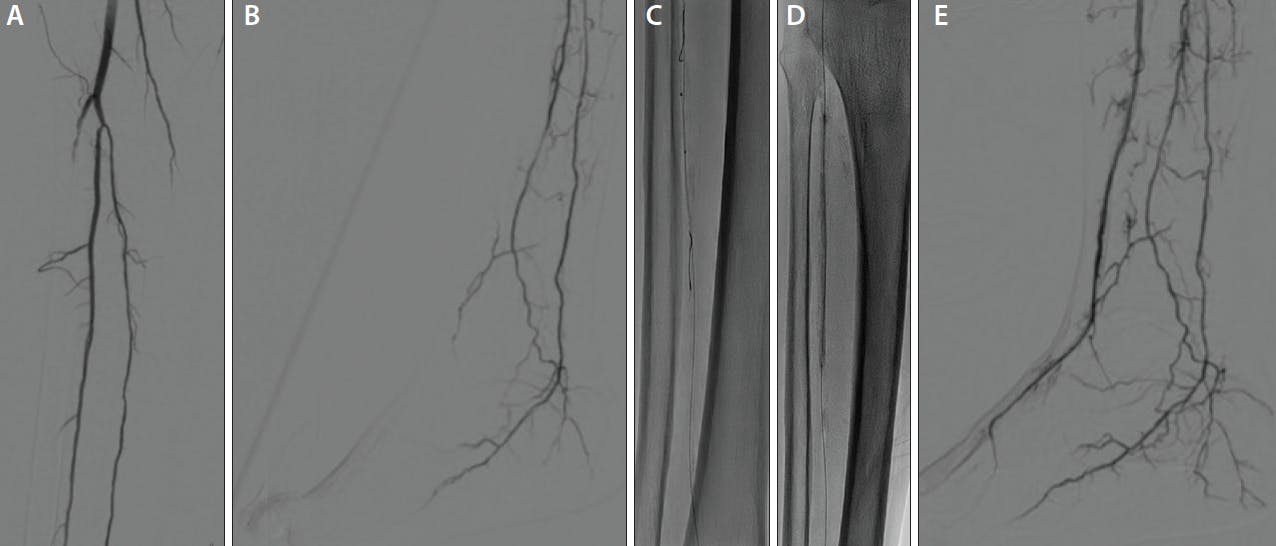
Figure 1. Arteriogram showing patent peroneal and posterior tibial arteries with a long-segment CTO of the AT artery (A). The DP artery had a lack of flow to supply the target angiosome (B). The SAFARI technique was employed to facilitate AT recanalization (C). A 3- X 120-mm Serranator PTA balloon was slowly inflated to 6 atm for 2 minutes between the DP and proximal AT (D). The completion arteriogram showed patent AT and DP with perfusion to the target digit five wound bed (E).
CONCLUSIONS
The Serranator balloon was perfectly suited to augment long-segment AT recanalization, achieving impressive luminal gain and brisk flow to the lateral forefoot wound. The patient went on to heal his minor amputation site wound in 6 weeks.
Case 2: Serranator PTA to Heal a Wound and Restore Quality of Life
PATIENT presentation
A man in his late 80s who is a recreational tennis player presented with a nonhealing, 1.5-cm wide and 0.3-cm deep right medial hallux wound. His risk factors included former smoking status and hypertension. He is maintained on 81 mg aspirin daily. ABIs were 0.5 on the right and 0.9 on the left.
INTERVENTION
The procedure began with left contralateral common femoral artery access for aortography and right lower extremity runoff arteriography. This demonstrated patent aortoiliac inflow and right femoropopliteal outflow. The posterior tibial artery was chronically occluded, and the peroneal artery was diminutive in caliber. There was diffuse disease involving the AT artery with long-segment severe stenosis proximally transitioning to CTO of the mid-AT with reconstitution of the distal AT into a patent DP artery (Figure 2A and 2B). Due to severe iliac tortuosity, antegrade right proximal superficial femoral artery access was achieved and a 6-F, 45-cm Destination sheath (Terumo Interventional Systems) was placed. The AT CTO was recanalized using a 0.014-inch Glidewire Advantage (Terumo Interventional Systems) and 0.018-inch NaviCross catheter (Terumo Interventional Systems), and AT predilation was performed using a 2- X 100-mm PTA balloon. Subsequently, a 3- X 120-mm Serranator PTA balloon was inflated slowly to 6 atm for 2 minutes across the recanalized AT segment (Figure 2C). Completion arteriography demonstrated widely patent AT and DP arteries with increased perfusion to the target hallux wound bed (Figure 2D and 2E).
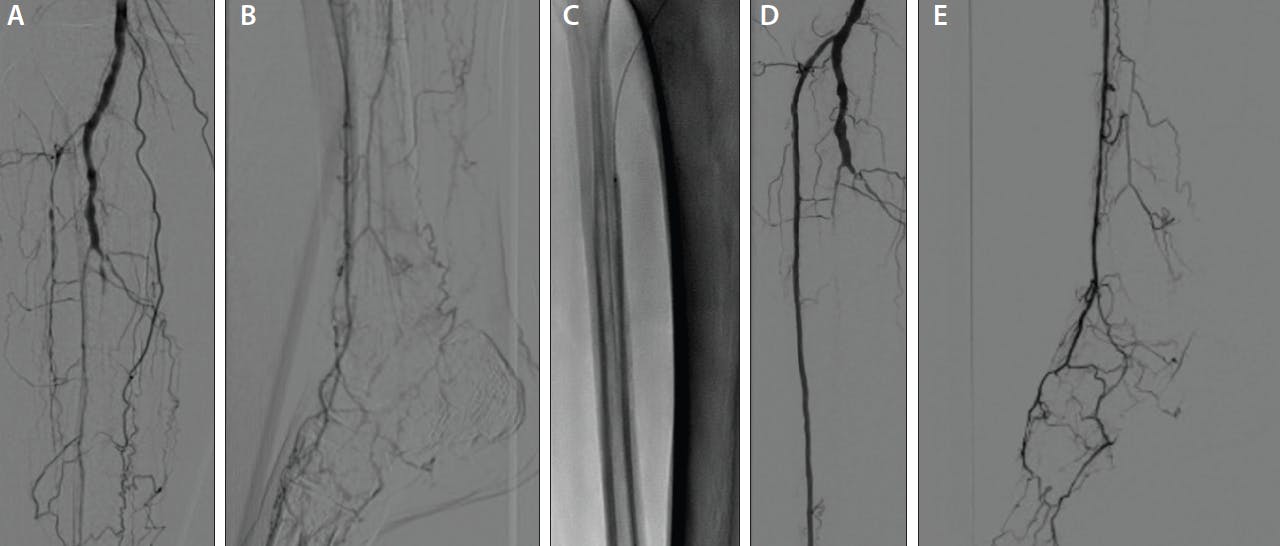
Figure 2. Arteriogram showing long-segment severe stenosis of the AT artery proximally transitioning to CTO at the mid-AT (A), with reconstitution of the distal AT into the patent DP artery (B). A 3- X 120-mm Serranator PTA balloon was slowly inflated to 6 atm for 2 minutes across the recanalized AT segment (C). The completion arteriogram showed patent AT (D) and DP (E) arteries with increased perfusion to the target hallux wound bed.
CONCLUSIONS
As in the previous case, the Serranator balloon delivered an excellent angiographic result, far superior to what would be expected for POBA of long-segment tibial disease. The patient’s wound healed completely by 4 weeks and he resumed playing tennis.
CASES 1 and 2: EXPLORING FURTHER
Are these results described in your cases typical for CLTI interventions?
Drs. Zimmermann and Leung: Satisfactory angiographic results are not consistently obtained with POBA alone despite meticulous sizing and prolonged inflation times. In our experience, serrated balloon angioplasty delivers consistently good results with decreased rates of flow-limiting dissection and vessel recoil compared to POBA, especially when treating heavily diseased BTK lesions, thus reducing the need for bailout stenting.
What is your inflation technique?
Drs. Zimmermann and Leung: Like with many endovascular devices, “go slow to finish fast.” With slow, controlled inflation, lesions will typically open well under nominal balloon pressure.
Do you typically predilate when using the Serranator PTA balloon?
Drs. Zimmermann and Leung: Although the Serranator PTA balloon has a very well-tapered tip, its profile is larger than that of plain 0.014-inch balloons. As such, predilation with a 2- or 2.5-mm balloon may be necessary for diffuse disease. For focal lesions, we usually go straight to the Serranator PTA balloon.
Why have you added the Serranator PTA balloon into your treatment algorithm?
Drs. Zimmermann and Leung: The Serranator PTA balloon fills a gap in the BTK treatment that was lacking with POBA alone. We’ve experienced consistently good results in terms of luminal gain and distal perfusion with a decreased need for post balloon scaffold placement. With its unique mechanism of action, the available Serranator PTA is well suited for the various BTK lesion morphologies encountered in CLTI patients and would likely be suitable for vessel prep before drug-coated balloon angioplasty. We are excited for the technology to become available in femoropopliteal artery sizing.
Jon George, MD, of Penn Medicine at the University of Pennsylvania Health System, discusses his experience with the Serranator PTA Serration Balloon in treating BTK disease.
Case 3: Successful Serranator After Failed POBA in A CRITICAL LIMB ISCHEMIA patient
By Michael C. Siah, MD
PATIENT presentation
A woman in her early 70s was referred to our clinic after a previous lower extremity arteriogram was obtained for a nonhealing right foot ulceration 3 months prior. After her intervention, the patient experienced persistent rest pain and no wound healing. Her focused exam was significant for nonhealing ulcers on her right foot/digits and no palpable pedal pulses (Figure 3).

Figure 3. Nonhealing ulcers on the patient’s right foot/digits.
DIAGNOSTIC ASSESSMENT
Arterial access was performed in the contralateral limb. Initial angiography revealed high-grade stenosis of the P3 segment of the popliteal artery and severe tibial disease (Figure 4). The prior arteriogram revealed significant tibial disease, including a 50-cm CTO in the distal tibial artery that was left untreated. It did not show any baseline popliteal lesions; however, following the balloon angioplasty, there was a small dissection plane that remained untreated that likely caused this new popliteal lesion.
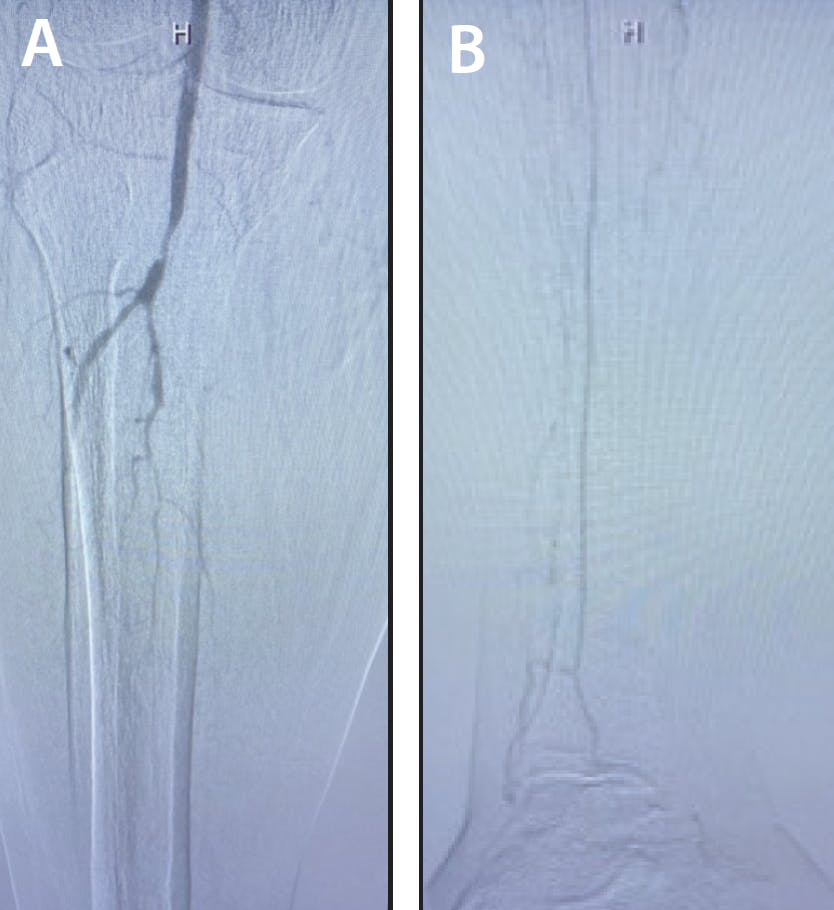
Figure 4. Angiogram showing high-grade stenosis of the tibial artery (A) and distal runoff (B).
INTERVENTION
Given the anatomy and location of the wounds, revascularization of the popliteal and AT artery was the interventional goal to provide in-line, angiosome-directed flow to the foot, facilitate wound healing, and prevent amputation. Using a 0.014-inch Glidewire Advantage guidewire and an 0.018-inch NaviCross support catheter, the CTO was crossed down to the DP artery. Orbital atherectomy with the Diamondback 360 (Cardiovascular Systems, Inc.) was performed with a 1.25-mm Micro Crown. Following channel creation, serration of the lesion was performed with sequential Serranator balloons at low atmospheres through the full lesion (Figure 5A-5C). Final angiography showed significant luminal gain, no recoil, and brisk flow (Figure 6). Intravascular ultrasound (IVUS) was also performed after the intervention, which demonstrated an open tibial artery with visible serrations into the medial layer of calcification (Figure 7). A Tack endovascular system (Philips) was placed in the previous popliteal dissection.
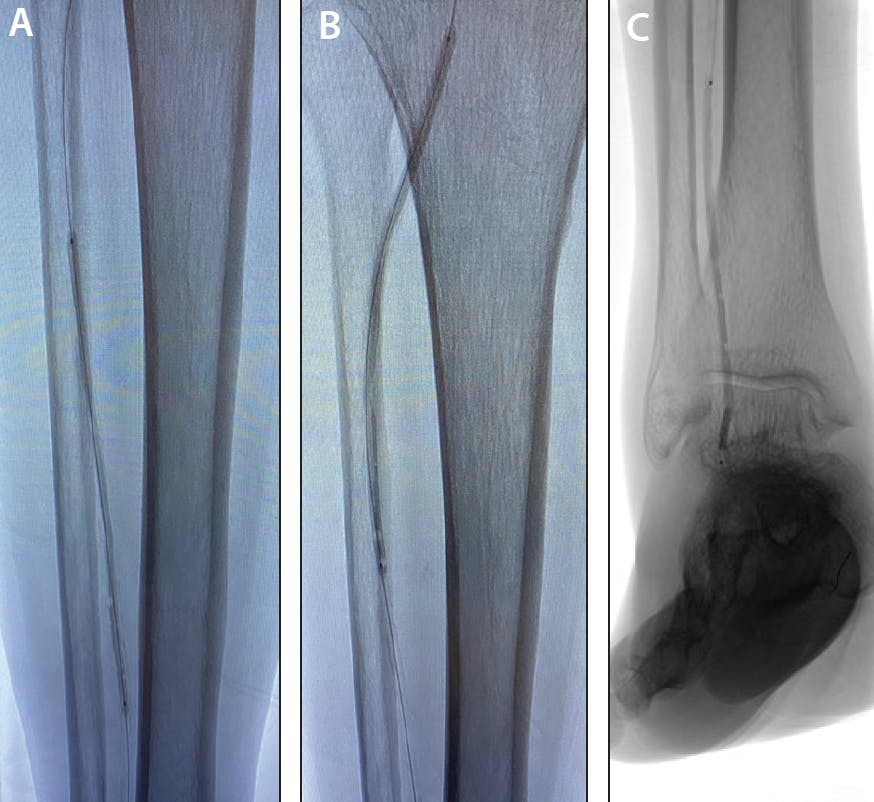
Figure 5. Sequential Serranator balloon catheters were used to serrate the full length of the lesion: Serranator 2.5 X 120 mm at 3 atm (A), Serranator 3 X 120 mm at 3 atm (B), and Serranator 2.5 X 120 mm at 3 atm (C).
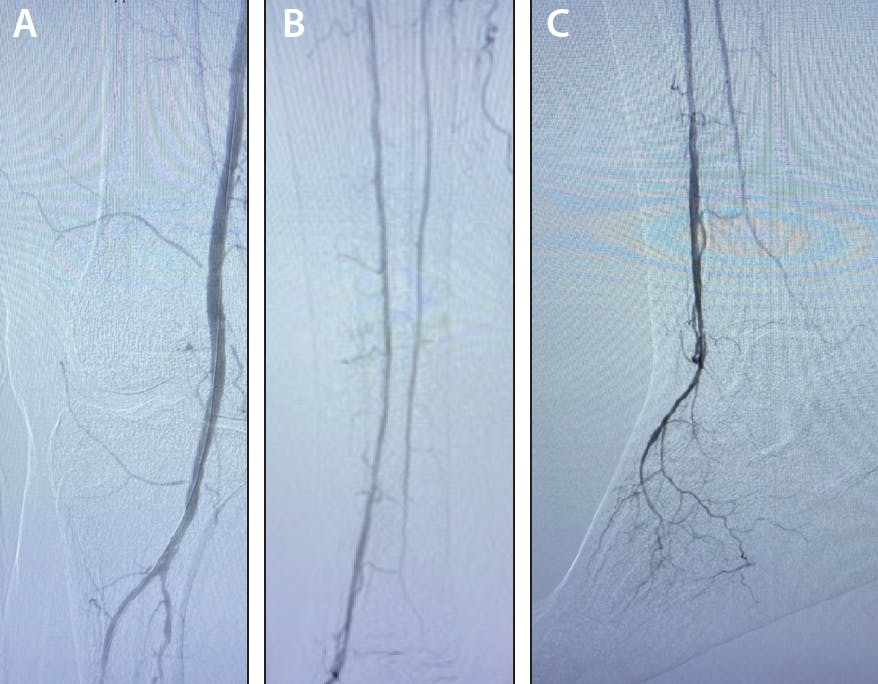
Figure 6. Final angiography showed significant luminal gain, no recoil, and brisk flow after Serranator use (A-C).
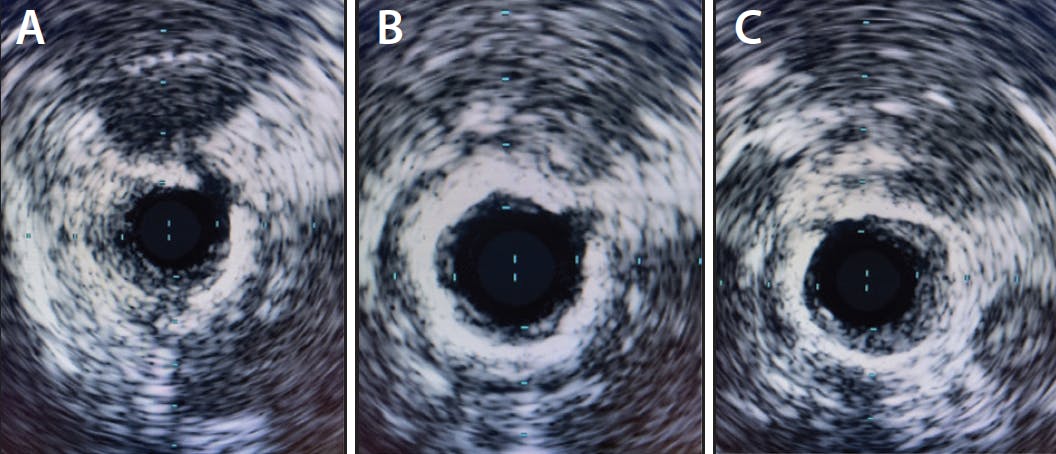
Figure 7. IVUS images showing open tibial artery with visible serrations into the medial layer of calcification.
CASE 3: EXPLORING FURTHER
Any thoughts looking back on this case?
Dr. Siah: It’s important to point out that these lesions are increasingly common, and we need a better solution than what has been done before. As we saw in this case, POBA was not an effective treatment to restore blood flow to the foot. Additionally, the luminal gain provided by effectively sized serration resulted in markedly improved perfusion to the foot compared to her previous intervention.
Why did you choose to use the Serranator PTA balloon in this case?
Dr. Siah: For a couple of reasons; in my previous experience with the Serranator device, I have seen impressive luminal gain after serration, without dissections or any significant recoil. Secondly, the patient already failed POBA, so I know I needed an alternative technology if we were going to try to prevent amputation. The size of this patient’s vessels and her underlying comorbidities made her a challenging candidate for bypass, as well as her absence of autogenous conduit.
In this case, you utilized atherectomy in combination with the Serranator PTA balloon. How do you see these two modalities working together?
Dr. Siah: Tibial CTOs can be very challenging to treat. I am a firm believer that atherectomy, particularly orbital atherectomy, can facilitate delivery of therapy in heavily diseased, small blood vessels. Not only does it allow for effective device delivery, but it allows for full luminal expansion at lower angioplasty pressures. That goes hand in hand with the effectiveness of the Serranator device—which aims to deliver point force along the entirety of the target treatment area at low balloon pressures, which in turn likely leads to more predictable, durable outcomes without the development of dissections.
How has the availability of the Serranator PTA balloon changed your practice when treating BTK lesions?
Dr. Siah: It has given me a new tool to treat complex patients. When I am treating a BTK lesion, whether it’s a focal stenosis or a long-segment CTO, I think about utilizing the technology. Its low-pressure, focal force mechanism has repeatedly demonstrated predictable results that have been impressive; I’ve seen fewer dissections on IVUS, and as a result, my cases have become less complicated. They’ve become shorter—I do not need to re-balloon areas due to dissection or recoil or pull other devices off the shelf to treat flow-limiting dissections.
How do you anticipate this device changing your treatment algorithm in above-the-knee lesions?
Dr. Siah: Its application above the knee is very exciting. I think, in conjunction with drug-eluting technology, we could have a game changer in our hands. We will be able to deliver drug to parts of the artery that haven’t been able to be reached before this point, and as someone who tries not to leave any metal behind during an intervention, I am optimistic that we will see “stent-like” results angiographically and hopefully into longer-term follow-up. What that ultimately means is increased durability of our interventions, leading to fewer repeat interventions for patients and, ultimately, fewer amputations for our patients and decreased cost to our health care system.
CONCLUSIONS
Pulsatile blood flow was restored to the foot, and the patient was referred to a wound clinic for ongoing management. After 8 weeks, her rest pain had resolved and a minor amputation procedure was planned.
Advertisement
Advertisement