Advertisement
Advertisement
May 2022
Sponsored by AngioDynamics, Inc.
Case Report: Use of the AlphaVac System for the Removal of Right Atrial Thrombus
Right heart thrombus (RHT) presents a challenging clinical dilemma with potentially catastrophic mortality. An increasing number of devices and techniques for endovascular thrombectomy have been developed in the last 20 years with overlapping applications in treating pulmonary embolism (PE), deep vein thrombus (DVT), and RHT.1-4
RHT is typically associated with PE from DVT but may develop in situ in the setting of cardiac chamber dilatation or hypokinesis. Catheter-related atrial thrombus is distinct and associated with central venous catheters or electrical pacer wires.5,6 Valvular endocarditis with mass-like vegetations and catheter- or wire-related septic thrombi can also occur, leading to septic PE.7 Left untreated, RHT is associated with a high mortality risk approaching 90% to 100%. Patients with RHT present with more hemodynamic instability and have a higher risk of recurrent PE and PE-related mortality.8
Although traditional therapies for RHT include anticoagulation, thrombolysis, and surgical embolectomy, there is a dearth of evidence in the registries regarding endovascular thrombectomy given its relative novelty. Endovascular aspiration thrombectomy systems have quickly become more favorable for right heart mass removal given their ability to rapidly debulk with faster procedure times and lower morbidity than operative embolectomy and the lesser risk of major hemorrhage compared with thrombolysis.9,10 Several devices such as the FlowTriever (Inari Medical) and the AngioVac system (AngioDynamics, Inc.) have been used in the treatment of RHT.11,12 Treatment decisions are heavily influenced by patient factors, operator experience, and local resources. This case report discusses the use of the new AlphaVac F2220 system (AngioDynamics, Inc.) in the removal of right atrial (RA) thrombus. The AlphaVac F22 system, which has been 510(k) cleared by the FDA, is indicated for the removal of thrombi or emboli from the venous system.
CASE REPORT
Initial Presentation
A man in his late 70s presented as an emergent intrahospital transfer with left lower extremity DVT, suspicion for caval thrombosis, and known large-volume mobile RA thrombus and bilateral PE with an intermediate-risk presentation seen on preoperative CT (Figure 1A) and echocardiography (Figure 1E). The patient was brought to the interventional radiology (IR) suite, and right common femoral vein access was utilized for placement of a 26-F DrySeal sheath (Gore & Associates). The inferior vena cava (IVC) was catheterized using a 0.035-inch Amplatz guidewire. The initial venogram demonstrated a patent IVC, which was discordant with CT findings and later thought to represent mixing artifact. Extensive mobile clot burden was confirmed within the RA on echocardiography, without evidence of adherence to the cardiac wall. Pulmonary angiography demonstrated extensive clot burden in the right lobar pulmonary artery (PA) (Figure 1C) and segmental PE within the left.
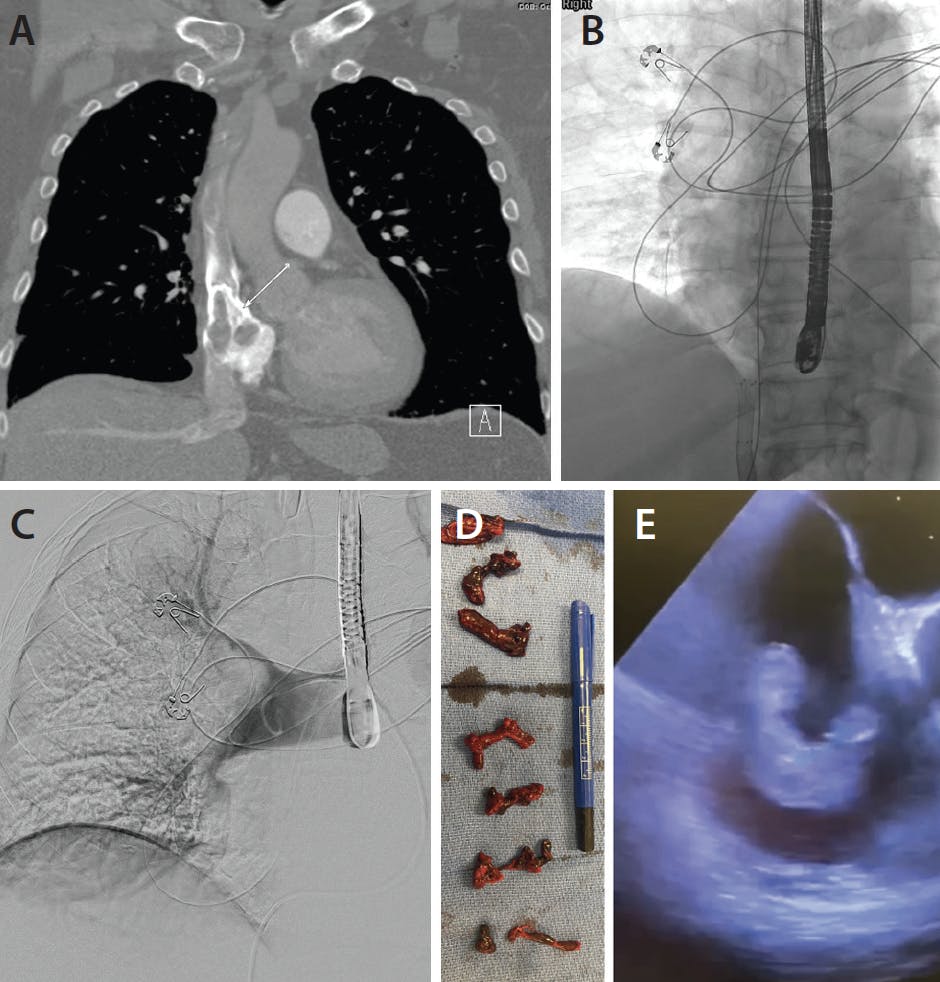
Figure 1. CTA demonstrating filling defects (arrow) within the RA (A). A 22-F AlphaVac cannula advanced to the RA under fluoroscopic and transesophageal echocardiographic guidance (B). Pulmonary angiography performed showing a right lobar PE (C). Thrombus retrieved within 1-2 passes with AlphaVac (D) and the corresponding echocardiogram of thrombus within the RA (E).
Procedural Overview
Mechanical thrombectomy was performed within the RA with the 22-F AlphaVac thrombectomy cannula. Under fluoroscopic and transesophageal echocardiographic guidance, the RA was cannulated with the device (Figure 1B), and subsequently, two 30-cc aspirations with vacuum lock resulted in complete evacuation of the RA thrombus (Figure 1D). The estimated blood loss was 200 cc. Attention was then turned to the pulmonary circulation.
PA pressure measurements were obtained via a multiple side-hole catheter. Mean right main PA pressure measured 45 mm Hg and left main PA systolic pressure measured 41 mm Hg. Given the patient’s size and catheter length limitation, the AlphaVac cannula in its current iteration could not be utilized for pulmonary thrombectomy. Thus, the decision was made to perform catheter-directed lysis and place an IVC filter to prevent new PE. The patient was stable throughout the procedure and was transferred to the intensive care unit (ICU) for overnight lysis.
Postprocedural Course
The patient was brought to the IR suite the following day for repeat pulmonary angiography and PA pressure measurement and underwent further thrombectomy after lysis. Two weeks later, the patient was discharged to a rehabilitation facility with oral anticoagulation.
DISCUSSION
This case highlights the utility of the AlphaVac aspiration thrombectomy device for RA thrombus retrieval. The AlphaVac is a first-generation aspiration thrombectomy device designed with the benefits of the AngioVac system and allowing for rapid large-volume aspiration without the need for extracorporeal bypass. The system consists of an ergonomic handle that acts as the engine or the vacuum source, a 22-F cannula (20° and 180° funnel tip options), an obturator, and a waste bag assembly. There are four waste bags included, holding up to 250 cc of blood or fluid per bag. The new catheter retains its proprietary funnel tip (similar to the AngioVac system), which aids in the guidance and removal of the intravascular material. The AlphaVac handle creates an off-circuit method of action and includes the volume-limiting switch, which allows the user to dictate the amount of aspirated material per pull of the handle, thereby minimizing blood loss during the procedure. The volume-limiting switch can be set on either a 10- or 30-cc setting. Once the material is engaged, the user may choose to either remain in the 10-cc setting or switch to 30 cc to initiate aspiration. There is also a vacuum lock mechanism that enhances user control by maintaining negative pressure with single-hand operation.
The case discussed in this article clearly shows the efficacy of the AlphaVac F2220 system in the removal of thrombus from the RA. However, the current iteration is not suitable for accessing the PAs. The APEX-AV trial, which is currently in its start-up phase (site recruitment), will evaluate the safety and efficacy of the new AlphaVac F1885 system in acute intermediate-risk PE patients. The AlphaVac F1885 thrombectomy system consists of an 18-F cannula (105-cm long) with an 85° angled tip and was recently cleared by the FDA for the removal of thrombus from the venous system*. The primary efficacy endpoint of the APEX-AV study is reduction in right ventricular/left ventricular diameter ratio between baseline and 48 hours postprocedure as assessed by CTA. The primary safety endpoint is the rate of major adverse events, including device-related death and major bleeding within the first 48 hours after the index procedure. The secondary efficacy endpoints include use of thrombolytics within 48 hours of the procedure, length of stay in the ICU/hospital within 30 days postprocedure, and change in modified Miller Index between baseline and 48 hours postprocedure as assessed by CTA. The secondary safety endpoints include rate of device-related complications, including clinical deterioration, cardiac injury, pulmonary vascular injury, major bleeding, and device-related death within 48 hours of the index procedure. This study will also conduct an exploratory analysis to evaluate unmet health care needs with study enrollments and outcomes. The clinical study is to be conducted at up to 20 investigative sites within the United States, and patients will be followed for 30 days post–index procedure. Overall study duration is estimated to be 18 months.13
CONCLUSION
This case report demonstrates the efficacy of the AlphaVac F2220 system in the removal of thrombus from the RA and shows the utility of such thrombectomy devices in preventing PE. Overall, the AlphaVac system, which has retained some of the features and benefits of the AngioVac system, presents a simplified setup (without the veno-venous circulation) for the removal of thrombi from the venous system, including the right heart. However, additional studies including prospective trials with adequate sample size are needed to validate its safety and efficacy in advancing patient care.
This case study represents the experience of one institution and is not indicative of all procedure results. Views and opinions expressed in the article are of the author and do not necessarily reflect the views and options of AngioDynamics, Inc., its affiliates or subsidiaries or their employees.
1. Tu T, Toma C, Tapson VF, et al. A prospective, single-arm, multicenter trial of catheter-directed mechanical thrombectomy for intermediate-risk acute pulmonary embolism: the FLARE study. JACC Cardiovasc Interv. 2019;12:859-869. doi: 10.1016/j.jcin.2018.12.022
2. Dexter DJ, Kado H, Schor J, et al. Interim outcomes of mechanical thrombectomy for deep vein thrombosis from the all-comer CLOUT registry. J Vasc Surg Venous Lymphat Disord. Published online February 23, 2022. doi: 10.1016/j.jvsv.2022.02.013
3. Moriarty JM, Rueda V, Liao M, et al. Endovascular removal of thrombus and right heart masses using the AngioVac system: results of 234 patients from the prospective, multicenter registry of AngioVac procedures in detail (RAPID). J Vasc Interv Radiol. 2021;32:549-557.e3. doi: 10.1016/j.jvir.2020.09.012
4. Sista AK, Horowitz JM, Tapson VF, et al. Indigo aspiration system for treatment of pulmonary embolism: results of the EXTRACT-PE trial. JACC Cardiovasc Interv. 2021;14:319-329. doi: 10.1016/j.jcin.2020.09.053
5. Lai E, Alishetti S, Wong JM, et al. Right ventricular thrombus in transit: raising the stakes in the management of pulmonary embolism. CASE (Phila). 2019;3:272-276. doi: 10.1016/j.case.2019.05.006
6. Wall C, Moore J, Thachil J. Catheter-related thrombosis: a practical approach. J Intensive Care Soc. 2016;17:160-167. doi: 10.1177/1751143715618683
7. George B, Voelkel A, Kotter J, et al. A novel approach to percutaneous removal of large tricuspid valve vegetations using suction filtration and veno-venous bypass: a single center experience. Catheter Cardiovasc Interv. 2017;90:1009-1015. doi: 10.1002/ccd.27097
8. Cervetti MR, Camporrotondo M, Chiappe MA, et al. On-pump beating heart treatment in pulmonary embolism and thrombus in transit. Arch Cardiol Mex. 2020;90:99-101. doi: 10.24875/ACM.19000243
9. Katsanos AH, Malhotra K, Goyal N, et al. Mortality risk in acute ischemic stroke patients with large vessel occlusion treated with mechanical thrombectomy. J Am Heart Assoc. 2019;8:e014425. doi: 10.1161/JAHA.119.014425
10. Lichtenberg MKW, Stahlhoff S, Młyńczak K, et al. Endovascular mechanical thrombectomy versus thrombolysis in patients with iliofemoral deep vein thrombosis—a systematic review and meta-analysis. Vasa. 2021;50:59-67. doi: 10.1024/0301-1526/a000875
11. Moriarty JM, Liao M, Kim GHJ, et al. Procedural outcomes associated with use of the AngioVac System for right heart thrombi: a safety report from RAPID registry data. Vasc Med. Published online February 17, 2022. doi: 10.1177/1358863X211073974
12. Basman C, Rashid U, Parmar YJ, et al. The role of percutaneous vacuum-assisted thrombectomy for intracardiac and intravascular pathology. J Card Surg. 2018;33:666-672. doi:10.1111/jocs.13806
13. Evaluating the safety and efficacy of the AlphaVac Multipurpose Mechanical Aspiration (MMA) F1885 PE for treatment of acute pulmonary embolism (APEX-AV). Clinicaltrials.gov. Accessed April 21, 2022.
https://clinicaltrials.gov/ct2/show/NCT05318092?term=APEX&cond=Pulmonary+Embolism&draw=2&rank=1
*The AlphaVac MMA Systems F2220, F22180, and F1885 are not indicated for treatment of pulmonary embolism and is considered off-label.
AlphaVac MMA System F2220 and F22180
The Cannula is indicated for:
- The non-surgical removal of thrombi or emboli from the vasculature
- Aspiration of contrast media and other fluids from the vasculature
- The Cannula is intended for use in the venous system.
- The Handle is indicated as a vacuum source for the AlphaVac Multipurpose Mechanical Aspiration System.
AlphaVac MMA System F1885
The Cannula is indicated for:
- The non-surgical removal of thrombi or emboli from the venous vasculature
- Aspiration of contrast media and other fluids from the venous vasculature
The Cannula is intended for use in the venous system.
The Handle is indicated as a vacuum source for the AlphaVac Multipurpose Mechanical Aspiration System.
Refer to Directions for Use provided with the product for complete Instructions, Warnings, Precautions, Possible Adverse Effects and Contraindications. Observe all instructions for use prior to use. Failure to do so may result in patient complications.
CAUTION: Federal law (USA) restricts this device to sale by or on the order of a physician. AngioDynamics and AlphaVac are trademarks and/or registered trademarks of AngioDynamics, Inc., an affiliate or subsidiary.
CAUTION – The AlphaVac MMA F1885 PE System when used for treatment of pulmonary embolism is an investigational device. Limited by United States law to investigational use.
Advertisement
Advertisement