Advertisement
Advertisement
October 2022
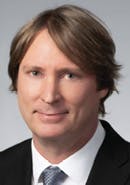
An Interview With James Milburn, MD, FACR
The neurointerventional radiologist from Ochsner discusses stroke therapy’s revolution, the next breakthrough procedures, keys to mentorship, and music choices in the lab.
In the relatively short time since interventional stroke thrombectomy gained level 1 evidence support, what are your observations about how the field of ischemic stroke therapy has evolved?
Ever since publication of the landmark stroke trials, neurointerventional teams have generally become much more aggressive toward treating emergent large vessel occlusion (ELVO) patients with mechanical thrombectomy.1 Thanks to DAWN, we are treating patients in extended windows all the way out to 24 hours from last seen well.2 Trials are underway exploring treatment of patients who already have large core infarcts, ELVOs with less severe symptoms, and strokes from medium and distal artery occlusions. The evidence appears to trend toward demonstrating that even in these more fringe groups, patients are being helped more than they are being harmed. There are many investigators pushing the limits of our knowledge in acute stroke therapy, as per Derdeyn in the February 2022 edition of Endovascular Today.3
As indications for acute stroke therapy widen and public awareness improves, we hope patients will increasingly present for more timely care. There is even a push for strokes to be worked up in the suite with the “direct to angio” concept to shorten time to reperfusion, so teams will need to be available even more readily and more often. Therefore, it will be crucial to train enough neurointerventionalists and develop adequate support networks that can keep up with these needs, because medical professionals are already suffering symptoms of burnout.4 It would be great to offer more stroke interventional services in rural areas rather than clustered primarily in major metropolitan cities, but that might not be cost-effective. There is also a potential future role for robotics to bring acute stroke care into rural areas, although more work is needed here as well.
The tools for mechanical thrombectomy have become much better, but there is still room to improve our ability to reliably achieve first-pass success and remove more distal emboli safely. Companies are pushing the limits of what can be done to access clots quickly and safely, and our patients are the beneficiaries of these developments.
Outside of stroke intervention, in which procedures or disease states do you currently see the most promise?
I am most excited about procedures where we can help the greatest numbers of patients. Embolization for chronic subdural hematoma is receiving a good deal of attention, with various trials underway studying different embolic agents. We will soon have a lot of evidence regarding the best way to treat this prevalent condition. Embolization may obviate the need for craniotomy in a large number of patients.
Another very common condition where we have tremendous promise is in treatment of idiopathic intracranial hypertension, which is another very common and debilitating disease. Dural sinus stenting has become common, and our tools and techniques are being refined. The recent innovation of endovascular inferior petrosal sinus shunting is very exciting. We are learning a lot about this disease, and the treatments thus far seem to be safe and effective.
For aneurysms, flow diverters are becoming less thrombogenic and more deliverable, allowing for the treatment of more distal locations. Intrasaccular devices are a great alternative to clipping wide-neck bifurcation aneurysms. For arteriovenous malformations, there is great promise in venous approaches being pioneered by our European colleagues. Neurointerventionalists have always been at the forefront of minimally invasive spine therapies, and I am particularly excited about the promise of spinous process spacers to treat some patients with spinal stenosis. Percutaneous basivertebral nerve radiofrequency ablation is another exciting new procedure that has much promise for our patients with back pain.
In 2020, you participated in an Endovascular Today panel where you discussed stroke early on in the COVID-19 pandemic.5 What does the incidence of ischemic stroke presentation look like these days at your institution? In what other ways has the New Orleans stroke network you are a part of changed since early in the pandemic?
The number of patients showing up to hospitals with stroke has returned to prepandemic levels in New Orleans and throughout the country. One of the unforeseen effects of the pandemic affecting our ability to treat stroke patients is the workforce shortages that are quite prevalent. It has become difficult to fully staff neuro intensive care units and angiography labs because so many people have changed jobs, taken travel assignments, or dropped out of the workforce altogether.
You’ve been involved with public awareness efforts related to improving systems of care for stroke, including your song “Six Feet Away” and the Get Ahead of Stroke campaign. What other areas in the neurointerventional realm, whether disease related or a social cause, could benefit from an effective awareness campaign?
We are proud of the support given by our Get Ahead of Stroke team. They work closely with the Society of NeuroInterventional Surgery (SNIS) to improve stroke systems on a state-by-state basis. They lobby politicians to improve systems of care such that patients can be brought to hospitals where they can receive the best care. One of the new campaigns we are beginning to embrace is the tremendous waste that occurs in health care, including in our interventional radiology departments. We are looking for ways to reduce waste and promote sustainability, and it has become a focus in many national meetings. Dr. Joshua Hirsch, Chair of the Health Policy Committee at SNIS, presented this material at our last annual meeting.
Earlier this year, you and colleagues published a paper in The Ochsner Journal on spinal dural arteriovenous fistulas (AVFs), a rare and underdiagnosed spinal pathology.6 What should other physicians know about this condition?
Spinal dural AVFs are critical to recognize because they are typically progressive unless they are discovered—in which case, they are eminently treatable. In good news, endovascular treatments are very effective. We published an illustrative case with classic imaging findings treated using Onyx (Medtronic) in a nonneurointerventional journal to educate clinicians and improve awareness.
A recent focus of your career has been mentorship, with your role as Mentorship Chair of SNIS and the author of a recent Editor’s Comment on the importance of mentorship in medicine.4 What makes for a healthy, successful mentor/mentee relationship?
You are correct, mentorship has become an important focus for me at this stage in my career, both in my home institution and as Mentorship Chair for SNIS. Most people have had informal mentors, and these can result in varying degrees of success. The mentor should have knowledge and experience and be willing to take the time to share, helping the mentee through the various stages of their career. The best relationships are formed between a mentor who finds personal value in giving back and a mentee who listens and acts on advice. That is the most natural and common type of mentorship, often in the workplace and during training between an experienced physician and a younger colleague, fellow, or resident. This can be the most impactful element, and hopefully the relationship will last over an entire career.
Another type of mentoring relationship can occur separate from the local training—one that brings outside guidance and another valuable perspective to supplement a mentee’s development. These meetings can occur at prescribed frequencies or ad hoc, using phone calls, over Zoom, and at scientific meetings. Clearly, these relationships are less easy to create, which is why societies including SNIS have developed formal mentoring programs, facilitating connections. This way, I think we can form stronger bonds through our societies across institutions and geographies. These outside mentorship relationships are best when driven by the mentee who understands their own individual needs. We described the literature and rationale behind formal mentoring and sponsorship in my recent Editor’s Commentary in Journal of NeuroInterventional Surgery, and I have taken the initiative to personally match dozens of mentees with mentors in our society.
You are also passionate about resident education; along with leadership roles with radiology/neurointerventional radiology residents and fellows at Ochsner Medical Center, you’ve published many papers on the topic. How did you become interested in resident education, and what do you think are the biggest issues facing it in your specialty?
Teaching is something I have always found rewarding, and most of my professional life has been spent as a radiology residency and fellowship program director. I receive personal value in giving back to my specialty and mentoring the next generation of doctors. I have also enjoyed publishing on a variety of educational topics with my program director colleagues around the country, in addition to neurointerventional research.
I have a neuroradiology background, and many of the luminaries in our field have come from radiology. It is unfortunate that fewer neuroradiologists are now entering the field, which is multifactorial. One reason that I frequently cite is the recent development of a direct interventional radiology residency. This field draws many potential students from the pool of candidates who are most likely to become interventional neuroradiologists. In my role as Co-Chair of the American Society of Neuroradiology’s Interventional Council, we are looking at ways to help this talented group of body interventionalists access supplemental training in neurointerventional radiology. Having neurointerventional role models in our residency has helped several of my recent residents choose a career in neurointervention.
As a gifted guitarist, what are some of your musical influences? What are some of the ways in which music and medicine can interact?
I grew up with classic rock guitarists, and they have been my chief influences. Some of my favorite bands include the Beatles, Rolling Stones, Jimi Hendrix, Santana, Led Zeppelin, early Chicago, Pink Floyd, Pearl Jam, Nirvana, and the Stone Temple Pilots. New Orleans has a great funk music scene that I love and support, especially live performances. Jazz music is a huge love and influence of mine, and I have a beautiful collection of original jazz vinyl from the 50s and 60s.
I make a point to always listen to music when in the lab, and I tend to choose music that makes me feel happy and relaxed. My choices trend toward music from the 70s, like Steely Dan and America, and there are several Pandora stations that work well for the occasion. I think music plays a huge role in my mental state at work, helping me focus and care for patients. I find it interesting to discuss music preferences for the lab with other interventionalists. We should do a cross-sectional study on this.
1. Milburn J, Mokin M, Frei D, et al. Roundtable discussion: exploring the limits of acute ischemic stroke intervention indications. Endovasc Today. 2022;2:46-50.
2. Nogueira RG, Jadhav AP, Haussen DC, et al. Thrombectomy 6 to 24 hours after stroke with a mismatch between deficit and infarct. N Engl J Med. 2018;378:11-21. doi: 10.1056/NEJMoa1706442
3. Derdeyn C, Mocco J, Jovin TG, et al. STEP: a platform trial for stroke thrombectomy. Endovasc Today. 2022;2:52-54.
3. Fargen KM, Arthur AS, Leslie-Mazwi T, et al. A survey of burnout and professional satisfaction among United States neurointerventionalists. J Neurointerv Surg. 2019;11:1100-1104. doi: 10.1136/neurintsurg-2019-014833
4. Milburn JM, Hirsch JA. Mentorship in neurointerventional surgery. J Neurointerv Surg. 2022;14:635. doi: 10.1136/neurintsurg-2022-019196
5. Altschul D, Klucznik RP, Milburn J. Stroke care trends during the COVID-19 pandemic. Endovasc Today. 2020;19:69-72.
6. Kelley M, April D, Bagert B, et al. Spinal dural arteriovenous fistula: the missing-piece sign. Ochsner J. 2022;22:10-14. doi: 10.31486/toj.21.0110
Advertisement
Advertisement
Interested in reading more interviews?
To read more interviews with thought leaders in the vascular field, check out our Profiles & Perspectives hub.
Read More