Advertisement
Advertisement
October 2022
Interventional Oncology for Gynecologic Malignancies
A role for minimally invasive procedures in metastatic disease of gynecologic origin.
By Kory Dees, MS; Andrew J. Gunn, MD; J. Michael Straughn Jr, MD; and Theresa M. Caridi, MD, FSIR
Gynecologic malignancies are the third most common group of cancers in women, affecting > 116,000 women each year in the United States.1 The most common subtype is uterine cancer, which has seen an increase in recent years.1 Primary tumors do not metastasize in most cases, but when they do, the liver is one of the most common sites of metastasis, second only to the pleural space.2-4 Ideally, patients are eligible for curative resection. When curative resection is not an option, standard of care has been to combine resection for debulking with chemotherapy and/or radiotherapy to achieve maximum reduction in tumor burden.5 Although many patients may be candidates for surgery from a technical perspective, cytoreductive surgery is invasive and accompanied by the risk of potential intraoperative complications such as hemorrhage, bladder injury, and intestinal injury.6,7
Early evidence suggests interventional oncology (IO) techniques such as percutaneous image-guided ablation and intra-arterial targeted therapy may be effective, minimally invasive, less expensive, associated with a shorter hospital stay, and have fewer complications compared to traditional surgical options.5,8,9 Perhaps more importantly, many patients are not surgical candidates, experience a mixed response to therapy, or are unable to tolerate additional therapy. This article reviews IO techniques and their use in the management of oligometastatic and metastatic disease of gynecologic cancers. Treatment of primary lesions and palliative interventions are outside the scope of this review.
LITERATURE REVIEW
There are limited data on percutaneous ablation and intra-arterial therapy for metastatic gynecologic malignancies. However, the available data suggest that percutaneous ablation and intra-arterial therapy may be promising interventions in the treatment of oligometastatic disease in appropriately selected patients. Patients with limited oligometastatic disease, isolated areas of metastasis resistant to systemic therapy, or those unable or unwilling to undergo traditional systemic therapy or surgery are examples of patients in whom ablation or intra-arterial therapy may be viable alternatives.9,10
Percutaneous ablation therapies cause tissue necrosis and cell death of a tumor while minimizing damage to surrounding normal tissue by using extreme temperatures induced through needle-based devices. Nonthermal ablation devices are also utilized, but there are no data related to their treatment in gynecologic malignancies. Thermal techniques including microwave (MWA) and radiofrequency ablation (RFA) utilize extreme heat in excess of 60° C. Alternatively, cryoablation (CA) causes necrosis and death by rapid cooling and creating an ice ball with a core temperature of –20° to –40° C. MWA and RFA are typically faster than CA using a 5- to 12-minute cycle, but they are typically limited to smaller-sized tumors and are difficult to visualize in real time. The CA cycle is 25 to 30 minutes and tumors > 5 cm can be ablated by using multiple probes. CA has the additional advantage of being able to be monitored by routine CT, MRI, or ultrasound.9
A retrospective review from Solomon et al reported the use of CA in 15 patients with 41 metastases of gynecologic origin.11 The median decrease in tumor size was 21.4% (2%-67.4%), 43.6% (16%-80.4%), 53.7% (16.6%-88.9%), and 58.2% (32%-88.9%) at 1-, 3-, 6-, and 9-month follow-up, respectively. At 6 months following RECIST (Response Evaluation Criteria in Solid Tumors) criteria, no patient had progressive disease; 86% of patients had a partial response, with the remaining patients having stable disease.11 Two case series reported on the use of CA, MWA, or RFA. Moynagh et al reported the use of CA or MWA in six patients with oligometastatic recurrences of gynecologic malignancies in the pelvic wall, abdominal wall, vagina, liver, rib, and retroperitoneum after standard therapy. All of these cases remained disease free at their last follow-up, with times ranging from 6 to 36 months.9 In a retrospective analysis by Yuan et al on the use of CA (n = 30), RFA (n = 47), or MWA (n = 47) to treat 119 metastatic tumors in 42 women, 95.6% of patients had a complete response after initial therapy, and 8.5% of the treated tumors had a local recurrence at a mean of 4.1 months (42-497 days) after initial therapy. Five of the eight recurrences were retreated with thermal ablation (TA), and 80% showed a complete response after one treatment, for an overall 96.2% efficacy over a median follow-up of 10 months.5
Three additional case series reported the use of RFA alone in the treatment of metastatic disease in patients with gynecologic malignancies.12-14 Arellano et al treated five patients with retroperitoneal metastases who underwent RFA with absence of fluorodeoxyglucose (FDG) activity on positron emission tomography (PET)/CT after RFA. There were two recurrences at sites other than the treated site, and these patients died at 9 and 13 months; the remaining three patients were disease free at 23.5 months.12 Another small series by Butros et al evaluating RFA in patients with a single pelvic recurrence of vulvar squamous cell carcinoma, cervical cancer, or endometrial cancer showed no instances of residual or recurrent disease at the treatment sites at 12- and 48-month follow-up (one patient had a recurrence at a previous surgical site).13 In a study by Liu et al of RFA in 11 patients with 22 liver metastases from ovarian cancer, 4.5% (1/22 metastases) showed local progression in the follow-up period. Median time to progression after RFA was 8 months, and mean overall survival time was 53.1 ± 10.0 months with 1-, 3-, and 5-year overall survival at 100%, 61%, and 61%, respectively.14
Intra-arterial therapies such as transarterial chemoembolization (TACE) and radioembolization are potential alternatives to traditional therapies including surgery, chemotherapy, radiation, and other emerging therapies such as TA in the treatment of gynecologic metastases. TACE consists of local intra-arterial delivery of cytotoxic chemotherapy directly into a tumor or metastasis in conjunction with or followed by embolic.10,15 Radioembolization uses microspheres with a diameter of 20–40 μm to deliver the radioactive isotope yttrium-90 (Y-90) into a tumor intra-arterially.10,16
Vogl et al reported on the use of TACE in the treatment of ovarian cancer metastasis to the liver in 65 patients.15 Response rates were determined using MRI in compliance with RECIST criteria. They saw a partial response in 16.9% of patients, stable disease in 58.5%, and progressive disease in 24.6%. Survival rate at 1, 2, and 3 years was 58%, 19%, and 13%, respectively, with a median survival of 14 months.15 Nance et al published a case of liver metastasis from cervical cancer refractory to chemotherapy and chemoembolization treated successfully with combination Y-90 and systemic pembrolizumab.16 The patient developed a hepatic metastasis while being unsuccessfully treated with six cycles of cisplatin. After failure to respond after two additional cycles of combination therapy with carboplatin, paclitaxel, and bevacizumab, TACE with doxorubicin was added along with the four remaining cycles of systemic chemotherapy. Due to continued progression, Y-90 radioembolization was performed with combination systemic pembrolizumab. MRI performed at 3-month follow-up revealed a decrease in size and enhancement of the hepatic lesions with a continued decrease in size and no FDG activity at 8-month follow-up.16
CASE EXAMPLES
Case 1: Ovarian Carcinoma
A woman in her early 60s was initially treated with total abdominal hysterectomy, bilateral salpingo-oophorectomy, omentectomy, and cytoreductive surgery followed by systemic chemotherapy for an ovarian carcinoma. A liver metastasis was discovered in the left lateral lobe of the liver (Figure 1A). No other sites of metastasis were found. The patient was referred to interventional radiology for consideration of liver-directed therapy. After consultation, she was treated with Y-90 radioembolization using a microcatheter to access the left hepatic artery (Figure 1B and 1C). Approximately 3 months after radioembolization, PET/CT showed a complete response (Figure 1D).
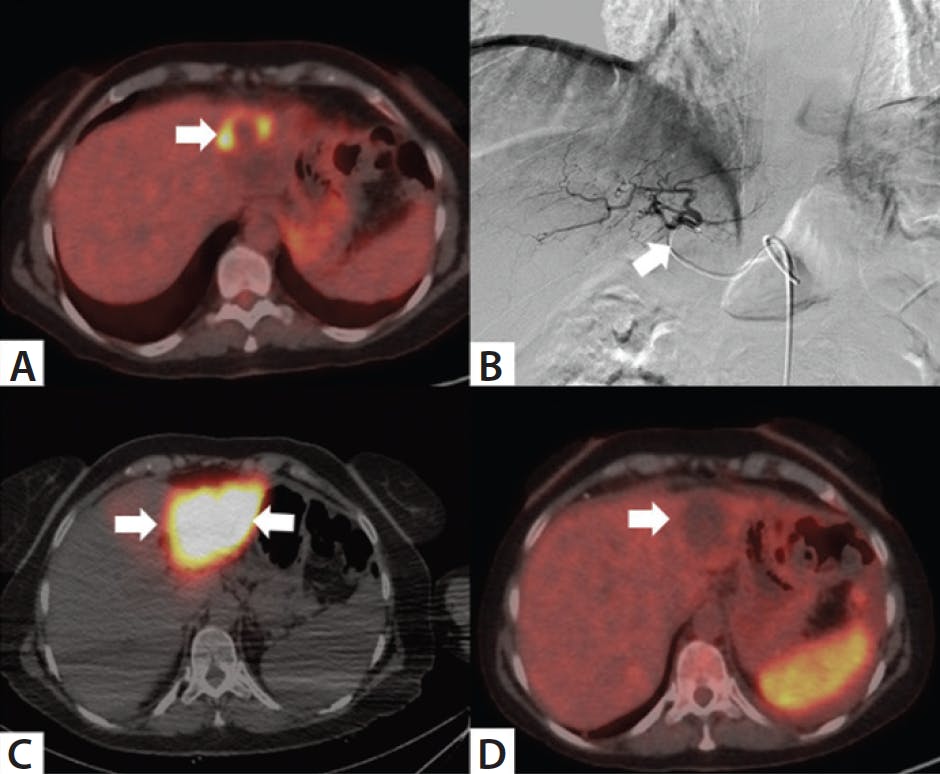
Figure 1. A woman in her mid 60s with a history of ovarian carcinoma. Axial slice from a PET/CT scan showed a partially necrotic, PET-avid metastasis in the left lobe of the liver (arrow) (A). Digital subtraction angiogram with the microcatheter in the left hepatic artery (arrow) during the radioembolization mapping procedure (B). Axial slice from a single-photon emission CT obtained after radioembolization showed distribution of the Y-90 in the left lateral segment of the liver (arrows) (C). Axial slice from a PET/CT obtained approximately 3 months after radioembolization showed a complete response to treatment (arrows) (D).
Case 2: Sertoli-Leydig Cell Tumor
A woman in her mid 40s with a remote history of right salpingo-oophorectomy for a Sertoli-Leydig cell tumor more recently underwent a second surgery for the same diagnosis that included a left salpingo-oophorectomy, debulking, and lymphadenectomy. She developed a metastasis in the right lobe of the liver (Figure 2A). The lesion was biopsied and found to be metastatic Sertoli-Leydig cell tumor. No other sites of metastatic disease were identified. She was referred to interventional radiology for consideration of percutaneous ablation. After consultation, percutaneous MWA was performed (Figure 2B). Given the lesion size, overlapping ablations were performed and adequate coverage of the lesion was obtained (Figure 2C). Approximately 6 weeks later, contrast-enhanced CT of the abdomen showed a complete response to the treatment (Figure 2D).
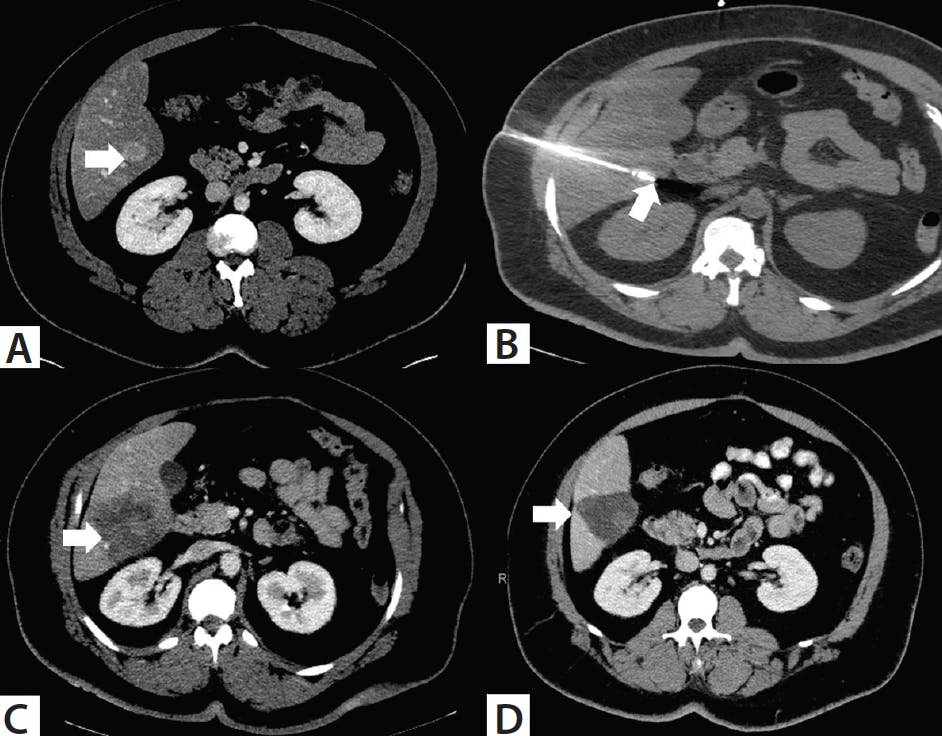
Figure 2. A woman in her mid 40s with a remote history of right salpingo-oophorectomy for a Sertoli-Leydig cell tumor. Axial slice from a contrast-enhanced CT scan of the abdomen showed an enhancing mass in the right lobe of the liver (arrow) (A). Axial CT image during the ablation procedure showed the ablation needle in position (arrow) (B). Axial slice from a contrast-enhanced CT of the abdomen obtained immediately after ablation showed good coverage of the area (C). Axial slice from a contrast-enhanced CT of the abdomen obtained approximately 6 weeks after the ablation showed a complete response to treatment (D).
Case 3: Ovarian Carcinoma
A woman in her early 40s with a prior history of ovarian cancer requiring total abdominal hysterectomy and bilateral salpingo-oophorectomy was not tolerating systemic therapy and developed a metastasis in the right lobe of the liver (Figure 3A). As this was her only site of metastatic disease, she was referred to interventional radiology for consideration of liver-directed therapy. After consultation, percutaneous CA was performed. To obtain an ice ball of acceptable size and shape, four ablation needles were required (Figure 3B). After a 10-minute initial freeze, a 5-minute active thaw, another 10-minute freeze, and a final active thaw, the ice ball adequately covered the lesion (Figure 3C). More than 1 year after the ablation procedure, contrast-enhanced CT of the abdomen showed a continued complete response to treatment (Figure 3D).
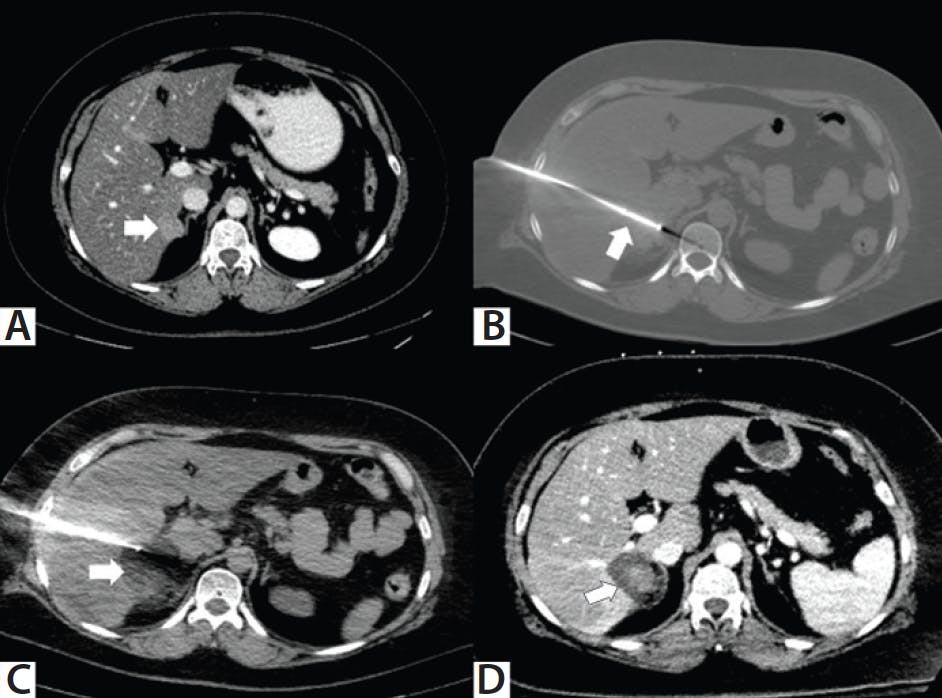
Figure 3. A woman in her early 40s with a prior history of ovarian carcinoma. Axial slice from a contrast-enhanced CT of the abdomen showed an enhancing metastasis in the right lobe of the liver (arrow) (A). Axial slice from a CT scan obtained during the CA procedure showed one of four ablation needles in position (arrow) (B). Axial slice from a CT scan obtained during the CA procedure showed the ice ball within the liver (arrow) with adequate coverage around the lesion (C). Axial slice from a contrast-enhanced CT of the abdomen obtained more than 1 year after the ablation procedure showed a continued complete response to treatment (arrow) (D).
CONCLUSION
Gynecologic malignancies are a group of malignancies with a rising prevalence. IO therapies have potential applications in gynecologic oncology metastatic disease. Percutaneous ablation and targeted intra-arterial therapies should be considered as part of a personalized patient care plan with collaboration from gynecologic oncologists and other specialists. Although the standard of care largely consists of resection and debulking surgery combined with chemotherapy and/or radiotherapy, there is a growing body of evidence suggesting that IO techniques can be used for patients who are not ideal surgical candidates, those with mixed response to treatment, and those who need a respite from conventional therapy.
1. Siegel RL, Miller KD, Fuchs HE, Jemal A. Cancer statistics, 2021. CA Cancer J Clin. 2021;71:7-33. doi: 10.3322/caac.21654
2. Dauplat J, Hacker NF, Nieberg RK, et al. Distant metastases in epithelial ovarian carcinoma. Cancer. 1987;60:1561-1566. doi: 10.1002/1097-0142(19871001)60:7<1561::aid-cncr2820600725>3.0.co;2-v
3. Bonnefoi H, A’Hern RP, Fisher C, et al. Natural history of stage IV epithelial ovarian cancer. J Clin Oncol. 1999;17:767-775. doi: 10.1200/JCO.1999.17.3.767
4. Cormio G, Rossi C, Cazzolla A, et al. Distant metastases in ovarian carcinoma. Int J Gynecol Cancer. 2003;13:125-129. doi: 10.1046/j.1525-1438.2003.13054.x
5. Yuan F, Wei SH, Konecny GE, et al. Image-guided percutaneous thermal ablation of oligometastatic ovarian and non-ovarian gynecologic tumors. J Vasc Interv Radiol. 2021;32:729-738. doi: 10.1016/j.jvir.2021.01.270
6. Iyer R, Gentry-Maharaj A, Nordin A, et al. Predictors of complications in gynaecological oncological surgery: a prospective multicentre study (UKGOSOC-UK gynaecological oncology surgical outcomes and complications). Br J Cancer. 2015;112:475-484. doi: 10.1038/bjc.2014.630
7. Gunakan E, Tohma YA, Tunc M, et al. Factors associated with surgical morbidity of primary debulking in epithelial ovarian cancer. Obstet Gynecol Sci. 2020;63:64-71. doi: 10.5468/ogs.2020.63.1.64
8. Shiina S, Sato K, Tateishi R, et al. Percutaneous ablation for hepatocellular carcinoma: comparison of various ablation techniques and surgery. Can J Gastroenterol Hepatol. 2018;2018:4756147. doi: 10.1155/2018/4756147
9. Moynagh MR, Dowdy SC, Welch B, et al. Image-guided tumor ablation in gynecologic oncology: Review of interventional oncology techniques and case examples highlighting a collaborative, multidisciplinary program. Gynecol Oncol. 2021;160:835-843. doi: 10.1016/j.ygyno.2020.12.037
10. Mouli SK, Gupta R, Sheth N, et al. Locoregional therapies for the treatment of hepatic metastases from breast and gynecologic cancers. Semin Intervent Radiol. Mar 2018;35:29-34. doi: 10.1055/s-0038-1636518
11. Solomon LA, Munkarah AR, Vorugu VR, et al. Image-guided percutaneous cryotherapy for the management of gynecologic cancer metastases. Gynecol Oncol. 2008;111:202-207. doi: 10.1016/j.ygyno.2008.08.003
12. Arellano RS, Flanders VL, Lee SI, et al. Imaging-guided percutaneous radiofrequency ablation of retroperitoneal metastatic disease in patients with gynecologic malignancies: clinical experience with eight patients. AJR Am J Roentgenol. 2010;194:1635-1638. doi: 10.2214/AJR.09.3561
13. Butros SR, DelCarmen MG, Uppot RN, Arellano RS. Image-guided percutaneous thermal ablation of metastatic pelvic tumor from gynecologic malignancies. Obstet Gynecol. 2014;123:500-505. doi: 10.1097/AOG.0000000000000133
14. Liu B, Huang G, Jiang C, et al. Ultrasound-guided percutaneous radiofrequency ablation of liver metastasis from ovarian cancer: a single-center initial experience. Int J Gynecol Cancer. 2017;27:1261-1267. doi: 10.1097/IGC.0000000000000939
15. Vogl TJ, Naguib NN, Lehnert T, et al. Initial experience with repetitive transarterial chemoembolization (TACE) as a third line treatment of ovarian cancer metastasis to the liver: indications, outcomes and role in patient’s management. Gynecol Oncol. 2012;124:225-229. doi: 10.1016/j.ygyno.2011.11.001
16. Nance ME, Biedermann GB, Bhat AP, Davis RM. Chemorefractory liver metastasis from cervical cancer successfully treated with a combination of yttrium-90 and immunotherapy. Radiol Case Rep. 2020;15:1359-1365. doi: 10.1016/j.radcr.2020.06.010
Advertisement
Advertisement