Advertisement
Advertisement
September 2022
Sponsored by AngioDynamics, Inc.
Single-Session Management of Acute Limb Ischemia With the Auryon Laser Atherectomy System
Acute limb ischemia (ALI), the sudden loss of limb perfusion, is a vascular emergency due to risk of limb and tissue loss.1 ALI may occur due to thromboembolism, plaque rupture, or sudden thrombosis, often in the setting of underlying chronic arterial disease.1 In addition, acute COVID-19 infection has been associated with increased risk of acute lower extremity thrombosis.2
Traditionally, ALI has been managed with open surgery (either surgical embolectomy or bypass) across the thrombosed segment. Endovascular management of ALI has emerged as an alternative to open surgery, with multivariate analysis demonstrating no significant difference in the limb salvage rate.3 Early approaches relied on catheter-directed pharmacologic thrombolysis. This technique requires multiple sessions in the angiographic laboratory and is limited by the risk of catastrophic hemorrhage, especially in the elderly and patients with underlying malignancy. Long infusion times and multiday treatment needed for lytic administration may preclude this therapy for patients with high-grade ALI.3
More recently, a class of thrombectomy and combined thrombectomy-atherectomy devices have emerged that allow endovascular specialists to manage ALI expediently during a single treatment, so termed “single-session thrombectomy.” The Auryon laser (AngioDynamics, Inc.) catheter in 2.0- and 2.35-mm catheter sizes with aspiration is indicated for use as an atherectomy device for arterial stenoses, including thrombus adjacent to stenosis and in-stent restenosis (ISR). This article presents two cases of ALI treated in a single session with the Auryon laser system.
CASE 1
A man in his early 40s with hyperlipidemia and a history of prior popliteal arterial thrombus presented with 1 week of acute thigh and calf rest pain. He had initially presented 3 months prior with pain and blue discoloration of the toes and was found to have a nonocclusive popliteal artery thrombus with distal embolic occlusions of all three tibial arteries at the ankle. This was treated at the time with open embolectomy of the popliteal artery, followed by stent grafting of the popliteal artery by another surgeon. The tibial occlusions were not treated. The patient is a nonsmoker, and since discovery of his popliteal thrombus, he had been maintained on therapeutic rivaroxaban and clopidogrel for secondary prevention. Hematologic evaluation identified no known prothrombotic condition.
On presentation to the emergency department, examination identified acute numbness and paresthesia of the midfoot, calf, and thigh. He had no muscle weakness. The common femoral pulse was palpable; however, Doppler signals were absent in the popliteal artery, and monophasic signals could be detected at the posterior tibial (PT) and dorsalis pedis (DP) arteries. CTA of the extremities identified occlusion of the stented portion of the popliteal artery with distal reconstitution at the P3 segment. There was occlusion of the PT and peroneal arteries, with supply by the foot solely from the anterior tibial (AT). He was diagnosed with Rutherford class 2a ALI and immediately heparinized.
Procedural Details
He was brought to the angiographic laboratory. Contralateral common femoral access was achieved, and a diagnostic angiogram from the right common femoral artery to the right foot was performed in stations. This confirmed the findings of acute occlusion of the popliteal stent graft with distal reconstitution immediately distal in the P3 segment (Figure 1). There was occlusion of the distal AT along with the majority of the PT and peroneal arteries, with reconstitution of the PT at the ankle. The pedal plantar loop and lateral and common plantar arteries were occluded.
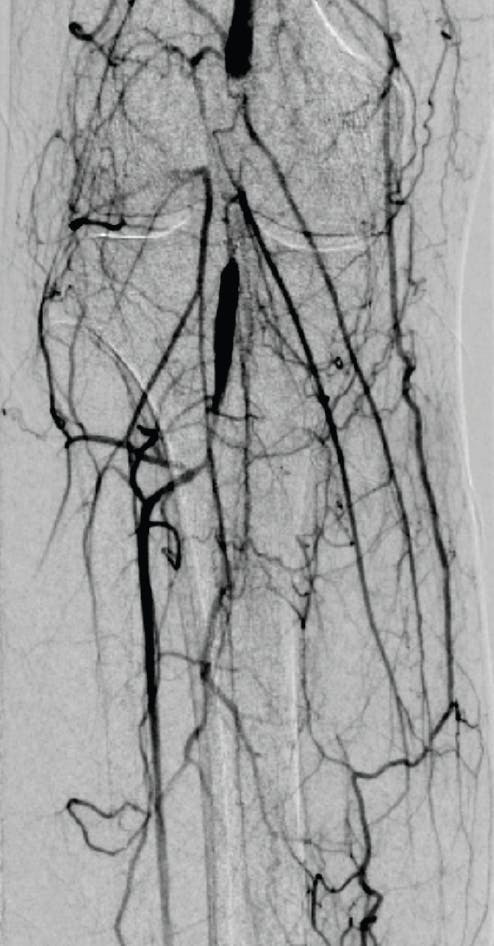
Figure 1. Right lower extremity angiogram prior to intervention demonstrates acute occlusion of popliteal stent graft. There is reconstitution immediately distal to the graft of the popliteal artery P3 segment from many geniculate collaterals. There is a single-vessel runoff from the AT artery.
After heparinizing the patient for intervention, a 6-F, 90-cm sheath was positioned at the right superficial femoral artery (SFA). The occluded popliteal stent graft was traversed with a 0.018-inch Hi-Torque Command ST guidewire (Abbott) through a 0.018-inch Quick-Cross support catheter (Philips). The guidewire and catheter were directed into the patent segment of the AT, and position in patent lumen was confirmed with an angiogram. The guidewire was exchanged for a 0.014-inch Hi-Torque Spartacore guidewire (Abbott). Over this guidewire, laser thrombectomy with aspiration was performed in the occluded popliteal stent graft with the 2.0-mm Auryon laser atherectomy catheter. Two passes were performed with suction engaged, the first at 50 mJ/mm2 fluence and the second at 60 mJ/mm2 fluence. The angiogram after laser thrombectomy with aspiration demonstrated a wide patent channel from the 2.0-mm Auryon laser without distal thromboembolism (Figure 2).
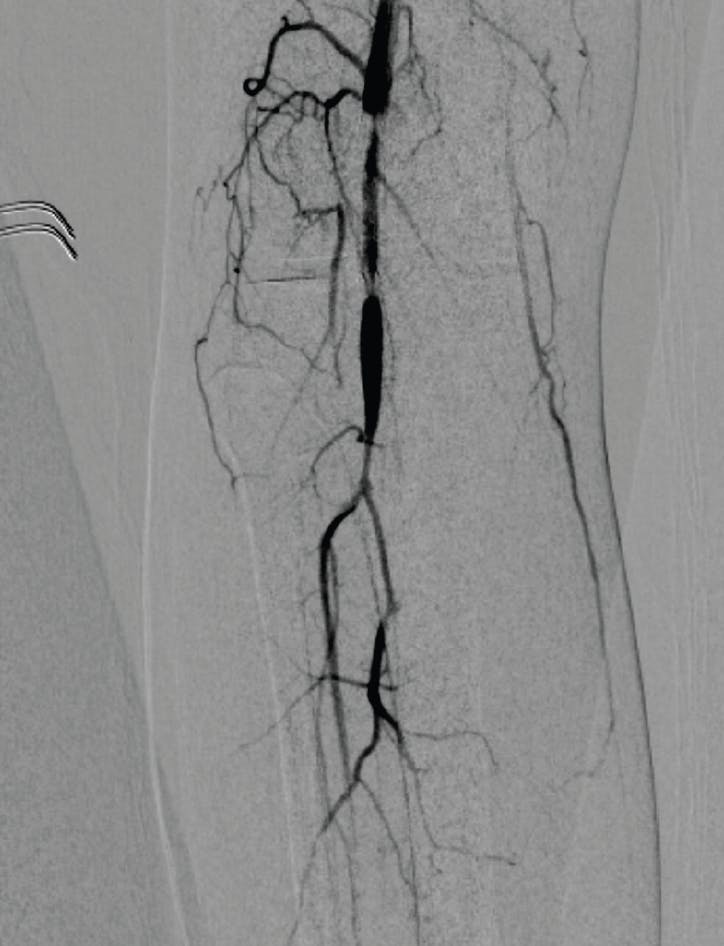
Figure 2. Angiogram following thrombectomy using the 2.0-mm Auryon laser catheter with aspiration. A robust patent lumen is present through the previously thrombosed stent graft. Improved inline flow is apparent with diminished geniculate collaterals. The single-vessel runoff is preserved without distal embolization.
The residual stenosis of the stent graft was then treated with 6-mm balloon angioplasty followed by 6-mm drug-coated balloon angioplasty. The chronic occlusion of the AT was treated with 3-mm balloon angioplasty to the level of the ankle. At the conclusion, there was restoration of brisk inline flow through the popliteal stent graft with a single-vessel runoff through the AT (Figure 3).
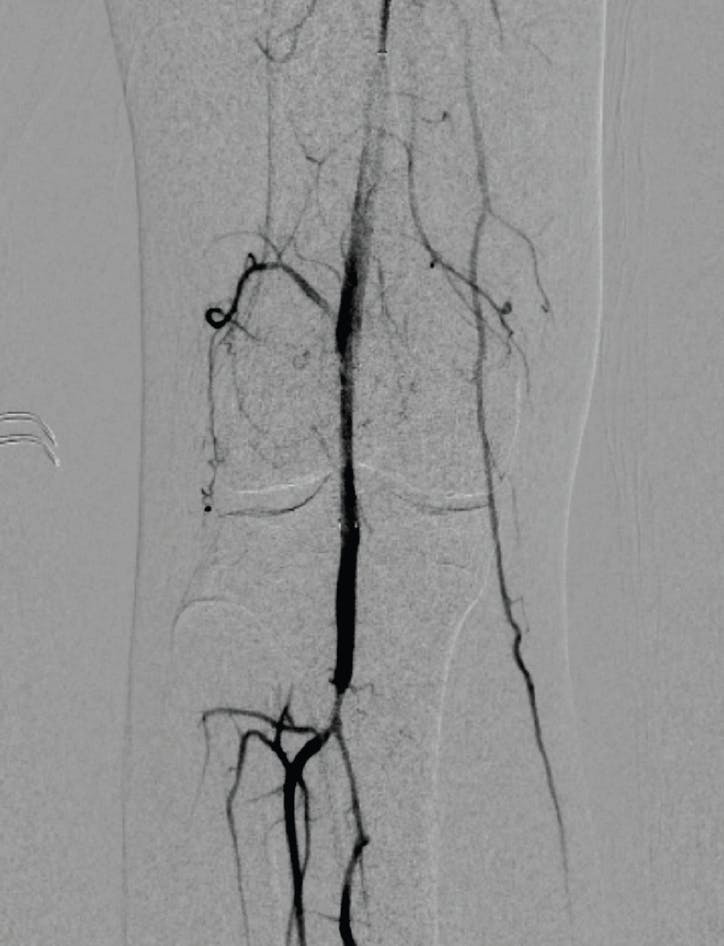
Figure 3. Angiogram following thrombectomy and angioplasty with 6-mm balloon. There is restored patency of the popliteal stent graft with brisk inline flow to the leg. No distal embolization is evident, and the single AT artery runoff is preserved. Geniculate collaterals are no longer opacified.
Postprocedure
By the following day, the patient’s rest pain and numbness resolved. He was discharged the following day on a regimen of clopidogrel and low-molecular-weight heparin. He returned 2 weeks later as an outpatient for elective revascularization of chronic peroneal, PT, and pedal plantar loop occlusions to restore adequate outflow and prevent rethrombosis.
Discussion
This case demonstrates the role of 2.0-mm Auryon laser thrombectomy with aspiration in single-session treatment of acute thrombotic occlusion of femoropopliteal stent grafts. This approach allows for rapid resolution of ALI compared to multiday pharmacologic lysis. Additionally, there is no systemic bleeding risk. Compared to open thrombectomy, there is diminished morbidity and length of stay. Stent graft occlusion poses a higher risk of major amputation compared to bare-metal stent (BMS) occlusion. Furthermore, organized thrombus that forms within stent grafts does not respond to pharmacologic lysis. Auryon laser thrombectomy is effective in removing this thrombus and restoring rapid patency without distal thromboembolism.
CASE 2
A woman in her early 40s with a medical history of type 1 diabetes, smoking, and peripheral vascular disease presented with ALI 1 week after outpatient revascularization. She had a history of tandem BMS and drug-eluting stents (DESs) for chronic SFA occlusion. She was maintained on dual antiplatelet therapy with aspirin and clopidogrel. She underwent right great toenail debridement with her podiatrist, which was complicated by gangrene of the distal hallux. For this, repeat angiography was performed 1 week prior to the current episode with revascularization of chronic ISR. The patient presented urgently from her podiatrist following this for worsening pain, progression of the hallux wound, and new ischemic ulcers of the heel.
On examination, dry gangrene of the hallux and 3-cm eschar of the heel were present. Pedal pulses were no longer palpable, and Doppler signal was monophasic in the right DP and PT arteries. She was admitted and an arterial duplex was obtained, which demonstrated occlusion of the distal SFA and popliteal arteries with reconstitution of flow in the distal popliteal via collaterals. The ankle-brachial index was reduced to 0.50 and toe-brachial index was 0.25. She was diagnosed with Rutherford class 2a ALI.
Procedural Details
The patient was anticoagulated with a heparin drip and brought urgently to the angiographic laboratory. A right lower extremity angiogram was obtained from a left common femoral access, which demonstrated acute occlusion of the right SFA and popliteal DES and BMS. There was reconstitution at the P3 popliteal segment and a three-vessel runoff with an intact pedal plantar loop (Figure 4).
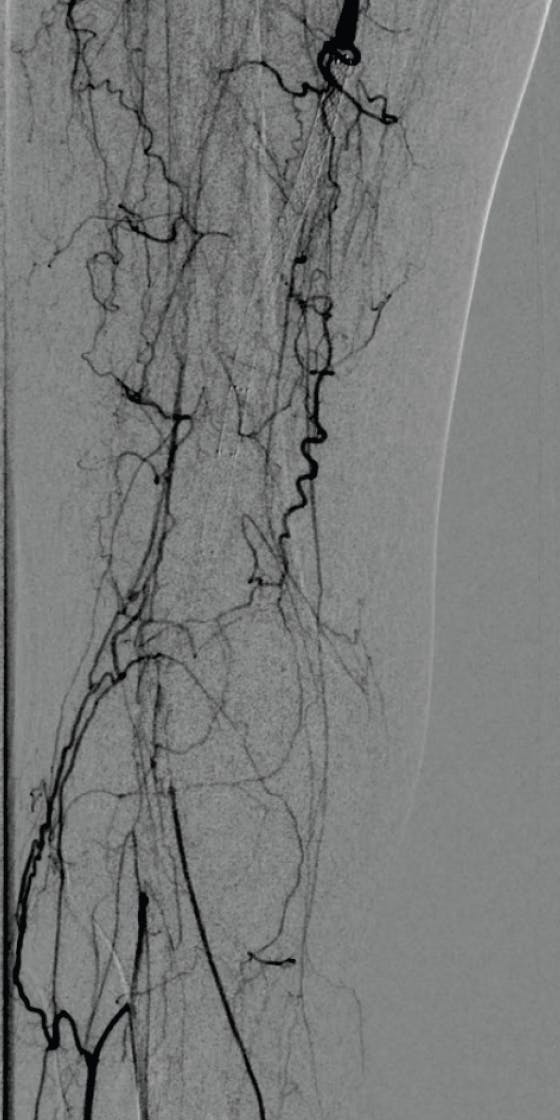
Figure 4. Right lower extremity angiogram prior to intervention demonstrates acute occlusion of the femoropopliteal BMS and DES. There is reconstitution of the distal popliteal artery P3 segment by profunda and geniculate collaterals.
The patient was therapeutically heparinized for intervention. A 7-F, 45-cm sheath was placed. The acute occlusion was traversed with a 0.018-inch Hi-Torque Command ST guidewire and a Quick-Cross support catheter. Intravascular positioning in patent lumen was confirmed via an angiogram through the microcatheter. The guidewire was exchanged for a 0.014-inch Hi-Torque Spartacore guidewire.
The 2.35-mm Auryon laser with aspiration was utilized for thrombectomy of the femoropopliteal occlusion. Initially, thrombectomy of the occluded stents was performed at a fluence of 50 mJ/mm2 fluency for two passes with the 2.3-mm catheter. Between each pass, the 2.35-mm catheter off-centering mechanism was rotated to perform thrombectomy on a different sector of the vessel. Next, the catheter was removed and flushed to evaluate thrombus and optimize thrombectomy. The catheter was reintroduced, and two passes were performed at 60 mJ/mm2 fluence in the femoropopliteal segment. Again, between passes, the off-centering mechanism of the catheter was rotated to engage thrombus at a different sector of the vessel. Postthrombectomy angiography revealed restoration of a widely patent channel without distal thromboembolism (Figure 5).
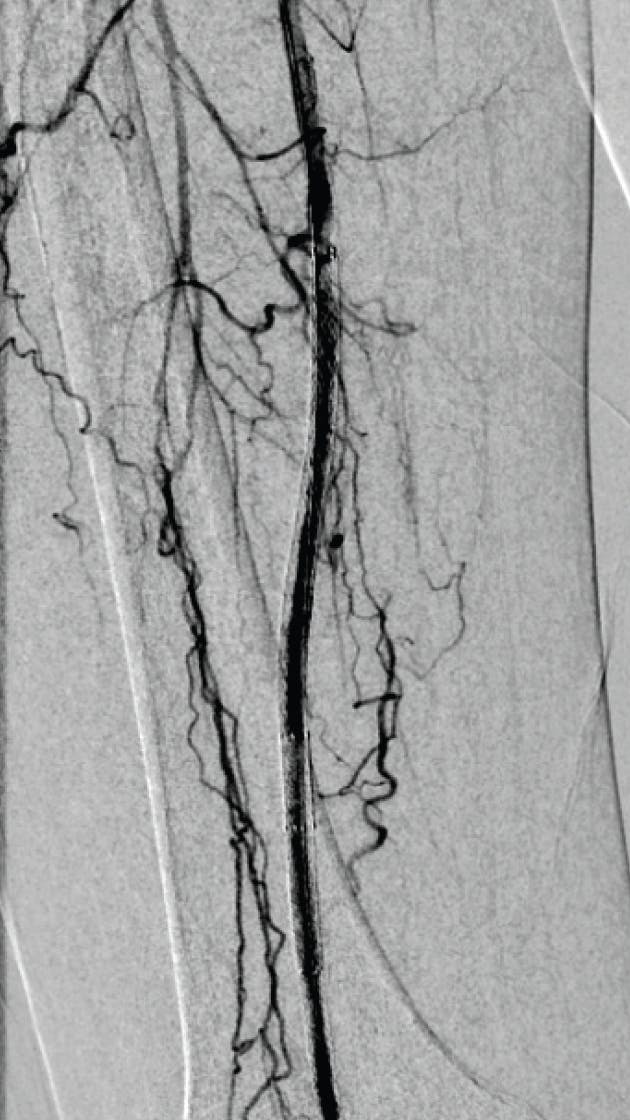
Figure 5. Angiogram following thrombectomy with the 2.35-mm Auryon laser catheter with aspiration. Multiple passes were performed utilizing the catheter’s off-centering mechanism to remove thrombus from the periphery of the stents. There is robust antegrade flow through the stent system to the distal popliteal artery with diminished collaterals. Irregularity at the proximal stent ostium was identified as the culprit lesion for thrombosis.
Given the rapid acute occlusion after prior intervention, the vessel and stents were evaluated with intravascular ultrasound (IVUS). This revealed an angiographically subtle dissection immediately cephalad to the femoral stent and small residual thrombus in the stent system. Angioplasty of the existing stents was performed with a 5-mm balloon. A new 6-mm BMS was placed in tandem with the current stent system to address the dissection. The entire segment was reevaluated with IVUS and repeat angiography, which demonstrated resolution of the dissection and brisk flow to a three-vessel distal runoff (Figure 6).
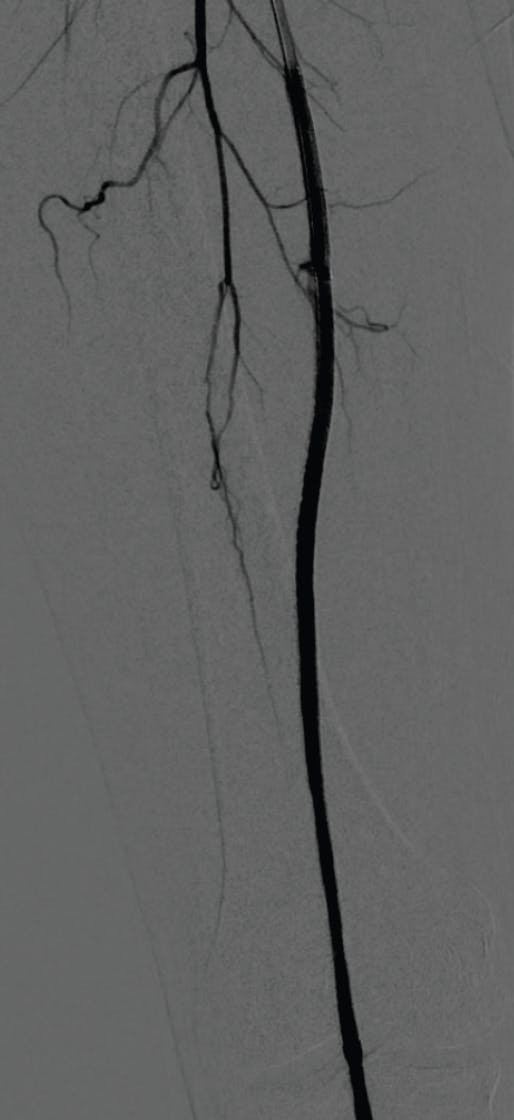
Figure 6. After angioplasty and stent exclusion of the SFA dissection, there is brisk inline flow through the distal femoropopliteal stent system. The geniculate and profunda collaterals are no longer seen.
Postprocedure
At 1-month follow-up, the patient had palpable pulses in the foot and progression of healing of her toe and heel wounds.
Discussion
This case demonstrates the utility of the Auryon 2.35-mm laser catheter with aspiration in single-session management of acute femoropopliteal occlusions. This approach allows treatment of ALI without logistical challenges of overnight pharmacologic lysis or the associated bleeding risks. Similarly, single-session endovascular management avoids the morbidity of open thrombectomy. The off-centering mechanism of the 2.35-mm catheter allows the operator to effectively remove thrombus from larger vessels by redirecting the catheter to engage eccentric thrombus. The combination of laser energy and aspiration effectively fragments and extracts large thrombotic burdens without significant distal embolization.
CONCLUSION
Treatment paradigms in ALI continue to evolve with the development of endovascular thrombectomy systems. These approaches allow for evaluation and treatment of ALI with rapid restoration of flow to the threatened limb. Single-session thrombectomy with Auryon laser allows for rapid endovascular management of ALI without the morbidity of open surgery or the hemorrhagic risks of catheter-directed lysis. This emerging approach is critical given the high risk of limb loss and overall cardiovascular events in ALI patients.
1. Hess CN, Huang Z, Patel MR, et al. Acute limb ischemia in peripheral artery disease. Circulation. 2019;140:556-565. doi: 10.1161/CIRCULATIONAHA.119.039773
2. Galyfos G, Sianou A, Frountzas M, et al. Acute limb ischemia among patients with COVID-19 infection. J Vasc Surg. 2022;75:326-342. doi: 10.1016/j.jvs.2021.07.222
3. Veenstra EB, van der Laan MJ, Zeebregts CJ, et al. A systematic review and meta-analysis of endovascular and surgical revascularization techniques in acute limb ischemia. J Vasc Surg. 2020;71:654-668.e3. doi: 10.1016/j.jvs.2019.05.031
AngioDynamics and Auryon are trademarks and/or registered trademarks of AngioDynamics, Inc., an affiliate or subsidiary.


Advertisement
Advertisement