Advertisement
Advertisement
April 2023
Sponsored by Medtronic
The Factors Influencing Coil Selection During Embolization Procedures

The use of embolization across the spectrum of disease has been steadily increasing through the years. Similarly, the tools available for peripheral interventionalists to successfully perform these embolization procedures have been evolving as well. Our task now is to learn how to best integrate these two lines of forward progress so we can confidently and appropriately use the growing number of embolic agents to best treat our patients.
One clear example of this is the evolution of the technology behind the coils we use today for embolization. Generational preferences and a growing focus on cost continue to push and pull us between the broad categories of detachable and pushable coils. Now, we must also choose between the presence or absence of fibers on coils, the softness or rigidity of coils, the length and volume of coils, and how these characteristics relate to the catheter being used for coil delivery. These factors need to be understood in the context of the mechanisms behind a coil-based occlusion to be certain that the coils we select are appropriate for a given blood vessel in a specific patient with a particular medical condition.
It is first important to recognize that both fibered and nonfibered coils within the lumen of a target vessel serve as a potential nidus for thrombosis.1 Artificial surfaces, such as those found on metal coils, promote hypercoagulability and thrombosis through interconnecting processes such as protein adsorption; adhesion of platelets, leukocytes, and red blood cells; thrombin generation; and complement activation.2 In addition, the apposition of coils to the endothelium results in microtrauma, which can also promote thrombosis due to increased platelet adhesion at the site of injury.3 Finally, the space-occupying nature of any coil alters blood flow to the point where this too contributes to clot formation. As a result, all three components of Virchow’s triad are met by placing coils in target vessels, supporting the fact that thrombosis is an integral part of every coil-based occlusion. The current debate that plays out in everyday practice both academically and clinically is determining the importance of each of these contributing factors to vessel occlusion and then deciding between the use of fibered coils (with an emphasis on vessel thrombosis) and nonfibered coils (with an emphasis on packing density).
UNDERSTANDING THROMBOGENICITY
Since Gianturco added wool strands to coils,4 the contribution of fibers to coil-induced thrombosis has supported their continued presence on many of the coils used today. Girdhar et al demonstrated that coils with nylon or polyglycolic-lactic acid fibers are more thrombogenic than nonfibered coils through enhanced generation of thrombin, which likely accelerates vessel occlusion.5 Trerotola et al sought to further understand how this difference could be applied to the acute effectiveness of embolization and found that the addition of fibers increases the immediate thrombogenicity of coils, leading to the use of fewer coils to achieve vessel occlusion.6 Importantly, Trerotola et al raised the idea that this difference is likely beneficial in certain clinical indications, such as trauma-related bleeding, when immediate occlusion is the obvious goal of embolization.6
The hesitation or reluctance to rely on fibered coils is secondary to the risk of recanalization in association with their use. Trerotola et al evaluated the lumen of vessels occluded after coil embolization and showed that the mean percent area of thrombus was significantly greater with fibered coils than with nonfibered coils.6
UNDERSTANDING PACKING DENSITY
Given what appears to be a greater reliance on intraluminal thrombus formation with fibered coils, concerns about recanalization due to innate thrombolytic processes have been raised. As a result, attention has been turning toward the concept of packing density to lessen the extent of thrombus formation and presumably reduce the risk of recanalization.
Practically speaking, packing density involves introducing the number of coils needed to result in occlusion based more on volume of coils than volume of thrombus. Packing density can also be defined mathematically as the number of coils multiplied by coil volume divided by the volume of the target intravascular space (such as a vessel segment or aneurysm); the volume of the target intravascular space and the coil volume can be approximated using the formula for volume of a cylinder (Figure 1).7
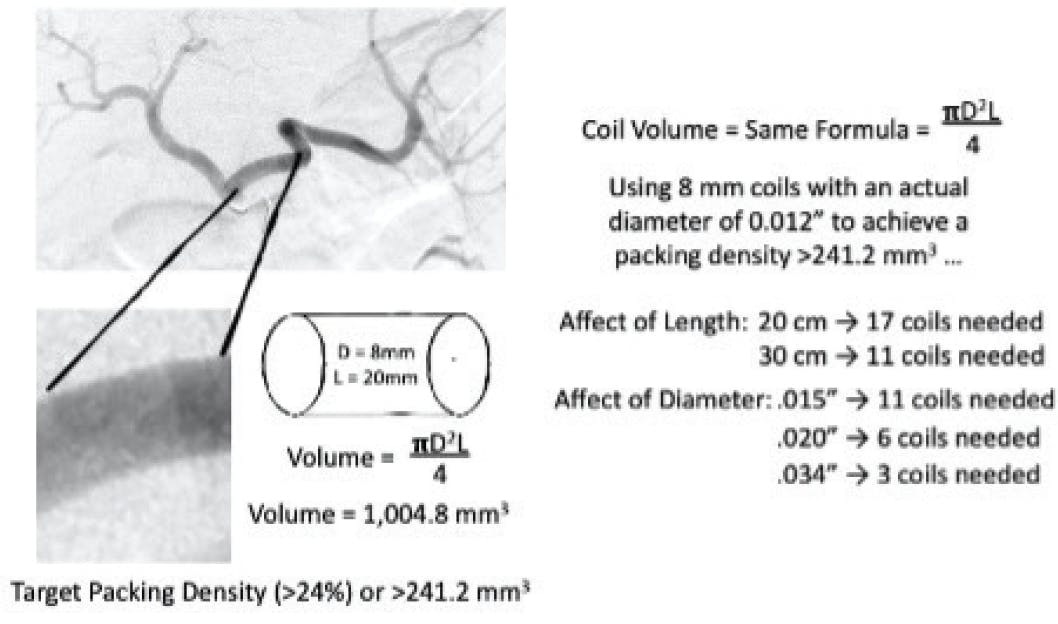
Figure 1. Using the formula for volume of a cylinder (which approximates the volume of a target vessel segment and the volume of a coil), this figure demonstrates the desired packing density, as well as the number of coils with different characteristics, required to achieve that packing density.
This concept is relevant because studies have shown that there is a threshold to packing density, where the risk of recanalization is significantly reduced when that threshold is exceeded. It is remarkable that this threshold has been reproduced. In the neuroendovascular space, Sluzewski et al showed that a packing density of 24% when embolizing cerebral aneurysms reduced the risk of compaction and subsequent recanalization.8 These findings were essentially duplicated in the periphery by Yasumoto et al who showed that compaction and recanalization were also reduced in visceral aneurysms treated with embolization when packing density was at least 24%.9 With these data in mind, the focus is to approach this degree of packing density when performing coil embolization. Calculators are available to understand the number of a particular type or brand of coil needed to achieve this packing density, but they may not always be practical to use during a procedure. As a result, understanding this conceptually and then striving to eliminate or minimize visible spaces in a coil pack during a procedure is a reasonable way for us to avoid recanalization during coil embolization procedures (Figure 2).
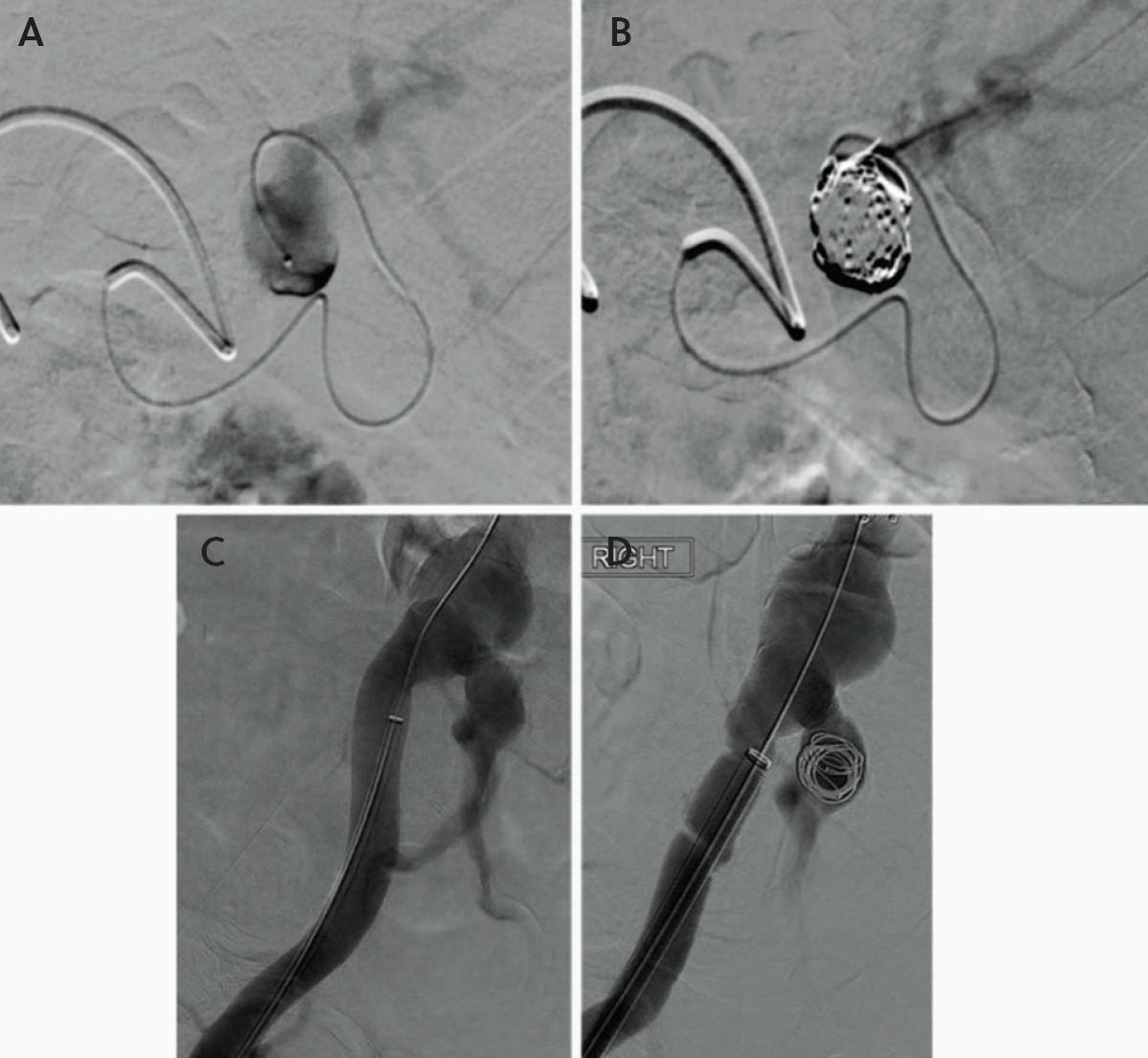
Figure 2. Images demonstrating acceptable packing density during splenic artery aneurysm embolization (A, B) and unacceptable packing density during an internal iliac embolization prior to endovascular aneurysm repair (C, D).
Coil manufacturers have recognized the importance of packing density and have used different strategies to help achieve that goal. The absence of fibers allows bare-metal coils such as the Ruby™* coils (Penumbra, Inc.) and Prestige Plus™* peripheral coil system (Balt USA) to be softer than fibered coils, achieving a high packing density within the target vascular space. For example, Vogler et al observed a median packing density of 55%, with low recanalization rates after gastroduodenal artery embolization with soft, bare-platinum coils.10 However, soft coils with a low fiber density (Concerto™ detachable coil system, Medtronic) or placement of fibers on only part of a coil (Embold™* detachable coil system, Boston Scientific Corporation) can overcome this, enabling tight packing with the benefits of a fibered coil.
The addition of hydrogel to coils (Azur™* Peripheral HydroCoil™* embolization system, Terumo Interventional Systems) is another way to improve packing density. The hydrogel on these coils is a bioactive polymer that expands on contact with blood, which increases the filling volume of the coils once they have been deployed in the target vessel.11 This allows more of the occlusion to consist of the metal coil loops and hydrogel as opposed to thrombus, and this has subsequently been associated with lower rates of vessel recanalization.12 However, if there is agreement that a packing density of 24% is acceptable for a lasting occlusion, then it means that thrombus will occupy 76% of the occlusion. In other words, thrombus is an important part of both a fiber-based occlusion and an occlusion based more on packing density. If we believe that lysis of this thrombus contributes significantly to recanalization, then recanalization must be recognized as a risk after embolization performed with any type of coils, which is exactly what Trerotola et al reported.6
AN INDIVIDUALIZED APPROACH TO COIL SELECTION
Finding the right balance between a fiber-based occlusion and an occlusion based on packing density is a nuanced thought process that should differ based on the patient, the indication for embolization, and the vascular bed being treated. Given the differences between each of these variables encountered in everyday practice, it seems unreasonable to think that one type of coil can successfully be used every time. As Trerotola et al stated, “a trauma patient with acute bleeding may be best served with one approach while a patient with a visceral aneurysm or vascular malformation should probably be approached differently.”6 I agree and, in fact, I think it is prudent for us to think of each coil in an embolization procedure as a separate case with different considerations going into device selection. For example, the first coil in a target vessel segment might be rigid so it serves as an anchor or frame for subsequent coils. The next coils might be softer to create the packing density needed for a lasting occlusion, while the final coil or two might be fibered to induce the thrombosis needed for acute occlusion. It is this type of thought process that is likely necessary to bring out the strength of each coil type to maximize the likelihood of success for our patients.
Disclosures
Dr. Siskin: Consultant to Medtronic and Boston Scientific Corporation.
1. Henkes H, Brew S, Miloslavski E, et al. The underlying mechanisms of endovascular exclusion of intracranial aneurysms by coils. How important is electrothrombosis? Interv Neuroradiol. 2003;9:17-140. doi: 10.1177/159101990300900202
2. Jaffer IH, Fredenburgh JC, Hirsh J, Weitz JI. Medical device-induced thrombosis: what causes it and how can we prevent it? J Thromb Haemost. 2015;13(suppl 1):S72-S81. doi: 10.1111/jth.12961
3. Yau JW, Teoh H, Verma S. Endothelial cell control of thrombosis. BMC Cardiovasc Dis. 2015;15:130-141. doi: 10.1186/s12872-015-0124-z
4. Gianturco C, Anderson JH, Wallace S. Mechanical devices for arterial occlusion. Am J Roentgenol Radium Ther Nucl Med. 1975;124:428-435. doi: 10.2214/ajr.124.3.428
5. Girdhar G, Read M, Sohn J, et al. In-vitro thrombogenicity assessment of polymer filament modified and native platinum embolic coils. J Neurol Sci. 2014;339:97-101. doi: 10.1016/j.jns.2014.01.030
6. Trerotola SO, Pressler GA, Premanandan C. Nylon fibered versus nonfibered embolization coils: comparison in a swine model. J Vasc Interv Radiol. 2019;30:949-955. doi: 10.1016/j.jvir.2018.10.004
7. Xiao N, Lewandowski RJ. Embolic agents: coils. Semin Intervent Radiol. 2022;39:113-118. doi: 10.1055/s-0041-1740939
8. Sluzewski M, van Rooij WJ, Slob MJ, et al. Relation between aneurysm volume, packing, and compaction in 145 consecutive aneurysms treated with coils. Radiology. 2004;231:653-658. doi: 10.1148/radiol.2313030460
9. Yasumoto T, Osuga K, Yamamoto H, et al. Long-term outcomes of coil packing for visceral aneurysms: correlation between packing density and incidence of coil compaction or recanaliation. J Vasc Interv Radiol. 2013;24:1798-1807. doi: 10.1016/j.jvir.2013.04.030
10. Vogler J, Gemender M, Samoilov D. Packing density and long-term occlusion after transcatheter vessel embolization with soft, bare-platinum detachable coils. Am J Interv Radiol. 2020;4:1-5. doi: 10.25259/AJIR_31_2019
11. Cantón G, Levy DI, Lasheras JC. Changes in the intraaneurysmal pressure due to HydroCoil embolization. Am J Neuroradiol. 2005;26:904-907.
12. Fohlen A, Namur J, Ghegediban H, et al. Midterm recanalization after arterial embolization using hydrogel-coated coils versus fibered coils in an animal model. J Vasc Intervent Radiol. 2019;30:940-948. doi: 10.1016/j.jvir.2018.05.005
Concerto™ Helix and 3D detachable coil system
Reference Statement
Important Information: Indications, contraindications, warnings and instructions for use can be found in the product labeling supplied with each device. Not all patients achieve the same results.
Indications for Use: The Concerto™ detachable coil system is indicated for arterial and venous embolizations in the peripheral vasculature.
Potential Adverse Effects of the Device on Health: The potential complications include, but are not limited to, the following: puncture site hematoma, thromboembolic episodes, vessel perforation, neurological deficits including stroke and death, vasospasms, vascular thrombosis, hemorrhage, and ischemia.
CAUTION: Federal (USA) law restricts these devices to sale, distribution and use by or on the order of a physician.
501263 ©2023 Medtronic. Medtronic, Medtronic logo are trademarks of Medtronic. TM* third party brands are trademarks of their respective owner. All other brands are trademarks of Medtronic. For global distribution. 04/2023
Advertisement
Advertisement