Advertisement
Advertisement
August 2023
Navigating Futility and End-of-Life Discussions
Knowing when and how to have difficult conversations with patients and families when viable options have been exhausted.
There is a famous adage that “good surgeons know how to operate, better ones when to operate, and the best when not to operate.” Interventional radiologists are often asked to intervene on critically ill patients near the end of life, and in many cases, we can provide life-extending if not lifesaving interventions for patients who would otherwise not survive. Other interventions are palliative in nature, improving quality of life even if not extending it. However, interventional radiologists also often struggle with requests for procedures that are unlikely to provide meaningful benefit, and these cases can be quite morally distressing.1,2 This article reviews current literature on requests for potentially inappropriate procedures and suggests strategies for navigating these challenging cases.
DEFINING FUTILITY
Futility has long been a challenging topic both medically and legally in health care, largely because it is difficult to definitively define and identify prospectively. Some have proposed more quantitative definitions such as a < 1% chance of meaningful benefit.3 The problem is that clinicians, at least at this time, are not very accurate in our abilities to correctly prognosticate. Even if we could, the concept of “meaningful benefit” can vary substantially across patients and cultures.4 This is why common definitions of futility tend to be more qualitative and thus less definitive. A 2018 review of perceptions of medical futility found no consensus.5 This is problematic because futile care exposes patients to risks without benefit but also in light of growing health care costs. A 2013 study of five intensive care units (ICUs) found 12% of patients received futile care during a 3-month period costing an estimated $2.6 million.6
Futility and requests for potentially inappropriate procedures may be particularly challenging in interventional radiology (IR) due to the minimally invasive nature of our procedures, allowing them to be performed in sicker patients with potentially lower risks.3 Interventional radiologists also tend not to be the primary clinician who knows the patient best, setting up common scenarios where the referring team feels the IR procedure should be tried as a last resort with minimal risks and IR feels pressured to do a procedure they believe is likely futile. In a survey of 685 practicing interventional radiologists and interventional radiologist trainees, differentiating between palliative and futile care was perceived as the top ethical issue facing the specialty.7 Nevertheless, this perception is not universal. When interventional radiologists have been interviewed about futility, one in four did not perceive futility as an important issue in their practices, with some feeling they never experience it: “If I can do the procedure successfully, it isn’t futile.”1 Of note, those who did struggle with futility were more likely to be later in their career in academic practice settings.
When asked for examples of futile IR interventions, the most common examples provided included multiple biliary drains for malignant biliary obstructions, gastrostomy tubes in terminally ill patients or those with advanced dementia, liver-directed therapy with advanced hepatic malignancy, and emergent transjugular intrahepatic portosystemic shunt creation.1 The American Geriatrics Society has a position statement recommending against placing gastrostomy tubes in patients with advanced dementia, which some practices have used to establish an institutional policy against this practice.8 There is also evidence that each additional biliary drain has diminishing potential to drive down the bilirubin sufficiently to qualify for additional therapy.9,10 Yet, there is also evidence that radioembolization for carefully selected patients with advanced hepatocellular carcinoma can have a median survival of well over 1 year,11 and proceduralists tend to remember those patients who beat all odds.
MANAGING REQUESTS FOR POTENTIALLY INAPPROPRIATE PROCEDURES
Beyond these challenges identifying and defining futile interventions, there are also cultural factors complicating this issue. These include unrealistic expectations among patients and families, sensationalized medical miracles in the media, and an imperative to exhaust all options at any cost.12 In the United States, fear of litigation and fee-for-service payment models also likely drive clinicians to provide interventions without clear benefit if their patient and referring clinician wants it.1 As such, navigating requests for potentially inappropriate procedures in IR can be quite complex and multifactorial.
One helpful starting point is a 2015 multisociety policy on requests for potentially inappropriate treatments in ICUs.13 Here, futility is differentiated from requests for “potentially inappropriate” treatments, noting that clearly futile care should never be performed. This is supported both ethically and legally, although policies vary by state and institution on how to handle cases where clinicians believe an intervention is futile and the patient or family disagrees. The term “potentially inappropriate” is meant to acknowledge the qualitative, value-laden, and often preliminary perception of these requests. Overall, the multisociety policy underscores the importance of advance care planning, family meetings, and using ethics or palliative care consultation as an outside mediator when there is disagreement.
IMPORTANCE OF ADVANCE CARE PLANNING
For interventional radiologists, perhaps the most evidence-based, low-hanging fruit would be more regular use of advance care planning in our workflows for critically ill patients.14 Advance care planning is the standardized discussion and documentation of the patient’s and often their families’ perceptions, values, and goals related to their care. A common form of advance care planning is facilitating a discussion on goals of care. Numerous studies, including randomized controlled trials, have shown that advance care planning and early palliative care involvement can improve patient and family quality of life and satisfaction while reducing costs at the end of life.15-17 Nevertheless, both interventions are underutilized. For example, a study of > 11,000 IR procedures at one health care system found that 9% inpatients died within 30 days of their procedure and 57% of those patients died before leaving the hospital. For inpatients who died shortly after their procedure, 59% had a documented goals-of-care discussion within 3 months prior and 35% had palliative care consultation. For outpatients who died within 6 months of their procedure, 37% had a goals-of-care discussion and 13% had palliative care consultation.14
Why is advance care planning so important? Because the value of our interventions rests on how they affect and are perceived by the patient and their loved ones. It can be easy to assume or project our own values and perceptions on patients, thinking in terms of what we would want for ourselves or our loved ones or pursuing more aggressive interventions in younger patients or those where we have a longitudinal relationship. These tendencies are not inherently wrong and humanize us, but we must balance them with the reality that we are not the ones being treated and we have no way of knowing the perceptions and values of our patients and their families related to our care if we do not ask them and listen.
Facilitating Conversations With Patients and Family Members
What do goals-of-care discussions look like in practice? We are all limited for time, and the best person to facilitate advance care planning is often not the interventional radiologist who is meeting an inpatient for the first time in an acute setting. Ideally, a clinician who has a longitudinal relationship would facilitate these conversations early in a terminal disease process, with repeat conversations as the patient’s clinical status changes. Such conversations can also be quite challenging, and facilitating them well is a skill set like anything else. So practically, it seems reasonable for interventional radiologists to ask referring teams whether such a conversation has occurred when receiving a consult for a potentially inappropriate procedure. If it has not occurred, the interventional radiologist can advocate for the conversation with or without their involvement. This may take the form of asking palliative care to see the patient before placing a third biliary drain for malignant obstruction or offering radioembolization for a patient with main portal vein tumor thrombus and extrahepatic disease. That said, other services are often not familiar with the risks and benefits of IR procedures, so if one has the bandwidth, it can be helpful to participate in multidisciplinary family meeting or goals-of-care discussions.
Other times, there may be limited resources or other barriers where the interventional radiologist is first to start such a conversation. These do not necessarily have to be long conversations and can be incorporated into one’s usual workup (Table 1). Some best practices include sitting with open body language rather than standing over the patient. Allow the patient to share their understanding of the clinical situation uninterrupted. Be sure to include that no intervention is an alternative to the potential therapy being discussed, as well as what will likely happen if no intervention is performed. In doing so, it is often helpful to normalize this decision in order to balance the cultural or family pressure to exhaust all interventions before pursuing things like hospice. For example, “Some people chose to not have another biliary drain placed or even remove the one they have when they are really sick like you and just focus on comfort at home…” Often, patients and families equate palliative care and hospice with “giving up,” so it can be helpful to differentiate these options for patients: “Palliative care is a medical specialty that helps people balance various potential treatments with their values and quality of life, kind of like a quarterback. It does not exclude you from getting treatments. Hospice is a bit more stringent and usually reserved for people with < 6 months left of life who are prioritizing comfort over additional treatments.”
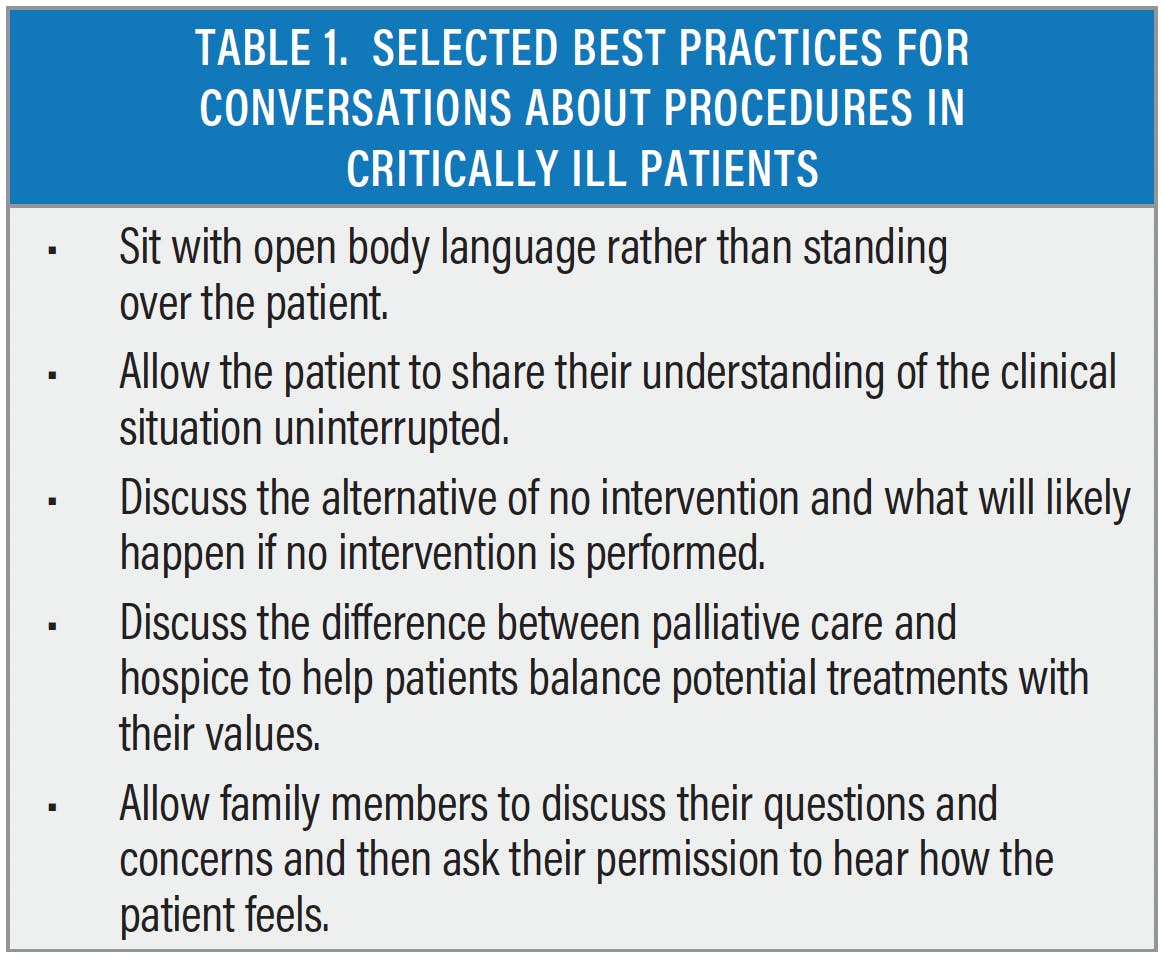
Other challenges that can arise in having these conversations involve the patient’s family. Sometimes a family member can seem overbearing, speaking on the patient’s behalf to pursue more aggressive treatments. This often comes from a sincere place of advocating for their loved one or not wanting to lose them. It can be helpful in these situations to let the family member say what they have to say and then ask their permission to hear how the patient feels. This offers them a sense of control while allowing everyone in the room to hear what the patient thinks. Other times, the relationship is more coercive, and it can be helpful to find a time when the family member is not present to better understand how the patient really feels. Some families and cultures may also request that their elderly loved one not be told about their diagnosis. This is permissible as long the patient is given the option to hear their diagnosis and defers to their family. However, they should be counseled that keeping a serious diagnosis truly secret while pursuing treatment often is not completely possible as the patient will likely overhear their care being discussed, or a diagnosis may be mentioned when checking in for an appointment or meeting a new clinician involved in their care.
Navigating DNR and DNI Status in the Periprocedural Setting
A final related issue that interventional radiologists should feel comfortable navigating is do not resuscitate (DNR) and do not intubate (DNI) status in the periprocedural setting. Current guidelines recommend that code status should be rediscussed in the setting of a procedure, but suspension of DNR/DNI orders should not be required.18,19 In other words, patients should be able to pursue procedures near the end of life with DNR/DNI orders in place. With such a case, it is often helpful to include this point when discussing the case with the IR team and during the time-out process to ensure all team members are aware of what may happen.20 Unfortunately, a recent survey of interventional radiologists showed that management of perioperative DNR/DNI status is quite heterogeneous, with many practices still requiring suspension for their procedures.21
SUMMARY
Interventional radiologists often care for critically ill patients and can encounter requests for procedures with questionable meaningful benefit. It can be helpful in these cases to facilitate advance care planning to clarify the patient’s and family’s values and goals related to their care and ascertain whether the IR procedure has a reasonable chance of achieving those goals. These conversations can be challenging, and it is helpful to have a close relationship with palliative care, who not only tend to be very open to collaborating with IR but can even become a valuable referral base for palliative interventions. It also seems reasonable to consider incorporating palliative care training into IR residency,22 whether it is lectures on best practices and local resources or a palliative care rotation. Our IR societies could also develop practical resources to support continuing medical education on these topics. Finally, there is also little research on this topic in IR, and it would be helpful to further investigate questions such as how advance care planning can be practically incorporated into diverse IR workflows and its clinical impact. Ultimately, at times, it is the cases we did not perform that are most important.
1. Keller EJ, Rabei R, Heller M, Kothary N. Perceptions of futility in interventional radiology: a multipractice systematic qualitative analysis. Cardiovasc Intervent Radiol. 2021;44:127-133. doi: 10.1007/s00270-020-02675-3
2. McCullough HK, Bain RM, Clark HP, Requarth JA. The radiologist as a palliative care subspecialist: providing symptom relief when cure is not possible. AJR Am J Roentgenol. 2011;196:462-467. doi: 10.2214/AJR.10.4672
3. Aghabarary M, Dehghan Nayeri N. Medical futility and its challenges: a review study. J Med Ethics Hist Med. 2016;9:11.
4. Kon AA, Shepard EK, Sederstrom NO, et al. Defining futile and potentially inappropriate interventions: a policy statement from the Society of Critical Care Medicine Ethics Committee. Crit Care Med. 2016;44:1769-1774. doi: 10.1097/CCM.0000000000001965
5. Müller R, Kaiser S. Perceptions of medical futility in clinical practice—a qualitative systematic review. J Crit Care. 2018;48:78-84. doi: 10.1016/j.jcrc.2018.08.008
6. Huynh TN, Kleerup EC, Wiley JF, et al. The frequency and cost of treatment perceived to be futile in critical care. JAMA Intern Med. 2013;173:1887-1894. doi: 10.1001/jamainternmed.2013.10261
7. Rockwell HD, Beeson SA, Keller EJ, et al. Perceptions of ethics in interventional radiology. Curr Probl Diagn Radiol. 2022;51:733-736. doi: 10.1067/j.cpradiol.2021.11.002
8. American Geriatrics Society Ethics Committee and Clinical Practice and Models of Care Committee. American Geriatrics Society feeding tubes in advanced dementia position statement. J Am Geriatr Soc. 2014;62:1590-1593. doi: 10.1111/jgs.12924
9. Niemelä J, Kallio R, Ohtonen P, et al. Is palliative percutaneous drainage for malignant biliary obstruction useful? World J Surg. 2018;42:2980-2986. doi: 10.1007/s00268-018-4567-0
10. Tuqan W, Innabi A, Alawneh A, et al. Prediction of survival following percutaneous biliary drainage for malignant biliary obstruction. J Transl Int Med. 2017;5:127-131. doi: 10.1515/jtim-2017-0014
11. Goswami P, Adeniran OR, S KF, et al. Overall survival and toxicity of Y90 radioembolization for hepatocellular carcinoma patients in Barcelona Clinic Liver Cancer stage C (BCLC-C). BMC Gastroenterol. 2022;22:467. doi: 10.1186/s12876-022-02528-y
12. Swetz KM, Burkle CM, Berge KH, Lanier WL. Ten common questions (and their answers) on medical futility. Mayo Clin Proc. 2014;89:943-959. doi: 10.1016/j.mayocp.2014.02.005
13. Bosslet GT, Pope TM, Rubenfeld GD, et al. An official ATS/AACN/ACCP/ESICM/SCCM policy statement: responding to requests for potentially inappropriate treatments in intensive care units. Am J Respir Crit Care Med. 2015;191:1318-1330. doi: 10.1164/rccm.201505-0924ST
14. Rockwell HD, Beeson SA, Keller EJ, et al. Utilisation of goals of care discussions and palliative care prior to image-guided procedures near the end of life. Clin Radiol. 2022;77:345-351. doi: 10.1016/j.crad.2022.01.050
15. Detering KM, Hancock AD, Reade MC, Silvester W. The impact of advance care planning on end of life care in elderly patients: randomised controlled trial. BMJ. 2010;340:c1345. doi: 10.1136/bmj.c1345
16. Engelhardt JB, McClive-Reed KP, Toseland RW, et al. Effects of a program for coordinated care of advanced illness on patients, surrogates, and healthcare costs: a randomized trial. Am J Manag Care. 2006;12:93-100.
17. May P, Normand C, Cassel JB, et al. Economics of palliative care for hospitalized adults with serious illness: a meta-analysis. JAMA Intern Med. 2018;178:820-829. doi: 10.1001/jamainternmed.2018.0750
18. American College of Surgeons. Statement on advance directives by patients: “do not resuscitate” in the operating room. Bull Am Coll Surg. 2014;99:42-43.
19. Jackson S. Perioperative do-not-resuscitate orders. AMA J Ethics. 2015;17:229-235. doi: 10.1001/journalofethics.2015.17.3.nlit1-1503
20. Cyphers E, Silberstein S, Keller EJ. Suspending do not resuscitate/do not intubate orders for image-guided procedures. Semin Intervent Radiol. 2022;39:338-340. doi: 10.1055/s-0042-1751290
21. Cyphers ED, Silberstein S, Forsman T, et al. Required suspension of do not resuscitate and/or do not intubate orders in interventional radiology: a survey of prevalence and practices. J Vasc Interv Radiol. 2023;34:919-920. doi: 10.1016/j.jvir.2022.12.032
22. Requarth JA. Whoever does image-guided palliative care needs to be properly trained to do so. AMA J Ethics. 2021;23:E826-831. doi: 10.1001/amajethics.2021.826
Advertisement
Advertisement