Advertisement
Advertisement
August 2023
Sponsored by Cagent Vascular
Serration Technology: Achieving Optimal Lumen Gain in Patients With CLTI
Clinicians present cases and describe their rationale for using the Serranator catheter.
The challenges of treating peripheral artery disease (PAD) and chronic limb-threatening ischemia (CLTI) require a comprehensive approach and robust endovascular toolbox. Endovascular specialists have become increasingly aggressive in treating this complex arterial disease to optimize wound healing, prevent amputation, and improve quality of life. Although there have been many innovations to the technology available, plain old balloon angioplasty (POBA) remains the predominant tool for revascularization. Technical challenges using POBA, particularly in infrapopliteal arteries, are well understood, such as inadequate lumen gain, dissection, and inadequate long-term durability.
Achieving meaningful luminal gain without dissection or less-described vessel recoil has remained inconsistent at best, until now. The Serranator® PTA Serration Balloon Catheter (Cagent Vascular) is a semicompliant balloon with three longitudinal serrated strips. The unique scoring elements are serrated, designed to modify the plaque by creating linear, interrupted scoring along the endoluminal surface. This occurs during balloon inflation and is designed to aid arterial expansion. Serration technology applies up to 1,000 times the point force of POBA along the linear planes of the serrated strips, thus delivering controlled and predictable vessel dilation at lower inflation pressures than legacy POBA technology.
The recent RECOIL study used angiography to compare outcomes of infrapopliteal arteries treated with Serranator or POBA.1 The study measured the lumen diameter immediately after angioplasty and then again at 15 minutes. The degree of vessel recoil was adjudicated by an independent core lab. In the Serranator group, mean recoil was 6% versus 55% in the POBA group (P < .008). This calculates to 89% less recoil using serration angioplasty.
This article presents two cases outlining the successful treatment of PAD and CLTI utilizing the Serranator balloon as the primary treatment modality.
1. Lichtenberg M. RECOIL study: core-lab adjudicated study to assess recoil after scoring PTA vs POBA. Presented at: Leipzig Interventional Course (LINC) 2023; June 6-9, 2023; Leipzig, Germany.
Case 1: Revascularization of Above- and Below-the-Knee Arteries
By Christopher J. Grilli, DO
CLINICAL PRESENTATION
A man in his early 60s was sent to the emergency department from a wound care center for a nonhealing right lower extremity wound. The patient complained of worsening right lower extremity pain and swelling, stating the pain was a 9 out of 10 for the past 2 days. Ankle-brachial indices (ABIs) of 0.29 on his right lower extremity and 0.97 on left lower extremity were obtained. The arterial duplex ultrasound showed an occlusion in the proximal to mid superficial femoral artery (SFA) with reconstitution distally and parvus tardus waveform in the popliteal artery (Figure 1). The mid anterior tibial (AT) artery was also occluded without reconstitution, and the posterior tibial (PT) artery was occluded proximal to mid with weak reconstitution distally. The peroneal artery was patent. The patient had no history of previous lower extremity revascularization. He had a history of hepatitis A, tobacco use, uncontrolled noninsulin-dependent diabetes mellitus, neuropathy, coronary artery disease (CAD), myocardial infarction, and cocaine abuse. He previously had a percutaneous coronary intervention and amputation of the fourth toe on his left foot.
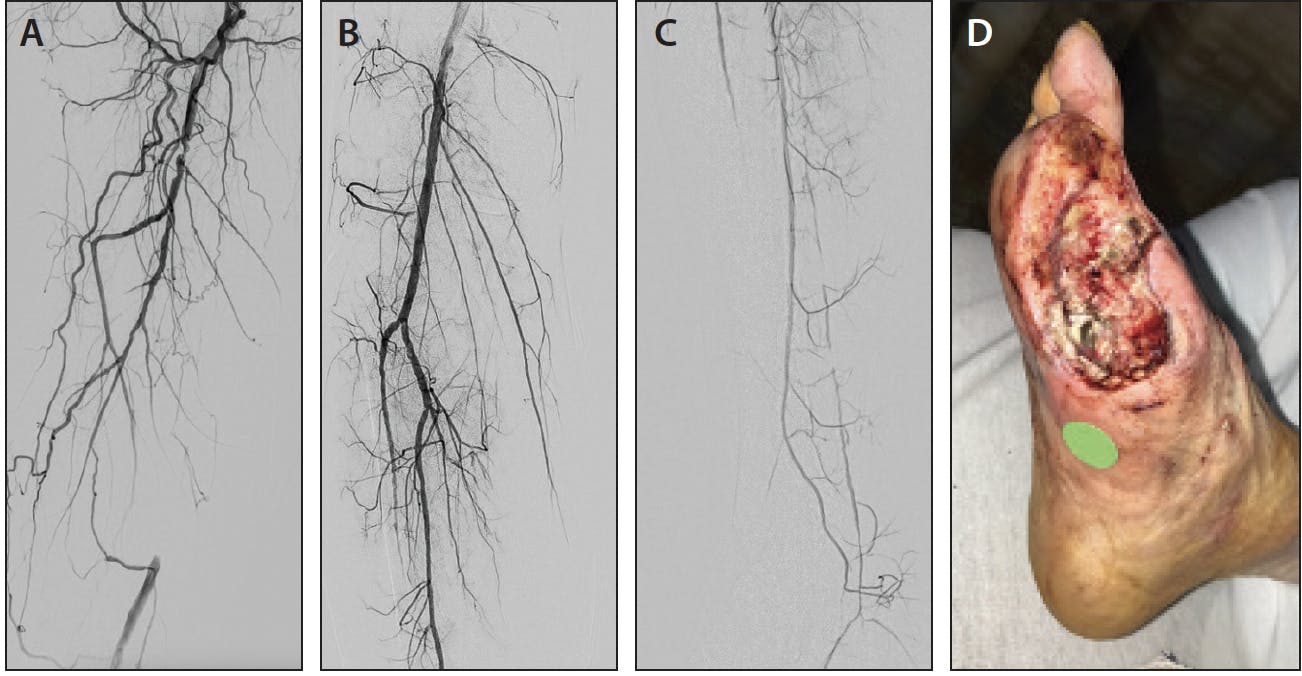
Figure 1. Pretreatment angiography. Occlusion in the proximal to mid SFA (A). Occlusion in the mid AT and proximal to mid PT (B). Weak reconstitution in the distal PT (C). Pretreatment wound (D).
PROCEDURE DETAILS
Intervention started with arterial access obtained in the left common femoral artery. Initial angiography showed a proximal to mid chronic SFA occlusion with reconstitution of distal SFA and multifocal moderate to severe stenosis in the profunda. It also showed patent popliteal and peroneal arteries but an occluded PT artery, with reconstitution displayed via peroneal collaterals and chronically mid-segment occluded AT and dorsalis pedis (DP) arteries. The patient was heparinized to target active clotting time of 260 seconds via a 6-F Destination guiding sheath (Terumo Interventional Systems).
An 0.035-inch Glidewire Advantage wire (Terumo Interventional Systems) was used initially to cannulate the SFA to the pedal vessels, and a 0.014-inch Glidewire Advantage was later used distally. Due to the high level of calcium present, the Rotarex atherectomy system (BD Interventional) was used to debulk the calcium and create a channel. After debulking, the 5- X 40-mm Serranator balloon was utilized multiple times throughout the SFA at 4 atm for 1 minute and 6 atm for 1 minute, totaling 2 minutes for each inflation. Without any dissection or need for a stent, the Serranator balloon was followed by a 6-F Ranger drug-coated balloon (DCB; Boston Scientific Corporation). Treatment of the PT artery required only a 2.5- X 120-mm Serranator balloon that was inflated several times throughout the length of the PT artery using the same inflation technique as previously performed. The Serranator provided optimal lumen gain throughout the PT artery, and no additional treatment was required after Serranator.
CONCLUSION
Following intervention of the SFA, final angiography showed substantial revascularization and brisk flow of the SFA (Figure 2). It also showed a revascularized, patent PT artery outpacing the peroneal artery all the way to the foot. The AT artery remained chronically occluded. ABIs following intervention showed massive improvement, with 1.01 on the right lower extremity. The patient’s pain significantly improved postoperative day 2, with good healing of the wound and discharge from the wound care center at approximately 5 months postprocedure.
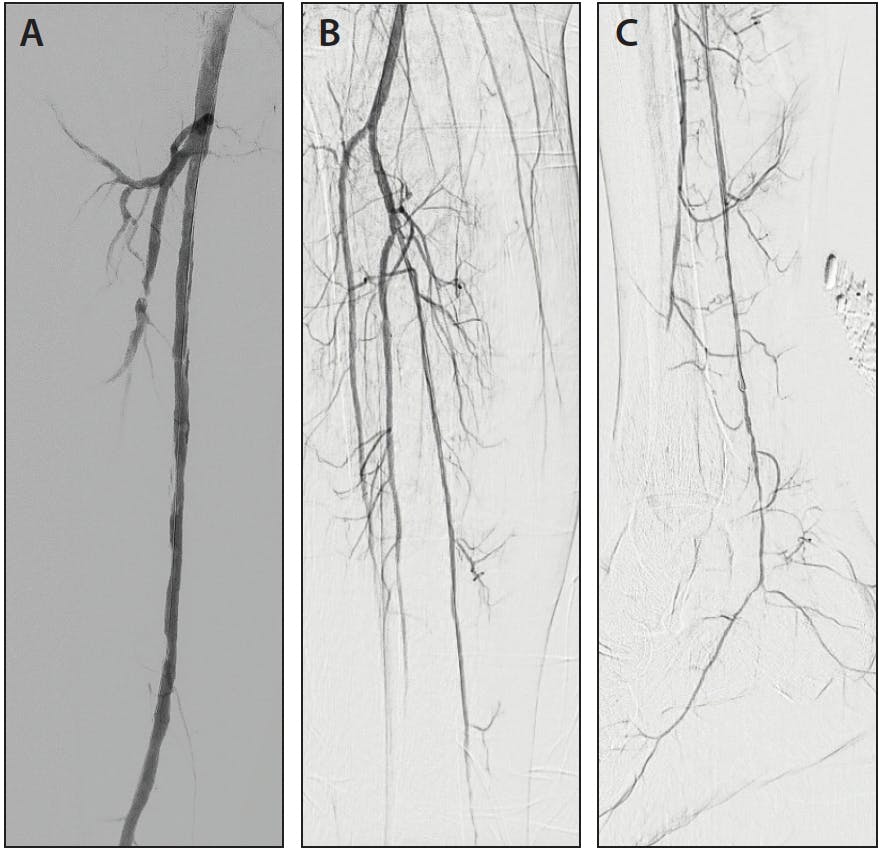
Figure 2. Postintervention angiography. SFA with brisk flow (A). PT artery outpaced the peroneal artery (B). Distal runoff to the foot (C).
CASE 1 DISCUSSION
What led to your decision to use the Serranator balloon?
Given the long segment SFA occlusion as well as tibial level occlusion, we felt that the best chance for patency and minimal recoil after angioplasty was by using the Serranator. There was also a desire to avoid stenting along the distal SFA into Hunter’s canal. Paired with the DCB, the Serranator achieved patency after angioplasty as well as during the initial follow-up.
Is there something about the Serranator’s mechanism of action that you believe makes it different than other specialty balloons?
The Serranator’s design goes beyond standard scoring balloons. We often still see high recoil and recalcitrant stenoses with standard scoring balloons, especially in calcified or chronically occluded segments. The Serranator’s serrations perform well to break up those lesions with less damage to the vessel and less chance of dissection compared to POBA.
How important is excellent lumen gain prior to using drug-coated therapy? Do you feel like Serranator consistently provides this in the SFA?
This is an excellent indication for Serranator. To maximize drug delivery, it is key to get as much luminal gain as possible prior to DCB use. This allows for maximal contact of the drug with the vessel wall.
Do you see recoil following use of the Serranator, particularly in the below-the-knee (BTK) arteries?
This is one of the main benefits of Serranator, resistance to recoil, especially in the BTK segment where there are limited device options and often no opportunity for stent placement.
CASE 2: Revascularization of AT and DP ArterIES
By Michael C. Siah, MD
CLINICAL PRESENTATION
A woman in her late 60s with a medical history significant for CAD and type 2 diabetes was referred to our clinic following a surgical dehiscence after a Charcot reconstruction of her left foot (Figure 1). The patient underwent arterial noninvasive studies, which revealed noncompressible ABIs, as well as a toe pressure of 29 mm Hg and toe-brachial index (TBI) of 0.1 in the left lower extremity.

Figure 1. Initial preinterventional nonhealing ulceration.
PROCEDURE DETAILS
Given the extent of tissue loss and the concern for potential amputation, left lower extremity arteriography was performed. Initial angiography revealed no aortoiliac or femoropopliteal disease. There was extensive tibial disease, with single-vessel runoff patent via the peroneal artery. Both the AT and PT arteries appeared occluded (Figure 2). Despite the caliber of the peroneal artery and its extensive collateral flow below the ankle, optimizing perfusion to the dorsum of the foot and directly to the wound area was essential to promote wound healing.
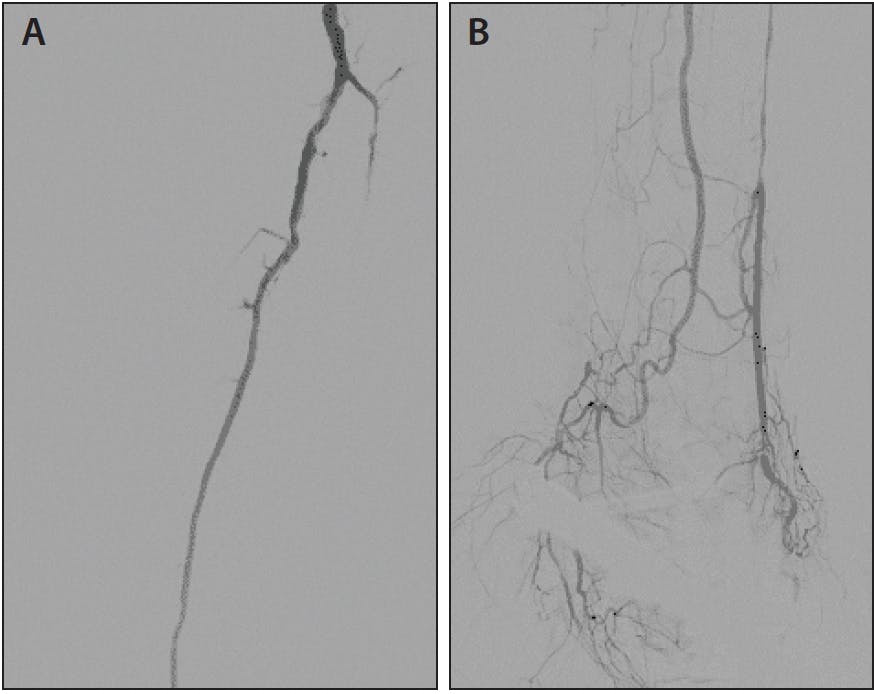
Figure 2. Preinterventional arteriogram demonstrating single-vessel runoff via the peroneal artery (A). The proximal AT artery appeared patent proximally, but it occluded. Distal tibial preinterventional arteriogram demonstrating single-vessel runoff via the peroneal artery, which reconstituted the plantar vessels (B). The distal AT artery appeared patent; however, there was a focal stenosis of the DP.
An 0.018-inch Glidewire Advantage wire and 0.018-inch Navicross support catheter (Terumo Interventional Systems) were used to cross the long segment AT artery occlusion into the DP. Following this, a 4- X 40-mm Serranator balloon was used to treat the focal DP stenosis. This was then exchanged for a 4- X 120-mm Serranator balloon that was used to treat the remainder of the AT artery. All inflations were performed for 3 minutes, and each inflation was taken to 5 atm. No predilation or preangioplasty atherectomy was performed to facilitate device delivery.
Completion arteriography was performed, demonstrating marked luminal gain, no recoil, and extensive wound blush (Figure 3). Intravascular ultrasound was performed, which revealed appropriate balloon sizing, as well as the absence of any dissections.
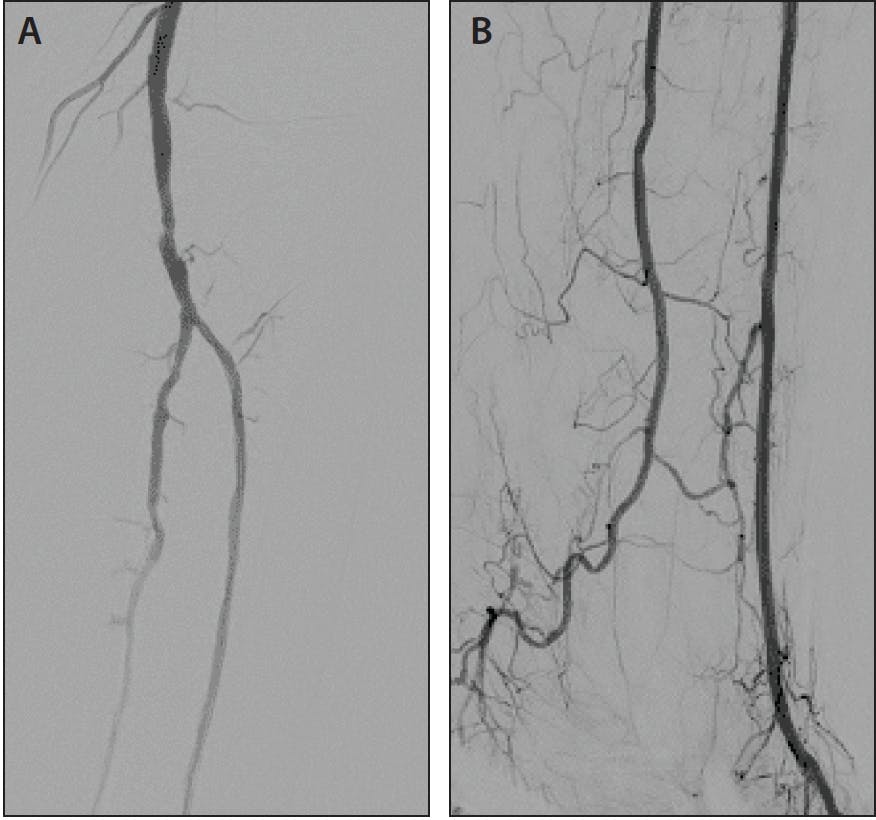
Figure 3. Completion arteriogram revealing an excellent technical result and widely patent AT (A) and DP (B).
POSTINTERVENTION COURSE
After our successful revascularization, the patient underwent multiple debridements, and vacuum-assisted closure therapy was utilized. She was enrolled in our multidisciplinary wound care clinic. Arterial noninvasive studies at 1 and 5 months revealed a widely patent AT artery, and ABI, toe pressures, and TBI of 1.08, 126 mm Hg, and 0.68, respectively. More importantly, over the course of the following 5 months, the patient’s clinical status markedly improved and her wound was nearly healed (Figure 4).
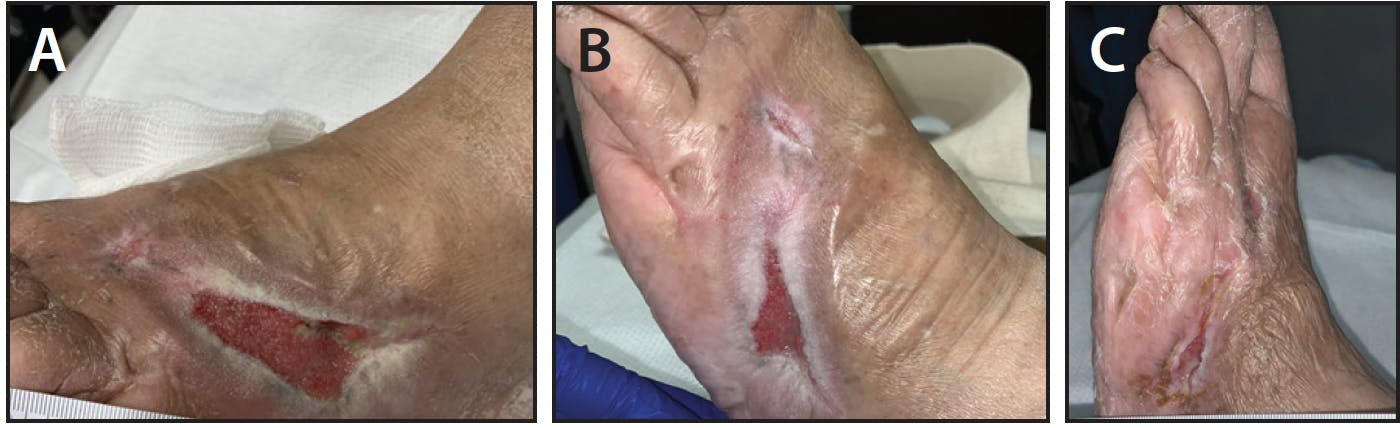
Figure 4. Wound at 3 (A), 4 (B), and 5 months (C) postintervention.
CASE 2 DISCUSSION
What is your typical treatment algorithm? When do you use the Serranator?
Typically, my algorithm revolves around delivering low-pressure angioplasty with aggressive balloon sizing. Many of the lesions I see in patients with CLTI have severe calcific disease, which can require atherectomy or specialty ballooning. I routinely use Serranator BTK, as its low-pressure, focal force mechanism has repeatedly demonstrated predictable results that have been impressive even in heavily calcified lesions. Given the typical long, diffuse disease we encounter BTK, the 120-mm Serranator has become my workhorse balloon.
How do you size the Serranator to the artery?
I generally select balloons that are slightly larger than the target reference vessel. I do this without concern for vessel rupture or dissection. The mechanism of serration angioplasty applies a controlled point force to the lesion at low pressure safely and effectively.
Are you seeing a lower recoil rate when using the Serranator?
Although I don’t routinely wait 15 minutes following a procedure to repeat imaging for patients, I almost never see early recoil after serration angioplasty, something that I had seen with conventional percutaneous transluminal angioplasty. I think my experience has been echoed in the results of Drs. Chandra and Lichtenberg’s recent study findings, which directly looked at recoil following serration angioplasty versus conventional angioplasty. Ultimately, a vessel that doesn’t recoil, or simply recoil as much, is better suited to supply blood to a target area, which leads to wound healing and amputation prevention. I think that’s what most CLTI interventionalists are interested in for their patients, and the data are promising. Anecdotally, this seems to relate to the biggest compliment I can attribute directly to serration angioplasty, which is the decrease in repeat procedures I’ve had to do on patients.
Advertisement
Advertisement