Advertisement
Advertisement
February 2023
Aspiration or Stent Retriever for Medium Vessel Occlusion?
How MeVOs differ from LVOs, the current status of endovascular capabilities, strengths and limitations of aspiration and stent retrievers, therapeutic decision-making, and existing and necessary data.
With Maxim Mokin, MD, PhD, and Patrick Nicholson, MBBCh BAO, FFR(RCSI)


How do medium vessel occlusions (MeVOs) differ from large vessel occlusions (LVOs), from presentation to technical challenges to expectations for outcomes?
Dr. Mokin: Before we begin discussing how MeVO stroke cases are managed, let me begin by stating that there is currently no good definition of what a “medium” or “distal” vessel occlusion is. Anatomic cutoffs seem to be all over the place, either when it comes to clinical trials with a strict set of rules, scientific presentations, or just day-to-day discussions among colleagues. In my opinion, this is one reason we keep getting conflicting data on comparing different types of interventions and so forth. For instance, I do not think that an M2 occlusion should be considered a MeVO. To simplify things, I consider any vessel ≤ 1.5 mm “not an LVO.”
When we bring up a discussion about MeVO strokes, we tend to think of primary MeVOs. There are also many MeVO thrombectomies performed for secondary intraprocedural occlusions when the initial clot breaks down and occludes more distal downstream branches. In fact, some researchers argue the number of thrombectomies for “secondary” MeVOs is higher than for “primary” ones, at least currently.
In general, primary MeVO cases are often more challenging to pick up on a noninvasive imaging study such as CTA. That is where perfusion imaging becomes valuable, not so much to determine whether the “penumbra/core” ratio is favorable but to help recognize the presence of a more distal occlusion. If I see a perfusion deficit suggestive of a MeVO and no obvious occlusion is appreciated on CTA of the head, especially if the patient demonstrates corresponding clinical deficits, I would still consider performing emergent thrombectomy.
With MeVO, the symptoms can often be rather “mild,” (National Institutes of Health Stroke Scale [NIHSS], 3-5), and thus the benefit of thrombectomy may or may not be higher than the risk of vessel injury, which sometimes seems to be increased in distal occlusions. Several studies (albeit retrospective) independently showed that subarachnoid hemorrhage is more frequently seen in cases of distal occlusions when compared with LVO thrombectomy.
Dr. Nicholson: We are now > 7 years from the publication of the pivotal group of positive randomized controlled trials (RCTs) that proved the unequivocal efficacy of thrombectomy in patients with LVOs. In this respect, patients who present in 2023 with an LVO and a significant clinical deficit are quite straightforward from a decision-making point of view. However, things are not so straightforward when we are faced with so-called MeVO. Although many centers—including my own—routinely treat patients with MeVO, we are still waiting for strong RCT data. In the meantime, these patients have a number of nuances that separate them from those with LVO. In terms of presentation, these patients often present with lower NIHSS than patients with LVO, meaning they can be more frequently missed. It is important to emphasize that low NIHSS does not mean that these patients automatically have a benign outcome from their stroke. Data from the INTERRSeCT and PRoveIT studies show that only 50% of such patients have an excellent or a good clinical outcome (modified Rankin Scale [mRS], 0-1). Overall, the natural prevalence and history of MeVO is largely unknown, in part because vascular imaging has not traditionally been performed in every center for patients with mild stroke symptoms. This may change in the future, as indications for CTA continue to expand and we see data from other prospective studies. To date, MeVOs have been underrepresented in the major thrombectomy trials, with M2 occlusions for example representing only about 8% of the patients overall. Additionally, given NIHSS cutoffs for trial inclusion, these M2 branches were mainly large, dominant branches, and this was confirmed in the HERMES data.
From a technical point of view, we need to use smaller-profile devices and longer catheters to safely treat MeVO versus those used for something like an internal carotid artery terminus occlusion. This is due to smaller vessel size and vessel distance and tortuosity, which theoretically increases the risk of vessel perforation and dissection. These smaller and longer devices have existed for many years and are in routine use, but we have to think about certain nuances like device length and compatibility of certain combinations of aspiration catheters and microcatheters. We know that these devices are safe, with data from large contemporary cohorts such as the ANGEL-ACT registry showing that generally we can remove clots in these distal branches with equal efficacy and safety when compared with LVO. From a broader point of view, we need to remember that the penumbra at risk is smaller, and so the risk/benefit ratio changes somewhat. In short, complications are less forgiving when you are dealing with MeVO.
How would you describe the current status of endovascular capabilities for MeVO?
Dr. Nicholson: The current cohort of devices specifically designed for MeVO are up to the task at hand. For example, in terms of aspiration catheters, low-profile catheters such as the 3MAX (Penumbra, Inc.) can be delivered over a 0.014-inch microwire alone and used for contact aspiration. For stent retrievers, smaller, lower-profile devices such as the Tigertriever 13 (Rapid Medical) are specifically designed for smaller vessels such as distal middle cerebral artery (MCA) branches, with a maximal expanded diameter of 2.5 mm.
Dr. Mokin: We are not there yet. To me, an ideal mode of thrombectomy or device needs to be safer and smaller (ie, specifically designed for smaller, more delicate vessels), whether it is a delivery microcatheter or the device profile itself. It is best seen in open surgical cases how fragile distal arterial beds are, with numerous tiny perforator branches that get easily damaged upon retracting brain tissue during surgery. We all have witnessed how guidewires, microcatheters, and thrombectomy devices cause arteries to straighten, changing the normal anatomic course or stretching them during thrombectomy, especially when stent retrievers are used. Frankly, I am surprised the rates of complications we see with MeVO thrombectomy are not higher. Truly, the brain is a remarkable organ and perhaps is “forgiving” after all.
What do you feel are the strengths of aspiration in MeVO cases, whether current or potential?
Dr. Mokin: In my opinion, the main appeal of aspiration thrombectomy is that there is no need to cross the occlusion with a guidewire or microcatheter, unlike when stent retrievers are used (Figure 1). When I see a microcatheter that is half the size of the target occlusion (or sometimes even more) attempting to cross the occlusion, it makes me very uncomfortable.
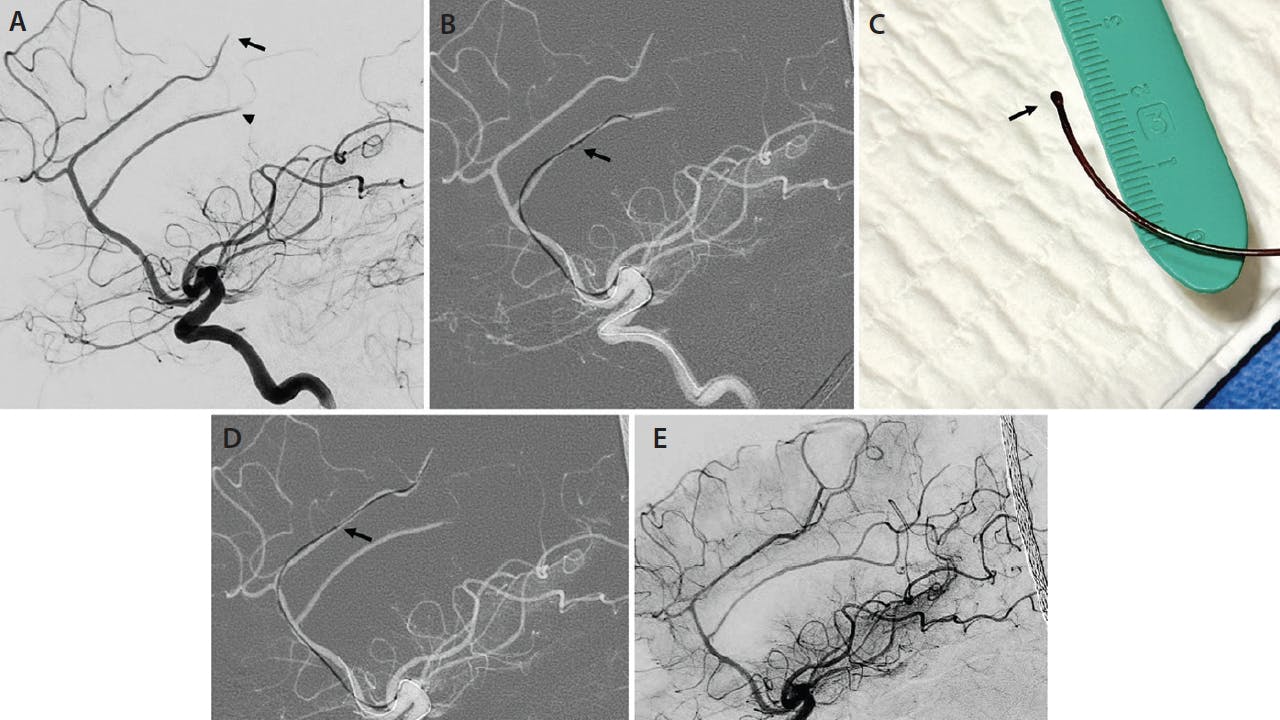
Figure 1. Aspiration and local thrombolysis. Digital subtraction angiography of carotid artery injection, showing occlusion of pericallosal (arrowhead) and callosomarginal (arrow) anterior cerebral artery branches (A). Roadmap, internal carotid artery injection. Aspiration thrombectomy of the pericallosal occlusion is performed using a 0.025-inch microcatheter (arrow). The microcatheter is carefully delivered over a 0.014-inch guidewire to ensure neither device traverses and disturbs the clot. Aspiration thrombectomy is performed. This is an example of off-label use of microcatheters, but it works rather well (B). Photograph of the microcatheter with clot material corked within its tip (C). For the more tortuous callosomarginal branch, pharmacologic thrombolysis with alteplase is chosen to avoid navigating the microcatheter via more challenging anatomy. The arrow shows the position of the microcatheter prior to delivery of alteplase on the original roadmap (D). Satisfactory revascularization of the anterior cerebral artery territory is now achieved. This patient also has a separate distal MCA occlusion (E).
In fact, I think that stent retriever thrombectomy might be more effective than aspiration as far as clot removal. However, I am also afraid that using stent retrievers comes with an increased risk of hemorrhagic complications, and given that patients with MeVO often present with mild symptoms, I am not yet convinced that such increased risk is justifiable. I do not have any strong data to support such observations; this is more of an opinion and the experience is anecdotal. If there is a well-designed study that proves me wrong, I admit I will likely switch to the use of stent retrievers as the first-line therapy.
Dr. Nicholson: A recent meta-analysis demonstrated that aspiration was associated with a slightly less chance of symptomatic intracerebral hemorrhage (sICH) than stent retrievers in patients with MeVO, but this did not affect final clinical outcome.1 Some anecdotally feel that aspiration is quicker, but this supposition lacks good data at this time. Although an aspiration catheter can sometimes get stuck at a bifurcation branch, this can be overcome with the use of a smaller-diameter internal microcatheter. Another potential issue is length, especially when trying to reach distal occlusions. This can be overcome with newer, longer aspiration catheters that are up to 160-cm long. Finally, sometimes extreme tortuosity can be an issue in reaching a distal MeVO, and a triaxial approach involving an aspiration catheter and a microcatheter may be required.
What do you feel are the strengths of stent retrievers in MeVO cases, whether current or potential?
Dr. Nicholson: Stent retrievers may be navigable more distally in the MCA, especially when compared with larger-bore aspiration catheters. As noted earlier, they are available in sizes down to 2.5 mm in diameter, and usually length is not an issue when reaching distal occlusions. One small single-center study comparing aspiration with stent retriever technique for distal occlusions showed a higher rate of first-pass success with stent retriever use, but this also resulted in a higher rate of sICH than with aspiration alone.2 This higher rate of sICH may be due to pulling the unsheathed stent retriever around tortuous MCA branches.
The most important take-home from these last two questions is that there are no strong data showing any clinically significant difference between these techniques in either recanalization rates or functional outcomes. Operators should therefore perform what they feel most comfortable or experienced with and what can offer fastest recanalization in their hands.
Dr. Mokin: I could see how stent retrievers specifically designed for distal vasculature (requiring a much smaller external diameter catheter for delivery, smaller stent profile, or less radial force) may be safer to use in MeVO cases. Again, for me, safety of a MeVO device is key.
What are the most significant current limitations of either option in this setting?
Dr. Mokin: I think that there is still a huge role for either systemic (intravenous [IV]) or local (intra-arterial) thrombolytics in MeVO stroke cases (Figure 1), and this may not include alteplase or similar thrombolytics we have access to presently but some newer agents such as those targeting von Willebrand factor. Time will tell. The data that smaller thrombi are more responsive to pharmacologic lytics than occlusions with large clot burden are compelling. IV drug administration is much easier (faster and can be done even at the point of first patient contact) than performing a sophisticated thrombectomy procedure.
Dr. Nicholson: The lack of strong prospective data proving efficacy of one technique over another is a problem but one that is being addressed through several ongoing MeVO registries and trials. Although concerns about device diameter and length (and consequently vessel perforation, dissection, and vasospasm rates) were an issue in the past, industry partners have responded accordingly. We now know that we can safely achieve good angiographic outcomes in these patients in about 70% to 80% of these patients. This was borne out in both the HERMES data and in a recent publication from the German Stroke Registry.3
How do you approach therapeutic decision-making in MeVO cases? What is your algorithmic approach and key dos and don’ts?
Dr. Mokin: I would say we currently treat all LVO strokes at our stroke center, except for those with an extremely poor imaging profile on noncontrast CT, such as with ASPECTS (Alberta Stroke Program Early CT Score) of 0 to 2. We stopped relying on perfusion to select patients for thrombectomy, and perfusion is used primarily to help diagnose LVO when CTA is nondiagnostic.
For MeVO cases, we tend to be less aggressive. Some degree of neurologic deficit is required to justify an intervention that has a certain degree of risk. The jury is still out on whether there is a benefit of intervention in patients with “mild” symptoms. For us, it is a case-by-case basis. Usually, we consider treatment if a patient’s NIHSS is > 6, but for milder symptoms, we would rather spend a little extra time trying to get a more detailed neurologic exam and make a decision that is in the patient’s best interest.
Dr. Nicholson: For me, the treatment of patients presenting with MeVO is taken on a case-by-case basis. I know we can get the vessel open relatively quickly, effectively, and safely. The question then becomes if the procedure is worth performing from a clinical point of view. Multiple factors are considered, including age, baseline functional status, NIHSS, ASPECTS, and clot location. Concerns about arch access are no longer a major issue in most cases. Although age should not preclude thrombectomy, it is a major factor, and a return to functional independence may be less likely in, for example, a 95-year-old patient than in a 45-year-old patient, if both present with M3 MCA occlusions. In addition, the risk/benefit profile is different in these patients. As such, and in the absence of strong guidelines pointing us in one direction or the other, I continue to approach each case by taking these factors into account.
Where do we stand with respect to collecting data on MeVO interventions with aspiration and/or stent retrievers? What kind of data do we need to see next to guide decision-making?
Dr. Nicholson: There are multiple large ongoing registries that capture both LVO and MeVO data. These include industry-sponsored registries, such as the ASSIST registry, and clinician-led efforts, such as the aforementioned German Stroke Registry. In addition, multiple ongoing RCTs looking specifically at MeVOs should provide data regarding both clinical outcomes and differences in technical-related outcomes.
One point to consider is that there perhaps may need to be more nuance to these data. It is true that what is considered a “good” outcome in LVO (ie, mRS of 0-2) may be a relatively crude measure of outcome when dealing with MeVO, where the risk/benefit profile of treatment may be different. We therefore may need to consider other functional outcome metrics such as quality-of-life assessment tools for these patients.
Dr. Mokin: Great question, and I am not sure I know the right answer here. Stroke with MeVO comprises such a heterogeneous population. I am skeptical that we will have our answers even if one or several randomized trials are conducted (where medical management alone is included as a control arm), but it certainly helps to have such high-quality data. Currently, we are in the dark. The available retrospective studies are all subject to selection bias, and I am not sure these data help us make well-informed decisions.
What device enhancements might help in this setting, whether for aspiration or stent retrievers?
Dr. Nicholson: In terms of aspiration catheters, distal trackability and the combination of a low-profile outer diameter with a maximally large inner diameter is the goal. Many newer devices are addressing these issues. For stent retrievers, smaller devices need to be delivered via smaller microcatheters, but these too are commercially available. When using a combined approach, the main issue to consider is length when using various combinations of devices for a triaxial approach.
Dr. Mokin: Perhaps innovations in imaging technologies will help us treat MeVO occlusions more effectively. We often focus on devices and forget that one reason for “device failure” might be that a particular device wasn’t the right choice in a particular patient but would be an ideal choice next time. For example, a lot of research is being conducted on how clot composition affects thrombectomy outcome. The main limitation of this research is that we currently have very limited ability to determine clot type a priori. Whether with advances in clot radiomics, use of “smart” guiders, or novel blood markers, I am hopeful that one day we will be able to choose a particular device based on unique clot properties and vessel characteristics.
1. Alawieh A, Chalhoub R, Al-Kasab S, et al. O-065: Technical and clinical outcomes in medium vessel occlusion (MeVO) thrombectomy by frontline technique–a multicenter study [abstract]. J Neurointerv Surg. 2022;14:A42-A43. doi: 10.1136/neurintsurg-2022-SNIS.65
2. Haussen DC, Eby B, Al-Bayati AR, et al. A comparative analysis of 3MAX aspiration versus 3 MM Trevo Retriever for distal occlusion thrombectomy in acute stroke. J Neurointerv Surg. 2020;12:279-282. doi: 10.1136/neurintsurg-2019-014990
3. Herzberg M, Dorn F, Trumm C, et al. Middle cerebral artery M2 thrombectomy: safety and technical considerations in the German Stroke Registry (GSR). J Clin Med. 2022;11:4619. doi: 10.3390/jcm11154619
Disclosures
Dr. Mokin: Grants from National Institutes of Health; consultant to Cerenovus, Medtronic, and MicroVention; stock options, Bendit Technologies, Borvo Medical, BrainQ, Endostream, Serenity Medical, Synchron, Sim&Cure, QAS.AI, and Quantanosis.AI.
Dr. Nicholson: Consultant to Cerenovus, Medtronic, Stryker Neurovascular, and Penumbra, Inc.
Advertisement
Advertisement