Advertisement
Advertisement
July 2023
Practical Lessons From PRESERVE
Highlights of the study’s methods and results, with insights from the study's Principal Investigators, David L. Gillespie, MD, FACS, and Matthew S. Johnson, MD, FSIR.
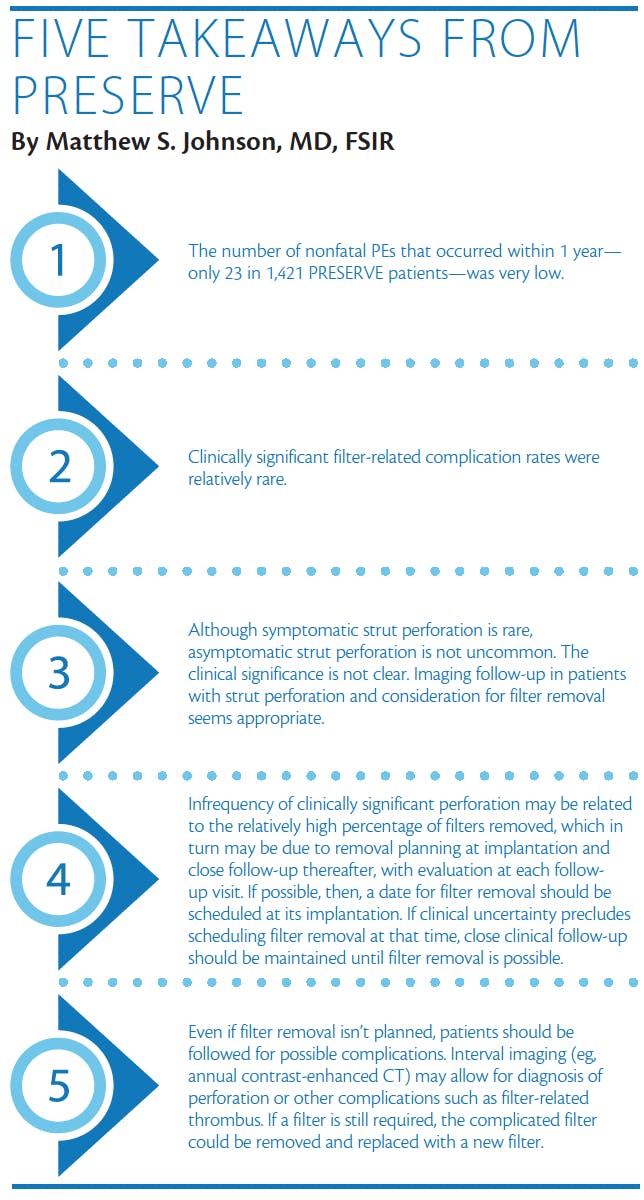
In the multicenter, prospective, open-label, nonrandomized PRESERVE study, implantation of inferior vena cava (IVC) filters in patients with venous thromboembolism (VTE) was associated with a relatively low rate of adverse events and incidence of clinically significant pulmonary embolism (PE). The findings were jointly published by Johnson et al in Journal of Vascular and Interventional Radiology and Journal of Vascular Surgery: Venous and Lymphatic Disorders.1,2
KEY FINDINGS
- Rates of the primary safety endpoint and primary effectiveness endpoint were 89.4% and 96.4%, respectively.
- Procedural adverse events were mostly minor, and clinically significant filter–related adverse events as defined in the study were rare.
- Incidence of VTE events within 1 year after IVC filter placement was 6.5%.
- 44.5% of all study IVC filters were removed at a mean of 101.5 ± 72.2 days.
The study aimed to evaluate current IVC filter use in the United States, including indications for placement, safety, success of removal, and incidence of embolic events after placement. Patients aged ≥ 18 years deemed eligible to receive an IVC filter and willing to comply with the scheduled follow-up protocol were enrolled between October 10, 2015, and March 31, 2019, from 54 United States sites.
Patients were evaluated at the time of the procedure and at 3, 6, 12, 18, and 24 months after IVC filter placement. They were followed for 1 month after retrieval if the IVC filter was removed. Imaging was scheduled at 3-month (radiograph) and 12- and 24-month (contrast-enhanced CT) follow-up for patients who still had IVC filters, which were then assessed by an independent core laboratory.
The primary safety endpoint was a composite of freedom from adverse events within the perioperative period and freedom from clinically significant perforation, IVC filter embolization, caval thrombotic occlusion, and/or new deep vein thrombosis (DVT) within 12 months after IVC filter placement. The primary effectiveness endpoint was a composite of procedural and technical success and freedom from new clinically significant PE at 12 months in situ or 1 month after retrieval.
A total of 1,429 participants were enrolled (mean age, 62.7 ± 14.7 years); 53.3% were male, 71.3% had acute or chronic VTE (30.7% with PE, 60% with DVT), 34.1% had a history of VTE (19.5% with PE, 22.6% with lower extremity DVT), and 8.9% of patients had no current or history of VTE. Logistic regression of the primary safety outcome versus IVC filter brand showed that there were no statistically significant differences between primary safety event rates across IVC filter types at 12 months postprocedure (P = .45). IVC filters were placed in 1,421 patients (1,386 in IVC, 27 in suprarenal IVC, five in both iliac veins, three in one iliac vein). Most IVC filters were retrievable (90.2%) or convertible (1.1%), with permanent IVC filters placed in 8.7% of patients.
Each primary endpoint was achieved, with primary safety endpoint and primary effectiveness rates of 89.4% and 96.4%, respectively. Thirty procedural adverse events were reported in 28 patients, and 27 clinically significant adverse events were reported 30 days after IVC filter placement. Eight patients had new or worsened DVTs (six of these had acute VTE on presentation).
Regarding IVC filter–related adverse events, migration > 20 mm occurred in three patients, four patients experienced embolization of all or part of the IVC filter, and perforation of the IVC ≥ 5 mm (5.2-16.2 mm) was demonstrated on CT in 15.4% of patients (211 CTs) at 12-month follow-up, as determined by the core laboratory.
The IVC filter retrieval rate was 49.3% of retrievable and 44.5% of all study IVC filters removed (mean, 101.5 ± 72.2 days; median, 86.3 days). Retrieval procedure–related adverse events were reported in 1.8% of patients, with one death due to an innominate vein injury. There were 80 DVTs, 23 PEs, and 15 caval thrombotic occlusions in 93 (6.5%) patients after IVC filter placement, as confirmed by the clinical events committee (at 73.1 ± 66.0 days, 65.7 ± 62.9 days, and 62.75 ± 46.19 days, respectively).
Key limitations of the PRESERVE study include its nonrandomized design, which restricts the ability to evaluate the prevention of significant complications; the relatively short current duration of follow-up, which does not include longer-term events occurring in filters that are not retrieved; and limited detail regarding anticoagulation status and its impact on results, although longer-term follow-up at 2 years is anticipated; and that the target enrollment of the study (2,100) was not met.
1. Johnson MS, Spies JB, Scott KT, et al. Predicting the safety and effectiveness of inferior vena cava filters (PRESERVE): outcomes at 12 months. J Vasc Interv Radiol. 2023;34:517-528.e6. doi: 10.1016/j.jvir.2022.12.009
2. Johnson MS, Spies JB, Scott KT, et al. Predicting the safety and effectiveness of inferior vena cava filters (PRESERVE): outcomes at 12 months. J Vasc Surg Venous Lymphat Disord. 2023;11:573-585.e6. doi: 10.1016/j.jvsv.2022.11.002
ENDOVASCULAR TODAY ASKS…
PRESERVE Co-Principal Investigator David L. Gillespie, MD, FACS, was asked to expand on the study’s key learning points, the importance of retrieval planning, and clinical questions remaining.
Looking back over the course of the PRESERVE study, which of its learning points do you feel are most practical and impactful for practices placing and retrieving IVC filters in 2023?
First, IVC filters in this study had a low incidence of complications, both on insertion and after placement for up to 2 years. Second, if IVC filters are followed closely and removed when not needed, it helps keep complications low. However, filter placement can be associated with adverse events.
The commencement of PRESERVE was noteworthy in its multidisciplinary composition, beginning with you and interventional radiologist Matthew Johnson, MD, as leading investigators. What are PRESERVE’s take-homes regarding the need for team approaches to placement and retrieval planning?
In the United States, the majority of IVC filters are placed by interventional radiologists; however, many different providers can also place them, including vascular surgeons, general surgeons, and interventional cardiologists. Thus, interspecialty communication and documentation are key to aid patient care.
A key take-home point is that IVC filters should be removed as soon as they are no longer needed, if possible. It is likely best if you follow your own IVC filter patients, schedule follow-up with them, and consider IVC filter removal at those visits.
What has been the biggest change in IVC filter placement and retrieval you have seen since the first PRESERVE patient was enrolled through the present day?
I believe it is now accepted practice that practitioners insert fewer prophylactic IVC filters. Similarly, practitioners need to follow their patients more closely to remove IVC filters when possible.
What are your team’s keys to success in planning for and ensuring timely filter removal?
We keep a registry of our IVC filter patients and consider removal when the patient can be safely anticoagulated and/or the filter is no longer needed. As shown by several previous studies, collecting a registry of patients who have had temporary IVC filters is easily accomplished.
As a Principal Investigator, what can you share with future investigators about enrollment hurdles (and potential solutions) encountered in large-scale clinical studies such as PRESERVE?
Large studies are expensive. Through a collaborative approach between industry and societies, we were able to provide an alternative to more expensive individual 522 studies.
As shown in the study, collaboration between industry partners can be an alternative to individual device trials. It is difficult to construct trials that answer all questions that practitioners and critics have. Although PRESERVE is not a prospective randomized study, it does provide a real-world look at how filters are actually employed and their subsequent complications.
It is hard to predict societal changes over the length of a trial, but these can affect the overall success of failure of the study. All things change. At the onset of the PRESERVE trial, IVC filter placement exceeded the incidence of the disease. During the course of this trial, however, physician practice patterns changed to be more selective in whom to place filters, more aggressive in following IVC filter patients, and more thoughtful in removing temporary filters. This effected the results of the study and resulted in improved patient care.
Advertisement
Advertisement