Advertisement
Advertisement
July 2023
VEIN: The Venous Ulcer Platform Study
Developing an adaptive platform trial for venous leg ulceration.
By Sarah Onida, BSc, PhD, FRCS; Francine Heatley, BSc, PhD; and Alun H. Davies, MA, DM, DSc, FRCS, FHEA, FEBVS, FACPh, FFST(Ed)
Venous leg ulcers (VLUs) are a major health concern worldwide. Affecting up to 4% of the elderly population,1 these wounds cause chronic pain, sleeplessness, and reduced quality of life.2 In addition, they present an important societal and financial burden, with reduced work productivity and a cost of 2% of the annual health care budget in Western societies.3 The importance of this condition is well recognized, with initiatives such as the National Wound Care Strategy program,4 James Lind Alliance Priority Setting partnership,5,6 and All-Party Parliamentary Group Venous Leg Ulcers: A Silent Crisis report7 highlighting the urgent care needs this patient group requires. International efforts include an American Venous Forum/Pacific Vascular Symposium call to action that aimed to reduce VLU prevalence 50% by 2019.8
Even with these initiatives, VLU epidemiology has not markedly changed over the last 10 years. Prevalence rates have remained static,9 despite change in practice following landmark trials.10,11
ADAPTIVE TRIAL DESIGNS
Randomized controlled trials (RCTs) represent the highest level of evidence due to minimization of bias and reduction in risk of systematic errors or confounders.12 However, RCTs are constrained by a fixed design and the practical limitations that come with it. Examples include limited assessment of treatments in a given trial, a cumbersome regulatory and administrative setup process for each trial, the time frame it takes for study sites to be set up and recruitment to gain momentum, the time to results and publication, and a limited ability to include novel technologies or integrate industry. The COVID-19 pandemic, when trial results were urgently required to help inform practice, highlighted the challenges of standard trial design and the need for a more responsive and adaptive research methodology.
Master protocol trials are study constructs that allow the assessment of multiple treatments and population subgroups within the same overall trial structure.13 Examples of such trials are basket and umbrella trials, which evaluate differential patient populations or treatments, respectively. Platform trials have the additional benefit of permitting the addition of new arms to the trial when novel treatments become available and dropping arms for early success or futility at predefined interim data assessment points (Figure 1).14 Results of clear benefit or futility can be used to immediately inform standard of care, helping shape treatment guidelines in a shorter period of time. Depending on the design, the presence of a single, shared control arm permits the overall recruitment of a smaller study population, while the long-term use of active study sites participating in the platform reduces inefficiencies in terms of study setup and gaining recruitment momentum.
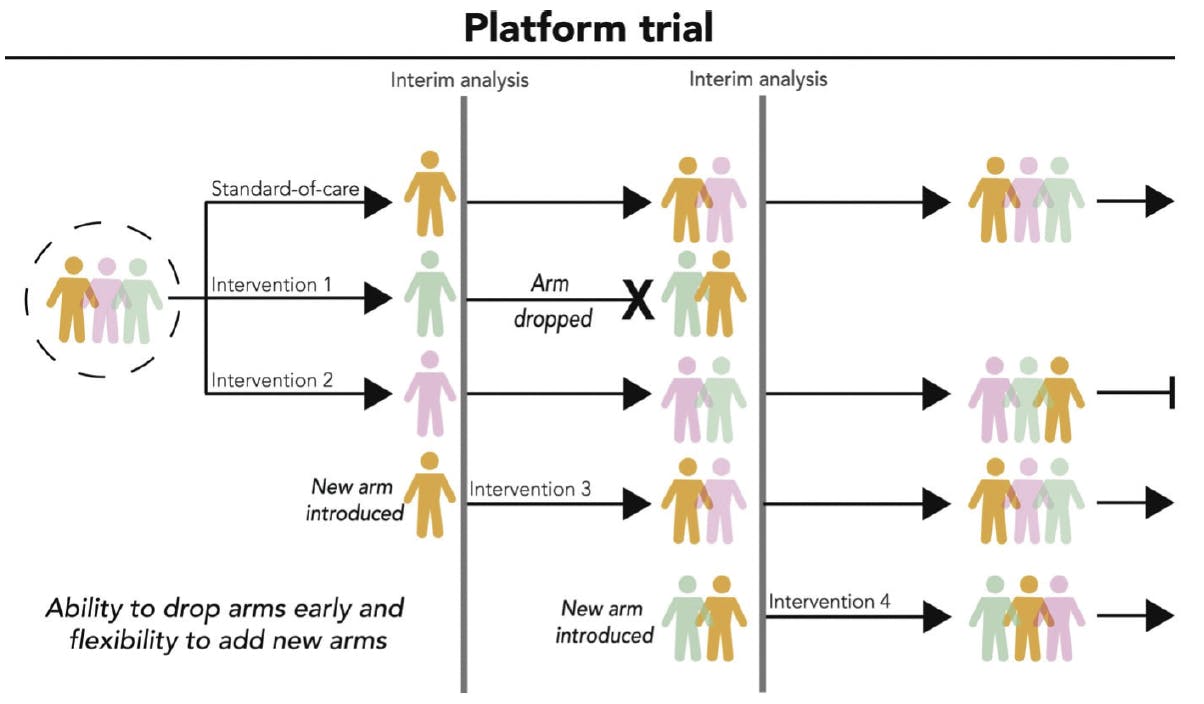
Figure 1. An illustration of a platform trial. Reprinted from Journal of Clinical Epidemiology, 125, Park JJH, Harari O, Dron L, et al, An overview of platform trials with a checklist for clinical readers, 1-8, Copyright 2020, with permission from Elsevier.
Platform trials have been used in the field of oncology15 but really came to the forefront during the COVID-19 pandemic. Examples include the RECOVERY and REMAP-CAP trials,16,17 which have both recruited tens of thousands of participants and provided early evidence of the effectiveness and futility of certain treatment regimens at interim analyses. The RECOVERY trial was particularly key in rapidly informing the management of COVID-19 therapy at the height of the pandemic. Importantly, the RECOVERY INTERNATIONAL trial has recruited > 1,500 participants in six international countries. As VLU trials can be notoriously difficult to recruit for,18,19 the international nature of this platform trial is key. This permits collaboration, increased participant recruitment, relevance of the work to a larger population, and quicker development of high-quality evidence to help inform international guidelines.
The benefits of platform trials have been recognized by the National Institute for Health and Care Research (NIHR) in the United Kingdom, which provided accelerator award funding to support the development of platform trial infrastructure in different health care areas.20 Our research group was awarded one of these awards to create the first platform trial in venous leg ulceration: the VEIN platform study.
THE VEIN PLATFORM STUDY
Venous leg ulceration is a condition with a complex care pathway. Patients are in different parts of the health care system, and the majority are based in the community or primary care. When identified and determined to be in need of investigation and intervention, patients are then referred to secondary or tertiary care for treatment, although this does not always happen. Management is extremely varied, ranging from self-care to exercise, wound care, compression, medication, endovenous therapy, or surgical intervention, to name a few.21
Novel therapies such as growth factors have recently come to the forefront.22 Although many treatments are available, the evidence for the vast majority is described as low in the literature. In fact, European guideline recommendations only provide level A evidence (from RCTs) for compression and early endovenous ablation to promote ulcer healing and prevent recurrence23; the remaining existing treatments for venous ulceration have lower levels of evidence due to the quality of research in the field currently.
The VEIN platform study will be the first platform study in venous leg ulceration with the goal of assessing a variety of treatments and interventions in patients with active and healed ulceration (CEAP [clinical, etiologic, anatomic, and pathophysiologic] C6 and C5 disease). The accelerator award is supporting the development of the team, infrastructure, and statistical design to deliver a funding application in November 2023. The prospective application is being developed via five work streams (WS), through which patient and public involvement and equality and diversity will be incorporated, employing both qualitative and quantitative methodology.
WS1: Evidence Synthesis and Identify Priority Areas
A generic scoping review was performed to comprehensively identify all treatments published for VLUs. The objective was to identify potential treatments that could be assessed in the prospective platform trial. More in-depth systematic reviews were performed for specific subgroups of treatments (eg, certain medications) to identify areas of potential interest. Published Cochrane reviews on VLUs were also assessed. WS1 data aimed to identify possible interventions, comparators, and outcomes reported in the literature.
WS2: Establishment of Key Platform Members
A platform trial requires input from a multidisciplinary team of individuals. To ensure the developing trial had a core group of individuals informing it, specialist advisory group (SPAG) representatives were invited to participate, in addition to patients wishing to participate in the development of the trial. Members include experts in data science, industry, training, statistics, clinical, behavioral, health economics, and equality and diversity who will help inform key trial characteristics in WS3.
WS3: Identification of Key Performance Indicators and Platform Trial Characteristics
In WS3, data from WS1 and expert input from WS2 will help inform possible avenues with respect to study design, patient-centric methodology, governance, health economic and statistical methodology, data analytics, data integration, and dissemination plans and ensure that equality and diversity considerations are kept in mind.
WS4: Consensus on Optimal Design, Methodology, and Delivery of the Research
Consensus on the research will be obtained via an iterative process involving both qualitative and quantitative data sourced from our expert members. In WS4, a PICO (patient or problem, intervention or exposure, comparison or control, outcome[s]) framework for the proposed platform trials will be finalized. In addition, database development, methodology for patient recruitment, timeline planning, budget, and dissemination methodology will be established.
WS5: Delivery of the Funding Application
WS5 will involve the delivery of the NIHR application for the platform trial.
VEIN PLATFORM MEMBERS
There are multiple levels of involvement in the VEIN platform trial, and they are open to anyone wishing to collaborate on this study.
Executive Group
The VEIN platform is supported by a core team that meets weekly to ensure the trial preparation is proceeding. This includes the joint lead applicants, statisticians, a project manager, and a patient and public involvement representative.
Core Groups
There are three core groups: a core patient group, a core clinical group, and a core stakeholder group. Individuals with expertise in venous ulceration who are engaged in the study and keen to help inform the future platform trial are welcome to join one of these groups. Groups meet virtually monthly and attend meetings and focus groups to help inform the study development.
Specialist Advisory Groups
Individuals with expertise in venous ulceration who would like to provide periodic input into the study but do not wish to be heavily involved can join one of the SPAGs. SPAGs include groups highly relevant to VLU research, including patient, clinical, statistical, industry, data science, qualitative, health economic, and trainee groups. We have identified representatives for each of these groups who can help communicate with the executive group. SPAG members can help inform the platform via questionnaire completion and proposals for possible trials.
We recognize the variety of management options in venous ulceration. To represent these, the clinical SPAG is subgrouped in different domains, or special interest groups (SPIGs). Each SPIG represents an area of venous ulcer care (Figure 2), with interventions in these areas representing possible trial arms to be assessed via the platform. Each SPIG has a designated representative who will champion their area and feedback to the executive group.
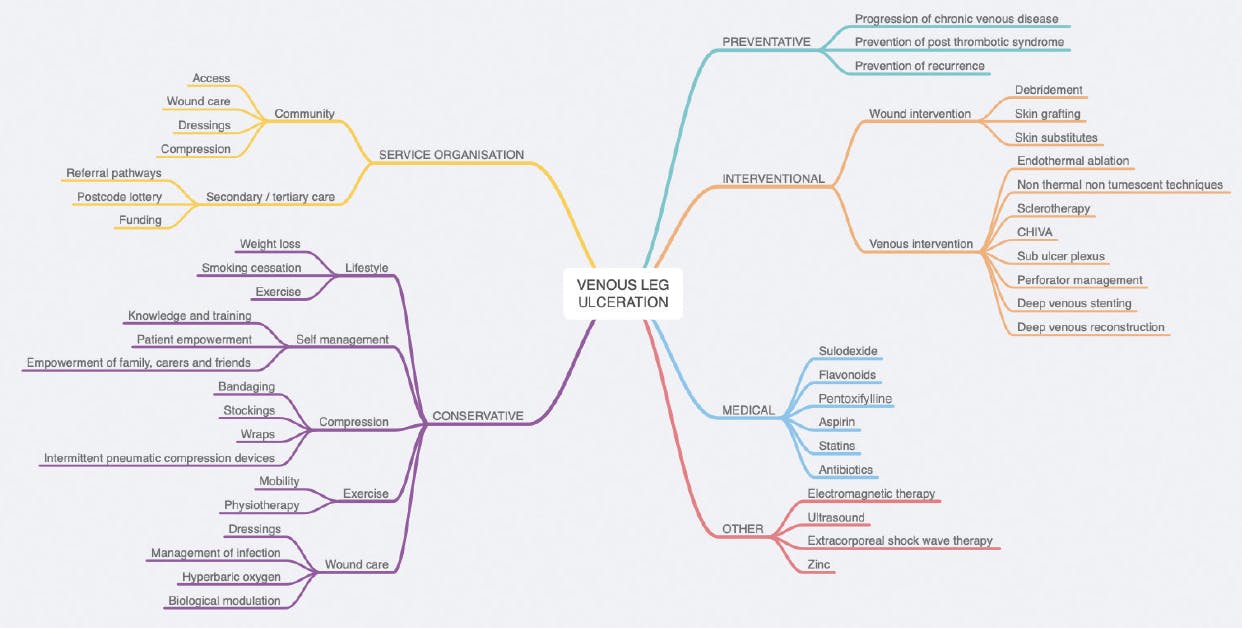
Figure 2. SPIGs representing VLU management areas who advise the core groups of the platform trial. CHIVA, conservative hemodynamic treatment for chronic venous insufficiency.
COLLABORATION
For the platform to be a success, it is extremely important to be inclusive and informed by a strong collaborative network. VLUs are a worldwide problem, and it is important that the research performed via the platform is relevant internationally. To deliver this, we have sourced broad international representation in our SPIGs and SPAGs and have invited international members to our core group. The research is supported by international stakeholders, including the American Venous Forum, American Vein and Lymphatic Society, International Union of Phlebology, and European Venous Forum. We are keen for the platform to be open so that in the future, researchers from any part of the world can propose studies to run via the platform using an established infrastructure. We believe this is going to give the opportunity to individuals with limited academic setups to be able to participate and lead in practice-changing research in this field.
CONCLUSION
The VEIN platform accelerator award provides the opportunity to set up the first platform infrastructure for VLU research. This is a golden opportunity to deliver adaptive trials in this disease, which requires urgent research to help support improved treatments and patient outcomes.
We invite anyone willing to help support platform trials in venous ulceration to contact us and be part of the VEIN platform. If interested, contact f.heatley@imperial.ac.uk or veinplatform@imperial.ac.uk.
1. Lal BK. Venous ulcers of the lower extremity: definition, epidemiology, and economic and social burdens. Semin Vasc Surg. 2015;28:3-5. doi: 10.1053/j.semvascsurg.2015.05.002
2. Sritharan K, Lane TR, Davies AH. The burden of depression in patients with symptomatic varicose veins. Eur J Vasc Endovasc Surg. 2012;43:480-484. doi: 10.1016/j.ejvs.2012.01.008
3. Rabe E, Pannier F. Societal costs of chronic venous disease in CEAP C4, C5, C6 disease. Phlebology. 2010;25(25 suppl 1):64-67. doi: 10.1258/phleb.2010.010s09
4. Development of a national wound care strategy: debating the issues. J Wound Care. 2018;27:403. doi: 10.12968/jowc.2018.27.6.403
5. Long J, Lathan R, Sidapra M, et al, on behalf of the Vascular Society of Great Britain and Ireland Wounds Special Interest Group. Research priorities for vascular wounds: results of the Vascular Society GBI/James Lind Alliance priority setting process. J Vasc Soc GB Irel. 2022;1:110-116. doi: 10.54522/jvsgbi.2022.027
6. Long J, Atkin L, Gronlund T, et al, on behalf of the Vascular Society of Great Britain and Ireland Venous Special Interest Group. Research priorities for venous conditions: results of the UK Vascular James Lind Alliance priority setting process. J Vasc Soc GB Irel. 2022;2:26-32. doi: 10.54522/jvsgbi.2022.038
7. All-Party Parliamentary Group on Vascular and Venous Disease. Venous leg ulcers: a silent crisis. Published November 10, 2019. Accessed May 30, 2023. https://static1.squarespace.com/static/5981cfcfe4fcb50783c82c8b/t/5da72c6c5f96434e62146b5b/1571237005848/Venous+leg+ulceration+2019.pdf
8. Henke P, Pacific Vascular Symposium 6 Faculty. The Pacific Vascular Symposium 6: the venous ulcer summit in perspective. J Vasc Surg. 2010;52(5 suppl):1S-2S. doi: 10.1016/j.jvs.2010.05.066
9. Salim S, Machin M, Patterson BO, et al. Global epidemiology of chronic venous disease: a systematic review with pooled prevalence analysis. Ann Surg. 2021;274:971-976. doi: 10.1097/SLA.0000000000004631
10. Gohel MS, Barwell JR, Taylor M, et al. Long term results of compression therapy alone versus compression plus surgery in chronic venous ulceration (ESCHAR): randomised controlled trial. BMJ. 2007;335:83. doi: 10.1136/bmj.39216.542442.BE
11. Gohel MS, Heatley F, Liu X, et al. A randomized trial of early endovenous ablation in venous ulceration. N Engl J Med. 2018;378:2105-2114. doi: 10.1056/NEJMoa1801214
12. Burns PB, Rohrich RJ, Chung KC. The levels of evidence and their role in evidence-based medicine. Plast Reconstr Surg. 2011;128:305-310. doi: 10.1097/PRS.0b013e318219c171
13. Bogin V. Master protocols: new directions in drug discovery. Contemp Clin Trials Commun. 2020;18:100568. doi: 10.1016/j.conctc.2020.100568
14. Park JJH, Harari O, Dron L, et al. An overview of platform trials with a checklist for clinical readers. J Clin Epidemiol. 2020;125:1-8. doi: 10.1016/j.jclinepi.2020.04.025
15. James ND, Sydes MR, Clarke NW, et al. STAMPEDE: systemic therapy for advancing or metastatic prostate cancer--a multi-arm multi-stage randomised controlled trial. Clin Oncol (R Coll Radiol). 2008;20:577-581. doi: 10.1016/j.clon.2008.07.002
16. Wise J, Coombes R. Covid-19: the inside story of the RECOVERY trial. BMJ. 2020;370:m2670. doi: 10.1136/bmj.m2670
17. Angus DC, Berry S, Lewis RJ, et al. The REMAP-CAP (randomized embedded multifactorial adaptive platform for community-acquired pneumonia) study. Rationale and design. Ann Am Thorac Soc. 2020;17:879-891. doi: 10.1513/AnnalsATS.202003-192SD
18. Davies AH, Hawdon AJ, Greenhalgh RM, Thompson S. Failure of a trial evaluating the effect of venous surgery on healing and recurrence rates in venous ulcers? The USABLE trial: rationale, design and methodology, and reasons for failure. Phlebology. 2004;19:137-142. doi: 10.1258/0268355041753371
19. Jull A, Wadham A, Bullen C, et al. Low dose aspirin as adjuvant treatment for venous leg ulceration: pragmatic, randomised, double blind, placebo controlled trial (Aspirin4VLU). BMJ. 2017;359: j5157. doi: 10.1136/bmj.j5157
20. National Institute for Health and Care Research. 22/104 HTA application acceleration award – platform studies in areas considered strategic priorities commissioning brief. Published July 28, 2022. Accessed May 28, 2023. https://www.nihr.ac.uk/documents/22104-hta-application-acceleration-award-platform-studies-in-areas-considered-strategic-priorities-commissioning-brief/31088
21. Bulbulia RA, Poskitt KR. The need for a national service framework for leg ulcers. Phlebology. 2010;(25 suppl):68-72. doi: 10.1258/phleb.2010.010s10
22. Lee Y, Lee MH, Phillips SA, Stacey MC. Growth factors for treating chronic venous leg ulcers: a systematic review and meta-analysis. Wound Repair Regen. 2022;30:117-125. doi: 10.1111/wrr.12982
23. De Maeseneer MG, Kakkos SK, Aherne T, et al. Editor’s choice - European Society for Vascular Surgery (ESVS) 2022 clinical practice guidelines on the management of chronic venous disease of the lower limbs. Eur J Vasc Endovasc Surg. 2022;63:184-267. Published correction appears in Eur J Vasc Endovasc Surg. 2022;64:284-285. doi: 10.1016/j.ejvs.2021.12.024
Advertisement
Advertisement