Advertisement
Advertisement
July 2023
Sponsored by Siemens Healthineers
Pioneering Neurovascular Office-Based Labs: Enhancing Patient Satisfaction and Accessibility With Advanced Biplane Systems
Why Raleigh Neurosurgical Clinic opened an OBL and what it means for their patients.
An office-based health care model is emerging as a viable option to traditional hospital settings. That model is called an office-based lab, or OBL, and patients are turning to it with frequency for procedures that were previously done in the hospital.
OBLs gained early popularity with vascular surgeons, cardiologists, and interventional radiologists. It also gained traction in the space of endovascular neurointerventions, only with technical limitations due to a mobile C-arm angiography equipment. The opening of Raleigh Neurosurgical Clinic in Raleigh, North Carolina, in August 2022—the first office-based endovascular neuro practice nationwide with a Siemens Healthineers fixed biplane angiography system—suggests that the tide is turning.
By leveraging advanced technology from its fixed biplane angiography system from Siemens Healthineers, principals at Raleigh Neurosurgical Clinic say the advantages are most evident in patient satisfaction, accessibility, and clinical outcomes.
“We may be among the first; however, people have been thinking about this for a long time. They just had not figured out how to get it done,” says Andrey Belayev, Endovascular Neurosurgeon at Raleigh Neurosurgical Clinic. “I suspect there will be a wave of OBLs focusing on endovascular neurointerventions in the future.”
Dr. Belayev was one of those neurosurgeons who had been contemplating a move to an OBL for years. His practice prides itself on treating patients with the most advanced and cost-effective endovascular techniques possible. He and his neuro team believed the patient benefits of performing endovascular neurointerventions in an OBL were too compelling to ignore. They had to find a way to make it work.
THE IMPORTANCE OF FIXED C-ARM TECHNOLOGY
“We explored all options and visited sites where providers were moving angiography to an outpatient setting. They were relying on mobile C-arms. We told ourselves that if we were going to do this, we had to provide the best patient care possible. That meant committing to fixed C-arm biplane technology,” says Jacob Rodman, CEO.
The team turned to Siemens Healthineers to install an Artis Q biplane system (Siemens Healthineers) due in large part to its exceptional image quality (Figure 1).
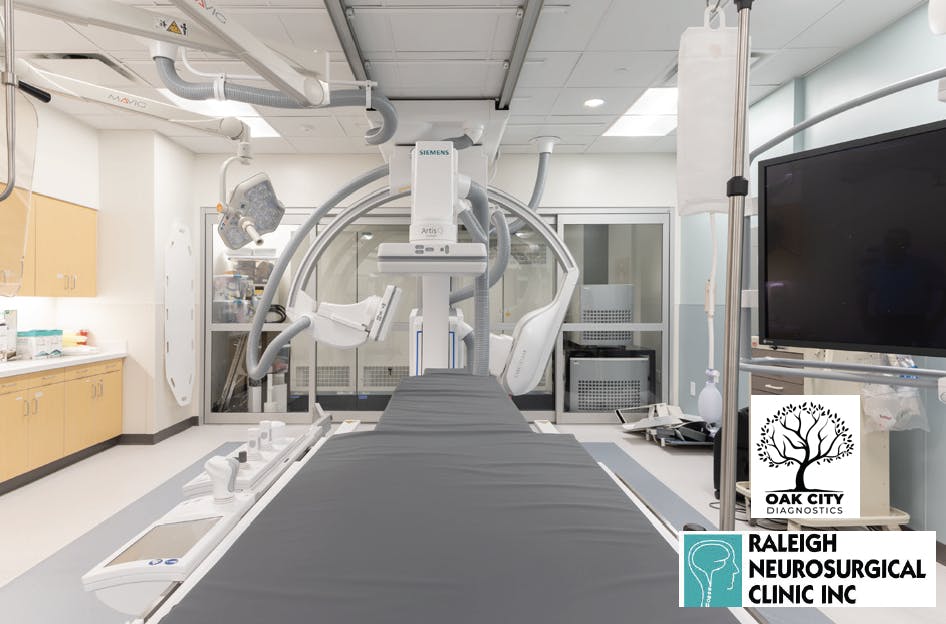
Figure 1. Artis Q biplane system.
A laser focus on what is best for patients is fundamental to Raleigh Neurosurgical Clinic. For their OBL, the team created an experience that maximizes patient and staff satisfaction while supporting clinical outcomes and reducing costs.
“The space we designed is amazing,” says Dr. Belayev. “Our patient wait time is minimal. One or two staff members walk them through the process, answering questions and keeping them comfortable through the entire procedure.”
SUPPORTING ACCESSIBILITY AND COMFORT
Efficiency—from scheduling to procedure—is fundamental to OBL success. “I don’t think you can overemphasize how efficient this space is,” says Rodman. “Patients are not going down one corridor for a procedure and through another area for recovery. They see their entire team right there. Patient steps and length of travel are all minimized.” Dr. Belayev agrees, “When patients navigate a hospital system, it can take 45 minutes to 1 hour to get where they need to be. They may meet 20 people before they see the surgeon. It is a long process that can be intimidating.”
In contrast, Raleigh Neurosurgical Clinic makes care more accessible and streamlines the clinical process. Patient scheduling is easier because diagnostic cases are scheduled in the OBL and more complex cases are performed at the hospital. About 99% of OBL cases are diagnostic cerebral angiography and procedural times are significantly faster, which supports better patient and staff experiences. “I hear interventional cardiologists in hospitals say their biggest challenge is getting cases done,” says Dr. Belayev. “I get my cases done because I do my angiography procedures in the OBL.”
PROVIDING HIGH-QUALITY CLINICAL EXPERIENCES
Faster procedures are possible because the team has more control over scheduling, equipment, and staff hires.
“We select the equipment that is most efficient and effective. We don’t have the red tape hospitals face,” says Dr. Belayev. “Many angiography systems in hospitals are older models, close to end of life, or work through companies not focused on reducing radiation exposure while maintaining good image quality. We’re different. Our angiography system is equivalent or better than hospital angiography suites, which is amazing.”
According to Dr. Belayev, Siemens Healthineers biplane technology offers patients additional advantages (Figure 2). Patients receive half the contrast they would receive on a single C-arm or single detector stand-alone system. Most procedures are done with a radial approach. This helps patients mobilize faster, reduces recovery times, and improves safety. Faster procedures help minimize radiation exposure.

Figure 2. Dr. Belayev performs an angiography procedure in the OBL.
Dr. Belayev has performed more than 100 diagnostic angiography procedures in the OBL. “Appropriate care is taking place in the appropriate site of service,” says Rodman. “Cases that can be done safely in the office are performed there. This frees up the hospital for more critically ill patients.”
“People don’t want to go to hospitals in general, especially after COVID,” says Dr. Belayev. “We provide a boutique-type experience. I routinely hear patients say it’s refreshing. They park their car and walk in. We offer them snacks, drinks, and iPads loaded with entertainment. Procedure times are fast, and people often tell me how nice our staff are. It’s a personalized experience for them.”
“We look forward to sharing our experiences at the 2023 Society of NeuroInterventional Surgery (SNIS) meeting.”
FORESHADOWING THE FUTURE OF NEUROVASCULAR CARE?
By developing its neurovascular OBL with a Siemens Healthineers biplane angiography system, Raleigh Neurosurgical Clinic represents a major advancement in outpatient care for neurologic disorders. Says Dr. Belayev, “By prioritizing patient satisfaction, accessibility, and high-quality clinical experiences, we provide more accurate diagnoses and targeted treatments while minimizing risks associated with radiation exposure and contrast use.”
It’s an innovative approach that highlights the potential of OBLs in improving patient care and paves the way for advancements in neurovascular medicine.
Disclaimer: The statements by Siemens Healthineers’ customers described herein are based on results that were achieved in the customer’s unique setting. Since there is no “typical” hospital and many variables exist (eg, hospital size, case mix, level of IT adoption), there can be no guarantee that other customers will achieve the same results.
This is Part 1 of an OBL series highlighting the benefits for neurovascular procedures. See the next edition to hear Raleigh Neurosurgical Clinic talk about business and patient outcomes.
To learn about fixed neuro angiography systems for OBLs, visit bit.ly/SiemensEVT.

Dr. Andrey Belayev is board certified in neurosurgery. In addition to his clinical practice as a general neurosurgeon, he specializes in the treatment of neurovascular disorders including aneurysms, vascular malformations of the brain and spine, carotid artery stenosis, and the acute treatment of stroke.
Dr. Belayev earned his medical degree at the University of Miami Miller School of Medicine. He then completed his residency in neurosurgery at University of Texas Health Science Center at San Antonio, where he served as Chief Resident. He completed his fellowship training in open cerebrovascular surgery and endovascular neurosurgery and at the prestigious Semmes-Murphey Clinic in Memphis. He completed a fellowship and advanced clinical training in microvascular and endovascular neurosurgery with the World Federation of Neurological Societies in Nagoya, Japan. Dr. Belayev is the author of several peer-reviewed manuscripts and has been invited to present his research findings at respected clinical meetings around the world.

Jacob Rodman is the Chief Executive Officer for Raleigh Neurosurgical Clinic, Inc., a group that was established in 1954. Jacob has over 20 years of management experience encompassing leadership positions at every level. He is a past president and board member for the North Carolina Medical Group Managers Association (NCMGMA). Jacob has also served on several advisory committees and boards for United Healthcare of NC, BCBS of NC, the Town of Morrisville’s budget office, Medical Mutual Insurance Company, and Wake Monarch Academy.
Jacob is currently President Elect for the Neurosurgery Executive Resource Value & Education Society (NERVES). Jacob is a board-certified medical practice executive by the American College of Medical Practice Executives (ACMPE). Jacob has presented both nationally and internationally on a variety of topics surrounding medical practice management and leadership.
Advertisement
Advertisement