Advertisement
Advertisement
June 2023
What’s Next (and Needed) in Neurovascular Research
Experts from the University of Calgary weigh in on current trends.

Your group has been among the lead investigators of research throughout neurointervention, including some of the seminal trials leading to the widespread adoption of mechanical thrombectomy for acute ischemic stroke (AIS). How has the neurointerventional research landscape evolved in the years that followed, a few years shy of a decade later?
Dr. Goyal: The last couple of years have been quite turbulent and exciting for neurointerventionalists, and they are definitely much busier than they were a decade ago! This is mostly because of dramatic changes in the way AIS is treated now. After the five landmark endovascular therapy (EVT) trials, EVT indications have rapidly expanded to patients in the late time window, patients with basilar occlusion, and those with large ischemic core. With several ongoing trials, we may soon have evidence for treatment of medium-sized vessel occlusions, so-called MeVOs, as well.
But, there are also exciting developments outside the field of AIS. Flow diverters have made treatment of wide-necked, otherwise untreatable aneurysms possible, and novel intrasaccular devices such as the WEB device (MicroVention Terumo) are adding to the armamentarium of methods to treat aneurysms efficiently and safely.
What are the current questions most in need of exploring via the next wave of clinical trials in the AIS field?
Dr. Ospel: I believe that cerebroprotection trials will probably be the next big wave. Although the last revolution in AIS treatment was mechanical, I think the next one will probably be pharmacological. Now that EVT has been widely adopted, we have a human ischemia reperfusion model, and as far as we know, this is one of the essential requirements for cerebroprotection to work in humans. Cerebroprotectants prolong ischemia tolerance to the brain. In other words, they do not prevent infarction, but they can prolong the time until infarction occurs—they can “slow down the clock.” Use of cerebroprotectants could help widen the therapeutic window for EVT and improve outcomes over and beyond EVT alone. Several randomized cerebroprotection EVT trials are currently underway. Our team is running the ESCAPE-NEXT trial, which seeks to confirm the benefit of adjunctive nerinetide in addition to EVT and has just finished enrollment. If ESCAPE-NEXT is positive, we could soon face the first approved cerebroprotectant for human acute stroke.
How has the ability to conduct rigorous randomized controlled trials changed in recent years, both in terms of new opportunities but also new hurdles?
Dr. Goyal: The way we conduct randomized trials has certainly changed a lot. Perhaps the most drastic change was seen during the COVID-19 pandemic, which led to a standstill of almost all trials. On the other hand, the pandemic has also catalyzed many changes, such as the more widespread use of telemedicine, including e-consent, remote site monitoring, and virtual site initiation visits, which has made our lives as trialists much easier. But in essence, running trials is still the same: Without investing personal energy and following-up with sites either on the phone or in person, it is almost impossible to get a high-quality trial across the finish line. I personally hope that with all the recent success, there will continue to be a change in culture, and we will continue our journey toward evidence-based medicine.
Dr. Goyal, your perspectives and experience were featured in a recent The New York Times article chronicling the mechanical thrombectomy revolution.1 What was the genesis of the piece, and how did you become involved? How has the article been received among your interventional colleagues?
Dr. Goyal: Well, frankly, I don’t know the genesis of the piece. The New York Times reporter Eva Holland contacted my colleague Dr. Michael Hill and expressed that she wanted to come to Calgary to write the article. As it turned out, she ended up spending several days with us, following us, showing up in the middle of the night for acute cases, and collecting information not only from us but also from the trainees and nurses.
I do think that we need to continue to increase patient education and awareness. In my opinion, the article is very well written from a layperson’s perspective, and our entire field has appreciated the general increase in awareness. Of course, it is clear that we will have to continue to put in effort toward patient education for a long time to come.
What do you hope will be the impact of the feature? What are the tangible results of wider public understanding of interventional stroke capabilities?
Dr. Goyal: As I mentioned, the biggest impact is increased awareness. At the end of the day, EVT is one of the most powerful treatments in all of medicine, and 8 years after the original trials, there should be no patient that is NOT treated due to lack of information or awareness. Of course, we know “time is brain,” and we hope that this increased awareness leads to patients and their families arriving at the “correct” hospital much faster.
What sparked the idea to develop Collavidence, which has been renamed “LetsGetProof”?
Dr. Ospel: The history behind LetsGetProof is that all neurovascular researchers, especially in early career stages like me, share some frustration when it comes to the current process of research funding—the biggest problem is that there is simply not enough money for research funding, particularly outside the Western world; however, even in North America and Europe, it is very hard to get your research funded. The National Institutes of Health, for instance, funds on average 20% of the submitted project proposals, and the funding process may work in favor of established senior researchers, which puts early career researchers, women, and minorities at a disadvantage. If you are an early career researcher from a low- or middle-income country, it is almost impossible to get research funding. On top of that, many granting agencies are interested in funding big questions on common conditions that affect thousands. As such, funding for relatively rare conditions is scarce. In addition, sometimes what we need more than anything else is a platform for a group of experts and researchers coming together, talking and thinking about the same problem, and looking at their data systematically. This is why we founded LetsGetProof. The reason for renaming Collavidence is quite simple: As it turns out, Collavidence is hard to remember and tough to spell!
How does LetsGetProof work, and who is its target audience?
Dr. Goyal: LetsGetProof is a freely accessible internet platform that connects stroke researchers with colleagues, potential donors, and other stakeholders. The goal of LetsGetProof is to facilitate research review and funding (Figure 1). The concept is similar to Kickstarter or GoFundMe. If a researcher wants to apply for funding for their research project, they submit a proposal using our streamlined template. The LetsGetProof userbase—which consists of a scientific review committee, experts in the field, patients with the conditions being studied, donors, and others—reviews the proposal, comments, adds new ideas, and identifies potential weak spots. As part of their submission, researchers include a budget, and donors on the website can pledge money to contribute to this budget, which gets paid out once the project’s budget goal has been met. It also puts the researcher in the driver’s seat: They actively reach out to the public and promote and market their project to potential donors, including friends and family.
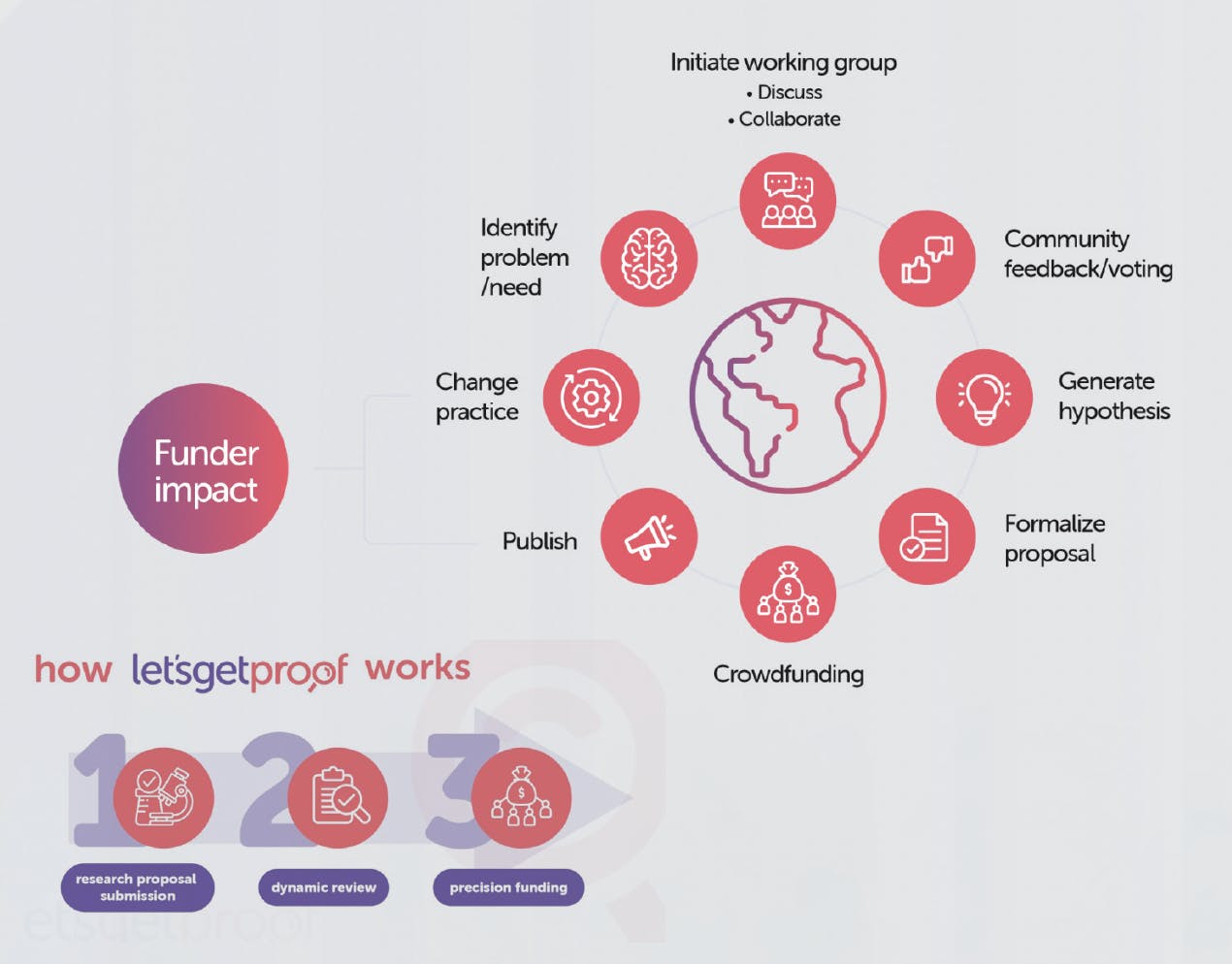
Figure 1. The LetsGetProof process.
Can you talk about the value the collaborative aspect of LetsGetProof adds to a project?
Dr. Ospel: I think that there are three important advantages that LetsGetProof offers over existing funding agencies:
1. Dynamic review. LetsGetproof allows researchers to easily get in touch with other experts and potential donors and enables a very direct and interactive way of communication between the researcher and the “crowd” that is reviewing their project. Researchers can then iteratively update and improve their project based on the feedback they receive, as compared with traditional funding agencies, where it often takes 6 months or longer until reviewer feedback is received.
2. The “precision funding” aspect. LetsGetProof allows donors to donate to a specific project that they’re passionate about, rather than having their money go to a black hole without any control over which research gets supported, as is the case with most other funding agencies.
3. LetsGetProof offers researchers more than just a way to fund their projects. It can be a meeting place to discuss topics. Researchers can create a “working group” on any topic, and hopefully that turns out to be a good way to turn a discussion into data-driven research, especially for rare conditions.
A few projects have already been reviewed and funded through our platform. We now have projects from several countries. As an example, here is the link to one of the stroke rehabilitation projects from India.
What are the essentials to training the next generation of clinical trialists?
Dr. Ospel: I think one of the biggest obstacles is that trials are not considered part of routine patient care. What I would love to see is a change of culture in everyday clinical practice, where medical students and residents routinely participate in trials as part of their training, feel as part of a research team, and get a chance to see the benefits of generating evidence to practice evidence-based medicine—which is what we are all aiming to do in the end. I think we should focus our efforts on getting smart junior people on board who are genuinely interested in research from the very beginning. If we can achieve that, everything else that’s needed, including training in trial design, grant writing, and statistics, will be possible.
What is your advice for those who would like to establish their centers as leading trial sites and themselves as first authors on the next paradigm-shifting research?
Dr. Goyal: The best advice I can personally give is work hard, surround yourself with a good team and help each other out, know what you are getting into, be prepared to fail often, and have fun with what you are doing. Getting a first-authored paper in The Lancet or attaining certain academic positions are the by-products of high-quality meaningful research.
1. Holland E. This revolutionary stroke treatment will save millions of lives. Eventually. The New York Times. Published March 1, 2023. Accessed May 16, 2023. https://www.nytimes.com/2023/03/01/magazine/evt-stroke-treatment.html
Disclosures
Dr. Ospel: Consultant to Nicolab.
Dr. Goyal: Consultant to Medtronic, Microvention, Stryker, Mentice, and Penumbra.
Advertisement
Advertisement