Advertisement
Advertisement
March 2023
Sponsored by Medtronic
The Patient Voice in Chronic Venous Disease Treatment: What We Have and What’s Coming Next
With Kathleen Gibson, MD, FACS, FAVLS, DABVLM; Al Compaan; and Manj Gohel, MBChB, MD, FRCS, FEBVS
Chronic venous disease (CVD) research largely overlooks the patient and their experiences with their treatment.1 In addition, anatomic closure—the commonly reported clinical outcome—does not account for residual saphenous reflux in untreated parts of the target vein.2 As experienced interventionalists, our interactions with patients clearly define the disparity between what’s known and what’s needed in the clinical trial landscape. Medtronic invited us to be the Principal Investigators for a clinical trial that is attempting to fill these gaps. The VenaSeal Spectrum Program is unique for its novel endpoints: patient treatment satisfaction (measured by the Venous Treatment Satisfaction Questionnaire, or VenousTSQ3) and elimination of truncal reflux. As we look forward to the first outcome presentations this year, we wanted to highlight the importance of the patient experience in CVD with both a patient interview and case study.
AL COMPAAN’S PATIENT TESTIMONIAL
What were your earliest experiences with varicose veins?
Mr. Compaan: Initially, my varicose veins were asymptomatic but cosmetically unpleasant. They worsened in my 30s, and I began to experience symptoms: itching, mottled discoloration and minor swelling at the ankles, and periodic throbbing/aching after prolonged standing.
What prompted you to seek treatment?
Mr. Compaan: My general practitioner told me to wear compression stockings to mitigate the varicosities. I was not thrilled about this idea, so I never did. In August 2017, my left calf began to ache after a long flight. My general practitioner diagnosed a superficial blood clot, which resorbed over several weeks on aspirin. However, concerns remained about the potential for future clots.
What concerns did you have about treatment?
Mr. Compaan: My concerns were safety, invasiveness, recovery time, complications, and durability.
First, I sought a good clinic and a good doctor. I did my own research and liked Dr. Gibson’s curriculum vitae and the range of treatment options offered in her clinic. My first visit was in late November 2017 for an ultrasound of both legs; the left leg was more dilated and symptomatic but both legs shared many of the same issues.
Various treatment options were discussed, including several involving ablation. Because my situation was viewed by my insurance as “cosmetic” and not medically necessary, I was on my own for payment. At the time, Dr. Gibson said there may be an opportunity to have the VenaSeal™ closure system (Medtronic) procedure as a Medtronic teaching/learning experience for other physicians, at no cost to me. The procedure was performed on my left leg in March 2018, with several observing physicians in attendance.
As I continued to have symptoms in my other leg, my right leg was treated with VenaSeal in February 2020 as part of a clinical trial.
What was your experience during and after the procedure?
Mr. Compaan: I did not experience any pain during either procedure. Local anesthetic was used at the insertion point with a minor needle prick. There was transitory discomfort as the catheter was moved (a pulling sensation), but Dr. Gibson was very good about warning me when I would feel the next tug. Recovery was uneventful: I had no postprocedure discomfort and returned to work the next day.
For the procedure on my right leg, I did experience some discomfort in my knee such that 4 days after the procedure I returned to the clinic for an exam. I was reassured that it wasn’t a clot, and the discomfort resolved in a week or so.
Has there been any overall change in your quality of life after having your veins treated?
Mr. Compaan: My experience was life changing. Importantly, I know that I have undergone remedial treatment and do not have to fear blood clots due to malfunctioning veins. The itching and swelling I had previously experienced are greatly mitigated, the achiness from standing for a long time is no more, and ankle swelling and discoloration are largely resolved. Cosmetically, the varicosities are noticeably diminished.
What should patients ask prior to a treatment for their CVD symptoms?
Mr. Compaan: Most importantly, is this procedure going to resolve my medical issue, and is this the best option for me? In this case, I asked Dr. Gibson: If these were your legs, what treatment would you choose? What are the benefits and drawbacks? How involved is the procedure? What are the potential complications? What will I experience during and after the procedure? What can I expect during recovery? How soon can I resume normal activities? Can I expect a positive outcome, and what is the long-term efficacy? Do I have to wear compression stockings?
Another question is: Does my insurance cover the procedure? I mention this last because it is an issue, perhaps a big issue, for patients considering vein treatment. Regardless, I absolutely would have moved forward with VenaSeal on both legs even if it meant paying 100% out of pocket. It was important for me to find an effective course of treatment for my vein issues, and I find great peace of mind knowing that I have had a lasting resolution.
DR. GOHEL’S PATIENT CASE
A male patient in his mid 60s presented to my clinic with bilateral chronic venous insufficiency and healed ulceration (CEAP [clinical, etiologic, anatomic, pathophysiologic] C5). Of note, he was still working in a physically active role, was taking anticoagulation (rivaroxaban) for atrial fibrillation, had well-controlled hypertension, and was an ex-smoker. An ankle-brachial index (ABI) assessment confirmed peripheral artery disease (PAD), with an ABI of 0.66 in the left leg. Physical examination confirmed advanced venous skin changes bilaterally, with prominent varicosities in the great saphenous vein (GSV) distribution (Figure 1A).
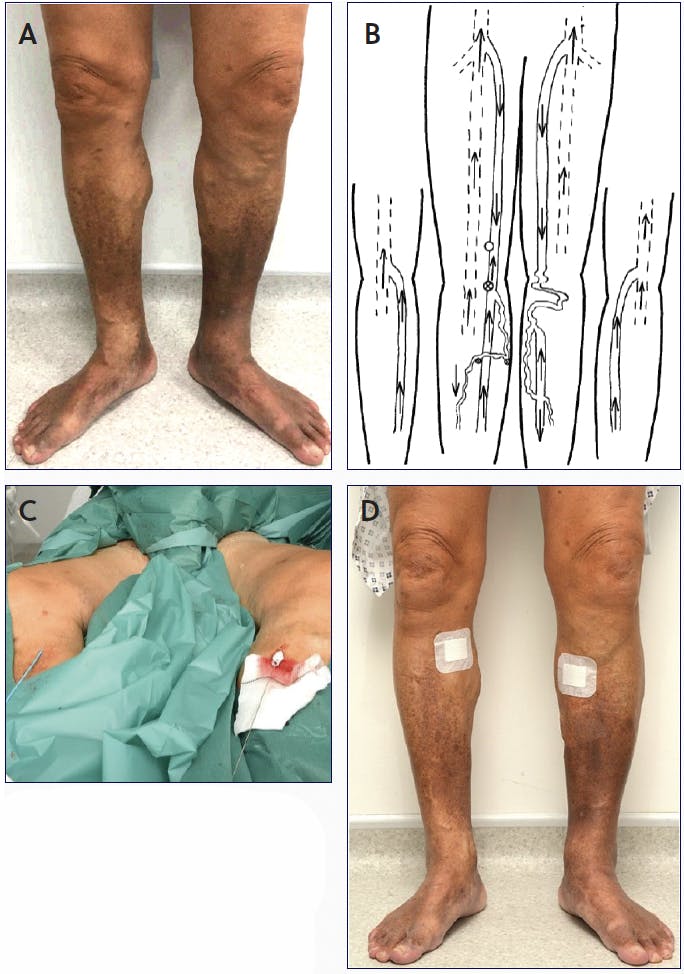
Figure 1. Patient’s legs before treatment (A). Patient’s superficial venous reflux prior to treatment (B). Cannulation of patient during treatment (C). Patient’s legs after treatment (D).
Duplex ultrasonography (DUS) was performed and confirmed the presence of superficial venous reflux in the GSV bilaterally, with the lowest point of reflux in the upper calf (Figure 1B). The GSV maximum diameter was 8 mm bilaterally.
Because the patient had healed ulceration with isolated superficial venous reflux, there was a clear rationale for endovenous intervention to treat the saphenous reflux and reduce the risk of recurrent ulceration. As part of a shared decision-making process, different treatment options and modalities were discussed with the patient. Specific reasons for choosing VenaSeal in this case were:
- Quick recovery because the patient wanted to minimize time off from work
- Ability to proceed with bilateral GSV ablation in a single procedure
- Avoidance of compression given his existing PAD and reduced ABI
- Avoidance of tumescence anesthesia, particularly as the patient was on anticoagulation
Bilateral GSV VenaSeal closure was performed under local anesthesia, with no interruption to anticoagulation. Cannulation was performed at the lowest point of reflux bilaterally (Figure 1C). Cyanoacrylate glue injections were performed per instructions for use. No adjuvant procedures were performed. Both GSVs were successfully closed, as confirmed by DUS.
Immediately postprocedure, a significant reduction was seen in the size of visible varicosities (Figure 1D). The patient was able to return to work the next day and had an uneventful recovery, with successful GSV closure at follow-up.
This case highlights some of the specific potential advantages of VenaSeal, particularly treatment of multisegment superficial reflux and avoidance of tumescent anesthesia or compression.
Disclosures
Dr. Gibson: Consultant to Medtronic, Gore, and Philips; receives research funding from Medtronic; advisory board service to Boston Scientific Corporation, Terumo, and Vesper.
Mr. Compaan: Consultant to Medtronic.
Dr. Gohel: Speaker for and consulting fees from Medtronic and Cook Medical.
1. Lam YL, De Maeseneer M, Lawson J, et al. Expert review on the VenaSeal® system for endovenous cyano-acrylate adhesive ablation of incompetent saphenous trunks in patients with varicose veins. Expert Rev Med Devices. 2017;14:755-762. doi: 10.1080/17434440.2017.1378093
2. Attaran RR, Bhalla A, Mena-Hurtado CI, Ochoa Chaar CI. Correlation between great saphenous length of treatment zone and diameter with improvement in symptoms after ablation. J Vasc Surg Venous Lymphat Disord. 2021;9:1443-1450. doi: 10.1016/j.jvsv.2021.02.013
3. Gilbride CJ, Wilson A, Bradley-Gilbride A, et al. Design of a treatment satisfaction measure for patients undergoing varicose vein treatment: Venous Treatment Satisfaction Questionnaire (VenousTSQ). Br J Surg. Published online December 7 2022. doi: 10.1093/bjs/znac387



VenaSeal™ closure system Brief Statement
Intended Use/Indications: The VenaSeal™ closure system (VenaSeal™ system) is indicated for use in the permanent closure of lower extremity superficial truncal veins, such as the great saphenous vein (GSV), through endovascular embolization with coaptation. The VenaSeal system is intended for use in adults with clinically symptomatic venous reflux as diagnosed by duplex ultrasound (DUS).
Contraindications: Separate use of the individual components of the VenaSeal closure system is contraindicated. These components must be used as a system. The use of the VenaSeal system is contraindicated when any of the following conditions exist: previous hypersensitivity reactions to the VenaSeal™ adhesive or cyanoacrylates, acute superficial thrombophlebitis, thrombophlebitis migrans, acute sepsis.
Potential Adverse Effects of the Device on Health: The potential adverse effects (e.g., complications) associated with the use of the VenaSeal system include, but are not limited to, adverse reactions to a foreign body (including, but not limited to, nonspecific mild inflammation of the cutaneous and subcutaneous tissue), arteriovenous fistula, bleeding from the access site, deep vein thrombosis (DVT), edema in the treated leg, embolization, including pulmonary embolism (PE), hematoma, hyperpigmentation, hypersensitivity or allergic reactions to cyanoacrylates, such as urticaria, shortness of breath, and anaphylactic shock, infection at the access site, pain, paresthesia, phlebitis, superficial thrombophlebitis, urticaria, erythema, or ulceration may occur at the injection site, vascular rupture and perforation, visible scarring.
Warnings, precautions, and instructions for use can be found in the product labeling at http://manuals.medtronic.com.
CAUTION: Federal (USA) law restricts this device to sale by or on the order of a physician.
501253 ©2023 Medtronic. Medtronic, Medtronic logo are trademarks of Medtronic. All other brands are trademarks of Medtronic. For global distribution. 03/2023
Advertisement
Advertisement