Advertisement
Advertisement
May 2023
Chronic Limb-Threatening Ischemia in the Era of AI
Improving patient care, current data, and the potential of artificial intelligence in CLTI treatment.
In his 2011 oft-quoted The Wall Street Journal op-ed, Marc Andreessen (a successful venture capitalist in Silicon Valley) fervently detailed “Why Software Is Eating the World.”1 By this, Andreessen meant that after decades of technologic progress in computing, storage, and the internet, we had finally reached a point where companies were creating viable solutions that would more efficiently handle an array of tasks such as sell books (Amazon), connect friends (Facebook), and stream entertainment (Netflix). He also quipped that software would change health care. In some ways it has-electronic health records (EHRs) and their use exploded in the 2010s. However, there remains huge opportunities to leverage the software revolution in health care, namely through the application of artificial intelligence (AI).
Limb salvage is a large undertaking, with varied patient phenotypes, increasing technologies and clinical programs to address specific issues, and very few clinical trials that provide high-quality evidence on what to do for the patient with chronic limb-threatening ischemia (CLTI) (eg, BEST-CLI and BASIL-2). Even with this new, high-quality evidence, how do we improve medical and surgical decision-making for patients who did not meet inclusion criteria for the clinical trials we rely on for evidence? This is where AI can help, by processing large amounts of data and learning what works for a patient with a specific set of demographic, clinical, and anatomic considerations.
USE CASES
Wound Identification and Management
Chronic, nonhealing wounds affect approximately 6.5 million Americans and cost an estimated $5 billion to treat each year (2009 estimates).2 In Europe, approximately 1.5 to 2 million individuals are likely to have chronic wounds at any one point in time, and costs in the United Kingdom have been estimated to be over £5 billion (2013/2014 estimates).3-5 Given how long ago these studies were conducted, the cost, prevalence, and overall impact of wounds are likely to be much higher as our populations have aged and developed more severe comorbidities amidst a diabetes and obesity epidemic. Furthermore, although data on wound care are murkier across the world, conditions leading to chronic wounds such as diabetes are expected to most rapidly increase in Asia, Africa, and South America.6 AI can significantly impact wound identification and management in a wide variety of settings.
Most patients who develop a wound present to nonspecialists who must be able to characterize and treat a wound to the best of their ability. However, delays in recognizing the underlying etiology of a wound can increase risk of poor outcomes. For over a decade, dermatologists and technologists have worked to train advanced deep learning algorithms to distinguish malignant from benign skin lesions, with some success. More recently, DermAssist (Google Health) aims to help people identify > 200 skin, hair, and nail conditions in minutes by using a mobile phone camera and answering a few questions. Such technologies could be used to help clinicians identify wounds with worrying characteristics that would benefit from earlier specialist referral. Indeed, early findings in the area of wound characterization using deep learning algorithms are promising, yet much work remains.7,8 Given the vast number of patients we see with wounds, creating robust data sets to train cutting-edge algorithms and evaluating how their application can change wound care management will be important areas of contribution for the endovascular specialist going forward.
Deep Phenotyping for Optimal Treatment Strategies
In 2014, Mills et al published a comprehensive wound grading system that could be used to characterize patients with CLTI more accurately and predict limb outcomes at 1 year.9,10 The Society for Vascular Surgery’s lower extremity threatened limb classification system, also known as the WIfI (Wound, Ischemia, foot Infection) score, provides an easily calculable metric that can be used to help guide treatment strategies for CLTI by considering the degree of tissue loss, perfusion, and presence and severity of foot infection.10,11 In 2019, guided by the goal of further improving the quality of care for CLTI, the Global Limb Anatomic Staging System (GLASS) was introduced. Similar to WIfI, GLASS has proved to be a useful tool for planning optimal revascularization strategies and risk-stratifying patient outcomes, particularly after endovascular revascularization procedures.12-14
Although WIfI and GLASS are more comprehensive than previous ischemia-related peripheral artery disease grading systems, other clinical factors that may drive treatment decisions and outcomes may not be well captured by these classification schemas. For example, patient frailty, typically calculated using a simple scoring system or short questionnaire, correlates with patient outcomes after vascular intervention.15,16 Because of the impact of frailty, the need to incorporate such measures into risk stratification strategies and during joint decision-making discussions with patients is imperative.
Although each of these frameworks (WIfI, GLASS, and frailty) may be simple enough to calculate individually, integrating data from these frameworks with additional available data will likely provide more powerful prognostication tools. Furthermore, there may be more complex interactions between patient factors that cannot be well-modeled with simpler risk scores. One approach is to feed all these clinical data into machine learning (ML) algorithms that can handle large amounts of data, account for complex relationships, and be optimized for predicting a wide range of outcomes or providing more refined disease phenotyping.
In a pioneering effort to use ML to identify unique CLTI patient phenotypes, Chung et al used high-quality clinical trial data to develop an ML model that can be used to automate detection of unique patient groups with CLTI that are highly correlated with patient outcomes.17 Using clinical trial data from a cohort of > 1,400 patients from the PREVENT III trial, investigators validated their approach of using an ML algorithm, known as topic modeling, to identify unique subgroups of CLTI patients. These subgroups were then evaluated for a composite measure of amputation-free survival, resolution of ischemic rest pain, and wound healing. Investigators identified three distinct cohorts and found that each of these groups had distinctly different amputation-free survival rates, rates of wound healing, and relief of rest pain.
Secondary analysis also identified that the most severe subgroup experienced death at twice the rate of the least severe subgroup. Interestingly, investigators found that wound and ischemia severity did not necessarily correlate with outcomes, meaning that some patients with milder wounds had worse outcomes than those with objectively more severe disease. This finding may be explained by the fact that investigators were able to capture a wider array of variables such as systemic disease and other comorbidities that affect outcomes outside of wound and perfusion-related characteristics. These efforts demonstrate that AI and ML can be used to automate identification of clinically significant patient groups, more efficiently integrating hundreds of data points. Also, AI models can account for a larger array of outcomes. Incorporating such deep phenotyping systems into clinical practice can be very important in disease states like CLTI where multiple important patient, environmental, and system-level factors must be considered.
Operative Planning
Currently, there are no widely available AI tools for pre- or intraoperative assistance for the management of CLTI; however, early work is underway. To date, most groups have focused on finding ways to automatically extract arterial segments of the lower extremity vascular tree using CTA or MRA.18,19 This automatic extraction enables further analysis that can identify lesions and severity of stenosis and may eventually assist in providing detailed reports that reduce time required for preoperative planning (Figure 1).20 AI can also be developed for intraoperative use cases such as automated vessel rendering and tracking that can reduce radiation exposure. Automated calculation of GLASS score and overall case difficulty can help with planning endovascular approaches or encouraging open revascularization sooner. Furthermore, with enough cases, AI can be trained to determine which vessels and to what extent they need to be revascularized to achieve wound healing in a particular patient. There are a number of other use cases, and as investigators tackle unique applications of AI for operative guidance, a focus on reducing case time, radiation exposure, and improving revascularization success should be of utmost focus.
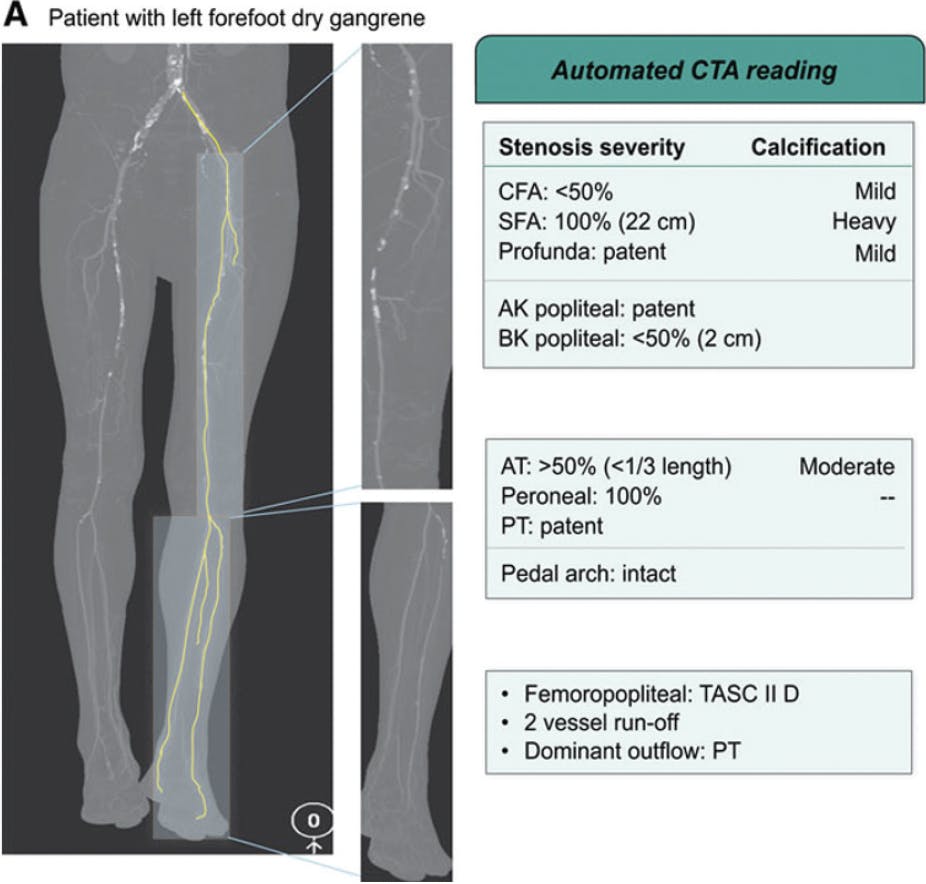
Figure 1. Example of automated data extraction and reporting that can be accomplished with AI. AK, above knee; AT, anterior tibial; BK, below knee; CFA, common femoral artery; PT, posterior tibial; SFA, superficial femoral artery; TASC, TransAtlantic Intersociety Consensus. Adapted from Flores AM, Demsas F, Leeper NJ, Ross EG. Leveraging machine learning and artificial intelligence to improve peripheral artery disease detection, treatment, and outcomes. Circ Res. 2021;128:1833-1850.
Patient Education
Poor patient health literacy is associated with a higher risk of poor outcomes such as amputation and death.21,22 Developing tools that augment patient education can have a meaningful effect on patient understanding of their disease process, self-efficacy, and care. Large language models and their interfaces, such as ChatGPT (OpenAI) and Bard (Google), represent some of the latest and most consequential advances in AI to date. Large language models are trained on a large corpus of data to perform a task that helps the model gain “understanding” (ie, develop a relevant representation) of large amounts of data. In the case of the underlying model for ChatGPT, it was trained on a large corpus of text to predict the next most probable word. In doing so, you can now type nearly any prompt into ChatGPT and receive a reasonable response, including medical questions. Sarraju et al evaluated the appropriateness of ChatGPT’s responses to 25 preventive cardiology questions and found that 84% of the questions were answered appropriately, while four questions had inappropriate responses.23
Similar experiments can be conducted to understand how much ChatGPT’s knowledge base understands CLTI from a patient’s perspective and how well this information can be relayed to patients of different reading levels (eg, “Explain like I’m 5 years old what a toe ulcer is”; “what causes a toe ulcer”). In addition to its already astonishing abilities, ChatGPT can also be trained to improve its knowledge base over time as more experts interact with it and correct its responses.
EVOLVING SCIENCE
Advanced Algorithms
AI is a rapidly advancing field and new approaches to using data to train intelligent systems continue to emerge. As discussed, large language models are one of the latest advances in AI. These models, also referred to as foundation models, are being tested in their ability to understand clinical data such as data from EHRs.24 Preliminary work demonstrates that this approach shows promise in reducing the burden of developing AI models for specific clinical tasks. Instead of training individual models with a small subset of data, one can fine-tune a foundation model for a specific task and obtain the same or better results. Another approach that has gained a lot of traction in the health care space is known as distributed or federated learning.25 Given the importance of maintaining patient privacy, new approaches to learning from data from different sites using different techniques of collecting data are needed. Federated learning approaches allow for creating AI technology that incorporates distributed data, theoretically improving the representation of patient diversity, model generalizability, and model accuracy over time.
Multimodal Data Integration
Although the previous examples emphasize different types of data (imaging vs clinical variables), the true power of AI will be unleashed by the use of multimodal data models. This refers to the integration of different types of data—imaging, clinical, genetic, and/or proteomic data.26 Such data integration can provide more precise understanding of unique patient characteristics and can be used prospectively to validate what types of treatments are more likely to lead to improved outcomes for patients globally and for different patient subgroups. For example, an AI solution that can identify different patterns of disease based on preoperative CTAs or diagnostic invasive angiography; automate calculation of WIfI, GLASS, and frailty, in addition to underlying genomic and/or proteomic risk factors; and predict optimal treatment strategies, patient disease trajectories, and/or make recommendations for care can help unleash next-generation care paradigms and also help improve quality of care. Such technology instituted by health care systems can help identify care improvement opportunities across clinical, demographic, and socioeconomic patient groups. On an individual level, patients could obtain more guidance on what may or may not work for their particular set of circumstances. AI assistance can also help relieve cognitive burden and act as vital clinical decision support.
POTENTIAL PITFALLS
Clinical Integration and Adoption
Vascular specialists have shown a propensity to adopt clinical devices and tools for direct patient treatment, but whether the willingness toward early adoption will translate toward AI solutions is an open question. Although a lot of time and effort can be spent perfecting an AI model, without considering who will adopt the technology, why, and how best to integrate AI into a clinical workflow, model adoption is likely to be low. Another important aspect of AI adoption will be payment and reimbursement. Although payment/reimbursement structures for health care vary widely across countries, it is important that the entity that dominates health care payments (eg, Centers for Medicare & Medicaid Services in the United States) supports the development of AI-assisted care through separate reimbursements for these technologies.
Data Bias
Much of the AI technology built today arise from a few places (three states in the United States specifically).27 Furthermore, investigators have found that AI technology can recognize race in medical radiographs, and this recognition can be hard to isolate or correct for.28 In essence, deep learning algorithms trained on certain medical imaging are anything but unbiased and this has several implications. First, if data sets are not enriched for a diverse patient group, technology may be built that systematically performs poorly for certain groups. Furthermore, AI algorithms can inadvertently make predictions based on race alone.
Given the problematic use of race as a construct in medicine, training AI technology on current medical data can very well perpetuate biased care. This knowledge requires AI developers to address potential for data bias early in project development. Such issues of bias can potentially be addressed by using data that represent a wide swath of the population, using algorithmic fairness modeling to identify any types of between-group bias early in model development and utilizing model surveillance checks (similar to FDA postmarket drug and device surveillance) to ensure systemic bias is not being perpetuated by AI models in clinical practice.
CONCLUSION
AI has the potential to improve the care and outcomes for patients with CLTI. Although there have been early promising results, there are no full-service AI platforms that currently serve this vulnerable patient population. However, the daily use of AI for our vascular patients will be inevitable. At the very least, as vascular specialists, we must pay attention to AI developments in medicine, and maybe even dream up our own utopian (or dystopian) vision of how AI will eat everything in health care.
1. Andreessen M. Why software is eating the world. Wall Street Journal. Published August 20, 2011. Accessed April 21, 2023. https://www.wsj.com/articles/SB10001424053111903480904576512250915629460
2. Sen CK, Gordillo GM, Roy S, et al. Human skin wounds: a major and snowballing threat to public health and the economy. Wound Repair Regen. 2009;17:763-771. doi: 10.1111/j.1524-475X.2009.00543.x
3. Lindholm C, Searle R. Wound management for the 21st century: combining effectiveness and efficiency. Int Wound J. 2016;13(suppl 2):5-15. doi: 10.1111/iwj.12623
4. MedTech Europe. The burden of wounds on EU healthcare systems. Accessed May 2, 2023. https://www.medtecheurope.org/wp-content/uploads/2015/10/290902009_MTE_The-Burden-of-Wounds-on-EU-Healthcare-Systems_Brochure.pdf
5. Guest JF, Ayoub N, McIlwraith T, et al. Health economic burden that wounds impose on the National Health Service in the UK. BMJ Open. 2015;5:e009283. doi: 10.1136/bmjopen-2015-009283
6. Mbanya JC, Gan D, Allgot B, et al. Diabetes Atlas. 3rd ed. International Diabetes Federation; 2006.
7. Rostami B, Anisuzzaman DM, Wang C, et al. Multiclass wound image classification using an ensemble deep CNN-based classifier. Comput Biol Med. 2021;134:104536. doi: 10.1016/j.compbiomed.2021.104536
8. Wang C, Anisuzzaman DM, Williamson V, et al. Fully automatic wound segmentation with deep convolutional neural networks. Sci Rep. 2020;10:21897. doi: 10.1038/s41598-020-78799-w
9. Mills JL Sr, Conte MS, Armstrong DG, et al. The Society for Vascular Surgery lower extremity threatened limb classification system: risk stratification based on wound, ischemia, and foot infection (WIfI). J Vasc Surg. 2014;59:220-34.e342. doi: 10.1016/j.jvs.2013.08.003
10. Mills JL Sr. The application of the Society for Vascular Surgery Wound, Ischemia, and foot Infection (WIfI) classification to stratify amputation risk. J Vasc Surg. 2017;65:591-593. doi: 10.1016/j.jvs.2016.12.090
11. Conte MS, Mills JL, Bradbury AW, White JV. Implementing global chronic limb-threatening ischemia guidelines in clinical practice: Utility of the Society for Vascular Surgery Threatened Limb Classification System (WifI). J Vasc Surg. 2020;72:1451-1452. doi: 10.1016/j.jvs.2020.06.049
12. Wijnand J, Zarkowsky D, Sorrentino T, et al. The new Global Limb Anatomic Staging System (GLASS) for CLTI: assessment of its utility in two limb preservation centers. Eur J Vasc Endovasc Surg. 2019;58(suppl 3):E577. doi: 10.1016/j.ejvs.2019.09.047
13. Liao H, Xu C, Wang P, et al. Global Limb Anatomic Staging System score correlates with the clinical outcomes in chronic limb threatening ischemia patients. Int Angiol. 2022;41:303-311. doi: 10.23736/S0392-9590.22.04891-X
14. Shirasu T, Takagi H, Gregg A, et al. Predictability of the global limb anatomic staging system (glass) for technical and limb related outcomes: a systematic review and meta-analysis. Eur J Vasc Endovasc Surg. 2022;64:32-40. doi: 10.1016/j.ejvs.2022.03.044
15. Kraiss LW, Al-Dulaimi R, Allen CM, et al. A Vascular Quality Initiative frailty assessment predicts postdischarge mortality in patients undergoing arterial reconstruction. J Vasc Surg. 2022;76:1325-1334.e3. doi: 10.1016/j.jvs.2022.05.017
16. Rothenberg KA, George EL, Trickey AW, et al. Assessment of the risk analysis index for prediction of mortality, major complications, and length of stay in patients who underwent vascular surgery. Ann Vasc Surg. 2020;66:442-453. doi: 10.1016/j.avsg.2020.01.015
17. Chung J, Freeman NLB, Kosorok MR, et al. Analysis of a machine learning-based risk stratification scheme for chronic limb-threatening ischemia. JAMA Netw Open. 2022;5:e223424. doi: 10.1001/jamanetworkopen.2022.3424
18. Mistelbauer G, Morar A, Schernthaner R, et al. Semi-automatic vessel detection for challenging cases of peripheral arterial disease. Comput Biol Med. 2021;133:104344. doi: 10.1016/j.compbiomed.2021.104344
19. Xu W, Yang X, Li Y, et al. Deep learning-based automated detection of arterial vessel wall and plaque on magnetic resonance vessel wall images. Front Neurosci. 2022;16:888814. doi: 10.3389/fnins.2022.888814
20. Flores AM, Demsas F, Leeper NJ, Ross EG. Leveraging machine learning and artificial intelligence to improve peripheral artery disease detection, treatment, and outcomes. Circ Res. 2021;128:1833-1850. doi: 10.1161/CIRCRESAHA.121.318224
21. Hadden K, Martin R, Prince L, Barnes CL. Patient health literacy and diabetic foot amputations. J Foot Ankle Surg. 2019;58:877-879. doi: 10.1053/j.jfas.2018.12.038
22. Fan ZY, Yang Y, Zhang F. Association between health literacy and mortality: a systematic review and meta-analysis. Arch Public Health. 2021;79:119. doi: 10.1186/s13690-021-00648-7
23. Sarraju A, Bruemmer D, Van Iterson E, et al. Appropriateness of cardiovascular disease prevention recommendations obtained from a popular online chat-based artificial intelligence model. JAMA. 2023;329:842-844. doi: 10.1001/jama.2023.1044
24. Steinberg E, Jung K, Fries JA, et al. Language models are an effective representation learning technique for electronic health record data. J Biomed Inform. 2021;113:103637. doi: 10.1016/j.jbi.2020.103637
25. Rieke N, Hancox J, Li W, et al. The future of digital health with federated learning. NPJ Digit Med. 2020;3:119. doi: 10.1038/s41746-020-00323-1
26. Amal S, Safarnejad L, Omiye JA, et al. Use of multi-modal data and machine learning to improve cardiovascular disease care. Front Cardiovasc Med. 2022;9:840262. doi: 10.3389/fcvm.2022.840262
27. Kaushal A, Altman R, Langlotz C. Geographic distribution of US cohorts used to train deep learning algorithms. JAMA. 2020;324:1212-1213. doi: 10.1001/jama.2020.12067
28. Gichoya JW, Banerjee I, Bhimireddy AR, et al. AI recognition of patient race in medical imaging: a modelling study. Lancet Digit Health. 2022;4:e406-e414. doi: 10.1016/S2589-7500(22)00063-2
Advertisement
Advertisement