Advertisement
Advertisement
May 2023
Sponsored by AngioDynamics, Inc.
The Auryon Atherectomy System Below the Knee in Patients With Chronic Limb-Threatening Ischemia
By Nicolas W. Shammas, MD, MS; James T. Torey, PA-C; and Michele Corbet, MS
The Auryon Atherectomy System (AngioDynamics, Inc.) has been shown to ablate calcified tissue but with low penetration depth.1,2 In larger vessels such as the femoropopliteal arteries, the device is a soft debulking tool with a reduction in plaque severity by about 33% but with a continued residual narrowing typically > 50%.3 Data from the Auryon IDE study and the Auryon SCE study support the soft ablation concept and show low target lesion revascularization (TLR) rates at 6 months (< 5%) and 1 year (< 20%), respectively.4,5 Additionally, given its limited penetration depth, it mostly spares the adventitia,6 which is likely to be advantageous in lessening the chance of restenosis and TLR.7 The device is cleared to treat smaller infrapopliteal vessels, but little data are available about its effectiveness in plaque excision, adventitial injury, or long-term limb salvage in these small fibrocalcific vessels. In the EX-PAD-03 study, there were a total of 17 infrapopliteal arteries studied with no reported perforation, no distal embolization, and continued low TLR rates at 6 months.4 The limited available data on the use of the Auryon laser in treating infrapopliteal disease were one of the major factors in deciding to pursue the following study.
The Auryon below-the-knee (BTK) study (Auryon BTK) is a multicenter, prospective, nonrandomized study designed to evaluate the effectiveness of the Auryon laser BTK in patients with limb ischemia (NCT05284240).8 The study has finished enrolling a total of 60 consecutive patients at four centers in the United States and is currently in the follow-up phase intended for 1 year. The primary outcome endpoints include a primary safety endpoint evaluating major adverse limb events and postoperative death at 30 days, defined as all-cause death, above-ankle amputation of the index limb, and major reintervention (new bypass graft, jump/interposition graft revision, or thrombectomy/thrombolysis) of the index limb involving a BTK artery. The primary performance endpoint includes procedure success, defined as ≤ 30% residual stenosis for the treated segment of the vessel without serious angiographic complications—flow-limiting dissection (D to F), perforation, distal embolization, or acute vessel closure after final treatment—as assessed by quantitative angiography. Multiple secondary endpoints are being evaluated, including patency and clinically driven TLR at 6 months and 1 year. An intravascular subgroup (n = 20) was enrolled to determine the extent and depth of dissections and ablation potential. The acute and 6-month results will be presented in 2023 and the 1-year data will be available in the first quarter of 2024.
This article presents two cases of patients with chronic limb-threatening ischemia (CLTI) that underwent treatment of the BTK arteries with the Auryon Atherectomy System.
CASE 1
A patient presented with right limb rest pain and Rutherford-Becker class 5. The patient’s ankle-brachial index (ABI) on the right was 0.3. Angiography revealed occlusion of the distal P3 segment of the right popliteal artery and the tibial arteries, including the tibioperoneal trunk, anterior tibialis (AT), and peroneal/posterior tibialis arteries (Figure 1A). The AT reconstituted with collaterals in its proximal segment. The distal popliteal was successfully crossed antegradely using a CXI 0.018-inch crossing catheter (Cordis) and a 12-g tip load Approach wire (Cook Medical). The wire was then exchanged for a 0.014-inch Spartacore wire (Abbott). The 0.9-mm Auryon catheter was then used to ablate the distal popliteal artery into the occluded AT at a fluence of 50 J/cm2 (Figure 1B). This was followed by a 4-mm low-pressure balloon dilation at 5 atm for 3 minutes. The distal popliteal into the origin of the AT was dilated with a 5-mm Lutonix balloon (BD Interventional) for 3 minutes. There were no dissections, perforations, or distal embolization (Figure 1C). The patient was seen on follow-up after 2 weeks with resolution of her symptoms and palpable right dorsalis pedis pulse.
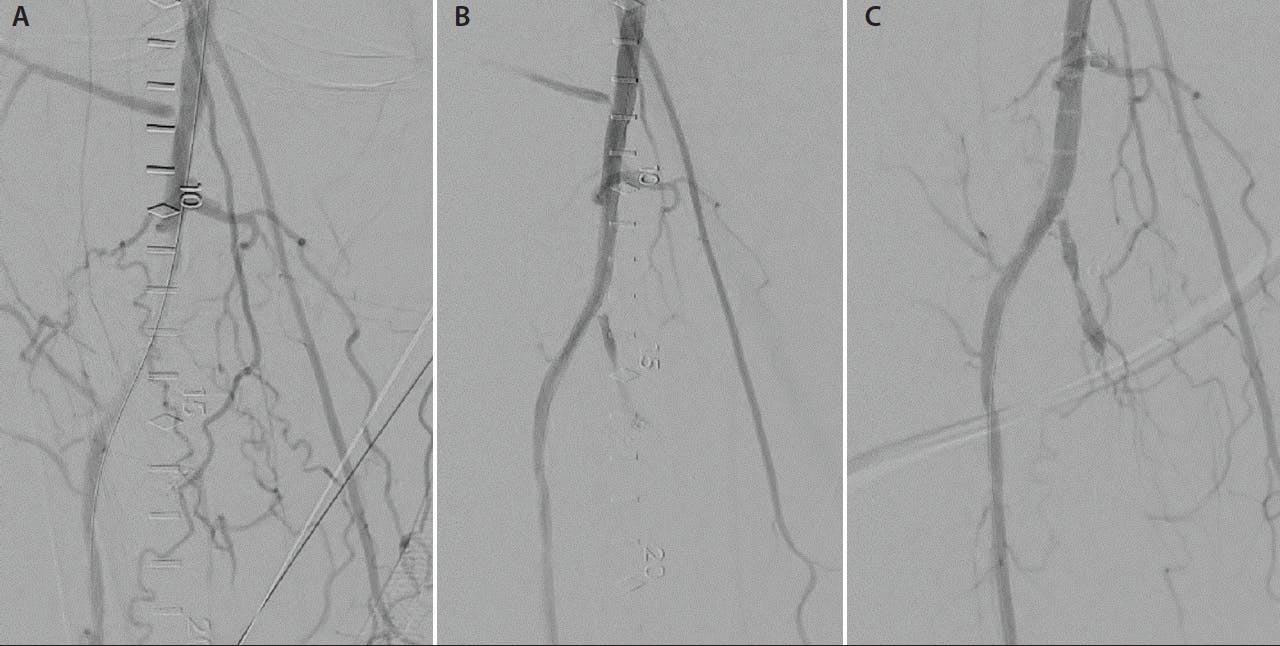
Figure 1. Angiogram showing occlusion of the distal P3 segment of the right popliteal artery and the tibial arteries, including the tibioperoneal trunk, AT, and peroneal/posterior tibialis arteries (A). The Auryon 0.9 laser used to ablate the distal popliteal artery into the occluded AT at a fluence of 50 J/cm2 (B). Final angiogram with no dissections, perforations, or distal embolization (C).
CASE 2
A patient presented with left limb rest pain and a nonhealing ulcer. Angiography revealed severe disease in the distal P3 segment of the left popliteal artery and occlusion of the left AT and posterior tibialis (Figure 2A). The only patent but severely diseased runoff was the peroneal collateralizing the dorsalis pedis and the posterior tibialis at the foot level. The 0.9-mm Auryon catheter was then used to ablate the distal popliteal artery into the diseased peroneal at a fluence of 50 J/cm2 (Figure 2B). This was followed by a 2.5-mm low-pressure balloon dilation. There were no dissections, perforations, or distal embolization (Figure 2C).
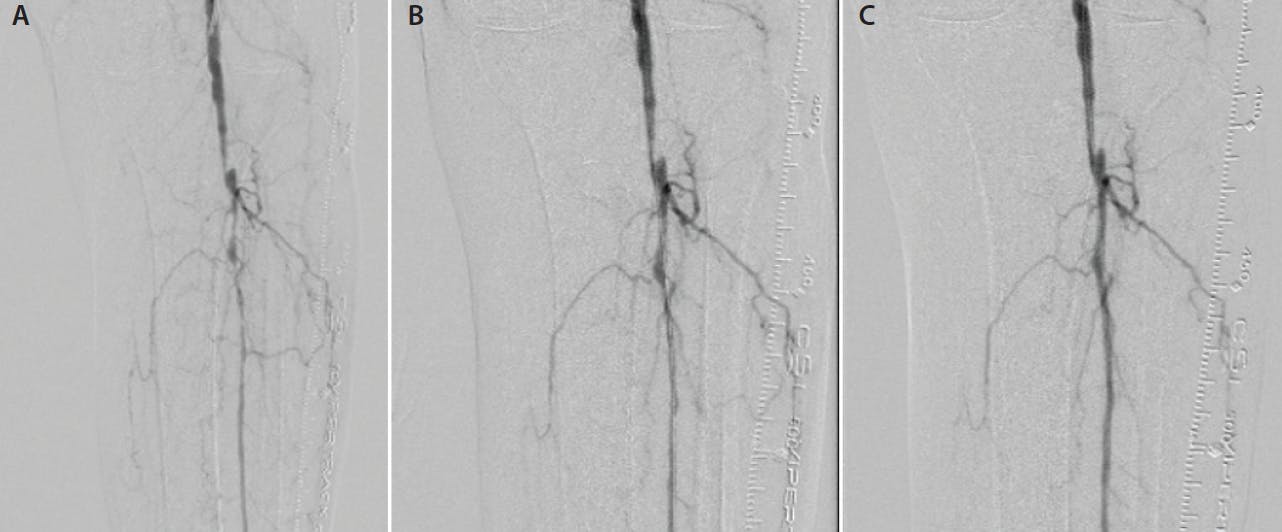
Figure 2. Angiogram showing disease in the distal P3 segment of the left popliteal artery and occlusion of the left AT and posterior tibialis (A). Auryon 0.9 laser used to ablate the distal popliteal artery into the diseased peroneal at a fluence of 50 J/cm2 (B). Final angiogram with no dissections, perforations, or distal embolization (C).
In the Auryon BTK study, a subgroup of 20 patients underwent intravascular ultrasound (IVUS) at baseline, postatherectomy, and after adjunctive balloon angioplasty. Figure 3 illustrates IVUS at baseline and postprocedure. The minimal luminal area (MLA) gain (3.72 mm2 prelaser to 4.94 mm2 postlaser) was seen with no change in the external elastic lamina area indicating actual ablation of the plaque (Figure 3A and 3B). After adjunctive angioplasty, an increase in MLA was noted along with the presence of dissections that are limited to within the intima/media (A or B as per the dissection classification) but not extending beyond the adventitia (C dissection; Figure 3C and 3D).9
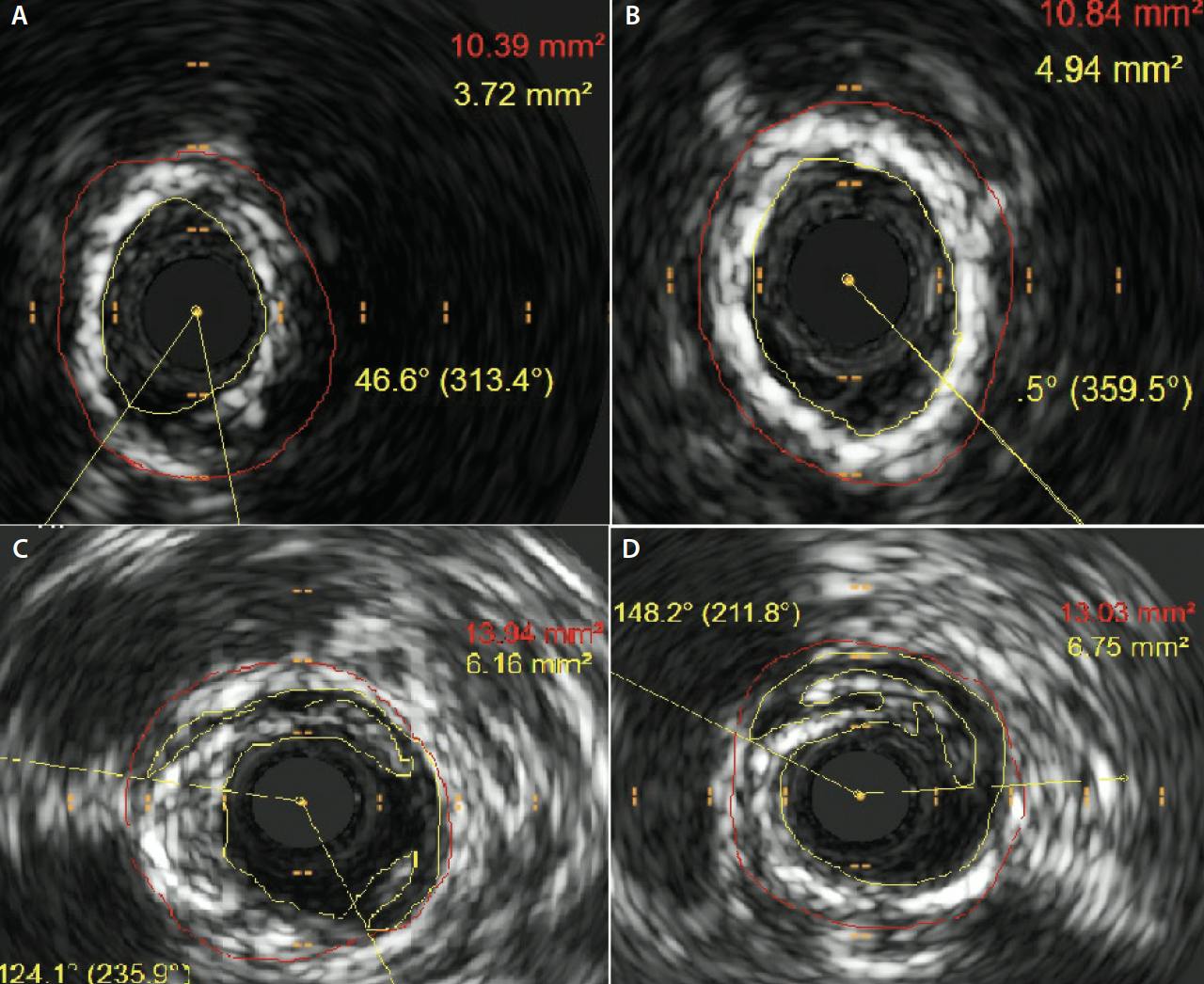
Figure 3. IVUS at baseline (A), postatherectomy (B), and postangioplasty (C, D).
DISCUSSION
The Auryon Atherectomy System seems to be particularly suited for BTK arterial intervention. The small 0.9-mm catheter can reach the distal tibial vessels and effectively ablate different plaque morphology including calcified disease. In our experience, the catheter has an excellent crossing profile even in severely calcified vessels. When severe calcium is present, operators may need to increase the fluence to 60 J/cm2 and allow the laser to ablate the lesion slowly. On a rare occasion, we had to predilate the lesion with a 1.5-mm balloon before laser ablation to assist with crossing the lesion and with no compromise to the treatment effectiveness. The Auryon laser has low penetration depth and therefore causes less injury to the deeper layer of the vessel; however, operators can offset this advantage by turning to fast ablation speed. It is imperative that the catheter be advanced slowly during ablation. A very low rate of deep (adventitial) dissections is seen with the Auryon laser. Furthermore, it is important to administer nitroglycerin before ablation to minimize spasm around the catheter. Generally, slow flow posttreatment of the tibial arteries is due to distal spasm and this typically resolves with intravascular nitroglycerin. The Auryon 1.5-mm catheter is an option for tibioperoneal and proximal posterior tibialis vessels. We tend to avoid the use of the 1.5-mm catheter in the AT given the sharp angulation of this vessel, which occasionally makes it harder for this catheter to cross the vessel.
In summary, the Auryon Atherectomy System is effective in treating tibial arteries BTK in patients with CLTI. Deep dissections are minimal and there is a high rate of acute procedural success. Currently, the Auryon BTK study is examining the intermediate and long-term outcomes of the Auryon laser atherectomy BTK. The 1-year results are expected to be available first quarter of 2024.
The Auryon Atherectomy System and Auryon Atherectomy Catheters with aspiration are indicated for use as atherectomy devices for arterial stenoses, including in-stent restenosis (ISR), and to aspirate thrombus adjacent to stenoses in native and stented infra-inguinal arteries.
The Auryon Atherectomy System and Auryon Atherectomy Catheters without aspiration are indicated for use in the treatment, including atherectomy, of infra-inguinal stenoses and occlusions.
UC/PA/JA 1825 05/2023.
1. Herzog A, Bogdan S, Glikson M, et al. Selective tissue ablation using laser radiation at 355 nm in lead extraction by a hybrid catheter; a preliminary report. Lasers Surg Med. 2016;48:281-287. doi: 10.1002/lsm.22451
2. Herzog A, Steinberg I, Ishaaya AA. Shaping photomechanical effects in tissue ablation using 355 nm laser pulses. J Biophotonics. 2017;10:1262-1270. doi: 10.1002/jbio.201600094
3. Shammas NW. How much debulking with atherectomy is enough when treating infrainguinal arterial interventions? The balance between residual stenosis and adventitial injury. Vasc Health Risk Manag. 2022;18:211-218. doi: 10.2147/VHRM.S353775
4. Shammas NW, Chandra P, Brodmann M, et al. Acute and 30-day safety and effectiveness evaluation of Eximo Medical’s B-Laser™, a novel atherectomy device, in subjects affected with infrainguinal peripheral arterial disease: results of the EX-PAD-03 trial. Cardiovasc Revasc Med. 2020;21:86-92. doi: 10.1016/j.carrev.2018.11.022
5. Shammas NW, Shammas GA, Halupnik G, et al. Auryon Laser in peripheral arterial interventions: a single-center experience (Auryon-SCE). J Invasive Cardiol. 2022;34:E428-E432.
6. Shammas NW, Torey JT, Shammas WJ, et al. Intravascular ultrasound assessment and correlation with angiographic findings of arterial dissections following Auryon laser atherectomy and adjunctive balloon angioplasty: results of the iDissection Auryon laser study. J Endovasc Ther. 2022;29:23-31. doi: 10.1177/15266028211028200
7. Rundback J, Chandra P, Brodmann M, et al. Novel laser-based catheter for peripheral atherectomy: 6-month results from the Eximo Medical B-Laser™ IDE study. Catheter Cardiovasc Interv. 2019;94:1010-1017. doi: 10.1002/ccd.28435
8. Prospective, multi-center, single-arm study of the Auryon Laser System for treatment of below-the-knee (BTK) arteries. Clinicaltrials.gov website. Accessed April 26, 2023. https://clinicaltrials.gov/ct2/show/NCT05284240
9. Shammas NW, Torey JT, Shammas WJ. Dissections in peripheral vascular interventions: a proposed classification using intravascular ultrasound. J Invasive Cardiol. 2018;30:145-146
Advertisement
Advertisement