Advertisement
Advertisement
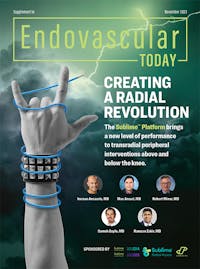
November 2023 Supplement
Sponsored by Surmodics, Inc.
Drivers of Radial-to-Peripheral Adoption in Real-World Practice
A conversation with Mac Ansari, MD.
Interventional cardiologist Dr. Mohammad (Mac) Ansari is Vice Chair of Clinical Research and Director of the Catheter Lab and Structural Heart Program at the Texas Tech Physicians Center for Cardiovascular Health in Lubbock, a tertiary care facility with a large catchment area. As with many hospitals, the onset of the COVID-19 pandemic led to a critical shortage of beds at the Texas Tech center and severe restrictions on patient admissions. As a result, the facility was forced to halt many peripheral artery disease (PAD) cath lab procedures, even among patients requiring time-sensitive treatment for chronic limb-threatening ischemia (CLTI). To meet the crisis, Dr. Ansari and his team made a rapid pivot from transfemoral access (TFA) to transradial access (TRA) endovascular treatment for PAD. In a preliminary analysis published in the Journal of Critical Limb Ischemia,1 Dr. Ansari and colleagues documented high rates of procedural success with TRA and decreased procedure time, radiation exposure, and contrast use for TRA compared with TFA. We spoke with Dr. Ansari about his experience adopting TRA for peripheral procedures.
The COVID-19 pandemic upended health care everywhere, but seemed especially disruptive for your CLTI patients. Why was that?
Our patient population is largely rural. During COVID, many of the smaller centers in our region ended up closing and all their patients were coming to us. When you have patients coming in from far-off locations, we don’t discharge them on the same day if they’ve received a femoral access procedure—if they go back and experience a bleed, they could be in serious trouble. So, I had to come up with a strategy that would allow us to do these procedures safely without having to keep patients overnight.
Were you using TRA for peripheral procedures before the pandemic?
Yes, I was doing some radial-to-peripheral, but it really picked up during COVID. My aim was to make sure patients who most needed procedures based on their disease patterns could get basic flow restoration done quickly, with same-day discharge. From the wrist, we found we could treat iliac, common femoral, SFA (superficial femoral artery), popliteal, and even proximal-tibial segments. Radial-to-peripheral turned out to be a very safe, approachable, and feasible option that enabled me to take care of my patients in this complex situation without worrying about groin access and bleeding issues. Amazingly, it helped all those patients waiting for procedures to get their procedures done.
Undoubtedly, establishing a radial-to-peripheral program required support from your colleagues and the hospital. What benefits were you able to show them?
Fortunately, we’ve been collecting data on all patients who have undergone peripheral interventions via TRA at the Texas Tech University Medical Centers in our Lonestar PAD registry. So, we’re able to support the safety and efficacy of the transradial approach with data. Last March, we published a pilot study of 184 TRA procedures conducted between April 2018 and October 2022 that showed that TRA decreased perioperative times, contrast use, and radiation exposure compared with TFA in peripheral interventions.1
In the May 2023 paper, you describe the potential for cost reduction and increased hospital efficiency for peripheral procedures performed with TRA compared with TFA. How can TRA reduce cost?
From the hospital perspective, there are two ways. For one, our radial access procedures have same-day discharge, so there’s cost reduction for individual patients. Patients get mobilized quickly and are able to leave the hospital quickly. But same-day discharge also frees up a bed that can be used for another patient. Same-day discharge has been the main driver of cost savings for transradial coronary interventions, and there’s no reason to think this would be different for peripheral interventions.2
There’s also a reduction in access site complications with TRA. This has been demonstrated repeatedly in the coronary space and is supported by data on peripheral patients.3,4 Beyond that, there are substantial benefits in increased patient and staff satisfaction, both of which are extremely important to hospitals, especially now. Our patient satisfaction scores have increased significantly with TRA adoption.
You mentioned staff satisfaction. How has radial-to-peripheral made a difference here?
In the past, our lab staff were typically not too happy having to do lower extremity cases because these cases took longer than the coronary cases. Similarly, the holding area staff, who are responsible for postprocedural care, disliked groin access cases—the length of recovery, need for close observation, and the inevitable complications. We’ve been able to reduce procedural as well as discharge time using TRA, and our employee satisfaction scores have improved.
This is very important, since staff fatigue and turnover have plagued hospitals in recent years. Every facility, including ours, really cares about staff satisfaction these days. Whenever you lose an employee it’s very expensive and time-consuming to fill the position and provide training for a replacement.5
Caution: Federal (US) law restricts the Sublime™ Radial Access Guide Sheath, the Sublime™ Radial Access .014 and .018 RX PTA Dilatation Catheters, and the Sublime™ Radial Access .014, .018, and .035 Microcatheters to sale by or on the order of a physician. Please refer to each product’s Instructions for Use for indications, contraindications, warnings, and precautions. SURMODICS, SUBLIME, and SURMODICS and SUBLIME logos are trademarks of Surmodics, Inc. and/or its affiliates. Third-party trademarks are the property of their respective owners.
1. Ansari MM, Pham A, Pollina C, et al. Multifactorial benefits of transradial access (TRA) in endovascular interventions to treat peripheral arterial disease—critical limb threatening ischemia. J Crit Limb Ischem. 2023;3:E85-E91. doi: 10.25270/jcli/CLIG23-00004
2. Lindner SM, McNeely CA, Amin AP. The value of transradial: Impact on patient satisfaction and healthcare economics. Interv Cardiol Clin. 2020;9:107-115. doi: 10.1016/j.iccl.2019.08.004
3. Ferrante G, Rao SV, Jüni P, et al. Radial versus femoral access for coronary interventions across the entire spectrum of patients with coronary artery disease: a meta-analysis of randomized trials. JACC Cardiovasc Interv. 2016;9:1419-1434. doi: 10.1016/j.jcin.2016.04.014
4. Meertens MM, Ng E, Loh SE, et al. Transradial approach for aortoiliac and femoropopliteal interventions: a systematic review and meta-analysis. J Endovasc Ther. 2018;25:599-607. doi: 10.1177/1526602818792854
5. NSI Nursing Solutions, Inc. 2023 NSI national health care retention & RN staffing report. NSI Nursing Solutions, Inc. Accessed November 2, 2023. https://www.nsinursingsolutions.com/Documents/Library/NSI_National_Health_Care_Retention_Report.pdf

Advertisement
Advertisement