Advertisement
Advertisement
November 2023
Anatomic Considerations for Treating Malperfusion in Type B Aortic Dissection
Careful evaluation of radiographic anatomy can optimize endovascular outcomes in malperfusion.
An acute type B aortic dissection (TBAD) is defined by an intimal flap, or entry tear, at or distal to the left subclavian artery (LSA). The condition has a variety of manifestations based on how that tear propagates along the wall of the aorta, creating a false lumen (FL) of arterial blood flow. The hemodynamic effects of arterial pressure in the FL can compromise flow through the true lumen (TL) to downstream aortic branch arteries, resulting in malperfusion to one or more vascular territories. The subsequent ischemia is a complex and dynamic process from which patients can become very sick, and depending on the specific territory, the ischemic insult can quickly become permanent. The urgent need for treatment of malperfusion makes this one of the two key diagnoses, the second being aortic rupture, comprising the category of “complicated” TBAD (cTBAD).
This article outlines some of the anatomic considerations for patients with identified malperfusion. With specific attention to imaging findings, we provide a few key principles that can guide endovascular treatment of this challenging problem.
USING DETAILED IMAGING TO DELINEATE ANATOMY AND PHYSIOLOGY
The diagnosis of malperfusion in cTBAD is based on two criteria: (1) imaging findings indicative of compromised flow to a downstream vascular territory and (2) clinical signs or symptoms of end-organ ischemia. The signs and symptoms of malperfusion can be subtle and nonspecific, particularly in the earliest stages. Similarly, while the overall radiographic appearance of TBAD can be dramatic, imaging findings indicating malperfusion can also be subtle.
It is estimated that 80% of malperfusion arises as the result of a dynamic stenosis or obstruction due to a pressure differential between the TL and FL, often more pronounced during systole, leading to compression of the TL in the aorta or its branches. Less frequently, malperfusion may also be static, typically due to thrombus formation in the FL and/or TL. Static malperfusion may occur either by itself or in combination with dynamic malperfusion and may be a later finding with worse prognosis.1
Any extracardiac vascular territory arising from the aorta is at risk for malperfusion in the setting of TBAD and may occur in as many as 20% of patients in the acute setting.2 The most commonly involved vascular territories are iliofemoral arteries resulting in lower extremity ischemia, superior mesenteric and celiac arteries resulting in acute mesenteric ischemia, and bilateral renal arteries resulting in renal failure. Less commonly, spinal cord ischemia may result3 and, when identified, is likely caused by multiterritory hypoperfusion, with the intercostal and lumbar segmental arteries as the primary contributor.
The anatomic manifestations of malperfusion are typically identified on CTA, which provides a wealth of high-resolution anatomic detail that is critical to the management of the full spectrum of TBAD. However, CTA has some limitations, particularly related to the fixed timing of the imaging and inability to fully represent the dynamic nature of a dissection. Arterial phase bolus timing may additionally demonstrate nonenhancement or underenhancement of areas that have any delay in perfusion. This is relevant with branch perfusion arising from the FL, most commonly the left renal artery, as well as in areas of FL with no outflow, which may be misinterpreted as thrombus. This has implications for the treatment strategy, as discussed herein.
Although clinical experience is helpful in interpreting subtle patterns of malperfusion seen on CTA, additional noninvasive study modalities (particularly arterial duplex ultrasound) can help delineate the hemodynamic impact of findings seen on CTA. Elevated velocities and abnormal waveforms on duplex ultrasound can confirm suspected malperfusion seen on CTA, particularly in the setting of inconclusive clinical findings. Increasing use of time-resolved and four-dimensional (4D) CTA and MRA are additional promising modalities for integration of hemodynamic information into anatomic findings (Figure 1; see video). As this technology advances, these modalities may help better delineate the clinical impact of radiographic anatomic findings in TBAD.4
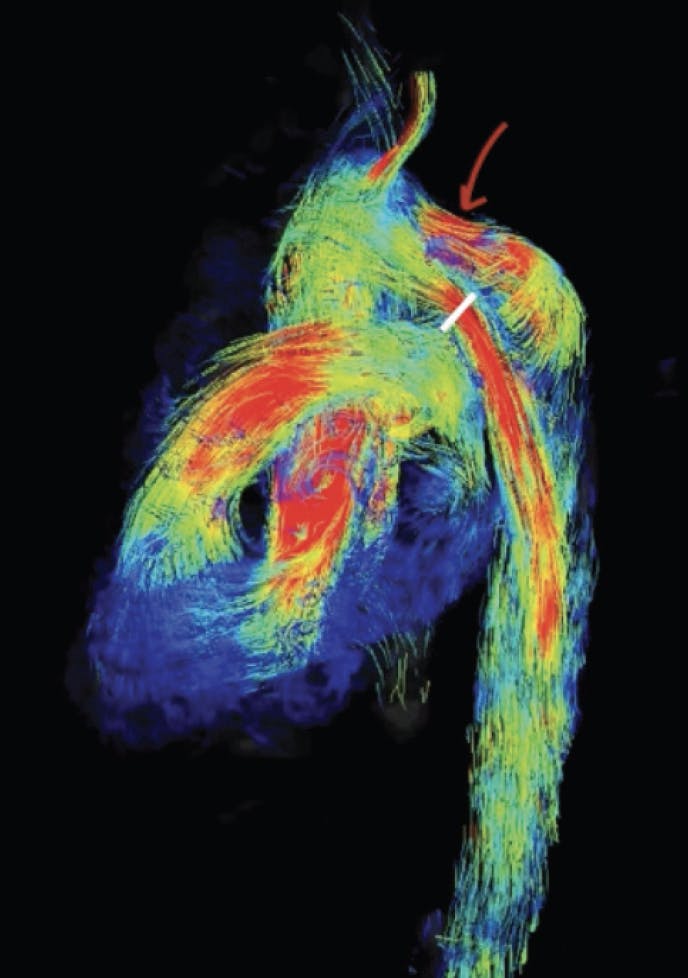
Figure 1. 4D MRI of acute TBAD showing systolic antegrade flow through large primary entry tear in aortic zone 3 (red arrow) and high-energy flow through compressed diameter TL just distal to the entry tear (white line).
(Courtesy of Bradley Allen, MD.)
In spite of the advances in noninvasive imaging technology, invasive techniques including diagnostic angiography and intravascular ultrasound (IVUS) often clarify the anatomy and confirm the diagnosis of malperfusion. In the setting of mesenteric malperfusion, the “floating viscera sign” is an excellent example of angiographic confirmation of dynamic malperfusion. This finding is present when low-pressure aortic angiography demonstrates predominant filling of the abdominal viscera, indicating a compressed TL. IVUS is a second critically important imaging modality in the endovascular treatment of TBAD and is particularly useful in assessing the dynamic nature of a dissection flap to further confirm dynamic malperfusion as well as resolution postintervention (Figure 2; see video).
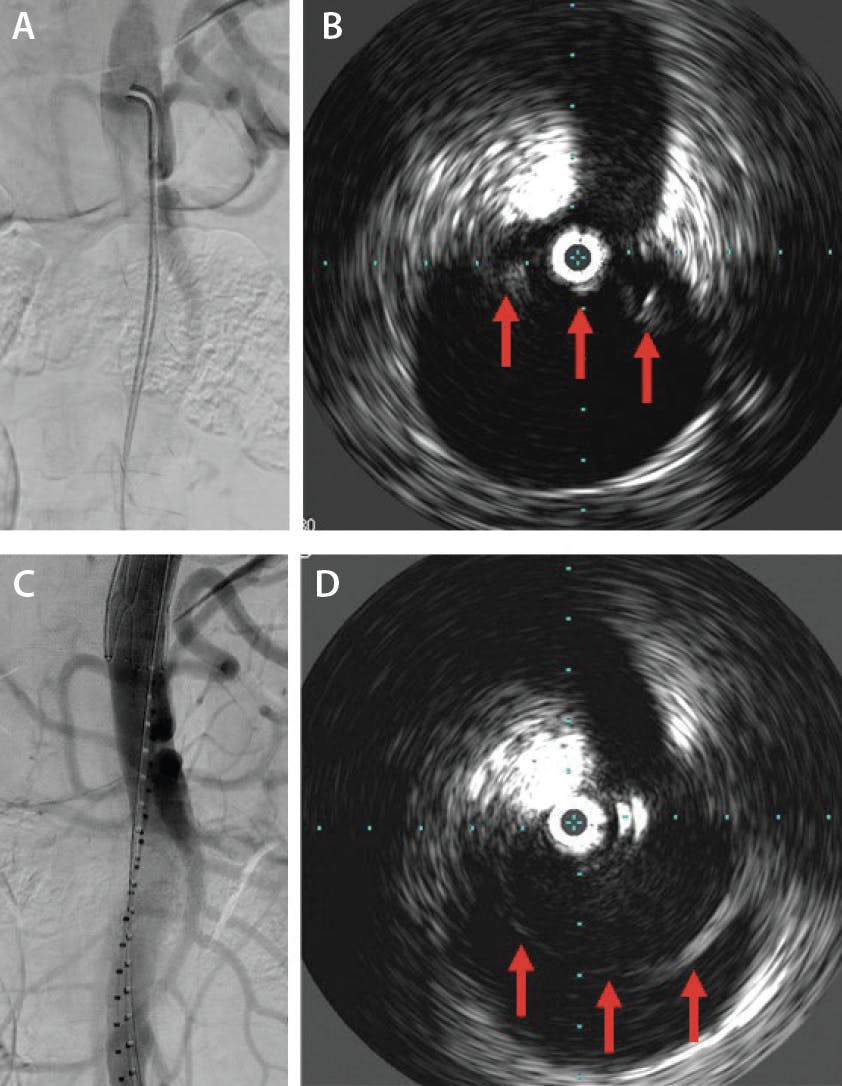
Figure 2. Acute TBAD with malperfusion. Angiography demonstrating a “floating viscera sign” (A) and correlating TL compression (B). After coverage of the primary entry tear and stenting to the supraceliac aorta, there is an expanded TL seen angiographically (C) and with IVUS (D).
AORTIC PROBLEMS WARRANT AORTIC SOLUTIONS
Because malperfusion is predominantly a dynamic process rooted in an aortic pathology, treatment strategies should be focused on the aorta. In most circumstances, coverage of the primary entry tear to depressurize the FL and allow TL expansion is effective in treating malperfusion—even malperfusion due to dissection extending into aortic branch arteries. In the setting of branch-vessel dissection without thrombosis, aortic-focused treatment that restores preferential flow through the TL of the branch often resolves malperfusion to the impacted vascular territory. Even if there is some residual angiographic abnormality, perfusion is usually more important than perfection, and branch vessel interventions in fragile and inflamed arteries should be avoided in acute TBAD, if possible.
The inflammation and friability of the arterial wall in acute TBAD are additionally and particularly important when considering the proximal landing zone in the setting of thoracic endovascular aortic repair (TEVAR) to cover the primary entry tear. Landing in proximal, nondiseased aorta is important to minimize the risk of retrograde type A aortic dissection (RTAD) or proximal stent graft–induced new entry tear (SINE). These complications can be devastating and carry an estimated 37% mortality risk.5,6 It is well described that minimal graft oversizing and avoiding proximal ballooning minimize this risk. Careful attention to the proximal extent of disease on centerline orthogonal imaging is also important when planning TEVAR. Often, dissection or associated intramural hematoma extends proximal to the LSA, even if the primary entry tear is more distal. In some circumstances, partial or complete coverage of the LSA may be necessary to achieve landing in healthy aorta. Still, the risk of RTAD is estimated to be approximately 2% in the setting of acute TBAD.7 There remains controversy on the safety of landing in proximal aorta that is not disease-free, particularly when balanced against life-threatening malperfusion for which alternative treatments are not feasible.
If coverage of the LSA is warranted during TEVAR, planned revascularization of the LSA or use of a branched aortic graft is appropriate. Coverage of the LSA without revascularization is appropriate in some urgent settings, but attention to an elevated risk of postprocedure adverse events is important.8 An exception to this approach in malperfusion is with concern for spinal cord ischemia where LSA revascularization is preferred to preserve the contribution of the left vertebral artery to the collateral network of spinal cord perfusion.
Although aortic intervention is the primary modality for treating malperfusion and resolves the majority of dynamic malperfusion, additional arterial branch revascularization is sometimes warranted. Particularly in the setting of static malperfusion, arterial branch cannulation and stenting may be necessary to treat persistent malperfusion in up to one-third of patients.9 Branch revascularization, either endovascular or open, should only be undertaken after dynamic malperfusion in the aorta has either been treated or excluded as a contributing factor.
Two specific anatomic variants of aortic dissection are worthy of mention in the setting of TEVAR for malperfusion. The first is multichannel dissection, which is estimated to occur in approximately 9% of all acute TBAD and is strongly associated with TBAD-related death.10 The importance of this complex anatomy is twofold. TL cannulation throughout the length of the aorta needs to be carefully confirmed, typically with IVUS, prior to treating any malperfusion. Equally important, this morphology is likely a manifestation of particularly adverse biology and/or hemodynamics. Therefore, the dissection flap and aorta in general should be assumed to be particularly fragile and at risk for adverse intraoperative events. The second anatomic variant worth noting is circumferential or near-circumferential dissection. This variant is likely to develop dynamic malperfusion when branch arteries, often mesenteric vessels, arise from a TL squeezed from multiple directions during systole (Figure 3). TEVAR should be performed with caution, minimizing graft manipulation due to an increased risk of both SINE and full intimal detachment and distal migration causing aortic occlusion.11
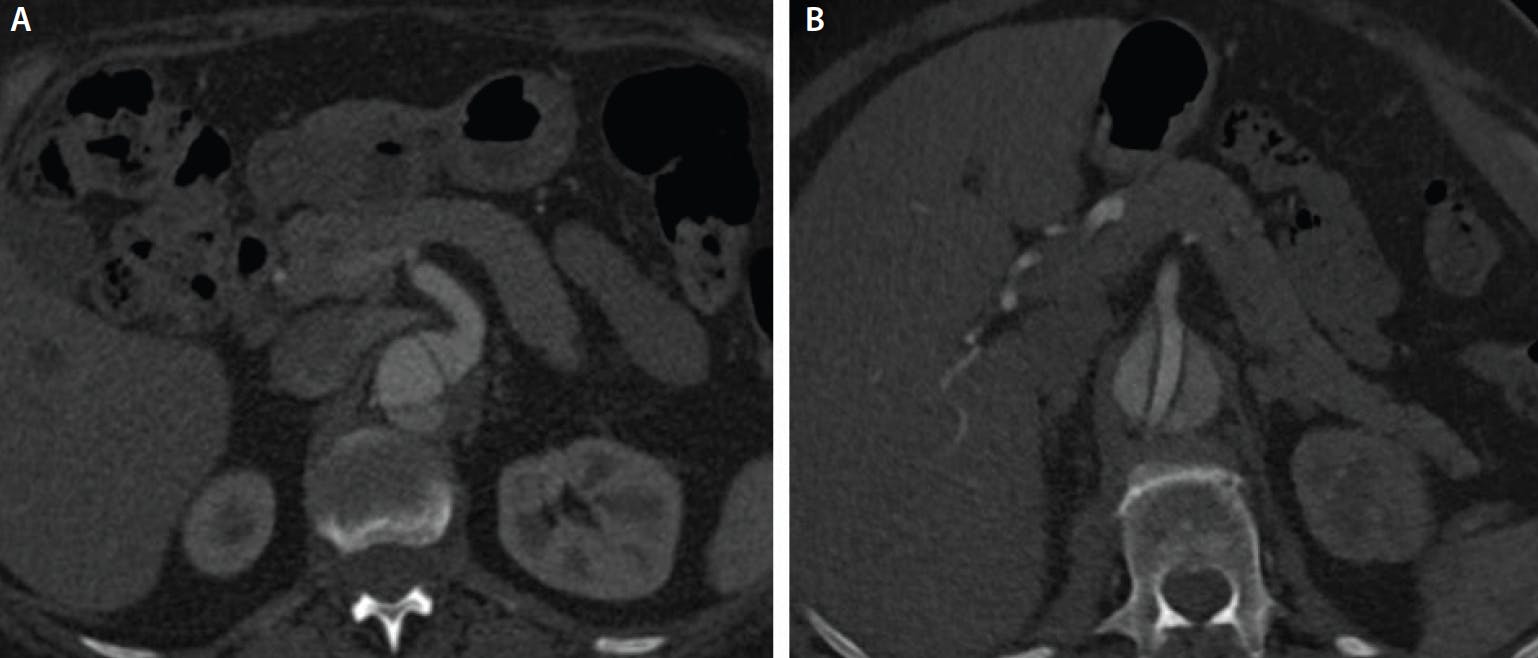
Figure 3. Multichannel dissection at the level of the superior mesenteric artery (A). Near-circumferential dissection with visceral malperfusion seen at the level of the superior mesenteric artery (B).
CONSIDERATIONS FOR THE FUTURE
Regardless of the intervention needed to treat malperfusion, a thoughtful approach to the long-term care of the patient is warranted. TBAD anatomy, especially extensive dissection, is rarely fully cured but is instead managed over time with surveillance, medical optimization, and recognizing that reintervention is needed in nearly 40% of patients at 10 years.12 Compounding an already challenging reintervention with a stent excessively protruding into the aorta, a poorly sized graft, or an open intervention in an important femoral access site should be avoided, if possible. Further, it is better to solve an acute problem now and leave open multiple options for future treatment than attempt definitive therapy in one procedure.
Finally, the anatomy and pathophysiology of malperfusion are inextricably intertwined, and we must acknowledge that there is a great deal we do not understand about both. We have many treatment strategies to manage a spectrum of presentations and anatomic factors, but therapy will continue to evolve, as will accepted treatment paradigms. This is an area for continued advancement in our understanding of TBAD and aortic disease more broadly.
1. Williams DM, Lee DY, Hamilton BH, et al. The dissected aorta: percutaneous treatment of ischemic complications--principles and results. J Vasc Interv Radiol. 1997;8:605-625. doi: 10.1016/s1051-0443(97)70619-5
2. Suzuki T, Mehta H, Ince H, et al. Clinical profiles and outcomes of acute type B aortic dissection in the current era: lessons from the International Registry of Aortic Dissection (IRAD). Circulation. 2003;108(suppl 1):312-317. doi: 10.1161/01.cir.0000087386.07204.09
3. Norton EL, Williams DM, Kim KM, et al. Management of acute type B aortic dissection with malperfusion via endovascular fenestration/stenting. J Thorac Cardiovasc Surg. 2020;160:1151-1161. doi: 10.1016/j.jtcvs.2019.09.065
4. Zilber ZA, Boddu A, Malaisrie SC, et al. Noninvasive morphologic and hemodynamic evaluation of type B aortic dissection: state of the art and future perspectives. Radiol Cardiothorac Imaging. 2021;3:e200456. doi: 10.1148/ryct.2021200456
5. Kuo EC, Veranyan N, Johnson CE, et al. Impact of proximal seal zone length and intramural hematoma on clinical outcomes and aortic remodeling after thoracic endovascular aortic repair for aortic dissections. J Vasc Surg. 2019;69:987-995. doi: 10.1016/j.jvs.2018.06.219
6. Chen Y, Zhang S, Liu L, et al. Retrograde type A aortic dissection after thoracic endovascular aortic repair: a systematic review and meta-analysis. J Am Heart Assoc. 2017;6:e004649. doi: 10.1161/jaha.116.004649
7. Beck AW, Wang G, Lombardi JV, et al. Retrograde type A dissection in the Vascular Quality Initiative thoracic endovascular aortic repair for dissection postapproval project. J Vasc Surg. 2022;75:1539-1551. doi: 10.1016/j.jvs.2021.11.075
8. Matsumura JS, Rizvi AZ. Left subclavian artery revascularization: Society for Vascular Surgery clinical practice guidelines. J Vasc Surg. 2010;52:65S-70S. doi: 10.1016/j.jvs.2010.07.003
9. Chia MC, Khorfan R, Eskandari MK. Adjunctive branch interventions during thoracic endovascular aortic repair for acute complicated type B dissection are not associated with inferior outcomes. J Vasc Surg. 2021;74:895-901. doi: 10.1016/j.jvs.2021.02.028
10. Sueyoshi E, Nagayama H, Hayashida T, et al. Comparison of outcome in aortic dissection with single false lumen versus multiple false lumens: CT assessment. Radiology. 2013;267:368-375. doi: 10.1148/radiol.12121274
11. Havelka GE, Tomita TM, Malaisrie SC, et al. Two cases of aortic intimal intussusception during endovascular repair of an acute type B dissection. J Endovasc Ther. 2016;23:521-528. doi: 10.1177/1526602816644917
12. Wilson-Smith AR, Muston H, Kamalanathan H, et al. Endovascular repair of acute complicated type B aortic dissection-systematic review and meta-analysis of long-term survival and reintervention. Ann Cardiothorac Surg. 2021;10:723-730. doi: 10.21037/acs-2021-taes-17
Advertisement
Advertisement