Advertisement
Advertisement
November 2023
How Does the Availability of Arch Branch Devices Change Our Management of Failing Residual Type B Dissections in the Arch?
Reviewing device type availability, technique, and level of expertise for the treatment of type I DeBakey aortic dissection.
By Scott Painter, MD; Vamsi K. Potluri, MD; and Carlos F. Bechara, MD, DFSVS
Management and repair of type I DeBakey aortic dissection is complex, especially because these patients typically require urgent repair. However, the approach and extent of repair, which is dependent on surgeon/institution decision-making and the patient’s comorbidities, continues to be debated. Why? Because there is a fine line between performing a procedure (conservative vs extensive) with the lowest risk possible (Figure 1) and, at the same time, a procedure that reduces reinterventions. These reinterventions could be in the immediate postoperative period due to persistent malperfusion after proximal repair, or they could be long-term reinterventions. Up to 30% of these patients will need distal aortic intervention in the future.1
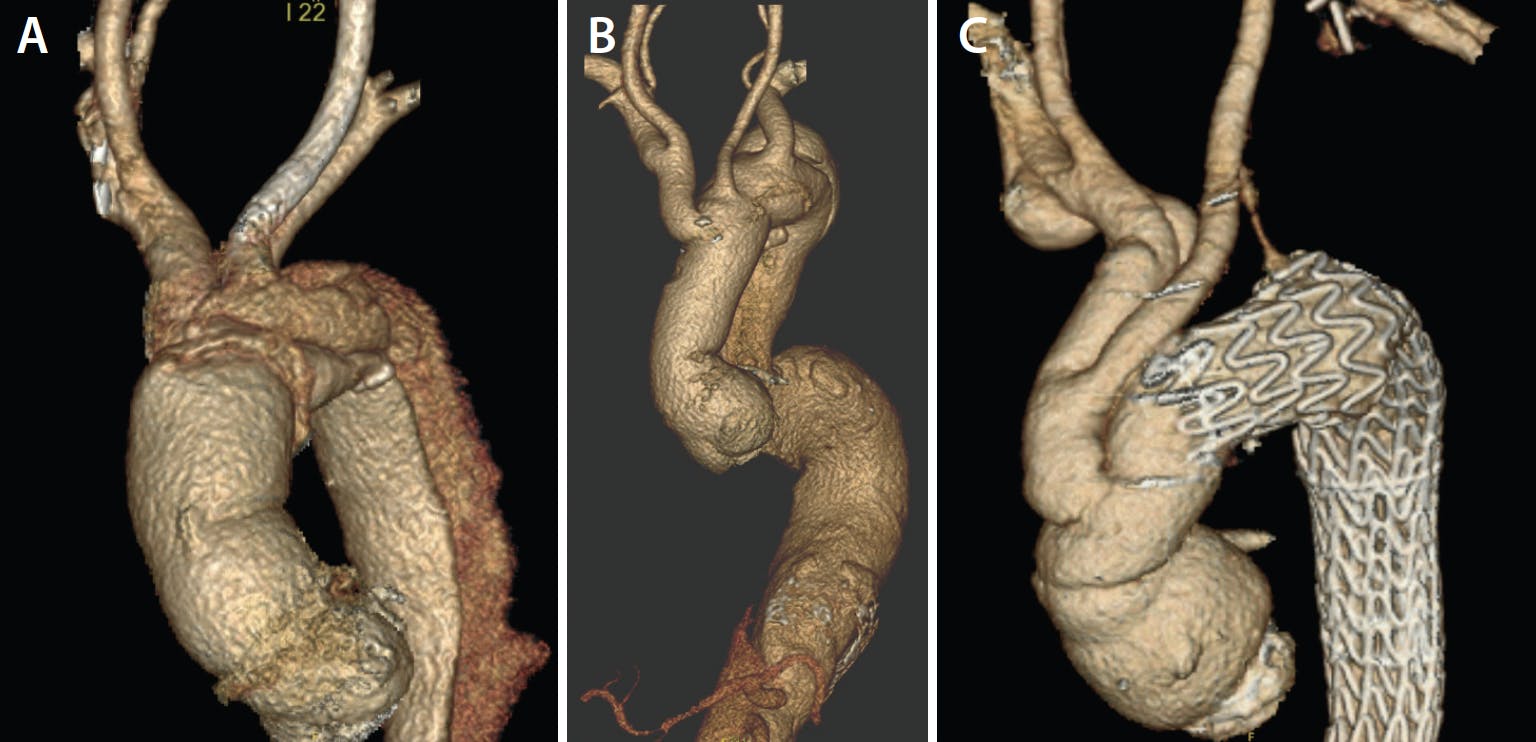
Figure 1. Ascending arch repair (A). Aortic arch replacement with innominate/left carotid implanted as an island (B). Total arch replacement with bifurcated graft to innominate/left carotid with elephant trunk, followed by left subclavian bypass/vertebral transposition and TEVAR into the elephant trunk (C).
A conservative approach would be ascending repair or hemiarch repair. A more extensive approach adds more arch replacement or surgery, such as total arch replacement with elephant trunk or frozen elephant trunk (FET). Extensive repair can reduce reintervention or make future interventions easier but at the cost of more organ ischemia at the time of the index operation. Operative mortality for extensive repair was approximately 27% compared to approximately 16% for hemiarch per a report from the Society of Thoracic Surgeons.2 High-volume centers have been able to reduce their operative mortality even for complex or extensive repairs. Roselli et al reported retrospective data from Cleveland Clinic comparing ascending aorta and hemiarch type I DeBakey dissection repair to modified FET.3 The 7-year survival after modified FET was 89% compared to 65% after limited hemiarch repair. In-hospital mortality and complications were not increased, with less renal failure and a trend toward improved intermediate survival, suggesting hybrid FET may be superior to both limited or extended-classic repair. But in reality, the majority of these cases are performed at low-volume community hospitals. Most surgeons will perform the procedures with the lowest risks and address the remaining dissected aorta on a different day.
LANDSCAPE OF AORTIC BRANCH DEVICES
Over the years, advanced endovascular repairs tackling residual thoracic and abdominal aortic dissection have evolved (eg, branched and fenestrated technology), inducing false lumen thrombosis. However, we lack options and devices to address residual arch dissection, and this is particularly a challenge in patients with only ascending or hemiarch repair. Currently, the only options besides reoperative surgery include physician-modified grafts, in situ laser fenestrations, and snorkel techniques. If we believe the safest surgical option to treat this highly lethal condition is an ascending repair or hemiarch, then we need devices that allow us to land safely in zone 0 or the surgical fabric.
Let’s assume we have off-the-shelf devices to treat residual arch dissection. Who should be performing these cases? As mentioned previously, most type A dissection procedures are performed in community hospitals, at around 10 cases a year. Should these patients be transferred to high-volume centers when stable or after discharge? Endovascular therapy of the arch requires another advanced skill set that not many hospitals have. In addition, a recent meta-analysis showed a 9.3% 30-day mortality for zone 0 thoracic endovascular aortic repair (TEVAR) and a 14.2% risk of stroke.4 With these numbers, extensive surgery at the index operation should potentially be considered, unless mortality and stroke can be lowered with both endovascular and/or extensive open repair. Only large registries or randomized trials will answer this question, and we might be able to find consensus with those.
Current Options
Outside of access through clinical trials, only the Gore TAG thoracic branch endoprosthesis (Gore & Associates) is available off the shelf in the United States, and it is intended to treat zone 2 aortic arch pathology. To use this device, extra-anatomic bypass must be performed to the carotids and left subclavian artery to land in zone 0. As of now, what is a safe operative repair to complement this single-branch device? One option is a modification of the Spielvogel arch repair technique. Instead of a bi- or trifurcated graft coming off the proximal arch graft to the supra-aortic trunk vessels, an alternative is to perform a single bypass to the innominate artery. If arch anatomy permits, and there is enough of a landing zone (3-4 cm) in the graft just distal to the takeoff of the innominate bypass, then a single-branch device with left supraclavicular incision for left carotid and subclavian revascularization might be feasible and safe.
Although data on ascending repair with single bypass to the innominate artery could not be found, data from a 2005 study by Spielvogel et al show a 4.6% mortality and stroke rate.5 It is possible that a single-graft bypass to the innominate artery could have lower mortality and morbidity than the Spielvogel technique. A group at Duke evaluated reoperative aortic reconstruction after type A dissection repair and outlined an algorithmic tailored operative approach that considers patient anatomy as well as comorbidities to help guide decision-making, which may be helpful to readers.1
CONCLUSION
Type I DeBakey aortic dissections are complex, and having no consensus on organ protection and the extent of repair makes it even more challenging. However, centers that have an advanced aortic center with a collaborative multidisciplinary approach have shown better outcomes and creative solutions to this complex problem. Regionalization of care might be the best way to treat patients with type I DeBakey dissection as outcomes are improved.6 Although we debate this complex pathology, advances in open and endovascular approaches are evolving. Recently, Terumo Aortic launched Thoraflex, the first FDA-approved hybrid graft to treat complex arch pathology. Will it prove to be safe, user-friendly, and advantageous to our patients? This can only be answered with data.
1. Vekstein AM, Doberne JW, Weissler EH, et al. Tailored approach and outcomes of aortic arch reconstruction after acute type A dissection repair. J Thorac Cardiovasc Surg. 2023;166:996-1008. doi: 10.1016/j.jtcvs.2022.02.016
2. Malaisrie SC, Szeto WY, Halas M, et al. 2021 The American Association for Thoracic Surgery expert consensus document: surgical treatment of acute type A dissection. J Thorac Cardiovasc Surg. 2021;162:735-758. doi: 10.1016/j.jtcvs.2021.04.053
3. Roselli EE, Kramer B, Germano E, et al. The modified frozen elephant trunk may outperform limited and extended-classic repair in acute type I dissection. Eur J Cardiothorac Surg. 2023;63:ezad122. doi: 10.1093/ejcts/ezad122
4. Ma Y, Siddiqui MS, Farhan SA, et al. A meta-analysis on the effect of proximal landing zone location on stroke and mortality in thoracic endovascular aortic repair. J Vasc Surg. 2023;17:1-8. doi: 10.1016/j.jvs.2023.05.014
5. Spielvogel D, Halstead JC, Meier M, et al. Aortic arch replacement using a trifurcated graft: simple, versatile, and safe. Ann Thorac Surg. 2005;80:90-95. doi: 10.1016/j.athoracsur.2005.02.002
6. Vendramin I, Lechiancole A, Piani D, et al. Influence of a regional network combined with a systematic multidisciplinary approach on the outcomes of patients with acute type A dissection. Int J Cardiol. 2023;15:391. doi: 10.1016/j.ijcard.2023.131278
Advertisement
Advertisement