Advertisement
Advertisement
November 2023
Updates in Radial Access for Lower Extremity Interventions
Surveying current technology for transradial access in peripheral artery disease intervention and areas for further innovation.
By Kelsey Berger, MD; Krystina Choinski, MD; and Rami Tadros, MD, FACS, RPVI
Radial access for diagnostic imaging and intervention has drastically advanced over recent decades. The first transradial coronary angiography was performed by Canadian cardiologist Campeau in 1989.1 As the technique evolved, Kiemeneij et al compared femoral, brachial, and transradial access (TRA) in the ACCESS study,2 with results demonstrating a lower incidence of complications using TRA. Over the decades, there has been rapid growth in the prevalence of cardiology procedures performed with TRA as a preferred approach.3 Among 253,179 diagnostic angiograms and 93,614 percutaneous coronary interventions (PCIs) performed at United States Veterans Affairs hospitals, TRA rates significantly increased from 2001 to 2018 for both diagnostic (17.5% to 60.4%; P < .01) and PCI procedures (14% to 51.8%; P < .01).4
The benefits of TRA versus transfemoral (TFA) access have been extensively described. Various advantages include reduced bleeding risk, patient preference, and lower cost.5-7 Studies also have shown lower overall risk of morbidity and mortality using TRA.6,8 As the use of TRA becomes more prevalent, its application for peripheral artery disease (PAD) and intervention is being explored more. Traditionally, lower extremity interventions have been pursued via TFA.9 Benefits of TFA access include large-caliber vessel for sheaths and interventional devices, easy trajectory to target lesions, support and trackability of guidewires, and various means of treatment for the lesion.10 TRA for peripheral interventions has been investigated, including above-the-knee angioplasty and stenting, with potential benefits.11,12 However, TFA remains the predominant access site choice in the management of PAD. There are still significant unmet needs for operators wishing to provide the same effective interventions for lower extremity PAD via TRA as with TFA.13
HOW WE DO IT
As previously described, to achieve access, the patient’s wrist is hyperextended and evaluated for patency, calcifications, size, and distal perfusion with concomitant radial compression (Barbeau test).14,15 A single anterior wall puncture is performed using a 21-gauge micropuncture needle and an 0.018-inch microwire. The left radial is typically preferred because it allows an additional 5 to 10 cm of usable catheter length and theoretically lowers stroke risk by avoiding manipulation of the aortic arch and carotid arteries.9 After exchanging for a sheath, an antispasmodic cocktail consisting of 2.5 to 5 mg of verapamil, 100 to 200 µg of nitroglycerin, and 2,000 to 3,000 units of heparin is administered to reduce the incidence of radial artery occlusion.16 Weight-dosed heparin is then administered to achieve an activated clotting time of 250 seconds. A wire can then be navigated into the descending thoracic aorta through a Sarah radial catheter (Terumo Interventional Systems) or similarly shaped catheter in a 30° left anterior oblique view. A treatment-length hydrophilic slender sheath may then be advanced over a stiff wire for the intervention. On completion of the procedure, the sheath is retracted under fluoroscopy with leading wire and a TR Band (Terumo Interventional Systems) is applied to the puncture site for hemostasis.
TRA works especially well in situations with difficult femoral access, whether that involves diseased common femoral arteries, extensive scar tissue over the access sites from prior surgical repair, or deep access in obese patients. TRA also excels in patients with hostile iliac bifurcations, making typical up-and-over access from the contralateral femoral more challenging.12,17 This includes patients with steep bifurcations and tortuous iliac arteries and patients who have undergone endovascular aortic repair, aortobifemoral bypasses, or femoral endarterectomies with patch repair. TRA can also be considered in patients with groin infections. Furthermore, TRA allows for the treatment of bilateral lower extremities in one setting, through one access site.
HIGHLIGHTS AND OPPORTUNITIES WITH CURRENT TECHNOLOGY OPTIONS
There are logistic contraindications that should also be noted. Relative contraindications to TRA include occluded radial artery, abnormal Barbeau test, peripheral vasculitis, and ipsilateral dialysis access.17 Additionally, small vessels (typically radial arteries < 2 mm) are unable to accommodate large enough sheaths to allow the passage of interventional tools. Even in adequately sized radial arteries (2-3 mm), sheath size is often limited to 6 F.18,19 To address the requisite for larger access sheaths in these smaller vessels, radial-to-peripheral sheaths have been developed (Table 1). Typically manufactured with smaller outer diameters and hydrophilic coating, these slender sheaths were created to avoid damage to smaller-diameter vessels. The longer sheaths also provide more support for crossing target lesions and delivering interventional devices. The longest sheaths currently available are the 120- and 150-cm Sublime (Surmodics, Inc.) available for both 0.035- and 0.018-inch platforms and the 119- and 149-cm R2P Destination (Terumo Interventional Systems) for a 0.035-inch platform.
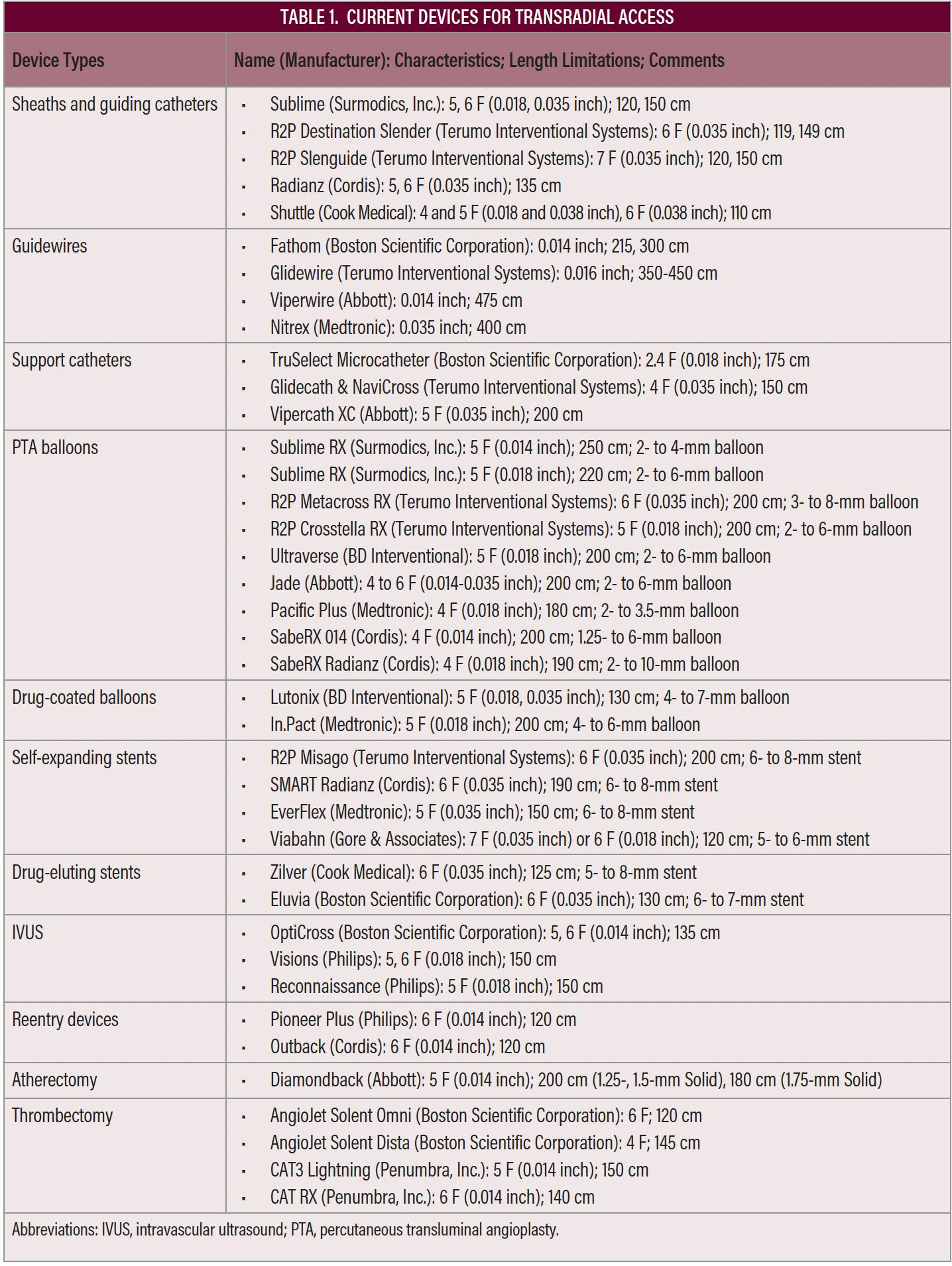
Length to target lesion is the second key limiting factor in treating peripheral disease from TRA. The typical distance from the left radial artery to the iliac arteries is 105 to 125 cm, 130 to 170 cm to the mid superficial femoral artery (SFA), 150 to 180 cm to the popliteal, and 200 to 250 cm to the tibial vessels.20 Most treatment devices are on shorter shaft lengths intended for TFA, thus limiting TRA treatment to the iliofemoral vessels, depending on the patient’s height. Most angioplasty balloons designed for TFA have a working catheter length of 135 to 150 cm, although there has been an expansion to longer balloons designed to reach the tibial vessels. Surmodics now has the longest balloons on the United States market (Sublime RX), offering 2- to 4-mm tibial balloons on a 220-cm shaft for a 5-F, 0.018-inch platform and 2- to 6-mm balloons on a 250-cm shaft for a 5-F, 0.014-inch system. Additionally, Jade (Abbott), Ultraverse 0.018 (BD Interventional), and SabeRX 014 (Cordis) offer balloons with 200-cm catheter lengths.
Despite data supporting improved patency with drug-coated balloons (DCBs) in the SFA and popliteal arteries, there is a sparsity of DCBs of adequate length to reach peripherally. The longest DCB currently available is the 0.018-inch In.Pact system (Medtronic), which offers 4- to 6-mm diameter balloons on a 200-cm catheter.21,22 Delving into other treatment options, of the many atherectomy devices available on the market, only the Diamondback (Abbott) comes in working lengths of 180 and 200 cm, long enough to potentially reach the popliteal and tibial vessels via TRA. The other available devices are of larger caliber (Jetstream [Boston Scientific Corporation] through a 7-F system) or are on shorter catheters (151-cm HawkOne [Medtronic], 135-cm Rotarex [BD Interventional]), leaving a gap in devices available to treat in-stent restenosis and eccentric plaque from radial access. Stent options are also limited, the longest being the 200-cm R2P Misago stent (Terumo Interventional Systems; 6-8 mm through a 6-F system) and the 190-cm SMART Radianz (Cordis; 6-8 mm through 6-F system). Drug-eluting stents have not yet been designed for TRA. Stents such as the Zilver (Cook Medical) and Eluvia (Boston Scientific Corporation) are only available in working lengths of 125 and 130 cm, respectively, limiting treatment to primarily SFAs. Currently, there are no tibial stents with a long-enough working length to employ from TRA.
There are limited bailout options for peripheral complications from TRA. If a dissection or perforation is encountered during treatment, reentry devices, tacking stents, and covered stents are frequently either too short to reach the target area or too large to safely traverse the access site. The longest covered stent that passes through a 6-F sheath is the Viabahn (Gore & Associates) on a 120-cm shaft, with the larger-diameter stents (> 6 mm) requiring ≥ 7-F access. Both reentry devices on the market, Outback (Cordis) and Pioneer Plus (Philips), can traverse a 6-F sheath but have only 120 cm of working catheter length. Intravascular ultrasound can be used to assess difficult dissections or diseased vessel segments but is only available in 135-cm (OptiCross, Boston Scientific Corporation) and 150-cm (Visions and Reconnaissance, both Philips) catheter lengths.
Thrombectomy devices are also important to mention as useful tools for limb salvage in the event of inadvertent embolism or thrombus formation during intervention. AngioJet (Boston Scientific Corporation) offers the best option for TRA, with the 4-F AngioJet Solent Dista available in 145 cm and the 6-F AngioJet Solent Omni in a 120-cm working length. Penumbra, Inc. also offers several options: the 6-F CAT6, 6-F CAT RX, and 5-F CAT3, with working lengths of 135, 140, and 150 cm, respectively. However, even 150-cm devices typically only reach the superficial femoral artery or popliteal vessels. For these reasons, many interventionalists limit TRA to less complex lesions (TransAtlantic Inter-Society Consensus A or B) above the knee.23
CONCLUSION
TRA offers an additional access site for treating peripheral vascular disease and addresses several limitations of TFA; however, its use is still limited by the technology available (Table 1). Although previously limited to interventions in the iliofemoral vessels, the treatment of popliteal and tibial disease is becoming more feasible with the advent of longer and more compact devices. Radial-to-peripheral intervention will continue to evolve with technology, and our field will learn to adapt with it.
1. Campeau L. Percutaneous radial artery approach for coronary angiography. Cathet Cardiovasc Diagn. 1989;16:3-7. doi: 10.1002/ccd.1810160103
2. Kiemeneij F, Laarman G, Odekerken D, et al. A randomized comparison of percutaneous transluminal coronary angioplasty by the radial, brachial and femoral approaches: the Access study. J Am Coll Cardiol. 1997;29:1269-1275. doi: 10.1016/s0735-1097(97)00064-8
3. Satheesh S, Subramanian A. How to do radial coronary angiogram? Indian Heart J. 2015;67:170-174. doi: 10.1016/j.ihj.2015.04.009
4. Doll J, Beaver K, Naranjo D, et al. Trends in arterial access site selection and bleeding outcomes following coronary procedures, 2011-2018. Circ Cardiovasc Qual Outcomes. 2022;15:e008359. doi: 10.1161/CIRCOUTCOMES.121.008359
5. Anjum I, Khan MA, Aadil M, et al. Transradial vs. transfemoral approach in cardiac catheterization: a literature review. Cureus. 2017;9:e1309. doi: 10.7759/cureus.1309
6. Bhat FA, Changal KH, Raina H, et al. Transradial versus transfemoral approach for coronary angiography and angioplasty - a prospective, randomized comparison. BMC Cardiovasc Disord. 2017;17:23. doi: 10.1186/s12872-016-0457-2
7. Roussanov O, Wilson SJ, Henley K, et al. Cost-effectiveness of the radial versus femoral artery approach to diagnostic cardiac catheterization. J Invasive Cardiol. 2007;19:349-353.
8. Kedev S, Kalpak O, Dharma S, et al. Complete transitioning to the radial approach for primary percutaneous coronary intervention: a real-world single-center registry of 1808 consecutive patients with acute ST-elevation myocardial infarction. J Invasive Cardiol. 2014;26:475-482.
9. Korabathina R, Yadav SS, Coppola JT, Staniloae CS. Transradial approach to lower extremity interventions. Vasc Health Risk Manag. 2010;6:503-509. doi: 10.2147/vhrm.s11529
10. Schwalm J, Stacey D, Pericak D, et al. Radial artery versus femoral artery access options in coronary angiogram procedures. Circ Cardiovasc Qual Outcomes. 2012;5:260-266. doi: 10.1161/CIRCOUTCOMES.111.962837
11. Trani C, Tommasino A, Burzotta F. Pushing the limits forward: transradial superficial femoral artery stenting. Catheter Cardiovasc Interv. 2010;76:1065-1071. doi: 10.1002/ccd.22717
12. Lorenzoni R, Lisi C, Corciu A, et al. Tailored use of transradial access for above-the-knee angioplasty. J Endovasc Ther. 2014;21:635-640. doi: 10.1583/14-4747R.1
13. Posham R, Young LB, Lookstein RA, et al. Radial access for lower extremity peripheral arterial interventions: do we have the tools? Semin Intervent Radiol. 2018;35:427-434. doi: 10.1055/s-0038-1676341
14. Coppola JT, Staniloae C. Radial access for peripheral vascular procedures. Endovasc Today. 2012;11:38-42, 44. https://evtoday.com/articles/2012-jan/radial-access-for-peripheral-vascular-procedures
15. Barbeau GR, Arsenault F, Dugas L, et al. Evaluation of the ulnopalmar arterial arches with pulse oximetry and plethysmography: comparison with the Allen’s test in 1010 patients. Am Heart J. 2004;147:489-493. doi: 10.1016/j.ahj.2003.10.038
16. Rathore S, Stables RH, Pauriah M, et al. A randomized comparison of TR Band and Radistop hemostatic compression devices after transradial coronary intervention. Catheter Cardiovasc Interv. 2010;76:660-667. doi: 10.1002/ccd.22615
17. Roy AK, Garot P, Louvard Y, et al. Comparison of transradial vs transfemoral access for aortoiliac and femoropopliteal interventions: a single-center experience. J Endovasc Ther. 2016;23:880-888. doi: 10.1177/1526602816665617
18. Saito S, Ikei H, Hosokawa G, Tanaka S. Influence of the ratio between radial artery inner diameter and sheath outer diameter on radial artery flow after transradial coronary intervention. Catheter Cardiovasc Interv. 1999;46:173-178. doi: 10.1002/(SICI)1522-726X(199902)46:2<173::AID-CCD12>3.0.CO;2-4
19. Kotowycz MA, Dzavik V. Radial artery patency after transradial catheterization. Circ Cardiovasc Interv. 2012;5:127-133. doi: 10.1161/CIRCINTERVENTIONS.111.965871
20. Parikh SA, Ricotta JJ, Ghamraoui. The state of transradial access for lower extremity intervention. Endovasc Today. 2021;20:76-78. https://evtoday.com/articles/2021-nov/the-state-of-transradial-access-for-lower-extremity-intervention
21. Liistro F, Porto I, Angioli P, et al. Drug-eluting balloon in peripheral intervention for below the knee angioplasty evaluation (DEBATE-BTK): a randomized trial in diabetic patients with critical limb ischemia. Circulation. 2013;128:615-621. doi: 10.1161/CIRCULATIONAHA.113.001811
22. Scheinert D, Duda S, Zeller T, et al. The LEVANT I (Lutonix paclitaxel-coated balloon for the prevention of femoropopliteal restenosis) trial for femoropopliteal revascularization: first-in-human randomized trial of low-dose drug-coated balloon versus uncoated balloon angioplasty. JACC Cardiovasc Interv. 2014;7:10-9. doi: 10.1016/j.jcin.2013.05.022
23. Trani C, Burzotta F, Tommasino A, Giammarinaro M. Transradial approach to treat superficial femoral artery in-stent restenosis. Catheter Cardiovasc Interv. 2009;74:494-498. doi: 10.1002/ccd.22091
Advertisement
Advertisement