Advertisement
Advertisement
September 2023 Supplement
Sponsored by Cagent Vascular
How Much Lumen Are You Willing to Lose?
Serranator® PTA Serration Balloon Catheter versus plain old balloon angioplasty.

Despite recoil being understood as a phenomenon in below-the-knee (BTK) intervention, there are limited studies and literature that investigate this unique challenge. What is your experience with recoil in your clinical practice?
Dr. Lichtenberg: We are very aware of recoil in our practice. Baumann et al illustrated recoil in 29/30 (97%) of patients at 15 minutes after balloon angioplasty,1 and in my estimation as an angiologist, this is something that is really affecting the patency outcome. It’s a real clinical challenge with a real clinical impact.
What is recoil and why does it happen?
Dr. Lichtenberg: Recoil is loss of acute lumen after angioplasty in diseased vessels, and it is especially seen in the BTK vessels. When we perform standard plain old balloon angioplasty (POBA) in a BTK diseased vessel, which typically presents as highly calcified, we find that after only 15 minutes, the result is much the same as before we started. Recoil severely effects the outcome of these critical limb ischemia patients (Figure 1).
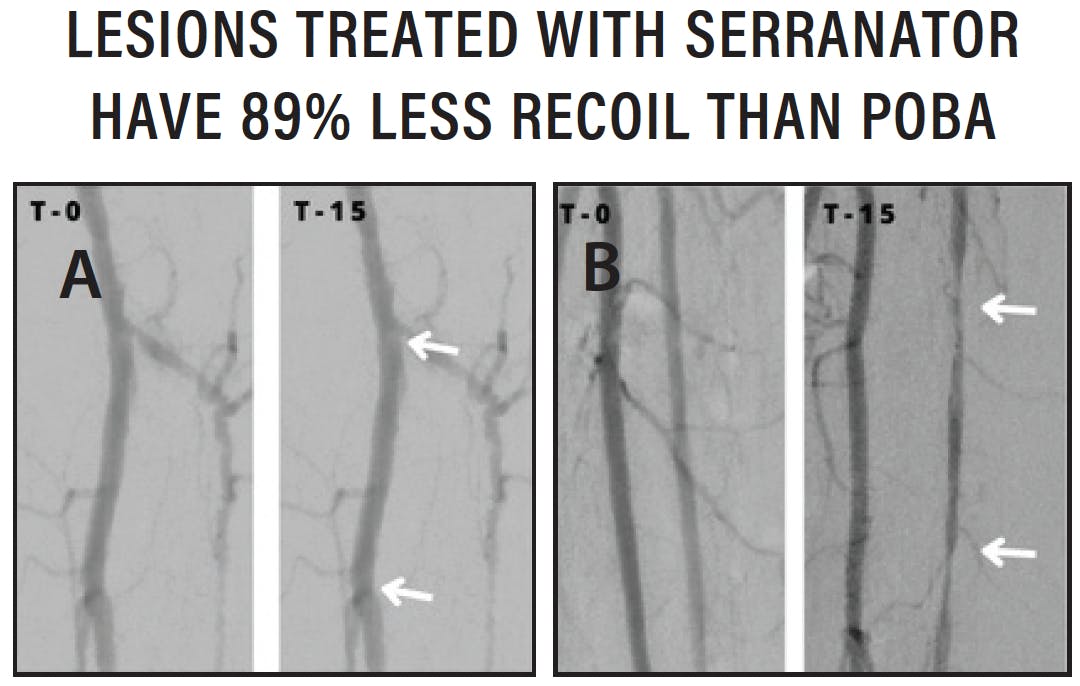
Figure 1. The Serranator had 6% mean recoil across all lesions at 15 minutes post-inflation (A). POBA had 55% mean recoil across all lesions at 15 minutes (B).
How does a vessel that experiences recoil impact flow? Is there an impact on the clinical outcome?
Dr. Lichtenberg: When the vessel recoils, you are essentially losing lumen you created within minutes of the procedure and consequently losing flow to the foot, which will certainly impact the clinical outcome. Our goal is to create the largest, most stable lumen possible. This means we must reduce or eliminate recoil to achieve the necessary outcome.
Tell us about the RECOIL study that compared Serranator® PTA Serration Balloon Catheter (Cagent Vascular) to POBA.2
Dr. Lichtenberg: We found a very impressive and highly significant difference between POBA and Serranator at 15 minutes post-inflation. This core lab–adjudicated study showed that Serranator has an 89% improvement in recoil over POBA in these tibial vessels. The mean recoil percent in the Serranator group was 6% versus 55% in the POBA group (Figure 1). My personal belief is that serration angioplasty increases the compliance of the vessel, and in doing so, lowers the risk of barotrauma, dissection, restenosis, and recoil.
1. Baumann F, Fust J, Engelberger RP, et al. Early recoil after balloon angioplasty of tibial artery obstructions in patients with critical limb ischemia. J Endovasc Ther. 2014;21:44-51. doi:10.1583/13-4486MR.1
2. Serranator Recoil study. Clinicaltrials.gov website. Accessed September 5, 2023. https://www.clinicaltrials.gov/study/NCT05161039
Advertisement
Advertisement