Advertisement
Advertisement
September 2023 Supplement
Sponsored by Cagent Vascular
Distal SFA CTO Treated With Serranator for Significant Luminal Gain Prior to DCB Angioplasty

PATIENT PRESENTATION
A man in his early 60s with history of tobacco abuse and coronary artery disease with prior coronary stenting was evaluated at an outside institution for severe short-distance claudication and was found to have an ankle-brachial index of 0.6 on the right and 0.4 on the left. CTA revealed bilateral superficial femoral artery (SFA) occlusions, and he underwent left leg interventions with stent placement. He was maintained on dual antiplatelet therapy and a statin. He subsequently presented for evaluation of short-distance claudication of the right leg.
DIAGNOSTIC ASSESSMENT
Noninvasive vascular testing was repeated, which found a right distal SFA occlusion, and the patient was brought to the catheterization laboratory for revascularization. Left common femoral artery access was established for aortography and right leg angiography. There was heavy calcification of the right SFA with chronic total occlusion (CTO) of a 6-cm segment in the distal SFA and popliteal reconstitution with three-vessel runoff (Figure 1).
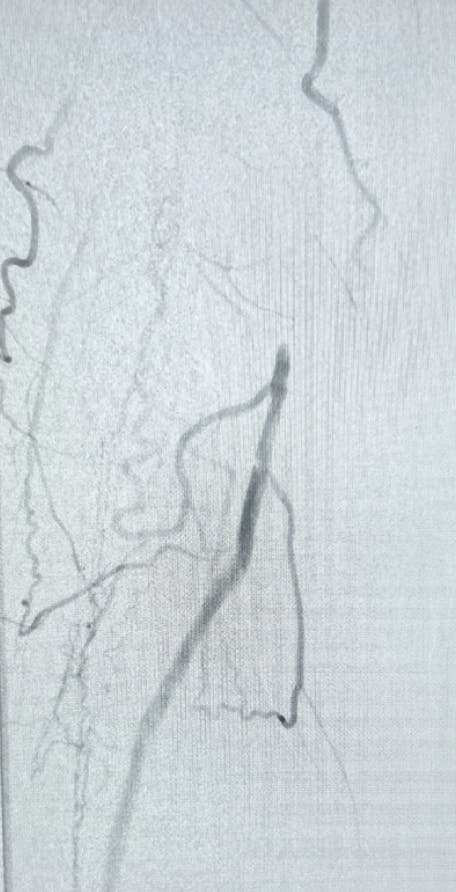
Figure 1. Pre-procedure angiogram.
INTERVENTION
A 7-F Destination sheath (Terumo Interventional Systems) was inserted, and the CTO lesion was crossed using a Glidewire Advantage and NaviCross catheter (both Terumo Interventional Systems). Popliteal re-entry was confirmed with angiography. The wire was exchanged to a 0.014-inch Grand Slam guidewire (Asahi Intecc), and predilation was performed with a 4- X 150-mm plain angioplasty balloon. A 0.014-inch intravascular ultrasound (IVUS) was then inserted, and the SFA was examined. The wire course was found to be luminal, without evidence of subintimal dissection. The lesion was heavily calcified, and significant stenosis was identified proximal to the area of CTO. The wire was exchanged to a 7-mm SpiderFX embolic protection device (Medtronic) and a 2.4-mm Jetstream XC atherectomy catheter (Boston Scientific Corporation) was inserted. Atherectomy was performed throughout the occluded segment and proximal stenotic areas. Five total passes were performed, but the fifth pass was truncated due to patient tolerance.
Although significant lumen gain was achieved with atherectomy, there remained areas of significant stenosis (Figure 2). The filter wire was captured and exchanged to a 0.014-inch Grand Slam. Balloon angioplasty with the 5- X 120-mm Serranator® PTA Serration Balloon Catheter (Cagent Vascular) was performed using two overlapping inflations of 120 seconds each at 8 atm (Figure 3). There was significant luminal improvement after serration balloon angioplasty (Figure 4). Therapy was completed with drug-coated balloon (DCB) angioplasty of the entire treated area using a 6- X 200-mm Ranger balloon (Boston Scientific Corporation; Figure 5). The result was excellent, with revascularization of the distal SFA and three-vessel runoff. The sheath was withdrawn and manual pressure held for hemostasis. The patient was maintained on dual antiplatelet therapy and a statin.
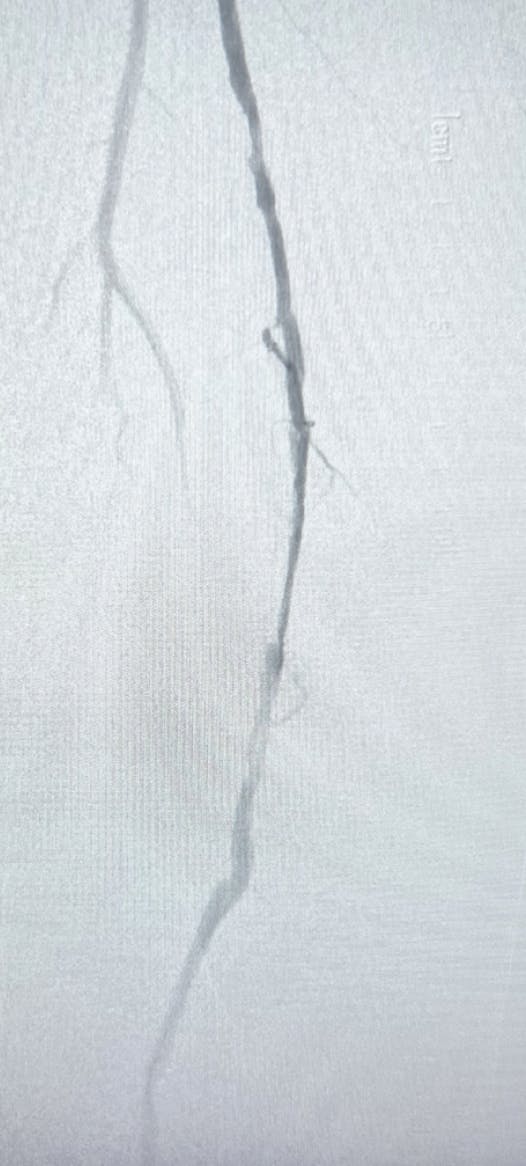
Figure 2. Post-atherectomy with remaining significant stenosis.
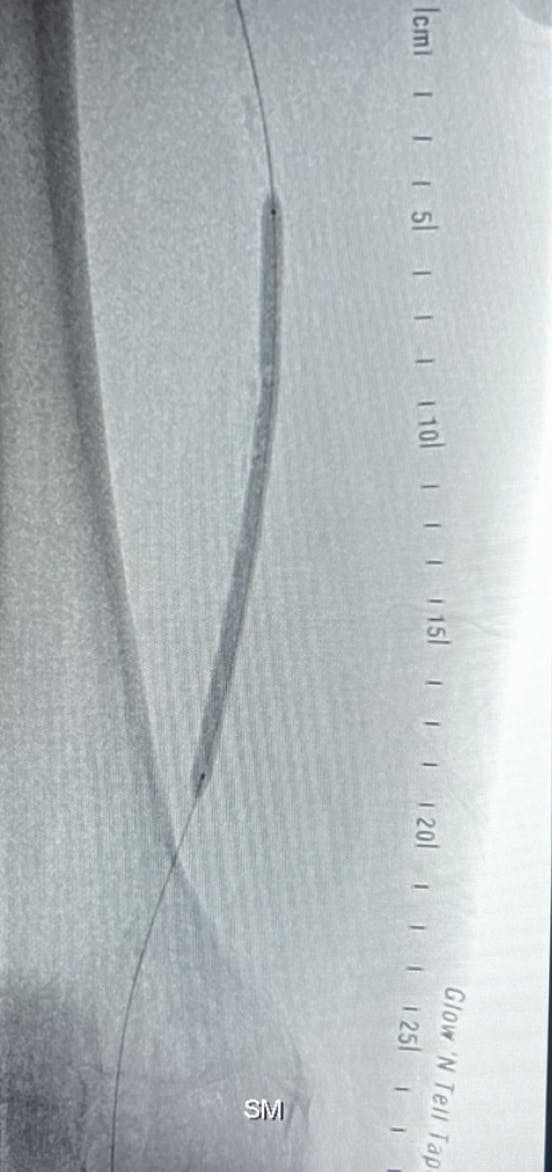
Figure 3. Inflation of the Serranator.
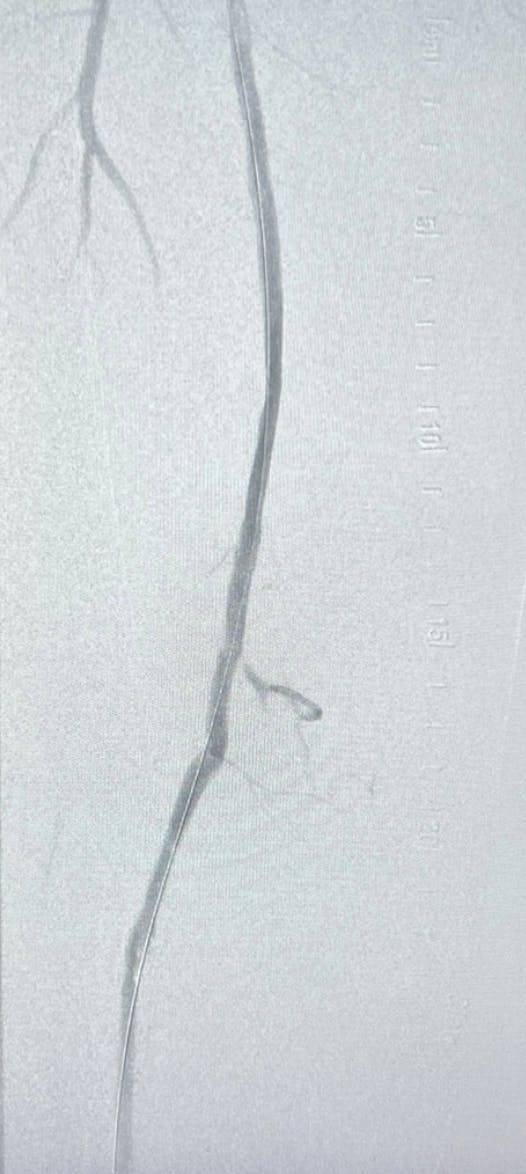
Figure 4. Improvement after serration balloon angioplasty.
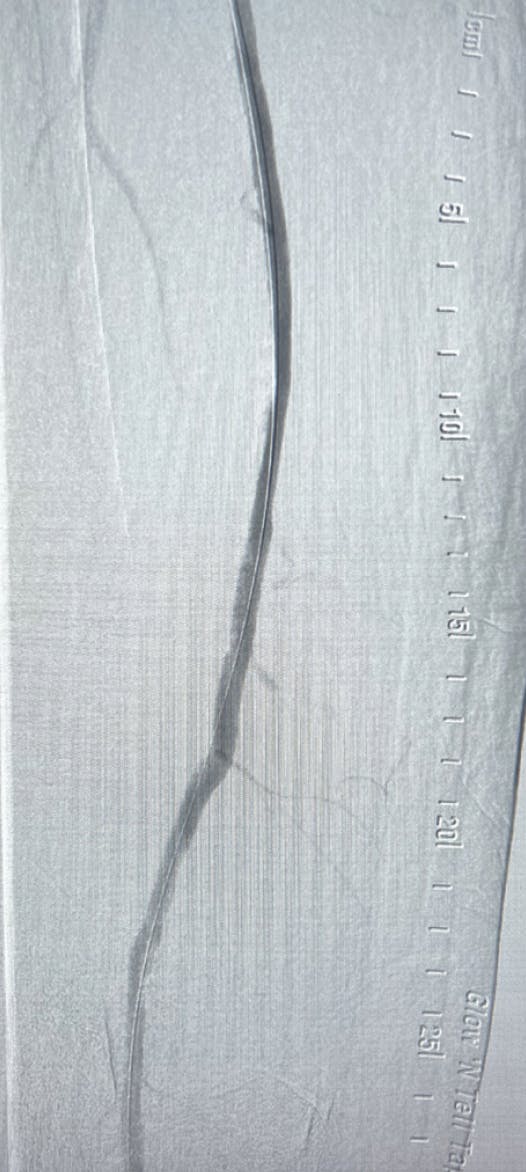
Figure 5. Completion angiogram after DCB angioplasty.
CONCLUSION
This case exemplifies the use of IVUS in decision-making for treatment of complex SFA lesions. Atherectomy and serration balloon angioplasty served as important adjuncts in lesion preparation for DCB angioplasty and the use of stents was avoided, with excellent outcome.
What is your typical treatment algorithm and when do you choose Serranator?
Dr. Hirsch: Treatment algorithm varies by lesion location and characteristics. When possible, I avoid the use of stents, favoring balloon angioplasty, atherectomy, and DCB angioplasty. Serranator has been particularly valuable in complex lesions with heavy calcium or residual stenosis following other plaque-modifying therapies.
How important is excellent lumen gain prior to using drug-coated therapy? Do you believe Serranator consistently provides this in the SFA?
Dr. Hirsch: Lesion preparation with good lumen gain prior to DCB angioplasty has proven to be the best strategy in our practice. I seldom rely on DCB alone for lumen gain. Serranator has become a reliable choice for plaque modification in resistant SFA lesions, particularly in cases with bad circumferential disease.
Is there something about the Serranator’s mechanism of action that you believe makes it different than other specialty balloons?
Dr. Hirsch: The serrated strip is significantly different from previous types of cutting balloons. The Serranator strips seem more aggressive than previous “controlled plaque fracture” balloons, achieving more predictable results with fewer dissections.
Do you utilize Serranator below the knee, and what types of results are you seeing?
Dr. Hirsch: The majority of Serranator cases have been below-knee applications, where I universally avoid stent placement. Results of tibial angioplasty with Serranator have been excellent with high limb salvage rates and exceptional patency for tibial level intervention.
Advertisement
Advertisement