Advertisement
Advertisement
September 2023 Supplement
Sponsored by Cagent Vascular
The Serranator® PTA Serration Balloon Catheter: Addressing the Unmet Need in Complex PAD Patients
Peripheral artery disease (PAD) is a global pandemic. In 2010, an estimate of 100 million people were diagnosed with PAD, and it is forecasted to rise from 30% to 50% by 2045, both driven by an aging population in higher income countries and the global rise of diabetes.1 Within this population, chronic limb-threatening ischemia (CLTI) patients are among the most technically challenging to treat and manage. Despite our advanced medical system, over 20% of CLTI patients still undergo primary amputation, with marked variation based on race and socioeconomic status.2 Despite access to advanced technologies, over 40% of CLTI patients need reintervention at 1 year.3 And despite our best efforts, over 40% of those undergoing major amputation will die at 1 year.2 Complex infrainguinal lesions perhaps require better solutions to achieve better outcomes.
SERRATION BALLOON ANGIOPLASTY
With the increasing complexity of disease in CLTI patients, there exists a need for optimizing endovascular therapies. The Serranator® PTA Serration Balloon Catheter (Cagent Vascular) is a disruptive technology over plain old balloon angioplasty (POBA) (Figure 1).

Figure 1. The Serranator has a nylon semicompliant balloon with three embedded external serrated metal strips. The elements are serrated, designed to create linear, interrupted scoring along the endoluminal surface.
Unlike other focal force balloons that utilize helical or longitudinal wires, the Serranator utilizes metallic elements that have surface serrations to concentrate pressure on multiple points of contact. This results in a point force 1,000 times greater than POBA and significant improvement over other focal force balloons where pressure is dissipated along the length of the wire elements (Figure 2).4

Figure 2. Serranator applies 1,000 times the force compared to POBA (A). Pre- (B) and post-Serranator (C) intravenous ultrasound images of the tibial artery demonstrate the effectiveness in calcification. Post-Serranator optical coherence tomography (OCT) shows the serration technology mechanism of action in the superficial femoral artery (D). Post-Serranator OCT shows serration effect within tibial artery (arrows, E).
Serration balloon angioplasty may also reduce dissection and uncontrolled fractures seen with POBA by directing energy along “serration” planes. Current iterations of the device come in a broad size matrix from 2.5 to 6.0 mm and from 40 to 120 mm in length, all 6-F compatible (see Specifications of Serranator Sidebar).
Specifications of the Serranator
- 0.018- and 0.014-inch guidewire compatible
- 6-F sheath compatible
- 150 cm catheter length
- 2.5 to 6.0 mm balloon diameters
- 40, 80, 120 mm balloon lengths
- Serration elements protrude 0.2 mm
The value proposition of such a tool comes from its deliverability and ease of use. It could be utilized for both vessel preparation prior to drug or stent delivery or utilized as a standalone tool while limiting recoil and dissections. It can be used in all lesion morphologies, including both fibrotic and calcific tissues. Compared to tools such as intravascular lithotripsy, there is a more favorable crossing profile with longer lengths, simpler setup, no loss of energy in noncalcified tissue, and no finite number of treatments with a single device. Moreover, in contrast to some atherectomy devices, risk of distal embolization is low, with the ability to both prepare and treat the vessel with a single solution.
ADDRESSING ATK DISEASE
There are multiple options for treatment of above-the-knee (ATK) disease. Fundamental to the nature of angioplasty is dissection. Despite the advent of drug-coated balloon (DCB) technologies, dissections may impact outcomes postintervention. The THUNDER study suggested higher target lesion revascularization (TLR) with significant dissection, but DCB angioplasty might mitigate restenosis as long as the lesions are not flow limiting.5 Serration angioplasty allows for controlled expansion of lesions, creates uniform fracture planes, and limits uncontrolled dissection.
Scaffolds (including drug-eluting stents [DESs]) have been shown to be effective in this space, especially when there are flow-limiting residual lesions after POBA.6 However, this could be at the expense of limiting normal vasomotor function of the superficial femoral and popliteal arteries. The chronic outward radial force and higher metal-to-tissue ratio may be associated with an intimal hyperplastic response, potentially with decreased patency and increased TLR, even when using biomimetic scaffolds.
As such, DCB devices remain attractive, as they may improve patency without leaving a durable implant. However, DCB efficacy can be impacted by calcium, which can limit drug uptake. Serration balloon angioplasty results in small fractures within treated lesions. In a porcine model, the microfissures created by the Serranator resulted in three times greater drug uptake versus POBA when used as preparation for DCB angioplasty.7 This may potentially address one of the greatest limitations of drug delivery in the PAD space, actually getting drug into the medial/adventitial layers where it could be most effective in slowing progression of disease; however, these findings need to be demonstrated clinically in humans.
DCB devices also do not address recoil, which historically has been addressed with vessel preparation tools and ultimately a high-radial-force scaffold. Atherectomy has also been leveraged to help improve angiographic results without clear improvement in outcomes.8 Serration angioplasty mitigates recoil with its high point force, allowing for other treatments, including both DCB or placing a scaffold when necessary.
Data supporting use of the Serranator in ATK lesions come from the PRELUDE study.9 This was a prospective, core lab–adjudicated study (N = 25) in native femoropopliteal lesions that showed low 22.7% residual stenosis and low bailout stent rate of 4.0% (one patient).9 Moreover, lesion expansion was achieved at low mean inflation pressures of only 8 atm regardless of the degree of calcification.9 Freedom from clinically driven TLR (CD-TLR) and target vessel revascularization was 100% at 6 months even without use of adjunctive DCB therapy.9
In this clinical example, a fibrocalcific femoropopliteal lesion in a Rutherford class (RC) 3 claudicant patient is seen at baseline (Figure 3A), Serranator-inflated (Figure 3B), and post-DCB (Figure 3C), showing excellent expansion and restoration of normal flow, without significant dissection.

Figure 3. A fibrocalcific femoropopliteal lesion in a RC 3 claudicant patient is seen at baseline (A), Serranator-inflated (B), and post-DCB (C), showing excellent expansion and restoration of normal flow, without significant dissection.
ADDRESSING BTK DISEASE
Below-the-knee (BTK) lesions present even greater challenges with regard to effective and durable outcomes in managing CLTI patients. A fundamental issue with addressing infrapopliteal disease is recoil seen in over 50% of patients post-POBA and may suggest why many trials have failed.10 But the answer is not simply to place a scaffold, as this strategy is limited by the lack of approved devices. Coronary DESs (off-label) may work well in the proximal third of the calf but face excessive crush forces beyond this zone.11 Tack scaffolds (Philips) are only used for dissection and cannot address recoil forces.12 Drug-eluting scaffolds such as Saval (Boston Scientific Corporation) were met with disappointing results.13 Results from bioresorbable drug-eluting technologies such as Esprit BTK (Abbott) are forthcoming, but also likely require aggressive vessel preparation to achieve optimal expansion.14
Data supporting use of serration angioplasty in BTK lesions come from the PRELUDE BTK study.15 This was a prospective, core lab–adjudicated study (N = 46; 53 lesions) of infrapopliteal lesions (47.8 ± 37.4 mm).15 Technical success was 91.7% with luminal expansion at low mean inflation pressures (6 atm).15 There was a low 21.8% residual stenosis with a low bailout stent rate of 1.9% (one patient).15 Freedom from major adverse limb events and postoperative death at 30 days was 95.7% and the 6-month freedom from CD-TLR was 97.7%.15
In a separate core lab–adjudicated infrapopliteal artery recoil study, serration angioplasty was associated with significantly less mean recoil than with POBA 15 minutes posttreatment (6% vs 55%; P = .009).10 This finding may help explain the successful 6-month outcomes seen in PRELUDE BTK. Recoil is perhaps even more prominent in lesions below the ankle, which have been excluded from most BTK trials. In an ongoing retrospective study, Serranator use in pedal arteries was examined (N = 41), including the pedal arch, which found 97% amputation-free survival and 89% wound healing at 5 months.16 Both the technical and clinical success of this technology in these zones may offer hope for even the most complex CLTI patients.
In this clinical example, we see a severely diseased popliteal into the tibioperoneal trunk (TPT) with anterior tibial (AT) in-stent restenosis in a CLTI patient with a hallux wound (RC 5) (Figure 4A). Serranator and DCB were initially used in the popliteal artery and TPT, showing both excellent luminal gain without recoil or dissection (Figure 4B and 4C). Additional serration angioplasty of the AT was performed with resolution of occlusion (Figure 4D).
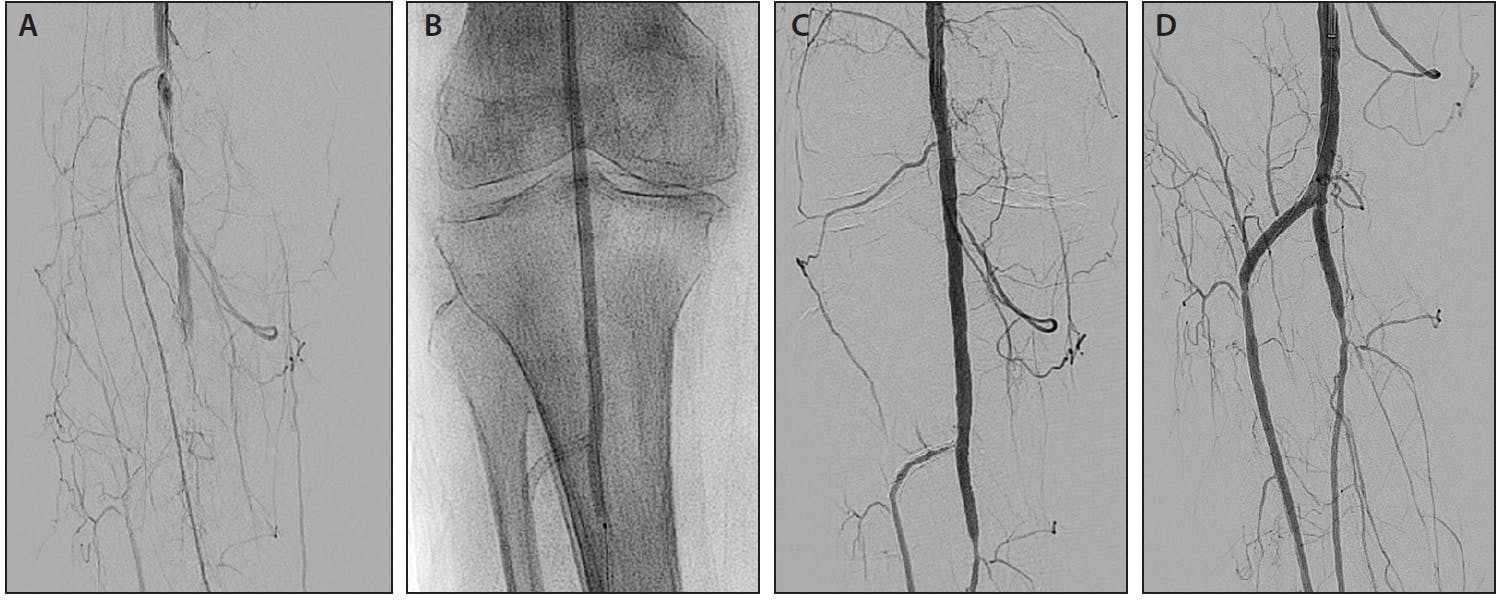
Figure 4. A severely diseased popliteal artery into the TPT with AT in-stent restenosis in a CLTI patient with a hallux wound (RC 5) (A). Serranator and DCB were initially used in the popliteal artery and TPT, showing both excellent luminal gain without recoil or dissection (B, C). Additional serration angioplasty of the AT was performed with resolution of occlusion (D).
CONCLUSION AND FUTURE DIRECTIONS
Serration balloon angioplasty offers a novel mechanism of action to facilitate vessel modification and preparation, either as a standalone option or adjunctive to other therapies. However, the technology could also conceivably be adapted to many other disease states where there exists a need for focal force balloon angioplasty. Obvious applications include larger balloons to facilitate large-bore access (ie, structural heart devices and endovascular aortic repair). Existing solutions also work for arterial inflow lesions and intragraft or fistulae stenoses in dialysis access cases. But, the technology could also be easily adapted to address larger venous outflow lesions and central vein stenoses, where recoil is a common phenomenon due to their fibrotic and elastic nature. Serration balloon angioplasty could also break fibrous bands seen in postthrombotic vein lesions. The applications of this mechanism of action to other disease states are potentially very attractive. Increased experience with this technology among clinicians will help drive adoption and identify unmet needs that could be addressed with basic modifications of the technology.
With the inherent limitations of existing plaque modification strategies, there exists a need for simple yet effective tools to achieve optimal results in both a cost-effective and efficient manner. Serration balloon angioplasty may offer such a paradigm, advancing the CLTI toolbox.
1. Nordanstig J, Behrendt CA, Bradbury AW, et al. Peripheral arterial disease (PAD) - a challenging manifestation of atherosclerosis. Prev Med. 2023;171:107489. doi: 10.1016/j.ypmed.2023.107489
2. Duff S, Mafilios MS, Bhounsule P, Hasegawa JT. The burden of critical limb ischemia: a review of recent literature. Vasc Health Risk Manag. 2019;15:187-208. doi: 10.2147/VHRM.S209241
3. Mohamedali A, Kiwan G, Kim T, et al. Reinterventions in patients with claudication and chronic limb threatening ischemia. Ann Vasc Surg. 2022;79:56-64. doi: 10.1016/j.avsg.2021.07.050
4. Data on file at Cagent Vascular.
5. Tepe G, Zeller T, Schnorr B, et al. High-grade, non-flow-limiting dissections do not negatively impact long-term outcome after paclitaxel-coated balloon angioplasty: an additional analysis from the THUNDER study. J Endovasc Ther. 2013;20:792-800. doi: 10.1583/13-4392R.1
6. Müller-Hülsbeck S, Keirse K, Zeller T, et al. Long-term results from the MAJESTIC trial of the Eluvia paclitaxel-eluting stent for femoropopliteal treatment: 3-year follow-up. Cardiovasc Intervent Radiol. 2017;40:1832-1838. doi: 10.1007/s00270-017-1771-5
7. Preclinical data: PK analysis paclitaxel DCB versus POBA in a porcine model. Data on file at Cagent Vascular.
8. Nugteren MJ, Welling RHA, Bakker OJ, et al. Vessel preparation in infrapopliteal arterial disease: a systematic review and meta-analysis. J Endovasc Ther. Published online September 4, 2022. doi: 10.1177/15266028221120752
9. Holden A, Hill A, Walker A, et al. PRELUDE prospective study of the Serranator device in the treatment of atherosclerotic lesions in the superficial femoral and popliteal arteries. J Endovasc Ther. 2019;26:18-25. doi: 10.1177/1526602818820787
10. Lichtenberg, M. Recoil study: Serranator versus POBA. Presented at: Leipzig Interventional Course (LINC); June 6-9, 2023; Leipzig, Germany.
11. Zuzek Z, Arora S, Helmy I, et al. Underutilization of drug-eluting stents in infrapopliteal intervention for chronic limb-threatening ischemia. J Endovasc Ther. 2023;30:45-56. doi: 10.1177/15266028211068763
12. Adams GL, Lichtenberg M, Wissgott C, et al. Twenty-four month results of tack-optimized balloon angioplasty using the Tack endovascular system in below-the-knee arteries. J Endovasc Ther. 2023;30:393-400. doi: 10.1177/15266028221083462
13. Van Overhagen, H. Primary results of the SAVAL trial. Presented at: Cardiovascular and Interventional Radiological Society of Europe (CIRSE); September 10-14, 2022; Barcelona, Spain.
14. LIFE BTK randomized control trial. Clinicaltrials.gov website. Accessed September 7, 2023. https://classic.clinicaltrials.gov/ct2/show/NCT04227899
15. Holden A, Lichtenberg M, Nowakowski P, et al. Prospective study of serration angioplasty in the infrapopliteal arteries using the Serranator device: PRELUDE BTK study. J Endovasc Ther. 2022;29:586-593. doi: 10.1177/15266028211059917
16. Gifford, E. Novel use of serrated balloon in pedal artery angioplasty. Presented at: Charing Cross International Symposium; April 25-27, 2023; London, United Kingdom.

Advertisement
Advertisement