Advertisement
Advertisement
September 2023 Supplement
Sponsored by Cagent Vascular
SFA CTO Treated With Serranator and Drug-Eluting Therapy

PATIENT PRESENTATION
A female patient in her upper 60s with typical past medical history of peripheral artery disease (PAD) including hypertension, hyperlipidemia, type 2 diabetes mellitus, history of tobacco use, as well as a penetrating ulcer of the ascending aorta and post-thoracic endovascular aortic repair and previous left common/external iliac Dacron graft placement, presented for the treatment of PAD. She presented with Rutherford class 2/3 claudication and was symptomatic, walking less than two blocks on optimal medical therapy.
DIAGNOSTIC ASSESSMENT
Prior to intervention, the patient underwent arterial duplex ultrasound, which demonstrated bilateral superficial femoral artery (SFA) chronic total occlusions (CTOs) (Figure 1). Her ankle-brachial indices were 0.62 and 0.63 on the right and left, respectively.
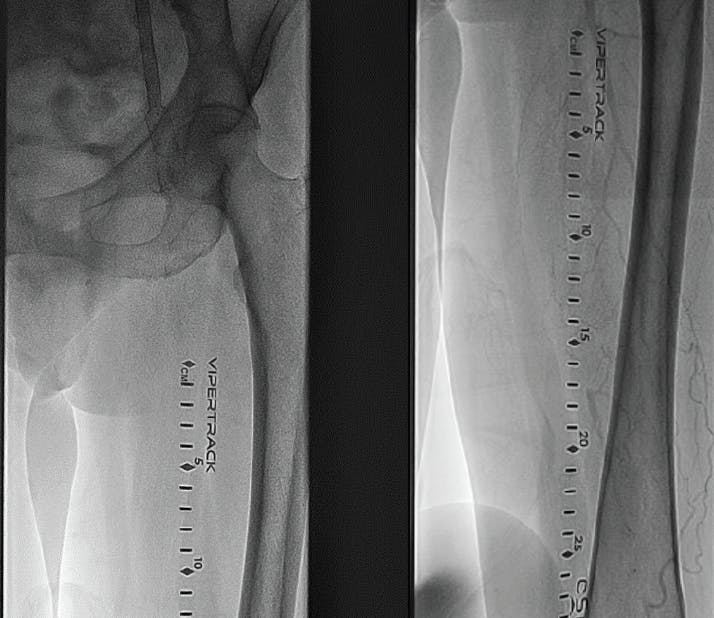
Figure 1. Baseline angiography demonstrating the SFA CTO.
INTERVENTION
The target treatment vessel for this case was the left SFA, with the right SFA CTO to be treated at another time. Contralateral access through the Dacron graft was performed, but due to a blunt ostium with no taper, accessing the SFA was challenging. Multiple attempts were made to wire down the SFA, including using an angled catheter with a stiff wire, but these proved unsuccessful. A second access was attempted via direct access to the SFA. Using a Spartacore wire (Abbott), the SFA was crossed in a retrograde fashion. After snaring and externalizing the wire, successful antegrade access was achieved; the retrograde wire was removed and the antegrade wire passed distally into the poster tibial artery. An Emboshield Nav6 filter (Abbott) was placed in the popliteal artery, and directional atherectomy (HawkOne, Medtronic) was performed in the proximal and distal segments of the SFA, with 4- X 120-mm plain balloon angioplasty (POBA) treatment through the course of the SFA. After POBA, a 5- X 120-mm Serranator® PTA Serration Balloon Catheter (Cagent Vascular) was used to achieve optimal lumen gain (Figure 2 and Figure 3). Drug-coated balloon therapy was utilized in the mid segment, and stents were placed at the proximal and distal segment of the SFA. The filter was removed, and on gross inspection was empty. Final angiography showed widely patent SFA, with no residual stenosis (Figure 4).
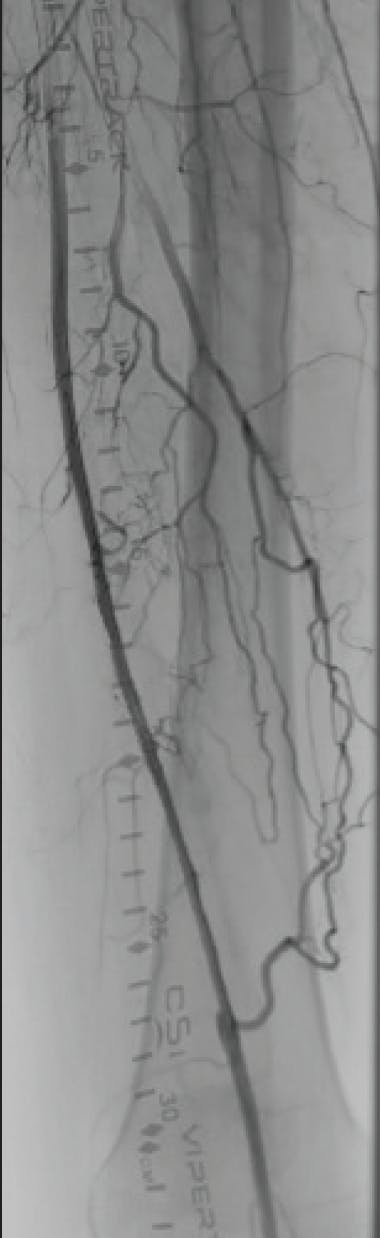
Figure 2. Angiography after directional atherectomy of the proximal and distal cap.
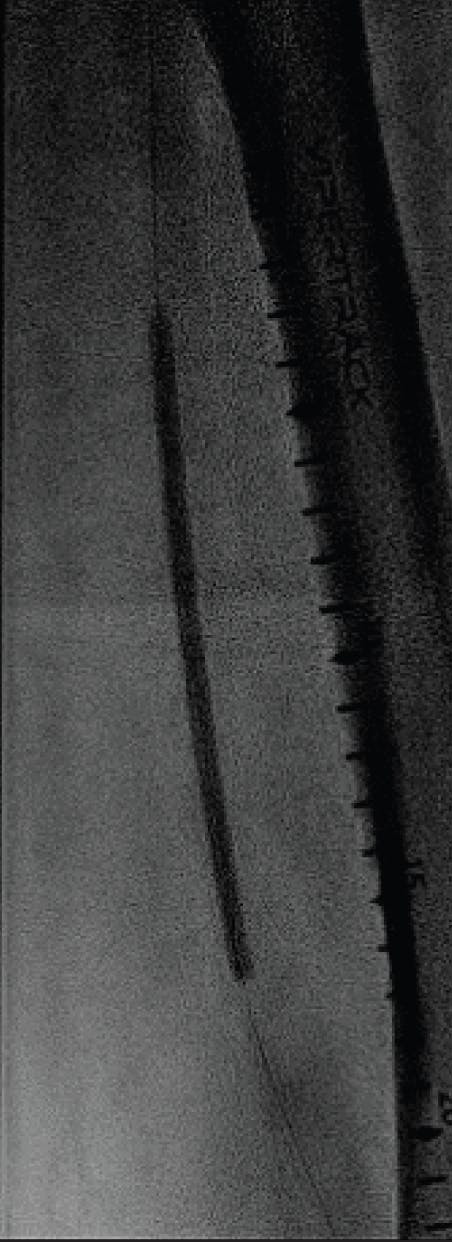
Figure 3. A 5- X 120-cm Serranator balloon inflated in the mid SFA (located from approximately 2-16 on ruler).
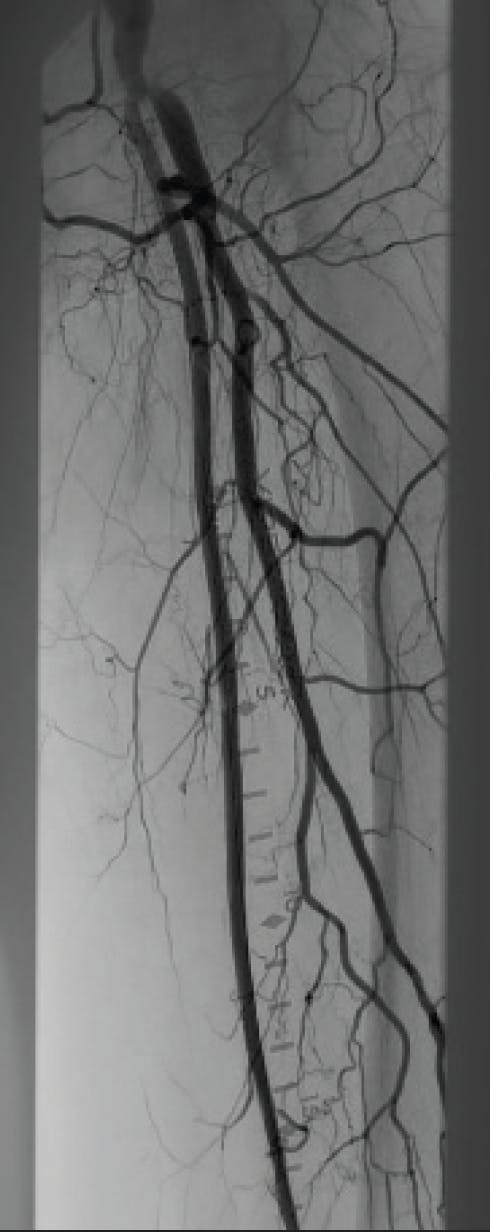
Figure 4. Angiography post-Serranator.
Looking back, what led to your decision to use the Serranator balloon?
Dr. Sharma: I knew I needed more than POBA and I wanted to leave as little metal as possible. The above-the-knee Serranator had recently been released, and given my positive experiences using it below the knee, I was confident it would help achieve large lumen gain with minimal risk of dissection. I also knew I was planning on using drug-elution therapy to conclude the case, and there is potentially greater drug uptake following Serranator compared to POBA.
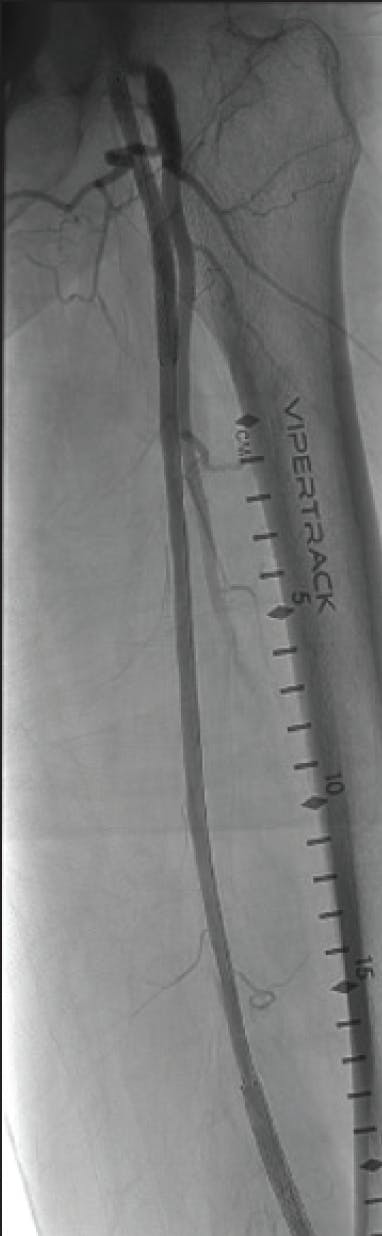
Figure 5. Final angiogram after DCB in mid-segment and proximal and distal stent placement.
We have learned from Prof. Brodmann’s paper that there is more blood flow following Serranator use versus POBA.1 Do you see that in your practice as well?
Dr. Sharma: I would agree, the luminal gain is better than POBA, and it’s obvious on angiography.
This was a patient with claudication. Have you also used the Serranator in patients with critical limb ischemia? If so, when and why might you use it?
Dr. Sharma: I believe it really helps with wound healing. Good antegrade blood flow is needed for wounds to heal, and when we use the Serranator, we get good blush, not sluggish flow. And most importantly, all without the need for stents.
You used the Serranator with atherectomy in this case. How do you think they work together in your practice?
Dr. Sharma: There are no randomized data, but as an interventional cardiologist at a high-volume center, I believe in debulking. Atherectomy, when used appropriately for the right vessel and right level, can debulk and allow the Serranator to then open the lumen. In this case, we debulked at the distal and ostial cap of the CTO and used the Serranator to expand the SFA and prepare for drug elution. I believe this combination use is great, if chosen appropriately.
Do you see recoil following use of the Serranator?
Dr. Sharma: There is less recoil after Serranator use for sure. I try hard to avoid the need for bailout stenting. The goal is to achieve robust flow to the foot with minimal risk of dissection and recoil and no need for a stent. The mechanism of action of the Serranator makes that more likely than POBA.
1. Guetl K, Muster V, Schweiger L, et al. Standard balloon angioplasty versus Serranator serration balloon angioplasty for the treatment of below-the-knee artery occlusive disease: a single-center subanalysis from the PRELUDE-BTK prospective study. J Endovasc Ther. Published online November 20, 2022. doi: 10.1177/15266028221134891
Advertisement
Advertisement