Advertisement
Advertisement
September 2023
Crossing of Complex Chronic Total Occlusions
An overview of managing severe PAD through advanced limb salvage techniques, with an emphasis on below-the-knee disease.
By Edel Mendoza, MD, and John H. Rundback, MD
Complex chronic total occlusions (CTOs) represent a unique subset of patients with peripheral artery disease (PAD) in whom endovascular techniques can be more challenging or are associated with higher risk of complications. Consequently, there are unique tools and techniques that can be used to allow successful revascularization in these cases with satisfying clinical results. This article covers the general approach to complex occlusions, with a focus on tibial interventions given their complexity and limited options due to vessel size.
PATIENT WORKUP AND CANDIDACY
Unlike disease in other vascular beds, in patients with peripheral arterial occlusions, revascularization is only warranted if there are referable symptoms. For patients with iliac or femoropopliteal occlusions, guidelines recommend a course of optimized medical therapy and exercise to see if patients can achieve satisfactory walking distances. Guideline-based medical management consists of HMG-CoA reductase inhibitors, antiplatelet therapy, smoking cessation, and strict hypertension and diabetic control.
More recently, there is evidence that dual pathway inhibition utilizing antiplatelet therapy with direct oral anticoagulants may have added benefit both for preventing recurrent limb events as well as reducing risk of major cardiovascular events.1,2 For patients with occlusive tibial disease, the initial presentation more often includes ischemic rest pain (Rutherford class 4) or ulcerations (Rutherford class 5-6), often without antecedent claudication symptoms, and revascularization is necessary to resolve pain as well as prevent ongoing tissue loss or minor/major amputation.
PREPROCEDURAL IMAGING
The initial evaluation includes history and physical examination, with confirmation of the level and severity of arterial disease with imaging. First-line imaging often consists of an arterial duplex ultrasound study and ankle-brachial indices to determine the PAD severity and identify the level of occlusion. The level of occlusion often determines the procedural approach. For patients with suspected aortoiliac disease, cross-sectional imaging is generally beneficial as an up-front approach, whereas in femoropopliteal and infrapopliteal disease, cross-sectional imaging is often reserved to clarify uncertain pathology or for surgical planning.
Tibial disease, especially in patients with diabetes or end-stage renal disease, can often be limited and should be more strongly correlated with clinical symptoms if imaging is equivocal. If radiographic imaging of the feet is available, medial artery calcification scores are correlated with small artery disease and are an indication of advanced disease.3 In patients with multilevel occlusive disease, duplex imaging distal to the first occlusion may be somewhat limited because of reduced flow related to the proximal occlusion. On occasion, in patients with chronic limb-threatening ischemia (CLTI) and more immediate limb risk, direct primary angiography is appropriate.
Fundamentally, the key findings that interventionalists are looking for on imaging are related to procedural planning and feasibility. These include the length of the occlusion, the point of origin of the occlusion as well as site of distal reconstitution if apparent, the degree of calcification at potential access sites as well as within the CTO, the patency of alternative access sites such as the pedal arteries, a general sense of the caliber of the vessel to be treated, and the quality of the runoff. Of these, access planning is the most important element. Other findings are relevant in terms of device planning and long-term prognostication with the patient.
ESSENTIAL DEVICES
The interventionalist toolkit is often dictated by both available devices and operator experience, with interventional decision-making involving a “CADENCE” approach: clinical history, anatomy, device performance, experience, niche applications, cost, and evidence.4 For access planning, standard micropuncture access kits, including pedal access kits, and short or long 4- to 7-F sheaths should be available. Crossing of complex occlusions is often done using an algorithmic approach (Figure 1). Antegrade lesion crossing is generally attempted first, although cap morphology using the CTOP (CTO crossing approach based on plaque cap morphology) classification may affect initial access choice.5 Straight or angled polymer-coated or hydrophilic wires ranging from 0.014 to 0.035 inches are used as a first-line attempt. Weighted-tip CTO wires and reentry devices can be used if initial attempts are unsuccessful. Sharp recanalization is often reserved for highly calcified lesions in straight arterial segments and can be done by using the back end of a guidewire or direct external puncture using the PIERCE technique with a small needle.6 Once the occlusion is crossed, plaque modification with atherectomy, thrombectomy, and/or lithotripsy can be valuable to optimize subsequent luminal gain and reduce recoil following subsequent plain or drug-coated balloon angioplasty.7 Intravascular ultrasound (IVUS) allows accurate sizing of the vessel, identification of wire positioning (intraluminal or subintimal), and recognition of significant occult or residual disease and may be associated with improved long-term patency.8 Relevant residual stenoses or dissections after percutaneous transluminal angioplasty should be treated with scaffolds including Tacks (Philips), self-expanding nitinol stents, or covered stents above the knee or coronary drug-eluting stents in the proximal segments below the knee. For operators performing complex PAD, a wide variety of tools and techniques should be easily available.
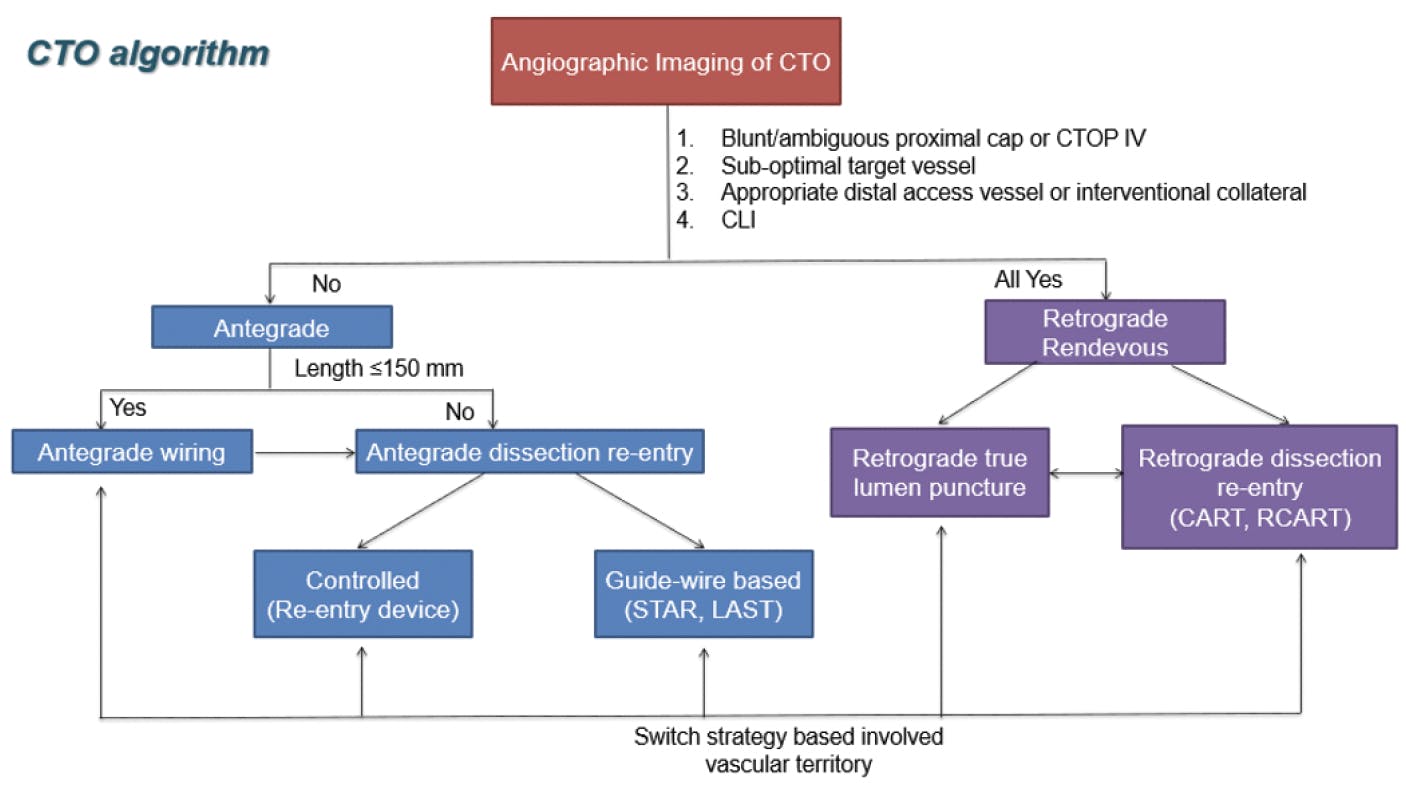
Figure 1. CTO crossing algorithm. CART, controlled antegrade retrograde tracking; CLI, critical limb ischemia; LAST, limited antegrade subintimal tracking; RCART, reverse CART; STAR, subintimal tracking and reentry. Used with permission from Banerjee S, Shishehbor MH, Mustapha JA, et al. A percutaneous crossing algorithm for femoropopliteal and tibial artery chronic total occlusions (PCTO algorithm). J Invasive Cardiol. 2019;31:111-119. https://www.hmpgloballearningnetwork.com/site/jic/articles/percutaneous-crossing-algorithm-femoropopliteal-and-tibial-artery-chronic-total-occlusions-pcto-algorithm.
PROCEDURAL APPROACH
Access site planning is critical for providing enough length and support to treat the occlusion and prevent access site complications. Factors to take into consideration include body habitus, underlying coagulopathy, iliac tortuosity, degree of calcification at or near the puncture site, and level of occlusion. In tibial disease, antegrade access of either the common femoral artery or proximal superficial femoral artery is recommended with a very low threshold for obtaining pedal access. Preprocedural imaging should ensure that there is no inflow disease that should be treated first prior to tibial intervention. In patients with multivessel tibial occlusive disease, we sometimes prefer to access and/or revascularize the more severely compromised vessel first, with the goal of restoring flow through at least this artery before addressing the primary arterial pedal perfusion, analogous to the concept of “protected angioplasty” during left main coronary interventions.
Once vascular access is obtained, angiography is used to determine the level and length of occlusion, sites of distal reconstitution, degree of calcification, and type of CTO morphology. Oblique angiography is often done to further characterize the lesion, which is especially important below the ankle. Anteroposterior cranial angiography of the foot allows an assessment of forefoot perfusion and has become our preferred visualization when planning plantar pedal arch reconstructions. Intra-arterial vasodilation with nitroglycerin or verapamil should be given before and during intervention to minimize vasospasm. Intra-arterial alteplase can also be given if there is concern for intraoperative thrombosis. Tibial lesions are predominantly crossed with 0.014- or 0.018-inch polymer-coated or hydrophilic wires and microcatheters, although low-profile balloons may also be used as the support catheter for this purpose. Telescoping the support catheter through a 0.035-inch catheter and/or exchanging for a longer sheath can provide additional support. A slight curve is generally placed at the tip of the crossing wire, although some operators prefer to form a J tip with the wire, which can make advancement in the dominant artery easier and prevent collateral selection. It is preferable to keep intraluminal positioning; gentle advancement during manual rotation of the catheter/wire can facilitate this. If antegrade crossing is unsuccessful, retrograde access should be obtained, and repeat attempts to cross the occlusion should be done. Crossing the occlusion in this manner is often met with less resistance. Luminal positioning can be determined by appearance and location of the guidewire as well as IVUS. Intermittent angiography can be performed but is often not necessary and may degrade visualization.
If unsuccessful, options include retrograde access and bidirectional crossing, also called “rendezvous” techniques.9 The retrograde wire is often supported by a short, 0.014- to 0.018-inch microcatheter, although wire passage through the access needle may be possible. It is less common to require placement of a retrograde sheath, which can compromise flow as well as visualization of pedal perfusion. More sophisticated techniques include transcollateral or indirect recanalization; wire pinning using an inflated balloon catheter to increase wire penetration force; and hydraulic push, in which contrast is forcefully injected through a microcatheter wedged into the occlusion. Contrast extravasation within the occluded segments is often self-limiting, but extra caution should be taken in noncompressible areas. Once the occlusion is crossed, predilatation with a 1.5- to 2.5-mm compliant balloon can be done to allow easier passage of devices or facilitate subsequent atherectomy and definitive revascularization. If there is a single-vessel runoff, extra caution should be taken to prevent distal embolization, as the consequences can be devastating, but these techniques can still be performed depending on operator experience and comfort. Once again, the protected angioplasty strategy may be considered in these cases.
Rendezvous procedures comprise several distinct steps (Figure 2):
1. Attempted antegrade crossing.
2. Placement of a 0.035-inch lumen catheter proximally as a “receiving” catheter for the retrograde wire.
3. Ultrasound-guided puncture of the distal tibial or pedal artery.
4. Retrograde wire crossing, often with the support of a 0.014- to 0.018-inch microcatheter.
5. If direct intraluminal retrograde crossing, passing the wire in to the antegrade catheter for exteriorization and subsequent case completion.
6. If both antegrade and retrograde wire pass subintimally, create a subintimal channel with both the antegrade (we use a 0.035-inch wire) and retrograde (0.014-0.018 inch) wires. This often involves migrating the antegrade and retrograde systems both cranially and caudally as necessary within the “rendezvous zone” until the wires are felt to be in the same plane. The rendezvous zone extends from the proximal occlusion cap to the point of distal reconstitution, with the goal being to not extend the subintimal plane beyond this zone.
7. An angled tip is necessary on both the antegrade catheter and retrograde wire, allowing the wire to be deflected off the vessel wall and into the receiving catheter.
8. The wire is externalized for through-and-through access to allow definitive angioplasty.
9. Hemostasis is achieved at the pedal access site via internal balloon, with dressing or manual compression.
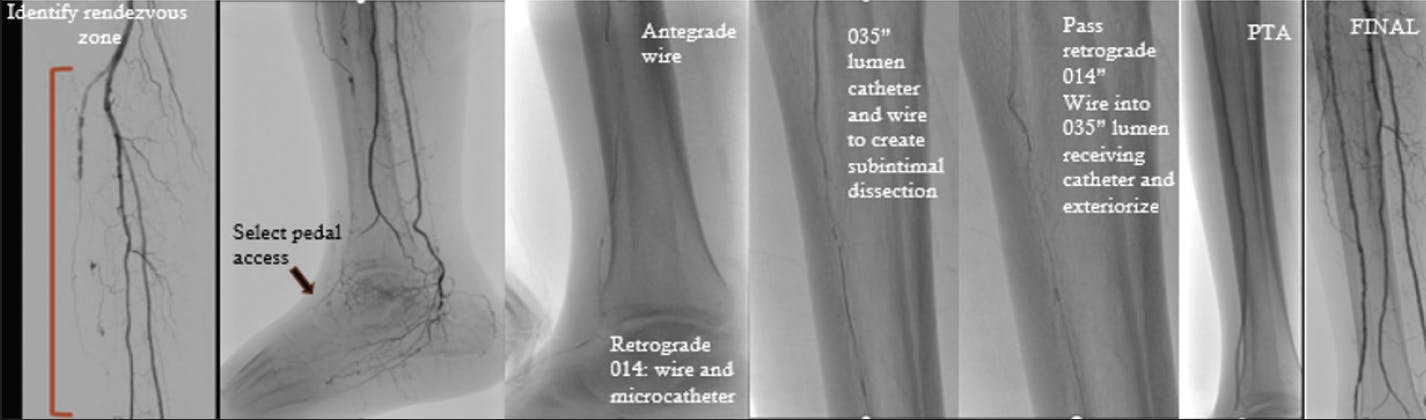
Figure 2. Rendezvous tibial procedure.
Even when the occlusion is adequately treated and the vessel is widely patent, antegrade flow can often appear sluggish or stagnant, which can be due to a combination of vasospasm, microemboli, small vessel disease, and/or high tissue resistance from ongoing ischemia, a condition referred to as “slow/no reflow.” Adequate antiplatelet therapy and anticoagulation, often with a short course of unfractionated heparin, can allow improvement of flow in many cases > 24 to 48 hours postintervention.
POSTOPERATIVE CARE AND FOLLOW-UP
Closure devices facilitate immediate hemostasis and early initiation of postprocedural medications and ambulation. Magnification of the arterial access site is critical to ensure that the punctured vessel is of adequate caliber for using a closure device and to identify impediments to closure (ie, calcification, stents) that might affect the choice of a passive or active closure device.
Patients are typically seen 2 to 4 weeks postintervention with a follow-up duplex ultrasound study, ankle-brachial index, and/or transcutaneous oxygen tension study depending on clinical severity. Close communication with wound care and podiatry is important to optimize wound healing and, if necessary, timing of amputation. Patients should continue to be monitored closely with surveillance imaging and physical examination, and repeat revascularization is considered based upon both the presence of maintained arterial patency and the patient’s clinical course.
COMPLICATION AVOIDANCE
The significant complications of these complex interventions are generally low but can cause significant morbidity and mortality. Proper planning of the appropriate access site and closure method is crucial to preventing major bleeding issues. Patients should be adequately heparinized throughout the procedure to prevent intraoperative thrombosis. Distal embolization protection devices can be used but are often not needed in experienced hands and are not suitable for below-the-knee treatment. Gentle and slow advancement of the atherectomy or thrombectomy device can also minimize embolic events (“go slow to finish fast”). Recent data have shown that combined antiplatelet and anticoagulant therapy can decrease postintervention thrombosis and major myocardial infarction and stroke.1,2
SUPPORTING DATA
There are many controversies regarding the optimal approach to treat complex PAD due to the wide heterogeneity of multiple factors, including patient population, disease patterns, operator training/preference, place of service, and device availability and cost. Because of this, there is a paucity of large randomized controlled trials to help guide treatment. We do know that the goal of treatment is ultimately limb salvage, as major amputations have been shown to have significantly increased mortality with a 5-year survival rate of 26% compared to 60% for limb salvage therapies.10 There are multiple techniques described in the literature regarding specific rendezvous procedures for complex tibial interventions, although they are derived from small case series. The approach varies widely; nevertheless, maintaining arterial perfusion is of utmost importance. There are conflicting data regarding the angiosome targeted concept, and we recommend more so angiographically mediated revascularization with close attention to pedal perfusion. In moderate-risk CLTI patients with infrapopliteal disease in the RENDEZVOUS registry, there was an increased rate of wound healing (57.5% vs 37.3%; P = .003) and decreased time to wound healing (211 vs 365 days; P = .008) in those who received pedal artery angioplasty as compared with those who did not.11 In addition, despite successful revascularization, there is an approximate 40% reintervention rate within the first year, so diligence must persist in the postoperative period through close surveillance.12 Even in these CLTI patients with complex CTOs, endovascular interventions are known to be safe and effective and result in symptom relief, wound healing, and decreased amputation rates.
1. Bonaca MP, Bauersachs RM, Anand SS, et al. Rivaroxaban in peripheral artery disease after revascularization. N Engl J Med. 2020;382:1994-2004. doi: 10.1056/NEJMoa2000052
2. Eikelboom JW, Connolly SJ, Bosch J, et al. Rivaroxaban with or without aspirin in stable cardiovascular disease. N Engl J Med. 2017;377:1319-1330. doi: 10.1056/NEJMoa1709118
3. Ferraresi R, Ucci A, Pizzuto A, et al. A novel scoring system for small artery disease and medial arterial calcification is strongly associated with major adverse limb events in patients with chronic limb-threatening ischemia. J Endovasc Ther. 2021;28:194-207. doi: 10.1177/1526602820966309
4. Rundback JH, Herman KC, Patel A. Superficial femoral artery intervention: creating an algorithmic approach for the use of old and novel (endovascular) technologies. Curr Treat Options Cardiovasc Med. 2015;17:400. doi: 10.1007/s11936-015-0400-3
5. Saab F, Jaff MR, Diaz-Sandoval LJ, et al. Chronic total occlusion crossing approach based on plaque cap morphology: the CTOP classification. J Endovasc Ther. 2018;25:284-291. doi: 10.1177/1526602818759333
6. Takei T, Miyamoto A, Takagi T, Yamauchi Y. A novel technique of percutaneous intraluminal cracking using a puncture needle for severe calcified lesions of below-the-knee and below-the-ankle arteries. Diagn Interv Radiol. 2021;27:413-417. doi: 10.5152/dir.2021.20675
7. Mustapha JA, Katzen BT, Neville RF, et al. Propensity score-adjusted comparison of long-term outcomes among revascularization strategies for critical limb ischemia. Circ Cardiovasc Interv. 2019;12:e008097. doi: 10.1161/CIRCINTERVENTIONS.119.008097
8. Soga Y, Ariyaratne TV, Secemsky E, et al. Intravascular ultrasound guidance during peripheral vascular interventions: long-term clinical outcomes and costs from the Japanese perspective. J Endovasc Ther. Published online July 2, 2023. doi: 10.1177/15266028231182382
9. Banerjee S, Shishehbor MH, Mustapha JA, et al. A percutaneous crossing algorithm for femoropopliteal and tibial artery chronic total occlusions (PCTO algorithm). J Invasive Cardiol. 2019;31:111-119.
10. Kalra M, Gloviczki P, Bower TC, et al. Limb salvage after successful pedal bypass grafting is associated with improved long-term survival. J Vasc Surg. 2001;33:6-16. doi: 10.1067/mva.2001.112300
11. Nakama T, Watanabe N, Haraguchi T, et al. Clinical outcomes of pedal artery angioplasty for patients with ischemic wounds: results from the multicenter RENDEZVOUS registry. JACC Cardiovasc Interv. 2017;10:79-90. doi: 10.1016/j.jcin.2016.10.025
12. Iida O, Nakamura M, Yamauchi Y, et al. 3-year outcomes of the OLIVE registry, a prospective multicenter study of patients with critical limb ischemia: a prospective, multi-center, three-year follow-up study on endovascular treatment for infra-inguinal vessel in patients with critical limb ischemia. JACC Cardiovasc Interv. 2015;8:1493-1502. doi: 10.1016/j.jcin.2015.07.005 doi: 10.1016/j.jcin.2015.07.005
Advertisement
Advertisement