Advertisement
Advertisement

Rapidly evolving endovascular technologies and techniques have dramatically expanded the treatment options for patients with peripheral artery disease (PAD) in recent years. Today’s practitioners, whether veteran or novice, must maintain constant vigilance to these advancements in vascular care in order to provide the most up-to-date options for the complex and heterogeneous disease processes encountered in everyday practice.
Each patient we treat has unique comorbidities and cardiovascular risk factors that influence treatment choice, but also has a unique lesion characteristics, including patterns of multivessel and/or multilevel disease, that impact device and technique efficacy. The heterogeneity of this population requires a wide-ranging skill set, as well as the humility to embrace new lessons from the experiences of our colleagues, whether entirely new approaches or the minor tweaks that make a considerable difference. The constant technologic advancement in this field and the ongoing accumulation of clinical data ensure there is always something new to learn.
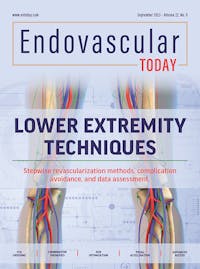
This edition of Endovascular Today asks a group of leading interventionalists for their approaches to patient workup, therapy selection, preprocedural tips and tricks, pitfall avoidance, and supporting data.
Edel Mendoza, MD, and John H. Rundback, MD, begin our lower extremity coverage with a look at PAD patients with complex chronic total occlusions. From patient workup and preprocedural imaging to procedural approach and postoperative care, they give us a technical guide to their management approach for these complex occlusions, with a focus on tibial interventions.
Our next technical walkthrough comes from Christopher J. Agrusa, MD, who shares his treatment algorithm and discusses how directional atherectomy (DA) and drug-coated balloon angioplasty can be used in combination to treat complex femoropopliteal atherosclerotic disease, as well as insights from the clinical trial landscape for DA.
For patients with life-limiting claudication or chronic limb-threatening ischemia, the femoropopliteal segment tends to be the most common site of plaque-related significant disease burden. Kumar Madassery, MD; Shaan Haider, BS; and Akhilesh Pillai, BS, present tips for attaining patency and ensuring success in this vascular bed, including consideration of how specific types of plaque burden and vessel wall injury impact which treatment tools and techniques are selected for a procedure.
Retrograde tibiopedal access may be the single-most important interventional technique for reducing technical failure rates in peripheral intervention, and in this issue, Katherine M. Reitz, MD, and Rabih Chaer, MD, describe their strategy and technique when employing retrograde tibiopedal access for infrapopliteal lesions, including discussion of patient evaluation, preintervention planning, and device selection.
Luis Mariano Palena, MD; Larry J. Diaz-Sandoval, MD; Elisa Piccolo, MD; and Marco Manzi, MD, introduce precise retrograde stenting of the ostium of the superficial femoral artery for complex femoropopliteal occlusions, also known as the PRESTO technique. Along with a step-by-step review of the technique, the authors discuss pre- and postoperative imaging, patient selection, devices, and complication management.
Closing out our lower extremity feature is a piece on pedal acceleration time (PAT) by Jill Sommerset, RVT; Miguel Montero-Baker, MD; Mary Costantino, MD; Riyad Karmy-Jones, MD; and Desarom Teso, MD. In this article, we learn about a proper protocol for incorporating PAT into periprocedural planning, on-table intervention, and immediate postprocedural assessment, with the goal of monitoring hemodynamic response to therapies and predicting wound healing potential.
In our monthly featured interview column, we chatted with Manj S. Gohel, MD, about involving patients in clinical decision-making, aftereffects of the EVRA trial and other concerns with venous leg ulcer care, and needs in deep venous occlusive disease.
As we all know, there is no “one approach fits all” solution to peripheral vascular disease. Based on our own training and experience, not every technique is right for us, nor the patient. Knowing what not to do in a given situation may be the biggest key to success, one that only comes with experience—whether direct or learned from colleagues.
We appreciate the authors’ graciousness in sharing their techniques, as well as their emphasis on understanding the importance of optimal medical therapy and the appropriate applications of alternative options, including open repair. We hope the lessons they share in this edition are helpful in your continued pursuit of excellence in the care of your patients.
Brian G. DeRubertis, MD, FACS
Guest Chief Medical Editor
Advertisement
Advertisement